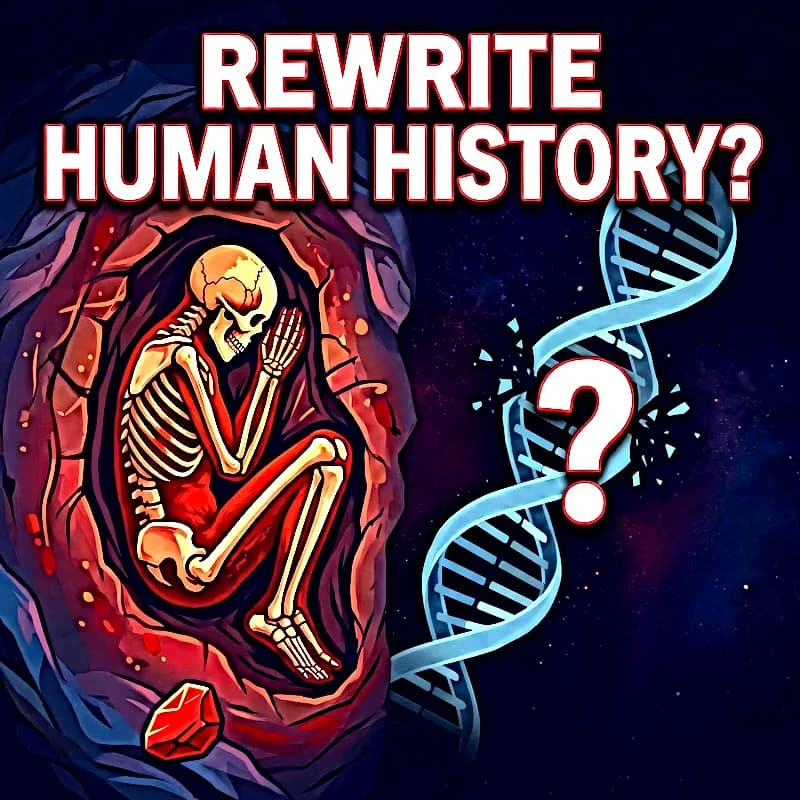
Forensic Analysis of Lake Mungo 3: Geochronological, Genetic, and Theoretical Conflict in the Willandra Lakes
The discovery of the remains designated as Lake Mungo 3 (LM3), colloquially known as Mungo Man, represents a singular inflection point in the study of human evolution and the settlement of the Sahul continent. Found in 1974 within the semi-arid lunettes of south-western New South Wales, these remains have served as the primary evidentiary battleground for two of the most significant controversies in modern paleoanthropology: the temporal transition of human arrival in Australia and the genetic validity of the "Out of Africa" model versus the "Multiregional Hypothesis".[1]Mungo Man's return reminds us that we need to listen to Indigenous knowledge https://landscapeaustralia.com/articles/mungo-mans-return-reminds-us-that-we-need-to-listen-to-indigenous-knowledge/, [2]Mitochondrial DNA sequences in ancient Australians: Implications https://www.pnas.org/doi/10.1073/pnas.98.2.537, [3]Ancient mtDNA sequences from the First Australians revisited - PNAS https://www.pnas.org/doi/10.1073/pnas.1521066113 This report provides a forensic deep-dive into the discovery, the ensuing 15-year battle over mitochondrial DNA (mtDNA) sequences, the massive discrepancies in chronometric dating, and the biographical motivations of the principal investigators involved in these disputes.
Dossier Snapshot
Year Span
1930-2017
Word Count
2,760
Source Entries
34
Citation Calls
73
Report Signal Profile
Section Headings
13
Table Lines
21
Unique Citations
34
Source Entries
34
Verification Metrics
| Metric | Value |
|---|---|
| Document ID | drr_mungo_man_australia |
| Section Headings | 13 |
| Table Lines | 21 |
| Year Span | 1930-2017 |
| Citation Coverage | 34/34 |
The Discovery (1974): Geomorphology and the Birth of Ritual
The Willandra Lakes Region, a World Heritage-listed area, contains a series of dry lake basins that flourished during the Pleistocene epoch.[4]Mungo Man - Australian Dictionary of Biography https://adb.anu.edu.au/biography/mungo-man-27704, [5]Lake Mungo remains (Mungo Lady and Mungo Man) | Research Starters | EBSCO Research https://www.ebsco.com/research-starters/anthropology/lake-mungo-remains-mungo-lady-and-mungo-man It was here, on February 26, 1974, that geologist Jim Bowler, then a research fellow at the Australian National University (ANU), identified the remains of LM3.[6]Lake Mungo remains - Wikipedia https://en.wikipedia.org/wiki/Lake_Mungo_remains, [7]Jim Bowler - Wikipedia https://en.wikipedia.org/wiki/Jim_Bowler Bowler was conducting geomorphological research, mapping the ancient shorelines and stratigraphic layers of the Lake Mungo lunette, when he observed a tiny patch of white carbonate-encrusted bone protruding from the sand.[8]Mungo Man is a physical reminder of the need for Indigenous recognition - The Guardian https://www.theguardian.com/world/2014/feb/25/mungo-man-physical-reminder-need-for-indigenous-recognition, [9]Finding Mungo Man: the moment Australia's story suddenly changed - The Guardian https://www.theguardian.com/australia-news/2017/nov/14/finding-mungo-man-the-moment-australias-story-suddenly-changed
This discovery occurred approximately 400 to 500 meters east of the 1968 site where Bowler had previously identified Lake Mungo 1 (LM1), or "Mungo Lady," the world's oldest evidence of ritual cremation.[1]Mungo Man's return reminds us that we need to listen to Indigenous knowledge https://landscapeaustralia.com/articles/mungo-mans-return-reminds-us-that-we-need-to-listen-to-indigenous-knowledge/, [4]Mungo Man - Australian Dictionary of Biography https://adb.anu.edu.au/biography/mungo-man-27704, [10]Mungo Man - Don's Maps https://www.donsmaps.com/mungo.html While Mungo Lady's remains were fragmentary and charred, LM3 was found as a nearly complete, fully articulated skeleton of an adult male.[6]Lake Mungo remains - Wikipedia https://en.wikipedia.org/wiki/Lake_Mungo_remains, [10]Mungo Man - Don's Maps https://www.donsmaps.com/mungo.html The individual was approximately 50 years old at the time of death, stood roughly 170 centimeters tall, and exhibited signs of severe osteoarthritis in the lumbar vertebrae and right elbow.[4]Mungo Man - Australian Dictionary of Biography https://adb.anu.edu.au/biography/mungo-man-27704, [6]Lake Mungo remains - Wikipedia https://en.wikipedia.org/wiki/Lake_Mungo_remains, [11]Mungo Lady - Australian Dictionary of Biography https://adb.anu.edu.au/biography/mungo-lady-27703
The Revolutionary Nature of the Red Ochre Burial
The excavation, led by anthropologist Alan Thorne and Jim Bowler, revealed that the body of Mungo Man had been laid in a prepared grave in a supine position, with the knees slightly bent and hands interlocked over the groin.[6]Lake Mungo remains - Wikipedia https://en.wikipedia.org/wiki/Lake_Mungo_remains, [12]Jim Bowler – Passing on the Message from Mungo Man - CanDoWisdom.com https://candowisdom.com/change/jim-bowler-mungo-man-message However, the most profound observation was the presence of red ochre—powdered hematite—which had been liberally sprinkled over the body during interment.[1]Mungo Man's return reminds us that we need to listen to Indigenous knowledge https://landscapeaustralia.com/articles/mungo-mans-return-reminds-us-that-we-need-to-listen-to-indigenous-knowledge/, [4]Mungo Man - Australian Dictionary of Biography https://adb.anu.edu.au/biography/mungo-man-27704
This specific detail was revolutionary for several reasons. First, the ochre was not local to the Lake Mungo basin; geochemical analysis indicated it had been transported from a distance of more than 200 kilometers.[1]Mungo Man's return reminds us that we need to listen to Indigenous knowledge https://landscapeaustralia.com/articles/mungo-mans-return-reminds-us-that-we-need-to-listen-to-indigenous-knowledge/, [12]Jim Bowler – Passing on the Message from Mungo Man - CanDoWisdom.com https://candowisdom.com/change/jim-bowler-mungo-man-message This implies a level of social organization, foresight, and trade or movement across the landscape that was previously uncredited to Pleistocene Australians. Second, the use of red ochre is a primary indicator of symbolic thought and artistic expression.[1]Mungo Man's return reminds us that we need to listen to Indigenous knowledge https://landscapeaustralia.com/articles/mungo-mans-return-reminds-us-that-we-need-to-listen-to-indigenous-knowledge/, [5]Lake Mungo remains (Mungo Lady and Mungo Man) | Research Starters | EBSCO Research https://www.ebsco.com/research-starters/anthropology/lake-mungo-remains-mungo-lady-and-mungo-man Prior to this discovery, the prevailing scientific view held that complex religious and funerary rituals emerged much later in human history.[4]Mungo Man - Australian Dictionary of Biography https://adb.anu.edu.au/biography/mungo-man-27704, [6]Lake Mungo remains - Wikipedia https://en.wikipedia.org/wiki/Lake_Mungo_remains Mungo Man provided definitive proof that by at least 40,000 years ago, human societies in Australia possessed metaphysical frameworks, ritualized mourning, and a sophisticated relationship with their environment.[1]Mungo Man's return reminds us that we need to listen to Indigenous knowledge https://landscapeaustralia.com/articles/mungo-mans-return-reminds-us-that-we-need-to-listen-to-indigenous-knowledge/, [4]Mungo Man - Australian Dictionary of Biography https://adb.anu.edu.au/biography/mungo-man-27704, [6]Lake Mungo remains - Wikipedia https://en.wikipedia.org/wiki/Lake_Mungo_remains
The DNA Controversy: The "Mungo Anomaly" and the Multiregional Challenge
In January 2001, Gregory Adcock and Alan Thorne published a paper in the Proceedings of the National Academy of Sciences (PNAS) that sent shockwaves through the scientific community.[2]Mitochondrial DNA sequences in ancient Australians: Implications https://www.pnas.org/doi/10.1073/pnas.98.2.537, [13]Mungo Man's DNA Shakes the Homo Family Tree - Peter Brown's Australian and Asian Palaeoanthropology https://www.peterbrown-palaeoanthropology.net/nolch.pdf Titled "Mitochondrial DNA sequences in ancient Australians: Implications for modern human origins," the study claimed to have successfully extracted mtDNA from 10 ancient Australians, including LM3.[2]Mitochondrial DNA sequences in ancient Australians: Implications https://www.pnas.org/doi/10.1073/pnas.98.2.537, [14]Commentary on G.J. Adcock, et al., 2001 "Mitochondrial DNA sequences in ancient Australians: implications for modern human origins | Request PDF - ResearchGate https://www.researchgate.net/publication/285402351_Commentary_on_GJ_Adcock_et_al_2001_Mitochondrial_
The 2001 Study (Adcock & Thorne)
The researchers focused on the hypervariable region of the mitochondrial genome.[2]Mitochondrial DNA sequences in ancient Australians: Implications https://www.pnas.org/doi/10.1073/pnas.98.2.537, [15]From the Cover: Mitochondrial DNA sequences in ancient Australians: Implications for modern human origins - ResearchGate https://www.researchgate.net/publication/24446708_From_the_Cover_Mitochondrial_DNA_sequences_in_ancient_Australians_Implications_for_modern They reported that while most of the ancient samples from Willandra Lakes and Kow Swamp shared sequences with modern Aboriginal Australians, the sequence from Mungo Man (accession number AF328739) was highly divergent.[2]Mitochondrial DNA sequences in ancient Australians: Implications https://www.pnas.org/doi/10.1073/pnas.98.2.537, [15]From the Cover: Mitochondrial DNA sequences in ancient Australians: Implications for modern human origins - ResearchGate https://www.researchgate.net/publication/24446708_From_the_Cover_Mitochondrial_DNA_sequences_in_ancient_Australians_Implications_for_modern Adcock and Thorne argued that this sequence represented an ancient mitochondrial lineage that diverged prior to the most recent common ancestor (MRCA) of all contemporary human mitochondrial genomes.[2]Mitochondrial DNA sequences in ancient Australians: Implications https://www.pnas.org/doi/10.1073/pnas.98.2.537, [13]Mungo Man's DNA Shakes the Homo Family Tree - Peter Brown's Australian and Asian Palaeoanthropology https://www.peterbrown-palaeoanthropology.net/nolch.pdf, [16]Mitochondrial DNA sequences in ancient Australians: Implications for modern human origins - PubMed https://pubmed.ncbi.nlm.nih.gov/11209053/ Specifically, they claimed that this "Mungo lineage" only survived as a segment inserted into chromosome 11 of the nuclear genome, a phenomenon known as a nuclear mitochondrial DNA (numt) insert.[2]Mitochondrial DNA sequences in ancient Australians: Implications https://www.pnas.org/doi/10.1073/pnas.98.2.537, [16]Mitochondrial DNA sequences in ancient Australians: Implications for modern human origins - PubMed https://pubmed.ncbi.nlm.nih.gov/11209053/ They argued that the presence of such a divergent lineage in an "anatomically modern" human in Australia challenged the "Out of Africa" model, which posits that all modern humans are descended from a single population that dispersed from Africa within the last 100,000 years.[2]Mitochondrial DNA sequences in ancient Australians: Implications https://www.pnas.org/doi/10.1073/pnas.98.2.537, [13]Mungo Man's DNA Shakes the Homo Family Tree - Peter Brown's Australian and Asian Palaeoanthropology https://www.peterbrown-palaeoanthropology.net/nolch.pdf Instead, they used this genetic "anomaly" to support the "Multiregional Hypothesis," suggesting that modern human origins were characterized by complex regional evolution and gene flow across the Old World, with Australia representing a unique pocket of ancient genetic survival.[2]Mitochondrial DNA sequences in ancient Australians: Implications https://www.pnas.org/doi/10.1073/pnas.98.2.537, [13]Mungo Man's DNA Shakes the Homo Family Tree - Peter Brown's Australian and Asian Palaeoanthropology https://www.peterbrown-palaeoanthropology.net/nolch.pdf, [17]Alan Gordon Thorne 1939–2012 - PaleoAnthropology https://paleoanthropology.org/ojs/index.php/paleo/article/download/699/660/1115
The 2016 Rebuttal (Heupink et al.)
The claims of Adcock and Thorne remained controversial for 15 years, with critics questioning the possibility of DNA preservation in the hot, variable climate of the Willandra Lakes.[13]Mungo Man's DNA Shakes the Homo Family Tree - Peter Brown's Australian and Asian Palaeoanthropology https://www.peterbrown-palaeoanthropology.net/nolch.pdf, [14]Commentary on G.J. Adcock, et al., 2001 "Mitochondrial DNA sequences in ancient Australians: implications for modern human origins | Request PDF - ResearchGate https://www.researchgate.net/publication/285402351_Commentary_on_GJ_Adcock_et_al_2001_Mitochondrial_ In 2016, a study led by Tim Heupink and David Lambert, also published in PNAS, revisited the remains using advanced second-generation (Next-Generation) sequencing and capture methods.[3]Ancient mtDNA sequences from the First Australians revisited - PNAS https://www.pnas.org/doi/10.1073/pnas.1521066113, [18]Ancient mtDNA sequences from the First Australians revisited - UQ eSpace - The University of Queensland https://espace.library.uq.edu.au/view/UQ:a8267fa The Heupink team re-examined the same specimens from the Willandra Lakes and Kow Swamp.[3]Ancient mtDNA sequences from the First Australians revisited - PNAS https://www.pnas.org/doi/10.1073/pnas.1521066113, [18]Ancient mtDNA sequences from the First Australians revisited - UQ eSpace - The University of Queensland https://espace.library.uq.edu.au/view/UQ:a8267fa Their findings were definitive: the original 2001 results for Mungo Man were the product of contamination.[3]Ancient mtDNA sequences from the First Australians revisited - PNAS https://www.pnas.org/doi/10.1073/pnas.1521066113, [19]What linguists should know about ancient DNA: A discussion of methods from the Genetic-Linguistic Interface Project - ResearchGate https://www.researchgate.net/publication/343255522_What_linguists_should_know_about_ancient_DNA_A_discussion_of_methods_from_the_ Using more rigorous protocols, they were unable to recover any Aboriginal Australian DNA from the LM3 sample.[3]Ancient mtDNA sequences from the First Australians revisited - PNAS https://www.pnas.org/doi/10.1073/pnas.1521066113, [20]Ancient mtDNA sequences from the First Australians revisited - Deutsches Historisches Institut Paris https://katalog.dhi-paris.fr/vufind/Record/JST124815863/Details?lng=fr Instead, they identified five distinct modern European mitochondrial haplotypes contaminating the remains.[3]Ancient mtDNA sequences from the First Australians revisited - PNAS https://www.pnas.org/doi/10.1073/pnas.1521066113, [21]https://www.parliament.wa.gov.au/publications/tabledpapers.nsf/displaypaper/4210482ca26a21fcffb4cddf48258d010003858f/file/tp−482.pdf https://www.parliament.wa.gov.au/publications/tabledpapers.nsf/displaypaper/4210482ca26a21fcffb4cddf48258d010003858f/file/tp-48
The "Time War": Geochronological Conflict and the Timeline Shift
The dating of the Lake Mungo remains has been a subject of persistent conflict, involving a "time war" between different scientific disciplines and methodologies. The debate centered on the discrepancy between Carbon-14 dating, which focuses on organic materials, and Optically Stimulated Luminescence (OSL), which dates the deposition of sediment grains.[22](PDF) New ages for human occupation and climatic change at Lake https://www.researchgate.net/publication/232797025_New_ages_for_human_occupation_and_climatic_change_at_Lake_Mungo_Australia, [23]Dating Mungo Man - Tas Walker's Biblical Geology http://biblicalgeology.net/2006/Dating-Mungo-Man.html
The Massive Discrepancies: Carbon-14 vs. OSL
Initially, radiocarbon dating of charcoal found in the vicinity of the Mungo remains suggested an age of approximately 24,000 to 32,000 years.[13]Mungo Man's DNA Shakes the Homo Family Tree - Peter Brown's Australian and Asian Palaeoanthropology https://www.peterbrown-palaeoanthropology.net/nolch.pdf, [23]Dating Mungo Man - Tas Walker's Biblical Geology http://biblicalgeology.net/2006/Dating-Mungo-Man.html, [24]Latest News - Bradshaw Foundation https://www.bradshawfoundation.com/migration/not-africa.html However, Carbon-14 dating is known to be susceptible to "under-aging" in samples older than 30,000 years, as even minute amounts of modern carbon contamination can significantly alter the results.[23]Dating Mungo Man - Tas Walker's Biblical Geology http://biblicalgeology.net/2006/Dating-Mungo-Man.html Furthermore, Carbon-14 can only date the charcoal itself, which may or may not be contemporaneous with the burial.[22](PDF) New ages for human occupation and climatic change at Lake https://www.researchgate.net/publication/232797025_New_ages_for_human_occupation_and_climatic_change_at_Lake_Mungo_Australia, [23]Dating Mungo Man - Tas Walker's Biblical Geology http://biblicalgeology.net/2006/Dating-Mungo-Man.html In contrast, OSL (Optically Stimulated Luminescence) and Thermoluminescence (TL) measure the last time sand grains were exposed to sunlight.[22](PDF) New ages for human occupation and climatic change at Lake https://www.researchgate.net/publication/232797025_New_ages_for_human_occupation_and_climatic_change_at_Lake_Mungo_Australia, [23]Dating Mungo Man - Tas Walker's Biblical Geology http://biblicalgeology.net/2006/Dating-Mungo-Man.html These methods focus on the "burial event" of the sediments themselves. In the late 1990s, the discrepancy reached its peak when Alan Thorne and colleagues published dates of 62,000 ± 6,000 years, using a combination of Electron Spin Resonance (ESR) on tooth enamel and Uranium-series (U-series) dating on bone.[22](PDF) New ages for human occupation and climatic change at Lake https://www.researchgate.net/publication/232797025_New_ages_for_human_occupation_and_climatic_change_at_Lake_Mungo_Australia, [23]Dating Mungo Man - Tas Walker's Biblical Geology http://biblicalgeology.net/2006/Dating-Mungo-Man.html, [25]Aboriginal Dreaming Tracks or Trading Paths: The Common Ways https://research-repository.griffith.edu.au/server/api/core/bitstreams/76991cb5-0262-5a57-889b-dfec60445c88/content
The Timeline Shift: 30,000 to 62,000 to 42,000 Years
The 62,000-year date was highly controversial, as it pushed human arrival in Australia back to a period that was significantly at odds with the regional archaeological record.[13]Mungo Man's DNA Shakes the Homo Family Tree - Peter Brown's Australian and Asian Palaeoanthropology https://www.peterbrown-palaeoanthropology.net/nolch.pdf, [22](PDF) New ages for human occupation and climatic change at Lake https://www.researchgate.net/publication/232797025_New_ages_for_human_occupation_and_climatic_change_at_Lake_Mungo_Australia, [26]On the reliability of age estimates for human remains at Lake Mungo - ResearchGate https://www.researchgate.net/publication/12518663_On_the_reliability_of_age_estimates_for_human_remains_at_Lake_Mungo Jim Bowler stubbornly refused to accept these dates, arguing that the 62,000-year estimate was incompatible with the geological stratigraphy of the Mungo lunette.[22](PDF) New ages for human occupation and climatic change at Lake https://www.researchgate.net/publication/232797025_New_ages_for_human_occupation_and_climatic_change_at_Lake_Mungo_Australia, [23]Dating Mungo Man - Tas Walker's Biblical Geology http://biblicalgeology.net/2006/Dating-Mungo-Man.html, [26]On the reliability of age estimates for human remains at Lake Mungo - ResearchGate https://www.researchgate.net/publication/12518663_On_the_reliability_of_age_estimates_for_human_remains_at_Lake_Mungo To resolve the conflict, a multidisciplinary team led by Bowler and involving four separate dating laboratories conducted an exhaustive study published in Nature in 2003.[22](PDF) New ages for human occupation and climatic change at Lake https://www.researchgate.net/publication/232797025_New_ages_for_human_occupation_and_climatic_change_at_Lake_Mungo_Australia, [27]New ages for human occupation and climatic change at Lake Mungo, Australia - PubMed https://pubmed.ncbi.nlm.nih.gov/12594511/, [28]New ages for human occupation and climatic change at Lake Mungo, Australia https://ideas.repec.org/a/nat/nature/v421y2003i6925d10.1038_nature01383.html They utilized a new series of 25 optical ages derived from quartz grains across two transects of the burial site.[22](PDF) New ages for human occupation and climatic change at Lake https://www.researchgate.net/publication/232797025_New_ages_for_human_occupation_and_climatic_change_at_Lake_Mungo_Australia
The Players: Biographies and Motivations of Thorne and Bowler
The scientific battle over Mungo Man was also a battle of ideologies and professional legacies. Two men stood at the center of this conflict: Alan Thorne and Jim Bowler.
Alan Thorne: The Multiregionalist
Alan Gordon Thorne (1939–2012) was an Australian-born anatomist and physical anthropologist.[31]Thorne, Alan Gordon (1939 - 2012) - Encyclopedia of Australian Science and Innovation https://www.eoas.info/biogs/P005566b.htm, [32]Alan Thorne - Wikipedia https://en.wikipedia.org/wiki/Alan_Thorne He was a leading proponent of the "Multiregional Hypothesis," a model he formalized alongside Milford Wolpoff and Wu Xinzhi in 1984.[17]Alan Gordon Thorne 1939–2012 - PaleoAnthropology https://paleoanthropology.org/ojs/index.php/paleo/article/download/699/660/1115, [33]Multiregional origin of modern humans - Wikipedia https://en.wikipedia.org/wiki/Multiregional_origin_of_modern_humans Thorne's career was dedicated to proving that modern humans did not simply replace earlier hominins but evolved from them in different regions with significant gene flow.[17]Alan Gordon Thorne 1939–2012 - PaleoAnthropology https://paleoanthropology.org/ojs/index.php/paleo/article/download/699/660/1115, [33]Multiregional origin of modern humans - Wikipedia https://en.wikipedia.org/wiki/Multiregional_origin_of_modern_humans, [34]Alan Gordon Thorne - Obituaries Australia https://oa.anu.edu.au/obituary/thorne-alan-gordon-16156 Thorne's "Dihybrid Model" for the peopling of Australia posited that two distinct populations—one "gracile" (like Mungo Man) from China and one "robust" (like Kow Swamp) from Java—had entered Australia at different times and eventually merged.[17]Alan Gordon Thorne 1939–2012 - PaleoAnthropology https://paleoanthropology.org/ojs/index.php/paleo/article/download/699/660/1115, [34]Alan Gordon Thorne - Obituaries Australia https://oa.anu.edu.au/obituary/thorne-alan-gordon-16156 It is often argued that Thorne's theoretical bias led him to interpret the 2001 DNA data and the 62,000-year dating as the definitive proof of his life's work.[13]Mungo Man's DNA Shakes the Homo Family Tree - Peter Brown's Australian and Asian Palaeoanthropology https://www.peterbrown-palaeoanthropology.net/nolch.pdf, [32]Alan Thorne - Wikipedia https://en.wikipedia.org/wiki/Alan_Thorne For Thorne, the older dates and the "unique" DNA sequence were essential components of a narrative that placed Australia at the center of a revolutionary understanding of human origins.[13]Mungo Man's DNA Shakes the Homo Family Tree - Peter Brown's Australian and Asian Palaeoanthropology https://www.peterbrown-palaeoanthropology.net/nolch.pdf, [32]Alan Thorne - Wikipedia https://en.wikipedia.org/wiki/Alan_Thorne
Jim Bowler: The Geologist of Deep Time
Jim Maurice Bowler (born 1930) is a geologist and geomorphologist whose work has been instrumental in establishing the deep-time history of human occupation in Australia.[7]Jim Bowler - Wikipedia https://en.wikipedia.org/wiki/Jim_Bowler, [9]Finding Mungo Man: the moment Australia's story suddenly changed - The Guardian https://www.theguardian.com/australia-news/2017/nov/14/finding-mungo-man-the-moment-australias-story-suddenly-changed Bowler's background was in the study of landscape and environmental history, and he discovered the Lake Mungo remains while researching the historical impact of climate change.[5]Lake Mungo remains (Mungo Lady and Mungo Man) | Research Starters | EBSCO Research https://www.ebsco.com/research-starters/anthropology/lake-mungo-remains-mungo-lady-and-mungo-man, [7]Jim Bowler - Wikipedia https://en.wikipedia.org/wiki/Jim_Bowler Bowler's stance on the 62,000-year date was one of persistent skepticism.[23]Dating Mungo Man - Tas Walker's Biblical Geology http://biblicalgeology.net/2006/Dating-Mungo-Man.html, [26]On the reliability of age estimates for human remains at Lake Mungo - ResearchGate https://www.researchgate.net/publication/12518663_On_the_reliability_of_age_estimates_for_human_remains_at_Lake_Mungo He prioritized field evidence and stratigraphic consistency over laboratory dates that he believed lacked geological context.[23]Dating Mungo Man - Tas Walker's Biblical Geology http://biblicalgeology.net/2006/Dating-Mungo-Man.html Bowler famously stated that "for this complex, laboratory-based dating to be successful, the data must be compatible with the external field evidence".[23]Dating Mungo Man - Tas Walker's Biblical Geology http://biblicalgeology.net/2006/Dating-Mungo-Man.html His commitment to the 42,000-year consensus was not a rejection of Thorne's theories on human migration, but a insistence on geochronological rigor.[22](PDF) New ages for human occupation and climatic change at Lake https://www.researchgate.net/publication/232797025_New_ages_for_human_occupation_and_climatic_change_at_Lake_Mungo_Australia, [23]Dating Mungo Man - Tas Walker's Biblical Geology http://biblicalgeology.net/2006/Dating-Mungo-Man.html In his later years, Bowler became a prominent advocate for the return of the Mungo remains to their traditional owners, the Barkindji, Mutthi Mutthi, and Ngiyampaa peoples, acknowledging the cultural pain caused by their initial removal.[1]Mungo Man's return reminds us that we need to listen to Indigenous knowledge https://landscapeaustralia.com/articles/mungo-mans-return-reminds-us-that-we-need-to-listen-to-indigenous-knowledge/, [9]Finding Mungo Man: the moment Australia's story suddenly changed - The Guardian https://www.theguardian.com/australia-news/2017/nov/14/finding-mungo-man-the-moment-australias-story-suddenly-changed, [12]Jim Bowler – Passing on the Message from Mungo Man - CanDoWisdom.com https://candowisdom.com/change/jim-bowler-mungo-man-message
Synthesis and Conclusion: The Legacy of Mungo Man
The forensic re-analysis of the Mungo Man case file reveals a narrative of scientific triumph and error, where the pursuit of revolutionary origins often collided with the constraints of available technology. The red ochre burial of 42,000 years ago remains an undisputed landmark in the history of human culture, establishing Australia as a cradle of sophisticated artistic and religious behavior in the Pleistocene.[1]Mungo Man's return reminds us that we need to listen to Indigenous knowledge https://landscapeaustralia.com/articles/mungo-mans-return-reminds-us-that-we-need-to-listen-to-indigenous-knowledge/, [4]Mungo Man - Australian Dictionary of Biography https://adb.anu.edu.au/biography/mungo-man-27704, [22](PDF) New ages for human occupation and climatic change at Lake https://www.researchgate.net/publication/232797025_New_ages_for_human_occupation_and_climatic_change_at_Lake_Mungo_Australia The 15-year battle over Mungo Man's DNA served as a critical test for the limitations of ancient DNA analysis.[3]Ancient mtDNA sequences from the First Australians revisited - PNAS https://www.pnas.org/doi/10.1073/pnas.1521066113 While the 2001 Adcock and Thorne study failed to survive the scrutiny of second-generation sequencing, it forced the scientific community to develop more rigorous standards for detecting contamination.[3]Ancient mtDNA sequences from the First Australians revisited - PNAS https://www.pnas.org/doi/10.1073/pnas.1521066113, [18]Ancient mtDNA sequences from the First Australians revisited - UQ eSpace - The University of Queensland https://espace.library.uq.edu.au/view/UQ:a8267fa, [19]What linguists should know about ancient DNA: A discussion of methods from the Genetic-Linguistic Interface Project - ResearchGate https://www.researchgate.net/publication/343255522_What_linguists_should_know_about_ancient_DNA_A_discussion_of_methods_from_the_ Similarly, the "time war" over dating methods resulted in a more nuanced understanding of "open" versus "closed" systems in geochronology, ultimately confirming that human arrival and ritualization in Australia occurred between 40,000 and 50,000 years ago.[22](PDF) New ages for human occupation and climatic change at Lake https://www.researchgate.net/publication/232797025_New_ages_for_human_occupation_and_climatic_change_at_Lake_Mungo_Australia, [28]New ages for human occupation and climatic change at Lake Mungo, Australia https://ideas.repec.org/a/nat/nature/v421y2003i6925d10.1038_nature01383.html In the final analysis, Mungo Man represents more than a collection of Pleistocene bones or a sequence of mtDNA. He represents the intersection of scientific curiosity and Indigenous heritage. While the "Multiregional" theories of Alan Thorne have largely been superseded by genomic data supporting a recent African origin, the remains of LM3 continue to provide a window into a complex Pleistocene society that was far more sophisticated than previous generations of scientists ever imagined.[1]Mungo Man's return reminds us that we need to listen to Indigenous knowledge https://landscapeaustralia.com/articles/mungo-mans-return-reminds-us-that-we-need-to-listen-to-indigenous-knowledge/, [3]Ancient mtDNA sequences from the First Australians revisited - PNAS https://www.pnas.org/doi/10.1073/pnas.1521066113, [33]Multiregional origin of modern humans - Wikipedia https://en.wikipedia.org/wiki/Multiregional_origin_of_modern_humans The repatriation of Mungo Man to his traditional lands in 2017 serves as the final chapter in this case file, reconciling the needs of science with the cultural rights of the descendants of the Willandra Lakes.[1]Mungo Man's return reminds us that we need to listen to Indigenous knowledge https://landscapeaustralia.com/articles/mungo-mans-return-reminds-us-that-we-need-to-listen-to-indigenous-knowledge/, [9]Finding Mungo Man: the moment Australia's story suddenly changed - The Guardian https://www.theguardian.com/australia-news/2017/nov/14/finding-mungo-man-the-moment-australias-story-suddenly-changed, [12]Jim Bowler – Passing on the Message from Mungo Man - CanDoWisdom.com https://candowisdom.com/change/jim-bowler-mungo-man-message
Sources
- Mungo Man's return reminds us that we need to listen to Indigenous knowledge, https://landscapeaustralia.com/articles/mungo-mans-return-reminds-us-that-we-need-to-listen-to-indigenous-knowledge/
- Mitochondrial DNA sequences in ancient Australians: Implications ..., https://www.pnas.org/doi/10.1073/pnas.98.2.537
- Ancient mtDNA sequences from the First Australians revisited - PNAS, https://www.pnas.org/doi/10.1073/pnas.1521066113
- Mungo Man - Australian Dictionary of Biography, https://adb.anu.edu.au/biography/mungo-man-27704
- Lake Mungo remains (Mungo Lady and Mungo Man) | Research Starters | EBSCO Research, https://www.ebsco.com/research-starters/anthropology/lake-mungo-remains-mungo-lady-and-mungo-man
- Lake Mungo remains - Wikipedia, https://en.wikipedia.org/wiki/Lake_Mungo_remains
- Jim Bowler - Wikipedia, https://en.wikipedia.org/wiki/Jim_Bowler
- Mungo Man is a physical reminder of the need for Indigenous recognition - The Guardian, https://www.theguardian.com/world/2014/feb/25/mungo-man-physical-reminder-need-for-indigenous-recognition
- Finding Mungo Man: the moment Australia's story suddenly changed - The Guardian, https://www.theguardian.com/australia-news/2017/nov/14/finding-mungo-man-the-moment-australias-story-suddenly-changed
- Mungo Man - Don's Maps, https://www.donsmaps.com/mungo.html
- Mungo Lady - Australian Dictionary of Biography, https://adb.anu.edu.au/biography/mungo-lady-27703
- Jim Bowler – Passing on the Message from Mungo Man - CanDoWisdom.com, https://candowisdom.com/change/jim-bowler-mungo-man-message
- Mungo Man's DNA Shakes the Homo Family Tree - Peter Brown's Australian and Asian Palaeoanthropology, https://www.peterbrown-palaeoanthropology.net/nolch.pdf
- Commentary on G.J. Adcock, et al., 2001 "Mitochondrial DNA sequences in ancient Australians: implications for modern human origins | Request PDF - ResearchGate, https://www.researchgate.net/publication/285402351_Commentary_on_GJ_Adcock_et_al_2001_Mitochondrial_DNA_sequences_in_ancient_Australians_implications_for_modern_human_origins
- From the Cover: Mitochondrial DNA sequences in ancient Australians: Implications for modern human origins - ResearchGate, https://www.researchgate.net/publication/24446708_From_the_Cover_Mitochondrial_DNA_sequences_in_ancient_Australians_Implications_for_modern_human_origins
- Mitochondrial DNA sequences in ancient Australians: Implications for modern human origins - PubMed, https://pubmed.ncbi.nlm.nih.gov/11209053/
- Alan Gordon Thorne 1939–2012 - PaleoAnthropology, https://paleoanthropology.org/ojs/index.php/paleo/article/download/699/660/1115
- Ancient mtDNA sequences from the First Australians revisited - UQ eSpace - The University of Queensland, https://espace.library.uq.edu.au/view/UQ:a8267fa
- What linguists should know about ancient DNA: A discussion of methods from the Genetic-Linguistic Interface Project - ResearchGate, https://www.researchgate.net/publication/343255522_What_linguists_should_know_about_ancient_DNA_A_discussion_of_methods_from_the_Genetic-Linguistic_Interface_Project
- Ancient mtDNA sequences from the First Australians revisited - Deutsches Historisches Institut Paris, https://katalog.dhi-paris.fr/vufind/Record/JST124815863/Details?lng=fr
- Aboriginal genes suggest Indian migration - Parliament of Western Australia, https://www.parliament.wa.gov.au/publications/tabledpapers.nsf/displaypaper/4210482ca26a21fcffb4cddf48258d010003858f/file/tp−482.pdf
- (PDF) New ages for human occupation and climatic change at Lake ..., https://www.researchgate.net/publication/232797025_New_ages_for_human_occupation_and_climatic_change_at_Lake_Mungo_Australia
- Dating Mungo Man - Tas Walker's Biblical Geology, http://biblicalgeology.net/2006/Dating-Mungo-Man.html
- Latest News - Bradshaw Foundation, https://www.bradshawfoundation.com/migration/not-africa.html
- Aboriginal Dreaming Tracks or Trading Paths: The Common Ways, https://research-repository.griffith.edu.au/server/api/core/bitstreams/76991cb5-0262-5a57-889b-dfec60445c88/content
- On the reliability of age estimates for human remains at Lake Mungo - ResearchGate, https://www.researchgate.net/publication/12518663_On_the_reliability_of_age_estimates_for_human_remains_at_Lake_Mungo
- New ages for human occupation and climatic change at Lake Mungo, Australia - PubMed, https://pubmed.ncbi.nlm.nih.gov/12594511/
- New ages for human occupation and climatic change at Lake Mungo, Australia, https://ideas.repec.org/a/nat/nature/v421y2003i6925d10.1038_nature01383.html
- Mungo Man, Settler Mythology, and the Contest of Australia's Deep History | Isis, https://www.journals.uchicago.edu/doi/10.1086/738222
- Mungo Lady | National Museum of Australia, https://www.nma.gov.au/defining-moments/resources/mungo-lady
- Thorne, Alan Gordon (1939 - 2012) - Encyclopedia of Australian Science and Innovation, https://www.eoas.info/biogs/P005566b.htm
- Alan Thorne - Wikipedia, https://en.wikipedia.org/wiki/Alan_Thorne
- Multiregional origin of modern humans - Wikipedia, https://en.wikipedia.org/wiki/Multiregional_origin_of_modern_humans
- Alan Gordon Thorne - Obituaries Australia, https://oa.anu.edu.au/obituary/thorne-alan-gordon-16156