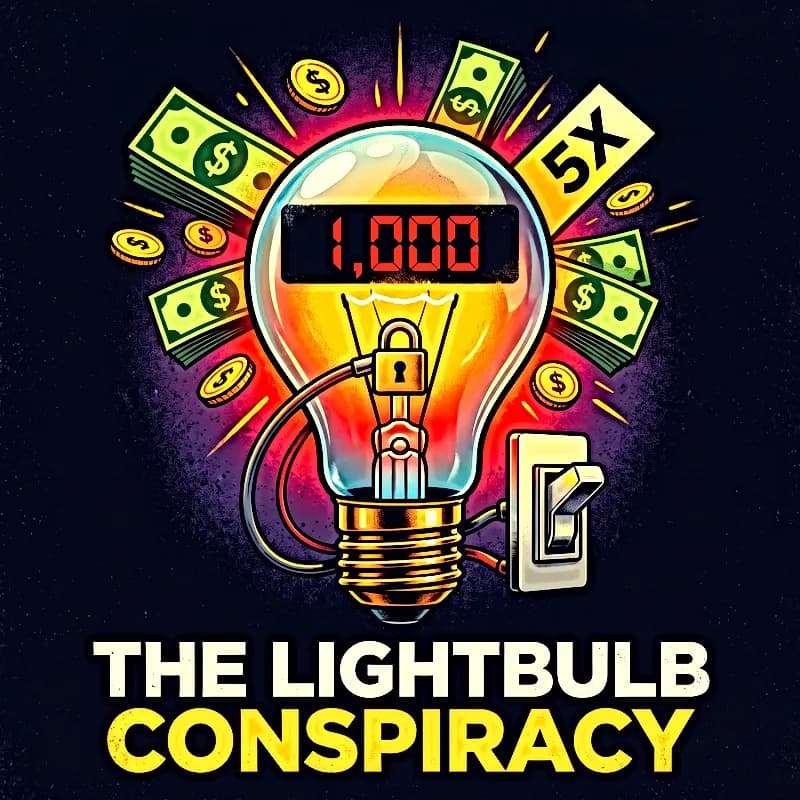
The Phoebus Cartel: Incandescent Lamp Lifespan Standardization and Planned Obsolescence
The Phoebus cartel was an international oligopoly formed in December 1924 by the world's leading incandescent lamp manufacturers, establishing global territorial quotas, cross-licensing arrangements, and product standardization [1]United States District Court for the District of New Jersey. (1949). *United States v. General Electric Co.*, 82 F. Supp. 753 https://law.justia.com/cases/federal/district-courts/FSupp/82/753/1755675/. Operating via a Swiss corporate vehicle (Phoebus S.A. Compagnie Industrielle pour le Développement de l'Éclairage), the cartel systematically engineered and enforced a 1,000-hour operational design life for general-service incandescent lamps, creating the historical foundation for modern planned obsolescence [1]United States District Court for the District of New Jersey. (1949). *United States v. General Electric Co.*, 82 F. Supp. 753 https://law.justia.com/cases/federal/district-courts/FSupp/82/753/1755675/, [2]Krajewski, M. (2014, September 24). *The Great Lightbulb Conspiracy: The Phoebus Cartel*. IEEE Spectrum https://spectrum.ieee.org/the-great-lightbulb-conspiracy.
Phoebus Cartel Profile
Founding Date
December 23, 1924
Corporate Vehicle
Phoebus S.A. (Geneva)
Standardized Lifespan
1,000 Operating Hours
Enforcement Hub
Central Testing Lab (Switzerland)
Antitrust Decree
U.S. v. General Electric (1953)
Lamp Lifespan and Market Dynamics
Pre-Cartel Reference Lifespan (Hours)
1800
Cartel Standard Lifespan (Hours)
1000
Post-Cartel Japanese Competition Lifespan (Hours)
1205
Tokyo Electric Sales Increase After Reduction (%)
500
GE Flashlight Lamp Business Projection (%)
60
Cartel Standardization: Engineering Tradeoffs vs. Anticompetitive Control
| Analytical Domain | Engineering & Economic Tradeoff::Cartel Exploitation & Enforcement::Antitrust & Legal Resolution |
|---|---|
| Operating Lifespan | Higher filament temperatures yield greater luminous efficacy per watt but accelerate tungsten evaporation::Deliberately reduced design life from ~1,800 to 1,000 hours |
| penalized factories exceeding limits | 1949 U.S. judgment ruled lifespan determination was an unlawful exercise of monopoly power |
| Centralized Testing | Standardized voltage and socket specifications across fragmented European grids::Mandatory submission of factory samples to Swiss laboratory |
| fines levied for deviations | 1953 decree prohibited agreements limiting the life, quality, or styles of electric lamps |
| Market Allocation | Cross-licensing of ductile tungsten patents (Coolidge/Langmuir processes)::Divided world into exclusive Home Countries and quota-regulated Common Territory::Dismantled through patent dedication to public and prohibition of territorial division |
| Commercial Turnover | Balancing bulb replacement costs against total consumer electricity expenses::Internal records confirmed strategy to multiply unit sales and protect margins as manufacturing costs fell::Judge Forman found manufacturer profit maximization was the primary motive for lifespan reduction |
Analyst Note
The Phoebus cartel represents the premier historical archetype of institutionalized planned obsolescence. While the physical physics of incandescent filaments dictates a genuine tradeoff between operational longevity and luminous efficiency, the cartel's secret quota systems, central testing laboratory, and penalty schedules demonstrated that the 1,000-hour target was collectively enforced to artificially stimulate replacement demand and preserve monopoly profits.
Formation and Cartel Architecture
The incandescent lamp industry in the early 1920s faced severe commercial saturation [1]United States District Court for the District of New Jersey. (1949). *United States v. General Electric Co.*, 82 F. Supp. 753 https://law.justia.com/cases/federal/district-courts/FSupp/82/753/1755675/, [2]Krajewski, M. (2014, September 24). *The Great Lightbulb Conspiracy: The Phoebus Cartel*. IEEE Spectrum https://spectrum.ieee.org/the-great-lightbulb-conspiracy. Breakthroughs in ductile tungsten drawing (the Coolidge process) and gas-filled bulb architecture (the Langmuir patent) had increased bulb durability to between 1,500 and 2,500 hours, dramatically slowing consumer replacement cycles [2]Krajewski, M. (2014, September 24). *The Great Lightbulb Conspiracy: The Phoebus Cartel*. IEEE Spectrum https://spectrum.ieee.org/the-great-lightbulb-conspiracy, [3]Supreme Court of the United States. (1926). *United States v. General Electric Co.*, 272 U.S. 476 https://supreme.justia.com/cases/federal/us/272/476/. In Germany, Osram witnessed its annual sales fall from 63 million units in 1922–1923 to 28 million the following year [2]Krajewski, M. (2014, September 24). *The Great Lightbulb Conspiracy: The Phoebus Cartel*. IEEE Spectrum https://spectrum.ieee.org/the-great-lightbulb-conspiracy.
On December 23, 1924, executives representing the major producers met in Geneva, Switzerland, signing the Convention for the Development and Progress of the International Incandescent Electric Lamp Industry [1]United States District Court for the District of New Jersey. (1949). *United States v. General Electric Co.*, 82 F. Supp. 753 https://law.justia.com/cases/federal/district-courts/FSupp/82/753/1755675/, [2]Krajewski, M. (2014, September 24). *The Great Lightbulb Conspiracy: The Phoebus Cartel*. IEEE Spectrum https://spectrum.ieee.org/the-great-lightbulb-conspiracy:
- Corporate Entity: The cartel registered Phoebus S.A. in Geneva on February 7, 1925 [4]Swiss Official Gazette of Commerce (Feuille Officielle Suisse du Commerce). (1925, February 7). *Registration of Phœbus S.A. Compagnie Industrielle pour le Développement de l'Éclairage* https://www.e-periodica.ch/digbib/view?pid=sha-001:1925:43.
- Core Signatories: Osram (Germany), Philips (Netherlands), Tungsram (Hungary), Compagnie des Lampes (France), and Associated Electrical Industries (AEI, United Kingdom) [1]United States District Court for the District of New Jersey. (1949). *United States v. General Electric Co.*, 82 F. Supp. 753 https://law.justia.com/cases/federal/district-courts/FSupp/82/753/1755675/, [2]Krajewski, M. (2014, September 24). *The Great Lightbulb Conspiracy: The Phoebus Cartel*. IEEE Spectrum https://spectrum.ieee.org/the-great-lightbulb-conspiracy.
- Role of General Electric: Although General Electric (GE) avoided signing directly to circumvent the Sherman Antitrust Act, the U.S. District Court found in 1949 that GE's wholly owned foreign subsidiary, International General Electric (IGE), was the central architect and organizer connecting Phoebus to the North American market [1]United States District Court for the District of New Jersey. (1949). *United States v. General Electric Co.*, 82 F. Supp. 753 https://law.justia.com/cases/federal/district-courts/FSupp/82/753/1755675/.
┌────────────────────────────────────────────────────────────────────────┐
│                   Phoebus Cartel Market Architecture                   │
├───────────────────┬────────────────────────────────────────────────────┤
│ Home Territories  │ Germany (Osram), Netherlands (Philips), France, UK │
│                   │ Closed to external cartel imports; absolute monopoly│
├───────────────────┼────────────────────────────────────────────────────┤
│ British Empire    │ Empire A (Australasia) & Empire B (Commonwealth)   │
│                   │ Administered under shared quotas by AEI and allies │
├───────────────────┼────────────────────────────────────────────────────┤
│ Common Territory  │ Asia, Latin America, Non-aligned Europe            │
│                   │ Allocated via Local Participating Percentages      │
└───────────────────┴────────────────────────────────────────────────────┘
The 1,000-Hour Standardization Program and Engineering Tradeoffs
Prior to the cartel, high-quality tungsten filament lamps routinely operated for 1,500 to 2,000+ hours [2]Krajewski, M. (2014, September 24). *The Great Lightbulb Conspiracy: The Phoebus Cartel*. IEEE Spectrum https://spectrum.ieee.org/the-great-lightbulb-conspiracy, [5]Monopolies and Restrictive Practices Commission. (1951). *Report on the Supply of Electric Lamps*. Her Majesty's Stationery Office (HMSO) https://assets.publishing.service.gov.uk/media/5a7c67f340f0b62aff6c1710/0287.pdf. Phoebus systematically instituted an industry-wide standard fixing the design life of general-service lamps at exactly 1,000 hours [2]Krajewski, M. (2014, September 24). *The Great Lightbulb Conspiracy: The Phoebus Cartel*. IEEE Spectrum https://spectrum.ieee.org/the-great-lightbulb-conspiracy.
Archival records analyzed by historian Markus Krajewski reveal the measured impact across cartel-monitored reference factories:
- 1926: Average tested lifespan was approximately 1,800 hours [2]Krajewski, M. (2014, September 24). *The Great Lightbulb Conspiracy: The Phoebus Cartel*. IEEE Spectrum https://spectrum.ieee.org/the-great-lightbulb-conspiracy.
- 1933–1934: Average tested lifespan fell to 1,205 hours, with no factory averaging above 1,500 hours [2]Krajewski, M. (2014, September 24). *The Great Lightbulb Conspiracy: The Phoebus Cartel*. IEEE Spectrum https://spectrum.ieee.org/the-great-lightbulb-conspiracy.
The Physics of Filament Tradeoffs
The cartel publicly defended the 1,000-hour ceiling on engineering grounds [1]United States District Court for the District of New Jersey. (1949). *United States v. General Electric Co.*, 82 F. Supp. 753 https://law.justia.com/cases/federal/district-courts/FSupp/82/753/1755675/, [5]Monopolies and Restrictive Practices Commission. (1951). *Report on the Supply of Electric Lamps*. Her Majesty's Stationery Office (HMSO) https://assets.publishing.service.gov.uk/media/5a7c67f340f0b62aff6c1710/0287.pdf. In incandescent lighting, filament life is non-linearly coupled to operating temperature and voltage:
Life ∝ (nominal voltage / operating voltage)ᵏ
where k ≈ 12–16 for tungsten filaments in gas-filled environments. Operating a filament hotter generates higher luminous efficacy (lumens per watt) and whiter light, but accelerates tungsten evaporation, leading to premature burnout [1]United States District Court for the District of New Jersey. (1949). *United States v. General Electric Co.*, 82 F. Supp. 753 https://law.justia.com/cases/federal/district-courts/FSupp/82/753/1755675/, [2]Krajewski, M. (2014, September 24). *The Great Lightbulb Conspiracy: The Phoebus Cartel*. IEEE Spectrum https://spectrum.ieee.org/the-great-lightbulb-conspiracy. Running a filament cooler prolongs lifespan at the expense of energy efficiency and increased electricity consumption [1]United States District Court for the District of New Jersey. (1949). *United States v. General Electric Co.*, 82 F. Supp. 753 https://law.justia.com/cases/federal/district-courts/FSupp/82/753/1755675/, [5]Monopolies and Restrictive Practices Commission. (1951). *Report on the Supply of Electric Lamps*. Her Majesty's Stationery Office (HMSO) https://assets.publishing.service.gov.uk/media/5a7c67f340f0b62aff6c1710/0287.pdf.
In 1951, the British Monopolies and Restrictive Practices Commission concluded that a 1,000-hour lifespan represented a plausible technical compromise between initial bulb purchase price and recurring electricity costs [5]Monopolies and Restrictive Practices Commission. (1951). *Report on the Supply of Electric Lamps*. Her Majesty's Stationery Office (HMSO) https://assets.publishing.service.gov.uk/media/5a7c67f340f0b62aff6c1710/0287.pdf. However, the 1949 U.S. antitrust court rejected the claim that public interest justified collective enforcement, noting that manufacturers deliberately suppressed durable designs to force repeat purchases [1]United States District Court for the District of New Jersey. (1949). *United States v. General Electric Co.*, 82 F. Supp. 753 https://law.justia.com/cases/federal/district-courts/FSupp/82/753/1755675/.
Centralized Enforcement: The Swiss Laboratory and Penalty Tables
To enforce adherence to the 1,000-hour threshold, Phoebus established a central testing laboratory in Switzerland [1]United States District Court for the District of New Jersey. (1949). *United States v. General Electric Co.*, 82 F. Supp. 753 https://law.justia.com/cases/federal/district-courts/FSupp/82/753/1755675/, [2]Krajewski, M. (2014, September 24). *The Great Lightbulb Conspiracy: The Phoebus Cartel*. IEEE Spectrum https://spectrum.ieee.org/the-great-lightbulb-conspiracy:
- Mandatory Sample Testing: Member factories were obligated to submit regular production batches to the Swiss laboratory, where bulbs were run on automated timing racks until failure [2]Krajewski, M. (2014, September 24). *The Great Lightbulb Conspiracy: The Phoebus Cartel*. IEEE Spectrum https://spectrum.ieee.org/the-great-lightbulb-conspiracy.
- Two-Sided Penalties: Fines were levied not only on lamps that failed prematurely (below 1,000 hours, protecting brand reputation), but also on lamps that exceeded the 1,000-hour ceiling (penalizing over-engineering that threatened turnover) [2]Krajewski, M. (2014, September 24). *The Great Lightbulb Conspiracy: The Phoebus Cartel*. IEEE Spectrum https://spectrum.ieee.org/the-great-lightbulb-conspiracy, [6]Moyse, P.-E. (2021). *The Uneasy Case of Programmed Obsolescence*. University of New Brunswick Law Journal, 72, 188–225 https://journals.lib.unb.ca/index.php/unblj/article/download/34216/1882530039/1882540737.
- 1929 Fine Schedule: Penalties scaled in Swiss francs based on the percentage deviation from the 1,000-hour target [2]Krajewski, M. (2014, September 24). *The Great Lightbulb Conspiracy: The Phoebus Cartel*. IEEE Spectrum https://spectrum.ieee.org/the-great-lightbulb-conspiracy, [6]Moyse, P.-E. (2021). *The Uneasy Case of Programmed Obsolescence*. University of New Brunswick Law Journal, 72, 188–225 https://journals.lib.unb.ca/index.php/unblj/article/download/34216/1882530039/1882540737.
Internal correspondence reveals the strictness of the enforcement regime. When Tokyo Electric reduced the lifespan of its lamps, sales surged fivefold; however, the company subsequently faced cartel fines for exceeding its allocated unit production quota [2]Krajewski, M. (2014, September 24). *The Great Lightbulb Conspiracy: The Phoebus Cartel*. IEEE Spectrum https://spectrum.ieee.org/the-great-lightbulb-conspiracy.
Economic Impact and Profitability
The deliberate truncation of bulb life generated immediate commercial returns [1]United States District Court for the District of New Jersey. (1949). *United States v. General Electric Co.*, 82 F. Supp. 753 https://law.justia.com/cases/federal/district-courts/FSupp/82/753/1755675/, [2]Krajewski, M. (2014, September 24). *The Great Lightbulb Conspiracy: The Phoebus Cartel*. IEEE Spectrum https://spectrum.ieee.org/the-great-lightbulb-conspiracy:
- Cartel Volume: Phoebus members increased unit sales from 335.7 million bulbs in fiscal 1926–1927 to 420.8 million by 1930–1931—a 25.4% increase during a period of falling manufacturing costs [2]Krajewski, M. (2014, September 24). *The Great Lightbulb Conspiracy: The Phoebus Cartel*. IEEE Spectrum https://spectrum.ieee.org/the-great-lightbulb-conspiracy.
- Margin Expansion: Stable retail pricing combined with lower manufacturing costs and shorter replacement cycles produced extraordinary profit margins. By 1939, GE's Lamp Department maintained an after-tax profit rate of 22.83%, compared to the 4.4% average across U.S. manufacturing corporations [1]United States District Court for the District of New Jersey. (1949). *United States v. General Electric Co.*, 82 F. Supp. 753 https://law.justia.com/cases/federal/district-courts/FSupp/82/753/1755675/.
- The Flashlight Bulb Experiment: In internal memoranda reviewed during antitrust discovery, GE engineers calculated that cutting flashlight lamp life in half would increase overall lamp business by 60% to 70% [1]United States District Court for the District of New Jersey. (1949). *United States v. General Electric Co.*, 82 F. Supp. 753 https://law.justia.com/cases/federal/district-courts/FSupp/82/753/1755675/.
Antitrust Dismantling: United States v. General Electric Co.
The Phoebus cartel began fracturing in the 1930s as key patents expired (1929–1933) and low-cost independent Japanese manufacturers flooded global markets with non-cartel bulbs [2]Krajewski, M. (2014, September 24). *The Great Lightbulb Conspiracy: The Phoebus Cartel*. IEEE Spectrum https://spectrum.ieee.org/the-great-lightbulb-conspiracy. The outbreak of World War II in 1939 completely severed international communication, leading to the formal nullification of the 1924 agreement in 1940 [1]United States District Court for the District of New Jersey. (1949). *United States v. General Electric Co.*, 82 F. Supp. 753 https://law.justia.com/cases/federal/district-courts/FSupp/82/753/1755675/, [2]Krajewski, M. (2014, September 24). *The Great Lightbulb Conspiracy: The Phoebus Cartel*. IEEE Spectrum https://spectrum.ieee.org/the-great-lightbulb-conspiracy.
In the United States, the Department of Justice initiated major antitrust proceedings in 1941, culminating in two historic decisions by Judge Philip Forman [1]United States District Court for the District of New Jersey. (1949). *United States v. General Electric Co.*, 82 F. Supp. 753 https://law.justia.com/cases/federal/district-courts/FSupp/82/753/1755675/, [7]United States District Court for the District of New Jersey. (1953). *United States v. General Electric Co.*, 115 F. Supp. 835 https://law.justia.com/cases/federal/district-courts/FSupp/115/835/1968371/:
- 1949 Merits Decision (82 F. Supp. 753): The court found General Electric guilty of violating Sections 1 and 2 of the Sherman Act, ruling that GE had utilized IGE and foreign cartel agreements to unlawfully monopolize the incandescent lamp market and set industry-wide lifespans [1]United States District Court for the District of New Jersey. (1949). *United States v. General Electric Co.*, 82 F. Supp. 753 https://law.justia.com/cases/federal/district-courts/FSupp/82/753/1755675/.
- 1953 Final Decree (115 F. Supp. 835): The court ordered GE to dedicate all existing incandescent lamp and component patents to the public domain, license lamp-making machinery patents at reasonable royalties, and prohibited agreements fixing prices or limiting product durability [7]United States District Court for the District of New Jersey. (1953). *United States v. General Electric Co.*, 115 F. Supp. 835 https://law.justia.com/cases/federal/district-courts/FSupp/115/835/1968371/.
Sources
- United States District Court for the District of New Jersey. (1949). United States v. General Electric Co., 82 F. Supp. 753. https://law.justia.com/cases/federal/district-courts/FSupp/82/753/1755675/
- Krajewski, M. (2014, September 24). The Great Lightbulb Conspiracy: The Phoebus Cartel. IEEE Spectrum. https://spectrum.ieee.org/the-great-lightbulb-conspiracy
- Supreme Court of the United States. (1926). United States v. General Electric Co., 272 U.S. 476. https://supreme.justia.com/cases/federal/us/272/476/
- Swiss Official Gazette of Commerce (Feuille Officielle Suisse du Commerce). (1925, February 7). Registration of Phœbus S.A. Compagnie Industrielle pour le Développement de l'Éclairage. https://www.e-periodica.ch/digbib/view?pid=sha-001:1925:43
- Monopolies and Restrictive Practices Commission. (1951). Report on the Supply of Electric Lamps. Her Majesty's Stationery Office (HMSO). https://assets.publishing.service.gov.uk/media/5a7c67f340f0b62aff6c1710/0287.pdf
- Moyse, P.-E. (2021). The Uneasy Case of Programmed Obsolescence. University of New Brunswick Law Journal, 72, 188–225. https://journals.lib.unb.ca/index.php/unblj/article/download/34216/1882530039/1882540737
- United States District Court for the District of New Jersey. (1953). United States v. General Electric Co., 115 F. Supp. 835. https://law.justia.com/cases/federal/district-courts/FSupp/115/835/1968371/
- London, B. (1932). Ending the Depression Through Planned Obsolescence. Project Gutenberg. https://www.gutenberg.org/ebooks/72003