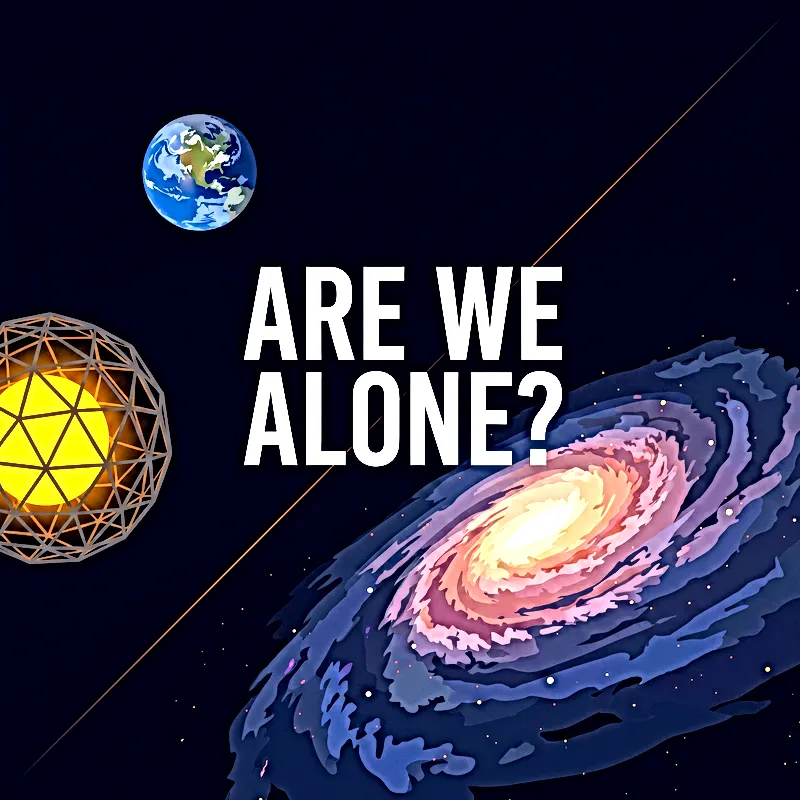
Standardizing Galactic Growth: A Multidimensional Reassessment of the Kardashev Scale and its Evolutionary Pathways
Kardashev Energy Tiers (Modern Baseline)
Type I (Planetary)
10^16 W
Type II (Stellar)
10^26 W
Type III (Galactic)
10^37 W
Humanity (2024)
1.91 x 10^13 W
Barrow Microdimensional Scale
Type I- (Macroscopic)
1
Type II- (Biological)
2
Type III- (Molecular)
3
Type IV- (Atomic)
4
Type V- (Nuclear)
5
Type VI- (Subatomic)
6
Analyst Note
A major constraint governs a civilization's transition from Type 0 to Type I on its home planet: the Planetary Waste Heat Limit. This constraint arises directly from the Second Law of Thermodynamics, which dictates that any energetic work performed by a technological species inevitably generates waste heat. This direct thermal limit creates a hard thermodynamic barrier for any planetary civilization attempting to reach Type I status using localized non-solar power sources.
The quantitative classification of advanced civilizations was initiated by Soviet astronomer Nikolai Kardashev in his seminal 1964 paper, "Transmission of Information by Extraterrestrial Civilizations." Kardashev built his model upon a functional definition of civilization, using contemporary human technological progression as a model for extrapolation under the axiom that physical laws are immutable throughout the cosmos. Recognizing that interstellar communication over astronomical distances requires immense energy resources to overcome cosmic background noise and maximize transmission distance, Kardashev established energy consumption as a direct proxy for civilizational development.
Thermodynamic Foundations and the Core Kardashev Tiers
The original Kardashev scale delineated three discrete classes of civilizations based on the absolute scale of their power consumption. These tiers are separated by immense factors of several billion, aligning with critical natural boundaries in astrophysics.
Civilizational Tiers
| Civilizational Tier | Modern Solar-Equivalent Metric::Primary Boundary of Capture::Extrapolated Engineering and Technologies |
|---|---|
| Type 0 (Pre-Planetary) | ~10^6 to 10^13 W::Sub-planetary terrestrial resources::Combustion of fossil fuels, nuclear fission, early planetary renewables |
| Type I (Planetary) | 10^16 to 10^17 W::Full incident planetary insolation::Global nuclear fusion grids, total tectonic and meteorological control |
| Type II (Stellar) | 4 x 10^26 W::Total energy output of parent star::Dyson spheres, Matryoshka brains, star lifting, stellar mining |
| Type III (Galactic) | 4 x 10^37 W::Combined energy of host galaxy::Relativistic stellar fleets, black hole energy extraction, quasar harnessing |
Sagan's Logarithmic Formula and the Information-Compute Pivot
Recognizing that the massive physical gaps between Kardashev's original discrete tiers made it difficult to map the incremental growth of human civilization, Carl Sagan proposed a continuous, decimalized logarithmic interpolation formula in 1973. This mathematical formulation calculates a continuous civilizational rating, K, directly from the total power output, P, measured in watts.
Sagan also recognized that energy consumption is a necessary but insufficient descriptor of civilizational complexity. He therefore formulated a complementary Information Mastery Scale designed to run parallel to the physical scale.
Sagan Information Class
| Sagan Information Class | Stored Information Threshold::Historical or Contemporary Analogy::Core Physical and Cosmological Limits |
|---|---|
| Class A | 10^6 bits (or 125 KB)::Primitive pre-literate spoken cultures::Information limited to oral human biological memory |
| Class D | 10^9 bits (or 125 MB)::Classical Antiquity (Greece / Rome)::Physical centralization limits (e.g., Library of Alexandria) |
| Class H | 10^13 bits (or 1.25 TB)::Late 20th century human civilization::Limited by early localized silicon computer storage |
| Class P/Q | 10^21 to 10^22 bits::Modern zettabyte global internet::Constrained by planetary energy supply and silicon density |
| Class Z | 10^31 bits::Theoretical ultimate civilization::Exceeds supercluster capacity |
| limited by speed of light | - |
Inward Precision versus Outward Expansion: John Barrow's Microdimensional Scale
A prominent critique of the Kardashev scale is its bias toward macroscopic space colonization and brute energy extraction. To address this, cosmologist John D. Barrow proposed the Barrow Scale (or Microdimensional Mastering Scale), which ranks societies based on their capacity to manipulate structures at increasingly microscopic scales of reality.
Integrating Kardashev's outward energy-amplitude axis with Barrow's inward microdimensional-precision axis defines a Two-Axis Civilization Space. By operating on subatomic scales and utilizing reversible quantum computing, civilizations could emit minimal waste heat, rendering them virtually undetectable to traditional macroscopic SETI technosignature searches.
Empirical Technosignature Detection and Modern SETI Surveys
The Kardashev framework transitioned from a theoretical model to an active empirical driver of modern observational astrophysics through Dysonian SETI. Modern surveys search for the thermodynamic waste heat signatures that are an inevitable byproduct of large-scale energy use.
The Glimpsing Heat from Alien Technologies (G-HAT) project surveyed approximately 100,000 resolved galaxies using NASA's Wide-field Infrared Survey Explorer (WISE) telescope, finding no galaxy in the sampled local universe hosting a Type III civilization reprocessing 85% or more of its host stellar luminosity into mid-infrared waste heat. However, a mature galactic society might operate with "strategic restraint" rather than building massive, warm megastructures.