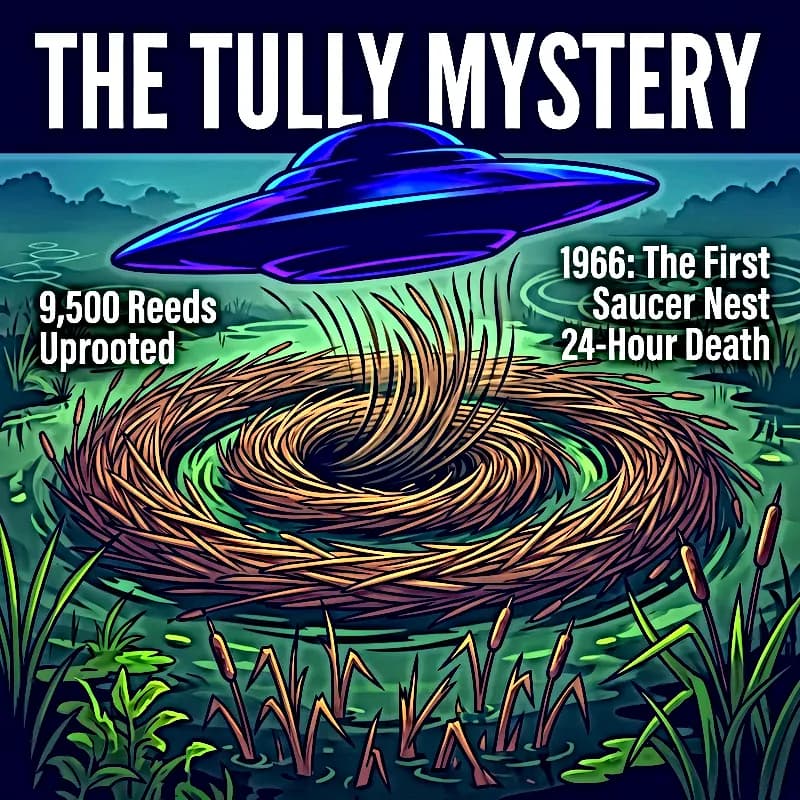
Forensic Environmental Analysis of the 1966 Horseshoe Lagoon Anomalous Physical Trace Sighting
Horseshoe Lagoon Event Profile
Date
January 19, 1966
Geometry
32x25 feet
Extraction Force
~954 kN
Necrotic Rate
Under 24 hours
Mechanical Forces and Trace Features
Total Uprooting Required
5
Clockwise Radial Alignment
5
Topographical Convex Dome
4
Meteorological Capability (Willy-Willy)
1
Analyst Note
The mechanical comparison shows that the hydrodynamic force generated by a powerful willy-willy or waterspout is underpowered by three orders of magnitude (a factor of 1,500) to achieve the clean extraction of the submerged root systems.
On the morning of Wednesday, January 19, 1966, a significant physical trace encounter occurred at Horseshoe Lagoon near Tully in North Queensland, Australia. George Pedley, a local banana farmer, observed his tractor motor experiencing electrical misfires as a sharp, high-velocity hissing sound became audible. He then witnessed a large, metallic, dual-saucer-shaped object rising vertically from the reed-choked lagoon.
Immediately following the object's departure, Pedley discovered a circular area of water completely cleared of its dense reed cover. The water within this zone was rotating in a steady clockwise direction. By the next morning, the open pool had been covered by a massive, tightly woven, floating platform of reeds that had buoyed to the surface overnight.
Morphological and Structural Profiling
| Physical Parameter | Measured Value / Forensic Observation::Analytical Significance |
|---|---|
| Macroscopic Geometry | Oval configuration measuring 32 feet by 25 feet::Corresponds closely to the 25-foot diameter of the reported aerial object. |
| Internal Alignment | Strict, uniform, radial distribution oriented in a clockwise swirl::Implies the application of a systematic, high-torque rotational vector. |
| Harvesting Mechanism | Complete uprooting of plants from the benthic mud layer |
| root systems intact | Indicates a strong vertical tensile force rather than horizontal bending or cutting. |
| Buoyancy & Load Capacity | Rigid, tightly woven floating platform capable of supporting a fully grown adult::Confirms a high degree of structural interlacing and compaction of the stems. |
| Topographical Molding | Depressed outer rim with an 18-inch high, 6-to-8-foot wide raised central dome::Suggests a physical mold or field-displacement matching the craft's underside. |
Aerohydrodynamic and Biomechanical Tension Analysis
To evaluate the validity of official meteorological explanations (like a "willy-willy" or small waterspout), the physical forces required to generate the Tully nest must be analyzed.
For a mature stand of Scleria poiformis, calculating the pulling force required to extract the estimated 9,543 stems within the 30-foot diameter nest area yields a total vertical tensile force of approximately 954 kN (roughly 97 metric tons).
In contrast, even assuming an extremely powerful convective vortex with wind speeds of 30 m/s inducing a bottom water current velocity of 1.0 m/s, the maximum available hydrodynamic shear stress is approximately 10 Pa. The required benthic extraction stress is approximately 15,000 Pa, leaving a 1,500:1 deficit.
Force Parameter Comparison
| Force Parameter | Required Value for Physical Trace::Maximum Available from Willy-Willy |
|---|---|
| Total Vertical Force | ≈954 kN::≈0.64 kN (Induced Hydrodynamic Drag) |
| Shear Stress at Bed | ≈15,000 Pa::≈10 Pa |
| Physical Action | Cohesive horizontal weaving and central molding::Chaotic centrifugal dispersion and outward scattering |
Inter-Agency Investigations
The physical trace evidence prompted conflicting investigations. The RAAF and Department of Air concluded the reeds had died from "natural submersion" and were molded by a willy-willy or waterspout. The University of Queensland concurred with the meteorological event theory.
The Queensland Flying Saucer Research Bureau (QFSRB) disputed these findings, pointing out there had been no recent flooding to trigger natural submersion. They also conducted control tests proving healthy reeds took at least 72 hours to turn brown naturally, whereas the nest reeds had browned in under 24 hours, pointing to severe localized stress (such as intense thermal, electromagnetic, or microwave exposure).
Sociological Legacy
Beyond its scientific interest, the 1966 Tully incident is widely recognized as the primary catalyst for the modern crop circle phenomenon. In 1991, Doug Bower and Dave Chorley revealed they began making crop circles in England inspired directly by the media sensation surrounding the swirled reed nests in the Australian press, as Bower had lived in Far North Queensland during the mid-1960s. Thus, the physical trace left in Horseshoe Lagoon in 1966 served as the conceptual blueprint for a global art movement.