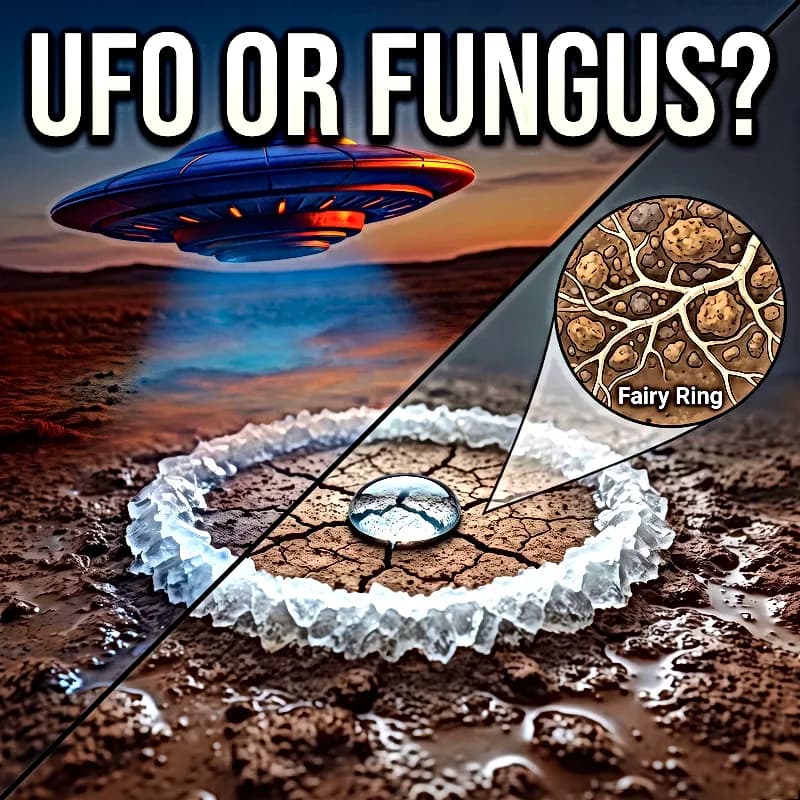
The 1971 Delphos, Kansas UFO Incident: Physical Soil Anomalies, Luminescence, Hydrophobicity, and the Fairy-Ring Hypothesis
The Delphos incident occurred at approximately 7:00 p.m. CST on November 2, 1971, on the Durel Johnson farm near Delphos, Kansas [1]Phillips, T. R. (1972). *Landing Trace at Delphos, Kansas*. Flying Saucer Review: Case Histories, Supplement 9, 2–5 https://podcastufo.com/wp-content/uploads/2022/08/Delphos-pdf.pdf. Sixteen-year-old Ronald Johnson reported observing an illuminated, mushroom-shaped object roughly nine feet in diameter hovering two feet above the ground at an estimated distance of 75 feet [1]Phillips, T. R. (1972). *Landing Trace at Delphos, Kansas*. Flying Saucer Review: Case Histories, Supplement 9, 2–5 https://podcastufo.com/wp-content/uploads/2022/08/Delphos-pdf.pdf. After the object departed, the Johnson family discovered a glowing, gray-white circular ground ring with a crusted surface texture [1]Phillips, T. R. (1972). *Landing Trace at Delphos, Kansas*. Flying Saucer Review: Case Histories, Supplement 9, 2–5 https://podcastufo.com/wp-content/uploads/2022/08/Delphos-pdf.pdf.
Delphos Physical Trace Profile
Incident Date
November 2, 1971
Location
Delphos, Kansas
Ring Dimensions
9 ft Diameter / ~1.5 ft Wide
Primary Anomaly
Extreme Soil Hydrophobicity
Evidentiary Assessment of Physical Trace Markers
Soil Hydrophobicity & Water-Repellent Coating
5
Subsurface Dryness (~12–14 Inches)
4
Organic Fulvic / Calcium Oxalate Biomarkers
4
Spontaneous Soil Luminescence on Site
2
Extraterrestrial Technological Deposit
1
Laboratory Findings vs. Analytical Interpretation
| Analytical Test / Property | Ring Soil Result::Control Comparison::Forensic Interpretation |
|---|---|
| Wetting Behavior | Floating hydrophobic globules |
| disperses with agitation | Standard water absorption::Indicates removable organic surfactant/coating on mineral grains |
| Water-Extractable Mass | 12.8–18.3 mg/g (avg 15.6 mg/g / 1.6 wt.%)::6.1–6.7 mg/g (avg 6.4 mg/g / 0.6 wt.%)::Ring soil contained ~2.4x more water-soluble organic extract |
| Dominant Extract Chemistry | Fulvic/humic carboxylate organic matter::Lower-concentration humates::Aromatic humic substances typical of biologically active grassland soils |
| Calcium Oxalate | Crystalline particulates identified via FTIR/EDX::Not prominent in control particulates::Common fungal biomineral formed by environmental oxalate cycling |
| Mineral Assemblage (XRD) | Quartz, feldspars, clays |
| no thermal alteration | Identical mineral assemblage::Rules out high-temperature pyrolytic scorching of soil |
Analyst Note
The Delphos ring remains one of the most thoroughly analyzed physical trace cases in ufology. However, the premise that extreme soil hydrophobicity and organic carboxylate coatings are unique signatures of an anomalous craft is refuted by modern soil pathology: Type-I fungal fairy rings naturally generate identical hydrophobic soil barriers through hydrophobin coatings and calcium oxalate biomineralization.
Incident Record and Physical-Trace Chronology
On November 3, 1971, the site was inspected by local law enforcement, including Sheriff Ralph Enlow, Undersheriff Harlan Enlow, and Kansas Highway Patrol Trooper Kenneth Yager [1]Phillips, T. R. (1972). *Landing Trace at Delphos, Kansas*. Flying Saucer Review: Case Histories, Supplement 9, 2–5 https://podcastufo.com/wp-content/uploads/2022/08/Delphos-pdf.pdf:
- Morphology: A doughnut-shaped ring with an outer diameter of approximately 9 feet and a band width of 1.5 to 2 feet [1]Phillips, T. R. (1972). *Landing Trace at Delphos, Kansas*. Flying Saucer Review: Case Histories, Supplement 9, 2–5 https://podcastufo.com/wp-content/uploads/2022/08/Delphos-pdf.pdf.
- Moisture Contrast: The ring band was completely dry and light-colored, whereas the center and surrounding soil were wet and muddy [1]Phillips, T. R. (1972). *Landing Trace at Delphos, Kansas*. Flying Saucer Review: Case Histories, Supplement 9, 2–5 https://podcastufo.com/wp-content/uploads/2022/08/Delphos-pdf.pdf.
- Radiological Survey: A Civil Defense radiological monitor detected no anomalous radioactivity above background [1]Phillips, T. R. (1972). *Landing Trace at Delphos, Kansas*. Flying Saucer Review: Case Histories, Supplement 9, 2–5 https://podcastufo.com/wp-content/uploads/2022/08/Delphos-pdf.pdf.
- Subsurface Depth: Investigator Ted Phillips and chemist Erol Faruk documented that the dry, hydrophobic zone extended 12 to 14 inches below the surface [1]Phillips, T. R. (1972). *Landing Trace at Delphos, Kansas*. Flying Saucer Review: Case Histories, Supplement 9, 2–5 https://podcastufo.com/wp-content/uploads/2022/08/Delphos-pdf.pdf, [2]Faruk, E. A. (1989). *The Delphos Case: Soil Analysis and Appraisal of a CE-2 Report*. Journal of UFO Studies, New Series 1, 39–65 https://cufos.org/PDFs/JUFOS/1989_NS_vol1_JUFOS.pdf.
┌────────────────────────────────────────────────────────────────────────┐
│                   Delphos Ring Soil Profile Schematic                  │
├────────────────────────────────────────────────────────────────────────┤
│                                                                        │
│   Muddy Surrounding Soil       Dry Ring Band (Hydrophobic)   Muddy Soil│
│   ██████████████████████       ░░░░░░░░░░░░░░░░░░░░░░░░░░░   ██████████│
│   ██ (Wet to 8+ in) ███        ░░ (Dry to 12-14 in) ░░░░░    ██████████│
│   ██████████████████████       ░░ [Fulvic/Humic Coating] ░   ██████████│
│                                ░░ [Ca-Oxalate Crystals]  ░             │
└────────────────────────────────────────────────────────────────────────┘
Laboratory Chemistry and Organic Coatings
Faruk's Organic Extraction (1989)
Erol A. Faruk established that the ring's water repellency was caused by a water-soluble organic carboxylate salt coating the soil particles [2]Faruk, E. A. (1989). *The Delphos Case: Soil Analysis and Appraisal of a CE-2 Report*. Journal of UFO Studies, New Series 1, 39–65 https://cufos.org/PDFs/JUFOS/1989_NS_vol1_JUFOS.pdf. While undisturbed soil resisted water penetration, mechanical agitation caused the organic coating to dissolve into an aqueous solution with soap-like foaming characteristics [2]Faruk, E. A. (1989). *The Delphos Case: Soil Analysis and Appraisal of a CE-2 Report*. Journal of UFO Studies, New Series 1, 39–65 https://cufos.org/PDFs/JUFOS/1989_NS_vol1_JUFOS.pdf.
Budinger's Multi-Instrumental Analysis (1999)
In 1999, analytical chemist Phyllis A. Budinger evaluated archived 1972 samples using FTIR, NMR, SEM/EDX, XPS, and XRD [3]Budinger, P. A. (1999). *Analytical Report on Soil Samples from the Delphos, Kansas UFO Landing Site (Technical Service Response UT001)*. Frontier Analysis Ltd https://documents.theblackvault.com/budinger/UT001.pdf:
- Extractable Fraction: Ring soils contained an average of 15.6 mg/g (1.6 wt.%) water-extractable material, compared to 6.4 mg/g (0.6 wt.%) in controls [3]Budinger, P. A. (1999). *Analytical Report on Soil Samples from the Delphos, Kansas UFO Landing Site (Technical Service Response UT001)*. Frontier Analysis Ltd https://documents.theblackvault.com/budinger/UT001.pdf.
- Composition: The organic coating was identified as a low-molecular-weight fulvic-like humic substance (~85%), calcium oxalate (~5%), and calcium carbonate (~1%) [3]Budinger, P. A. (1999). *Analytical Report on Soil Samples from the Delphos, Kansas UFO Landing Site (Technical Service Response UT001)*. Frontier Analysis Ltd https://documents.theblackvault.com/budinger/UT001.pdf.
- Thermal Integrity: X-ray diffraction revealed no structural alteration of quartz, feldspar, or clay minerals, disproving high-temperature thermal scorching [3]Budinger, P. A. (1999). *Analytical Report on Soil Samples from the Delphos, Kansas UFO Landing Site (Technical Service Response UT001)*. Frontier Analysis Ltd https://documents.theblackvault.com/budinger/UT001.pdf.
- Surface Particulates: White particulates were chemically heterogeneous, consisting of calcium oxalate crystals, quartz, carbonates, and cellulosic plant fragments [3]Budinger, P. A. (1999). *Analytical Report on Soil Samples from the Delphos, Kansas UFO Landing Site (Technical Service Response UT001)*. Frontier Analysis Ltd https://documents.theblackvault.com/budinger/UT001.pdf.
The Fairy-Ring Hypothesis in Modern Soil Science
A common argument in historic UFO literature claimed that fungal fairy rings absorb water, and therefore the Delphos hydrophobic soil could not be fungal in origin. Modern agronomy and soil microbiology refute this premise:
- Type-I Fairy Ring Hydrophobicity: Turfgrass pathology guidelines from North Carolina State University and the University of Florida confirm that Type-I fairy rings produce extreme, localized soil hydrophobicity [4]North Carolina State University Extension. (2023). *Fairy Ring in Turf*. NC State Extension Publications https://content.ces.ncsu.edu/fairy-ring-in-turf, [5]University of Florida IFAS Extension. (2022). *Fairy Rings*. EDIS Publication LH046 https://ask.ifas.ufl.edu/publication/LH046.
- Hydrophobin-Mediated Repellency: A 2026 field study in ISME Communications demonstrated that the fairy-ring fungus Marasmius oreades produces extensive soil hydrophobicity via hydrophobin protein coatings on soil particles [6]ISME Communications. (2026). *Species-Specific Hydro-Physical and Chemical Footprints of Fairy-Ring Fungi in Grassland Soils*. ISME Communications, 6(1), ycag177 https://academic.oup.com/ismecommun/article/6/1/ycag177/8713268.
- Calcium Oxalate Biomineralization: Fungi secrete oxalic acid that reacts with soil calcium to precipitate calcium oxalate crystals on mycelial filaments [7]Source entry missing for citation [7], [8]Franceschi, V. R., & Nakata, P. A. (2005). *Calcium Oxalate in Plants: Formation and Function*. Annual Review of Plant Biology, 56, 41–71 https://pmc.ncbi.nlm.nih.gov/articles/PMC2786522/.
- Humic Enrichment: Fungal decomposition of turf roots naturally enriches localized soil horizons with fulvic and humic acids [3]Budinger, P. A. (1999). *Analytical Report on Soil Samples from the Delphos, Kansas UFO Landing Site (Technical Service Response UT001)*. Frontier Analysis Ltd https://documents.theblackvault.com/budinger/UT001.pdf, [9]USDA Natural Resources Conservation Service. *Soil Organic Matter Types and Humic Fractions*. Soil Tech Note 13A https://www.nrcs.usda.gov/state-offices/illinois/soil-tech-note-13a-types-of-organic-matter-som.
Sources
- Phillips, T. R. (1972). Landing Trace at Delphos, Kansas. Flying Saucer Review: Case Histories, Supplement 9, 2–5. https://podcastufo.com/wp-content/uploads/2022/08/Delphos-pdf.pdf
- Faruk, E. A. (1989). The Delphos Case: Soil Analysis and Appraisal of a CE-2 Report. Journal of UFO Studies, New Series 1, 39–65. https://cufos.org/PDFs/JUFOS/1989_NS_vol1_JUFOS.pdf
- Budinger, P. A. (1999). Analytical Report on Soil Samples from the Delphos, Kansas UFO Landing Site (Technical Service Response UT001). Frontier Analysis Ltd. https://documents.theblackvault.com/budinger/UT001.pdf
- North Carolina State University Extension. (2023). Fairy Ring in Turf. NC State Extension Publications. https://content.ces.ncsu.edu/fairy-ring-in-turf
- University of Florida IFAS Extension. (2022). Fairy Rings. EDIS Publication LH046. https://ask.ifas.ufl.edu/publication/LH046
- ISME Communications. (2026). Species-Specific Hydro-Physical and Chemical Footprints of Fairy-Ring Fungi in Grassland Soils. ISME Communications, 6(1), ycag177. https://academic.oup.com/ismecommun/article/6/1/ycag177/8713268
- Gadd, G. M. (1999). Fungal Production of Citric and Oxalic Acid: Importance in Metal Speciation, Mineral Weathering, and Bioremediation. Current Opinion in Biotechnology, 10(3), 253–259.
- Franceschi, V. R., & Nakata, P. A. (2005). Calcium Oxalate in Plants: Formation and Function. Annual Review of Plant Biology, 56, 41–71. https://pmc.ncbi.nlm.nih.gov/articles/PMC2786522/
- USDA Natural Resources Conservation Service. Soil Organic Matter Types and Humic Fractions. Soil Tech Note 13A. https://www.nrcs.usda.gov/state-offices/illinois/soil-tech-note-13a-types-of-organic-matter-som