Forensic Technical and Geopolitical Analysis of the September 22, 1979, Vela Incident: A Multidisciplinary Evaluation of Alert 747
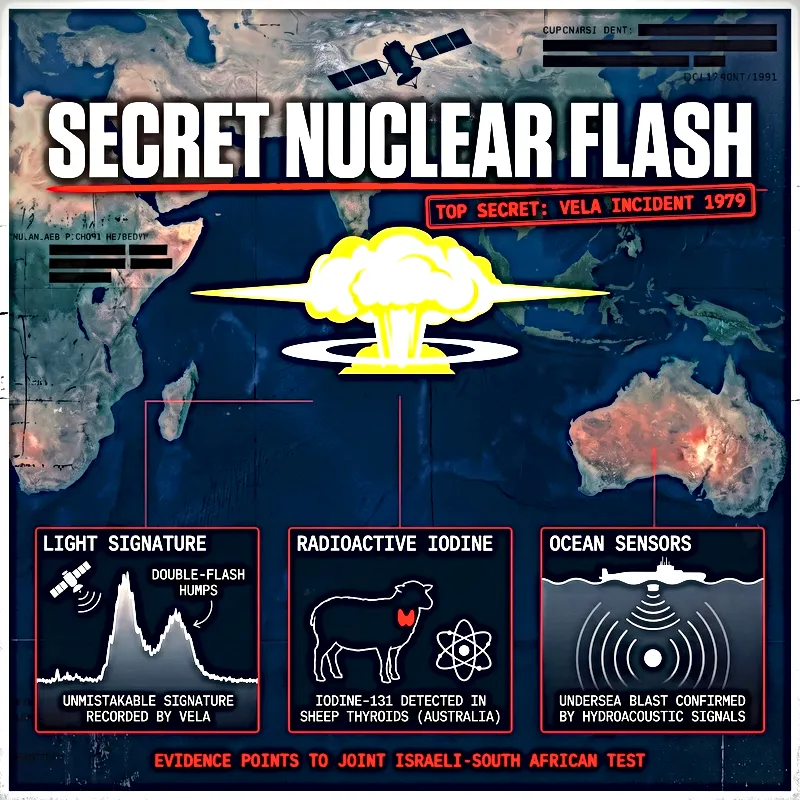
This comprehensive forensic analysis investigates the 1979 Vela Incident, a mysterious "double flash" detected by a U.S. satellite that suggested a clandestine nuclear test occurred in the South Indian Ocean. The text contrasts the official White House conclusion, which attributed the event to a natural micrometeoroid impact, against a mountain of multidisciplinary evidence including hydroacoustic signals, ionospheric disturbances, and radioactive iodine found in Australian livestock. By examining the technical data alongside the geopolitical alliance between Israel and Apartheid-era South Africa, the report argues that the incident was likely a successful joint nuclear trial. Ultimately, the source highlights a significant tension between scientific truth and political realpolitik, suggesting the U.S. government may have intentionally obscured a proliferation event to maintain diplomatic stability.
Case Snapshot
Subject
Vela Incident / Alert 747
Source Entries
25
Detection Date
September 22, 1979 00:53 UTC
Satellite
Vela 6911 (5B)
Estimated Yield
2–3 kilotons
Location
~47°S 40°E (Prince Edward Islands)
Suspected Actors
Israel / South Africa
Evidence Distribution
Section Headings
13
Markdown Tables
5
Unique Citations
25
Inline References
98
Core Timeline Anchors
| Date | Milestone |
|---|---|
| 1963 | Partial Test Ban Treaty signed — Vela Hotel program monitors compliance |
| 1975 | Secret meetings between P.W. Botha and Shimon Peres on nuclear cooperation |
| 1977 | Vastrap (Kalahari) test site discovered by Soviet and American satellites |
| Sep 22, 1979 | Vela 6911 detects Alert 747 double flash at 00:53 UTC |
| Oct 1979 | Ruina Panel convened by White House Science Adviser Frank Press |
| Mid-1980 | Ruina Panel concludes event was 'probably not' nuclear |
| Oct–Nov 1979 | Iodine-131 detected in Australian sheep thyroids |
| 2010 | Declassified documents reveal extent of Israel-South Africa nuclear partnership |
Introduction
The detection of a distinctive double flash of light by the United States Vela 6911 satellite on September 22, 1979, remains one of the most significant and controversial enigmas of the Cold War nuclear era. Formally designated as Alert 747, or colloquially as the Vela Incident, the event occurred at approximately 00:53 UTC in the remote maritime region of the South Indian Ocean, specifically near the Prince Edward Islands.[1]Vela incident - Wikipedia https://en.wikipedia.org/wiki/Vela_incident, [2]The 22 September 1979 Vela Incident: Radionuclide and Hydroacoustic Evidence - Science & Global Security https://scienceandglobalsecurity.org/archive/sgs26degeer.pdf, [3]What was the Vela Incident (1979)? - Boot Camp & Military Fitness Institute https://bootcampmilitaryfitnessinstitute.com/2021/09/14/what-was-the-vela-incident-1979/ While the photometric signature recorded by the satellite's sensors appeared to be the unmistakable fingerprint of an atmospheric nuclear detonation, the subsequent official determination by a White House-appointed panel suggested a natural origin—a conclusion that stands in stark contrast to declassified intelligence assessments, hydroacoustic data, and radionuclide findings.[4]The Vela Incident: South Atlantic Mystery Flash in September 1979 - National Security Archive https://nsarchive.gwu.edu/briefing-book/nuclear-vault/2016-12-06/vela-incident-south-atlantic-mystery-flash-september-1979-raised-questions-about-nuclear-test, [5]Israel's 1979 Nuclear Test and the U.S. Government's Attempt to Cover It Up - Nuclear Proliferation Policy https://npolicy.org/article_file/Israels_1979_Nuclear_Test_and_the_U_S__Governments_Attempt_to_Cover_It_Up_040411_1601_preview.pdf, [6]The Vela Incident: Nuclear Bombs vs. Asteroid Collisions - The Collector https://www.thecollector.com/vela-incident/ This report provides an exhaustive forensic examination of the technical data, the divergent scientific interpretations, and the complex geopolitical landscape involving a suspected covert nuclear test by Israel and Apartheid-era South Africa.
The Vela Surveillance Architecture and the Detection of Alert 747
The Vela Hotel program, established under the auspices of the Advanced Research Projects Agency (ARPA) and the U.S. Air Force, was a critical component of the American strategic infrastructure designed to monitor international compliance with the 1963 Partial Test Ban Treaty.[1]Vela incident - Wikipedia https://en.wikipedia.org/wiki/Vela_incident, [3]What was the Vela Incident (1979)? - Boot Camp & Military Fitness Institute https://bootcampmilitaryfitnessinstitute.com/2021/09/14/what-was-the-vela-incident-1979/ These satellites were launched in pairs and positioned in high circular orbits—approximately 110,000 kilometers from Earth—to provide near-total global coverage for the detection of nuclear-related radiation and optical signatures.[7]The 22 September 1979 Vela Incident: The Detected Double Flash - SciSpace https://scispace.com/pdf/the-22-september-1979-vela-incident-the-detected-double-4oah0f9ysw.pdf, [8]THE VELA INCIDENT | Ditsong Museums of South Africa https://ditsong.org.za/en/the-vela-incident/ By the time of the 1979 incident, the Vela fleet had successfully and accurately identified 41 previous atmospheric nuclear tests conducted by France, China, and other nations, each of which was subsequently corroborated by other diagnostic means.[1]Vela incident - Wikipedia https://en.wikipedia.org/wiki/Vela_incident, [6]The Vela Incident: Nuclear Bombs vs. Asteroid Collisions - The Collector https://www.thecollector.com/vela-incident/
Vela 6911, also known as Vela 10 or 5B, was an aging satellite that had surpassed its initial design lifetime but remained operational.[3]What was the Vela Incident (1979)? - Boot Camp & Military Fitness Institute https://bootcampmilitaryfitnessinstitute.com/2021/09/14/what-was-the-vela-incident-1979/, [4]The Vela Incident: South Atlantic Mystery Flash in September 1979 - National Security Archive https://nsarchive.gwu.edu/briefing-book/nuclear-vault/2016-12-06/vela-incident-south-atlantic-mystery-flash-september-1979-raised-questions-about-nuclear-test Its primary diagnostic tool for atmospheric monitoring was the bhangmeter, a specialized silicon solid-state sensor designed to record the time-history of light intensity from a nuclear explosion.[2]The 22 September 1979 Vela Incident: Radionuclide and Hydroacoustic Evidence - Science & Global Security https://scienceandglobalsecurity.org/archive/sgs26degeer.pdf, [7]The 22 September 1979 Vela Incident: The Detected Double Flash - SciSpace https://scispace.com/pdf/the-22-september-1979-vela-incident-the-detected-double-4oah0f9ysw.pdf On the morning of September 22, 1979, Vela 6911 was positioned over the South Atlantic, providing a clear field of view that encompassed large portions of the southern hemisphere, including South Africa and the surrounding oceans.[7]The 22 September 1979 Vela Incident: The Detected Double Flash - SciSpace https://scispace.com/pdf/the-22-september-1979-vela-incident-the-detected-double-4oah0f9ysw.pdf, [8]THE VELA INCIDENT | Ditsong Museums of South Africa https://ditsong.org.za/en/the-vela-incident/
The Photometric Physics of the Double Flash Signature
The bhangmeter's primary function is to capture the unique "double-pulse" light curve generated by a nuclear detonation in the atmosphere. This phenomenon is a direct consequence of the physical interaction between the expanding shockwave and the surrounding air. In the first few microseconds of a detonation, the intense thermal radiation from the device causes the air to become incandescently hot, creating a brief but extremely intense initial flash of light.[1]Vela incident - Wikipedia https://en.wikipedia.org/wiki/Vela_incident, [3]What was the Vela Incident (1979)? - Boot Camp & Military Fitness Institute https://bootcampmilitaryfitnessinstitute.com/2021/09/14/what-was-the-vela-incident-1979/, [8]THE VELA INCIDENT | Ditsong Museums of South Africa https://ditsong.org.za/en/the-vela-incident/ As the shockwave expands, it heats the air to such high temperatures that it becomes ionized and temporarily opaque to visible light, a phase known as the hydrodynamic minimum (t_min).[1]Vela incident - Wikipedia https://en.wikipedia.org/wiki/Vela_incident, [3]What was the Vela Incident (1979)? - Boot Camp & Military Fitness Institute https://bootcampmilitaryfitnessinstitute.com/2021/09/14/what-was-the-vela-incident-1979/
As the shockwave continues to expand and cool, its opacity decreases, allowing the light from the internal, longer-lived fireball to emerge. This results in a second, larger, and more sustained peak of light intensity (t_max).[1]Vela incident - Wikipedia https://en.wikipedia.org/wiki/Vela_incident, [3]What was the Vela Incident (1979)? - Boot Camp & Military Fitness Institute https://bootcampmilitaryfitnessinstitute.com/2021/09/14/what-was-the-vela-incident-1979/, [8]THE VELA INCIDENT | Ditsong Museums of South Africa https://ditsong.org.za/en/the-vela-incident/ The specific ratio of the intensity of the two peaks, the duration between them, and the time-to-minimum are mathematically correlated to the energy release, or yield, of the nuclear device. For Alert 747, the recorded light curve was assessed by initial analysts at the Air Force Technical Applications Center (AFTAC) and Los Alamos National Laboratory as being characteristic of a 2 to 3 kiloton nuclear explosion.[1]Vela incident - Wikipedia https://en.wikipedia.org/wiki/Vela_incident, [6]The Vela Incident: Nuclear Bombs vs. Asteroid Collisions - The Collector https://www.thecollector.com/vela-incident/
The Ruina Panel: The Politics of the Micrometeoroid Hypothesis
In the weeks following the detection, the Carter administration faced significant internal and external pressure to explain the flash. In late October 1979, White House Science Adviser Frank Press convened a "blue-ribbon" panel of eight distinguished scientists, chaired by Jack Ruina of MIT, to evaluate the data.[2]The 22 September 1979 Vela Incident: Radionuclide and Hydroacoustic Evidence - Science & Global Security https://scienceandglobalsecurity.org/archive/sgs26degeer.pdf, [6]The Vela Incident: Nuclear Bombs vs. Asteroid Collisions - The Collector https://www.thecollector.com/vela-incident/, [10]Israel's Nuclear Arsenal: The Vela Incident - Jewish Virtual Library https://www.jewishvirtuallibrary.org/israel-s-nuclear-program-the-vela-incident The panel was tasked with determining whether the signal was nuclear in origin or the result of natural phenomena.[2]The 22 September 1979 Vela Incident: Radionuclide and Hydroacoustic Evidence - Science & Global Security https://scienceandglobalsecurity.org/archive/sgs26degeer.pdf, [5]Israel's 1979 Nuclear Test and the U.S. Government's Attempt to Cover It Up - Nuclear Proliferation Policy https://npolicy.org/article_file/Israels_1979_Nuclear_Test_and_the_U_S__Governments_Attempt_to_Cover_It_Up_040411_1601_preview.pdf
Technical Deviations and the "Zoo-on" Classification
The Ruina Panel's final report, released in mid-1980, concluded that the signal was "probably not" a nuclear explosion.[1]Vela incident - Wikipedia https://en.wikipedia.org/wiki/Vela_incident, [6]The Vela Incident: Nuclear Bombs vs. Asteroid Collisions - The Collector https://www.thecollector.com/vela-incident/, [10]Israel's Nuclear Arsenal: The Vela Incident - Jewish Virtual Library https://www.jewishvirtuallibrary.org/israel-s-nuclear-program-the-vela-incident This finding was based on perceived anomalies in the light signature compared to the 41 previous "clean" detections. Specifically, the panel noted a discrepancy in the relative amplitudes recorded by the two bhangmeters, YCA and YVA, during the second pulse.[4]The Vela Incident: South Atlantic Mystery Flash in September 1979 - National Security Archive https://nsarchive.gwu.edu/briefing-book/nuclear-vault/2016-12-06/vela-incident-south-atlantic-mystery-flash-september-1979-raised-questions-about-nuclear-test, [7]The 22 September 1979 Vela Incident: The Detected Double Flash - SciSpace https://scispace.com/pdf/the-22-september-1979-vela-incident-the-detected-double-4oah0f9ysw.pdf While the first pulse showed a high degree of correlation between the sensors, the second pulse exhibited a variation in intensity that the panel argued was inconsistent with a distant terrestrial source.[7]The 22 September 1979 Vela Incident: The Detected Double Flash - SciSpace https://scispace.com/pdf/the-22-september-1979-vela-incident-the-detected-double-4oah0f9ysw.pdf
The panel classified Alert 747 as a "zoo-on"—a member of the "Vela zoo" of unexplained signals that were occasionally triggered by sensors on aging satellites.[1]Vela incident - Wikipedia https://en.wikipedia.org/wiki/Vela_incident, [2]The 22 September 1979 Vela Incident: Radionuclide and Hydroacoustic Evidence - Science & Global Security https://scienceandglobalsecurity.org/archive/sgs26degeer.pdf, [11]Vela Incident | Military Wiki - Fandom https://military-history.fandom.com/wiki/Vela_Incident They hypothesized that a small micrometeoroid had impacted the satellite, dislodging a cloud of debris—likely fragments of aluminum or solar panel material—that entered the bhangmeters' field of view.[7]The 22 September 1979 Vela Incident: The Detected Double Flash - SciSpace https://scispace.com/pdf/the-22-september-1979-vela-incident-the-detected-double-4oah0f9ysw.pdf, [9]The September 22, 1979 Mystery Flash: Did South Africa Detonate a Nuclear Bomb? - African Activist Archive https://africanactivist.msu.edu/recordFiles/210-849-20732/RKWOAFlashopt.pdf Sunlight reflecting off these particles close to the sensors could, in their view, mimic the double-flash pattern of a nuclear explosion while explaining the amplitude discrepancy due to the differing perspectives of the two sensors at such a close range.[7]The 22 September 1979 Vela Incident: The Detected Double Flash - SciSpace https://scispace.com/pdf/the-22-september-1979-vela-incident-the-detected-double-4oah0f9ysw.pdf, [12]Online Supplement to the 22 September 1979 Vela Incident - Science & Global Security https://scienceandglobalsecurity.org/archive/sgs25wright_app.pdf
Critique of the Ruina Findings
The Ruina Panel's conclusions have been widely criticized by members of the intelligence and scientific communities who argue the panel was politically motivated to avoid a confirmation of nuclear proliferation.[1]Vela incident - Wikipedia https://en.wikipedia.org/wiki/Vela_incident, [5]Israel's 1979 Nuclear Test and the U.S. Government's Attempt to Cover It Up - Nuclear Proliferation Policy https://npolicy.org/article_file/Israels_1979_Nuclear_Test_and_the_U_S__Governments_Attempt_to_Cover_It_Up_040411_1601_preview.pdf Declassified documents suggest that the White House may have withheld critical intelligence regarding Israel-South Africa military cooperation from the panel to ensure they focused only on technical data.[5]Israel's 1979 Nuclear Test and the U.S. Government's Attempt to Cover It Up - Nuclear Proliferation Policy https://npolicy.org/article_file/Israels_1979_Nuclear_Test_and_the_U_S__Governments_Attempt_to_Cover_It_Up_040411_1601_preview.pdf Furthermore, statistical analysis conducted by the Stanford Research Institute (SRI) evaluated the probability of a micrometeoroid strike mimicking a nuclear signature so precisely. The calculated probability was approximately one in 100 billion, casting significant doubt on the "zoo-on" theory.[5]Israel's 1979 Nuclear Test and the U.S. Government's Attempt to Cover It Up - Nuclear Proliferation Policy https://npolicy.org/article_file/Israels_1979_Nuclear_Test_and_the_U_S__Governments_Attempt_to_Cover_It_Up_040411_1601_preview.pdf
Additionally, the Ruina Panel dismissed or ignored significant corroborative evidence from other sources, including hydroacoustic data and ionospheric disturbances, which the panel deemed too speculative or non-confirmatory.[1]Vela incident - Wikipedia https://en.wikipedia.org/wiki/Vela_incident, [2]The 22 September 1979 Vela Incident: Radionuclide and Hydroacoustic Evidence - Science & Global Security https://scienceandglobalsecurity.org/archive/sgs26degeer.pdf, [6]The Vela Incident: Nuclear Bombs vs. Asteroid Collisions - The Collector https://www.thecollector.com/vela-incident/
Hydroacoustic Anomalies: The 300-Page NRL Investigation
While the White House panel focused on the optical data, the Naval Research Laboratory (NRL) undertook an exhaustive analysis of hydroacoustic signals detected on the day of the event. These signals were captured by two major systems: the Missile Impact Location System (MILS) and the Sound Surveillance System (SOSUS).[1]Vela incident - Wikipedia https://en.wikipedia.org/wiki/Vela_incident, [8]THE VELA INCIDENT | Ditsong Museums of South Africa https://ditsong.org.za/en/the-vela-incident/, [13]Remote detection of nuclear activities - Science & Global Security https://scienceandglobalsecurity.org/editorial/2018/05/remote_detection_of_nuclear_activities.html
The SOFAR Channel and Signal Propagation
Underwater acoustic waves can travel immense distances with little energy loss when trapped in the SOFAR (Sound Fixing and Ranging) channel, a layer of the ocean where sound speed is at its minimum.[13]Remote detection of nuclear activities - Science & Global Security https://scienceandglobalsecurity.org/editorial/2018/05/remote_detection_of_nuclear_activities.html, [14]Physics: SOFAR channel - HandWiki https://handwiki.org/wiki/Physics:SOFAR_channel This channel acts as a natural waveguide, allowing signals from high-energy events like nuclear explosions to be detected thousands of kilometers away.[14]Physics: SOFAR channel - HandWiki https://handwiki.org/wiki/Physics:SOFAR_channel On September 22, 1979, the MILS hydrophones at Ascension Island in the Atlantic detected a signal exactly 110 minutes after the Vela optical flash.[2]The 22 September 1979 Vela Incident: Radionuclide and Hydroacoustic Evidence - Science & Global Security https://scienceandglobalsecurity.org/archive/sgs26degeer.pdf, [13]Remote detection of nuclear activities - Science & Global Security https://scienceandglobalsecurity.org/editorial/2018/05/remote_detection_of_nuclear_activities.html
The NRL analysis, detailed in a 300-page classified report, concluded that the arrival time and signal characteristics were perfectly consistent with a source near the Prince Edward Islands.[2]The 22 September 1979 Vela Incident: Radionuclide and Hydroacoustic Evidence - Science & Global Security https://scienceandglobalsecurity.org/archive/sgs26degeer.pdf, [9]The September 22, 1979 Mystery Flash: Did South Africa Detonate a Nuclear Bomb? - African Activist Archive https://africanactivist.msu.edu/recordFiles/210-849-20732/RKWOAFlashopt.pdf, [13]Remote detection of nuclear activities - Science & Global Security https://scienceandglobalsecurity.org/editorial/2018/05/remote_detection_of_nuclear_activities.html The signal was described as having the "unique" characteristics of a nuclear blast in a maritime environment, sharing spectral signatures with previously observed French tests in the Pacific.[4]The Vela Incident: South Atlantic Mystery Flash in September 1979 - National Security Archive https://nsarchive.gwu.edu/briefing-book/nuclear-vault/2016-12-06/vela-incident-south-atlantic-mystery-flash-september-1979-raised-questions-about-nuclear-test, [10]Israel's Nuclear Arsenal: The Vela Incident - Jewish Virtual Library https://www.jewishvirtuallibrary.org/israel-s-nuclear-program-the-vela-incident, [13]Remote detection of nuclear activities - Science & Global Security https://scienceandglobalsecurity.org/editorial/2018/05/remote_detection_of_nuclear_activities.html The hydroacoustic data also allowed the NRL to pinpoint the potential site of the explosion to the shallow waters between Prince Edward and Marion Islands, a location that matched the satellite's observation window.[2]The 22 September 1979 Vela Incident: Radionuclide and Hydroacoustic Evidence - Science & Global Security https://scienceandglobalsecurity.org/archive/sgs26degeer.pdf, [8]THE VELA INCIDENT | Ditsong Museums of South Africa https://ditsong.org.za/en/the-vela-incident/, [13]Remote detection of nuclear activities - Science & Global Security https://scienceandglobalsecurity.org/editorial/2018/05/remote_detection_of_nuclear_activities.html
Ionospheric Ripples: The Arecibo Observatory Data
Further corroboration of a high-energy atmospheric disturbance came from the Arecibo Observatory in Puerto Rico. Using its 305-meter radio telescope and incoherent scatter radar (ISR), the observatory detected an anomalous traveling ionospheric disturbance (TID) on the morning of September 22, 1979.[1]Vela incident - Wikipedia https://en.wikipedia.org/wiki/Vela_incident, [15]The Vela Flash: Forty Years Ago | National Security Archive https://nsarchive.gwu.edu/briefing-book/nuclear-vault/2019-09-22/vela-flash-forty-years-ago
Mechanism of the Ionospheric Disturbance
A nuclear detonation in the lower atmosphere generates powerful internal gravity waves that propagate vertically and horizontally into the upper atmosphere.[15]The Vela Flash: Forty Years Ago | National Security Archive https://nsarchive.gwu.edu/briefing-book/nuclear-vault/2019-09-22/vela-flash-forty-years-ago, [16]Department of Nuclear Science and Engineering - DSpace@MIT http://dspace.mit.edu/bitstream/handle/1721.1/44774/300288420-MIT.pdf?sequence=2 These waves interact with the ionosphere, causing periodic fluctuations in electron density that can be detected by sophisticated radar systems.[17]Ionospheric Disturbance Analysis - IDEALS https://www.ideals.illinois.edu/items/115816/bitstreams/378748/data.pdf The Arecibo radar recorded a wave moving from the southeast to the northwest—a direction and velocity that had not been observed previously.[1]Vela incident - Wikipedia https://en.wikipedia.org/wiki/Vela_incident, [11]Vela Incident | Military Wiki - Fandom https://military-history.fandom.com/wiki/Vela_Incident
Technical assessments by the Department of Energy and other intelligence analysts determined that the timing and trajectory of this ionospheric wave were consistent with a shockwave originating in the South Indian Ocean and propagating through the Earth's atmosphere.[4]The Vela Incident: South Atlantic Mystery Flash in September 1979 - National Security Archive https://nsarchive.gwu.edu/briefing-book/nuclear-vault/2016-12-06/vela-incident-south-atlantic-mystery-flash-september-1979-raised-questions-about-nuclear-test, [15]The Vela Flash: Forty Years Ago | National Security Archive https://nsarchive.gwu.edu/briefing-book/nuclear-vault/2019-09-22/vela-flash-forty-years-ago The signature of the TID at Arecibo closely mirrored the ionospheric effects recorded during large-scale Soviet atmospheric nuclear tests in the early 1960s, providing a third independent "pillar" of evidence for the nuclear hypothesis.[1]Vela incident - Wikipedia https://en.wikipedia.org/wiki/Vela_incident, [8]THE VELA INCIDENT | Ditsong Museums of South Africa https://ditsong.org.za/en/the-vela-incident/, [11]Vela Incident | Military Wiki - Fandom https://military-history.fandom.com/wiki/Vela_Incident
Radionuclide Evidence: Iodine-131 in Australian Sheep
The collection of radioactive fallout is considered the "gold standard" for confirming a nuclear event. While the U.S. Air Force flew 25 sorties over the suspected region in the weeks following the flash without publicly reporting a detection, subsequent forensic investigations discovered evidence of fission products in the biosphere.[3]What was the Vela Incident (1979)? - Boot Camp & Military Fitness Institute https://bootcampmilitaryfitnessinstitute.com/2021/09/14/what-was-the-vela-incident-1979/, [8]THE VELA INCIDENT | Ditsong Museums of South Africa https://ditsong.org.za/en/the-vela-incident/
The Forensic Importance of Thyroid Filtering
The most significant radionuclide finding involved the detection of iodine-131 in the thyroid glands of sheep slaughtered in the Australian states of Victoria and Tasmania in October and November 1979.[2]The 22 September 1979 Vela Incident: Radionuclide and Hydroacoustic Evidence - Science & Global Security https://scienceandglobalsecurity.org/archive/sgs26degeer.pdf, [9]The September 22, 1979 Mystery Flash: Did South Africa Detonate a Nuclear Bomb? - African Activist Archive https://africanactivist.msu.edu/recordFiles/210-849-20732/RKWOAFlashopt.pdf Iodine-131 is a short-lived isotope with a half-life of 8.025 days, produced in significant quantities during nuclear fission.[2]The 22 September 1979 Vela Incident: Radionuclide and Hydroacoustic Evidence - Science & Global Security https://scienceandglobalsecurity.org/archive/sgs26degeer.pdf Thyroid glands are highly effective biological filters for iodine, concentrating the isotope even when levels in the air or water are below the detection limits of standard particulate filters.[2]The 22 September 1979 Vela Incident: Radionuclide and Hydroacoustic Evidence - Science & Global Security https://scienceandglobalsecurity.org/archive/sgs26degeer.pdf
Analysis of the sheep thyroids revealed activity levels of approximately 1.9±0.6 pCi/g, with specific activity in some samples measured at 0.67±0.25 pCi/g on October 22, 1979.[2]The 22 September 1979 Vela Incident: Radionuclide and Hydroacoustic Evidence - Science & Global Security https://scienceandglobalsecurity.org/archive/sgs26degeer.pdf, [18]Online supplement: Radionuclide and Hydroacoustic Evidence Appendices - Science & Global Security https://scienceandglobalsecurity.org/archive/sgs26degeer_app.pdf These concentrations are consistent with the fallout expected from a low-yield nuclear test occurring thousands of miles away.[2]The 22 September 1979 Vela Incident: Radionuclide and Hydroacoustic Evidence - Science & Global Security https://scienceandglobalsecurity.org/archive/sgs26degeer.pdf
Meteorological Trajectories and Deposition
Meteorological modeling of the weather systems in the southern hemisphere on the day of the event confirmed that a radioactive plume could have been transported from the Prince Edward Islands toward Australia.[2]The 22 September 1979 Vela Incident: Radionuclide and Hydroacoustic Evidence - Science & Global Security https://scienceandglobalsecurity.org/archive/sgs26degeer.pdf, [9]The September 22, 1979 Mystery Flash: Did South Africa Detonate a Nuclear Bomb? - African Activist Archive https://africanactivist.msu.edu/recordFiles/210-849-20732/RKWOAFlashopt.pdf A cyclonic storm system active in the Indian Ocean at the time would have likely caused "rain-out" of the bulk of the debris near the test site, but trace amounts would have remained in the atmosphere.[2]The 22 September 1979 Vela Incident: Radionuclide and Hydroacoustic Evidence - Science & Global Security https://scienceandglobalsecurity.org/archive/sgs26degeer.pdf Rainfall recorded in southeastern Australia on September 26, 1979, aligns with the projected arrival of the plume, providing a mechanism for the deposition of iodine-131 onto the pastures where the sheep were grazing.[2]The 22 September 1979 Vela Incident: Radionuclide and Hydroacoustic Evidence - Science & Global Security https://scienceandglobalsecurity.org/archive/sgs26degeer.pdf
Geopolitical Landscape: The Israel-South Africa Nuclear Nexus
The potential for a joint nuclear test must be understood within the context of the strategic partnership between Israel and South Africa during the late 1970s. Both nations were increasingly isolated on the world stage—South Africa due to its apartheid policies and Israel due to regional conflict—and both perceived a dire need for advanced deterrent capabilities.[19]Atomic Agency: South Africa, Détente, and the Cold War's Peripheral Proliferation - UNH Scholars Repository https://scholars.unh.edu/cgi/viewcontent.cgi?article=3026&context=thesis, [20]South African Nuclear Program - Atomic Heritage Foundation https://ahf.nuclearmuseum.org/ahf/history/south-african-nuclear-program/, [21]South Africa and weapons of mass destruction - Wikipedia https://en.wikipedia.org/wiki/South_Africa_and_weapons_of_mass_destruction
The 1975 Agreement and Technology Exchange
Declassified documents from 2010 revealed that as early as 1975, secret meetings took place between high-level officials, including P.W. Botha and Shimon Peres, where military and nuclear cooperation was discussed.[21]South Africa and weapons of mass destruction - Wikipedia https://en.wikipedia.org/wiki/South_Africa_and_weapons_of_mass_destruction, [22]Apartheid South Africa's Nuclear Weapons Programme and Its Impact on Southern Africa - Unisa https://ir.unisa.ac.za/bitstream/handle/10500/18336/Austral%20SA%20and%20Southern%20Africa.pdf?sequence=1&isAllowed=y Intelligence reports suggest that Israel offered to sell Jericho missiles to South Africa, potentially including nuclear warheads.[5]Israel's 1979 Nuclear Test and the U.S. Government's Attempt to Cover It Up - Nuclear Proliferation Policy https://npolicy.org/article_file/Israels_1979_Nuclear_Test_and_the_U_S__Governments_Attempt_to_Cover_It_Up_040411_1601_preview.pdf, [22]Apartheid South Africa's Nuclear Weapons Programme and Its Impact on Southern Africa - Unisa https://ir.unisa.ac.za/bitstream/handle/10500/18336/Austral%20SA%20and%20Southern%20Africa.pdf?sequence=1&isAllowed=y In exchange for Israeli technical expertise and bomb designs, South Africa provided significant quantities of uranium (reportedly 500 tons) and access to its vast territories for testing.[5]Israel's 1979 Nuclear Test and the U.S. Government's Attempt to Cover It Up - Nuclear Proliferation Policy https://npolicy.org/article_file/Israels_1979_Nuclear_Test_and_the_U_S__Governments_Attempt_to_Cover_It_Up_040411_1601_preview.pdf, [21]South Africa and weapons of mass destruction - Wikipedia https://en.wikipedia.org/wiki/South_Africa_and_weapons_of_mass_destruction
By 1979, South Africa had already prepared an underground test site at Vastrap in the Kalahari Desert, but this facility had been discovered by Soviet and American satellites in 1977, leading to intense international pressure to abort any tests.[20]South African Nuclear Program - Atomic Heritage Foundation https://ahf.nuclearmuseum.org/ahf/history/south-african-nuclear-program/, [23]THE 22 SEPTEMBER 1979 EVENT-EXCERPT - CIA https://www.cia.gov/readingroom/docs/DOC_0000037625.pdf A maritime test in the remote South Indian Ocean offered a clandestine alternative that would be far more difficult to definitively attribute to a specific nation.[24]FRAZIER_JAVAN_24 - Auburn University https://etd.auburn.edu/bitstream/handle/10415/420/FRAZIER_JAVAN_24.pdf.txt?sequence=2&isAllowed=y
Motivation and Strategy of the Alleged Test
For Israel, a clandestine sea test would have allowed for the verification of low-yield tactical warheads or neutron bomb designs required for its battlefield defense strategies.[5]Israel's 1979 Nuclear Test and the U.S. Government's Attempt to Cover It Up - Nuclear Proliferation Policy https://npolicy.org/article_file/Israels_1979_Nuclear_Test_and_the_U_S__Governments_Attempt_to_Cover_It_Up_040411_1601_preview.pdf, [24]FRAZIER_JAVAN_24 - Auburn University https://etd.auburn.edu/bitstream/handle/10415/420/FRAZIER_JAVAN_24.pdf.txt?sequence=2&isAllowed=y For South Africa, the test served its "Total Onslaught" doctrine, providing proof of a "deterrent of last resort" against what it viewed as a communist threat in Southern Africa.[22]Apartheid South Africa's Nuclear Weapons Programme and Its Impact on Southern Africa - Unisa https://ir.unisa.ac.za/bitstream/handle/10500/18336/Austral%20SA%20and%20Southern%20Africa.pdf?sequence=1&isAllowed=y, [23]THE 22 SEPTEMBER 1979 EVENT-EXCERPT - CIA https://www.cia.gov/readingroom/docs/DOC_0000037625.pdf, [25]NPR 1.1: A Chronology of South Africa's Nuclear Program - James Martin Center for Nonproliferation Studies https://www.nonproliferation.org/wp-content/uploads/npr/masiza11.pdf
A secret joint test in the waters off South African territory would benefit both parties: the Israelis could test their designs with a high degree of security, while the South Africans could count on the fact that any detection in that region would likely be attributed to them rather than Israel.[24]FRAZIER_JAVAN_24 - Auburn University https://etd.auburn.edu/bitstream/handle/10415/420/FRAZIER_JAVAN_24.pdf.txt?sequence=2&isAllowed=y
The Carter Administration's Response: Nonproliferation vs. Realpolitik
The detection of Alert 747 occurred at a sensitive moment for President Jimmy Carter's administration. Carter had made the prevention of nuclear proliferation a central pillar of his foreign policy and was working toward the ratification of the SALT II treaty with the Soviet Union.[4]The Vela Incident: South Atlantic Mystery Flash in September 1979 - National Security Archive https://nsarchive.gwu.edu/briefing-book/nuclear-vault/2016-12-06/vela-incident-south-atlantic-mystery-flash-september-1979-raised-questions-about-nuclear-test, [5]Israel's 1979 Nuclear Test and the U.S. Government's Attempt to Cover It Up - Nuclear Proliferation Policy https://npolicy.org/article_file/Israels_1979_Nuclear_Test_and_the_U_S__Governments_Attempt_to_Cover_It_Up_040411_1601_preview.pdf
The SALT II and Treaty Implications
A confirmed nuclear test by a U.S. ally like Israel or South Africa would have been catastrophic for Carter's agenda. If the U.S. acknowledged a test, it would be legally and politically obligated to impose harsh sanctions under the Symington Amendment, which could have derailed the newly signed Egypt-Israel peace treaty.[4]The Vela Incident: South Atlantic Mystery Flash in September 1979 - National Security Archive https://nsarchive.gwu.edu/briefing-book/nuclear-vault/2016-12-06/vela-incident-south-atlantic-mystery-flash-september-1979-raised-questions-about-nuclear-test, [5]Israel's 1979 Nuclear Test and the U.S. Government's Attempt to Cover It Up - Nuclear Proliferation Policy https://npolicy.org/article_file/Israels_1979_Nuclear_Test_and_the_U_S__Governments_Attempt_to_Cover_It_Up_040411_1601_preview.pdf Furthermore, a clandestine test that went unpunished would undermine the credibility of the monitoring systems for the Limited Test Ban Treaty, giving fuel to opponents of SALT II who argued that the Soviets could also test nuclear weapons undetected.[5]Israel's 1979 Nuclear Test and the U.S. Government's Attempt to Cover It Up - Nuclear Proliferation Policy https://npolicy.org/article_file/Israels_1979_Nuclear_Test_and_the_U_S__Governments_Attempt_to_Cover_It_Up_040411_1601_preview.pdf
The Strategic Utility of the Ruina Panel
Many analysts conclude that the Ruina Panel was established not to uncover the truth, but to provide "strategic obfuscation".[5]Israel's 1979 Nuclear Test and the U.S. Government's Attempt to Cover It Up - Nuclear Proliferation Policy https://npolicy.org/article_file/Israels_1979_Nuclear_Test_and_the_U_S__Governments_Attempt_to_Cover_It_Up_040411_1601_preview.pdf By creating a scientific debate over technical "anomalies," the administration was able to move the official stance from "high confidence" of a nuclear blast to "inconclusive".[1]Vela incident - Wikipedia https://en.wikipedia.org/wiki/Vela_incident, [6]The Vela Incident: Nuclear Bombs vs. Asteroid Collisions - The Collector https://www.thecollector.com/vela-incident/ This ambiguity allowed the State Department to avoid taking drastic diplomatic actions against Israel or South Africa while maintaining the appearance of a diligent investigation.[4]The Vela Incident: South Atlantic Mystery Flash in September 1979 - National Security Archive https://nsarchive.gwu.edu/briefing-book/nuclear-vault/2016-12-06/vela-incident-south-atlantic-mystery-flash-september-1979-raised-questions-about-nuclear-test, [5]Israel's 1979 Nuclear Test and the U.S. Government's Attempt to Cover It Up - Nuclear Proliferation Policy https://npolicy.org/article_file/Israels_1979_Nuclear_Test_and_the_U_S__Governments_Attempt_to_Cover_It_Up_040411_1601_preview.pdf
Internal documents show that high-level officials at the CIA and DIA remained convinced of a nuclear origin. A CIA assessment from late 1979 estimated a "90% plus" probability that the flash was a nuclear test.[6]The Vela Incident: Nuclear Bombs vs. Asteroid Collisions - The Collector https://www.thecollector.com/vela-incident/, [15]The Vela Flash: Forty Years Ago | National Security Archive https://nsarchive.gwu.edu/briefing-book/nuclear-vault/2019-09-22/vela-flash-forty-years-ago Even President Carter's own diary entries reflect a private belief that the Israelis had conducted a test.[4]The Vela Incident: South Atlantic Mystery Flash in September 1979 - National Security Archive https://nsarchive.gwu.edu/briefing-book/nuclear-vault/2016-12-06/vela-incident-south-atlantic-mystery-flash-september-1979-raised-questions-about-nuclear-test, [10]Israel's Nuclear Arsenal: The Vela Incident - Jewish Virtual Library https://www.jewishvirtuallibrary.org/israel-s-nuclear-program-the-vela-incident, [15]The Vela Flash: Forty Years Ago | National Security Archive https://nsarchive.gwu.edu/briefing-book/nuclear-vault/2019-09-22/vela-flash-forty-years-ago
Synthesis of Evidence and Final Evaluation
The investigation into the September 22, 1979, Vela incident reveals a deep chasm between technical forensic evidence and political policy objectives. When evaluated through the lens of modern multidisciplinary analysis, the "micrometeoroid" or "zoo-on" hypothesis put forward by the Ruina Panel appears increasingly implausible. The statistical improbability of a debris-induced signal mimicking the complex physics of a nuclear double-flash, combined with the lack of a viable geometric mechanism for debris to trigger the sensors in such a manner, suggests that the panel's focus on signal anomalies was a reach for a non-nuclear explanation.[5]Israel's 1979 Nuclear Test and the U.S. Government's Attempt to Cover It Up - Nuclear Proliferation Policy https://npolicy.org/article_file/Israels_1979_Nuclear_Test_and_the_U_S__Governments_Attempt_to_Cover_It_Up_040411_1601_preview.pdf, [7]The 22 September 1979 Vela Incident: The Detected Double Flash - SciSpace https://scispace.com/pdf/the-22-september-1979-vela-incident-the-detected-double-4oah0f9ysw.pdf, [12]Online Supplement to the 22 September 1979 Vela Incident - Science & Global Security https://scienceandglobalsecurity.org/archive/sgs25wright_app.pdf
In contrast, the "three pillars" of evidence—the optical flash, the hydroacoustic signals, and the iodine-131 found in Australian sheep—provide a consistent and corroborating narrative for a low-yield nuclear explosion near the Prince Edward Islands.[2]The 22 September 1979 Vela Incident: Radionuclide and Hydroacoustic Evidence - Science & Global Security https://scienceandglobalsecurity.org/archive/sgs26degeer.pdf, [13]Remote detection of nuclear activities - Science & Global Security https://scienceandglobalsecurity.org/editorial/2018/05/remote_detection_of_nuclear_activities.html The addition of the ionospheric ripples detected at Arecibo, which matched the signature of historical nuclear tests, provides a fourth independent validation.[1]Vela incident - Wikipedia https://en.wikipedia.org/wiki/Vela_incident, [4]The Vela Incident: South Atlantic Mystery Flash in September 1979 - National Security Archive https://nsarchive.gwu.edu/briefing-book/nuclear-vault/2016-12-06/vela-incident-south-atlantic-mystery-flash-september-1979-raised-questions-about-nuclear-test, [8]THE VELA INCIDENT | Ditsong Museums of South Africa https://ditsong.org.za/en/the-vela-incident/
The September 22, 1979, event is best understood as a successful, though not entirely undetected, covert nuclear test conducted by the Israel-South Africa alliance. The technical data recorded by the Vela 6911 satellite was accurate and functional, as maintained by the scientists at Los Alamos who designed it.[1]Vela incident - Wikipedia https://en.wikipedia.org/wiki/Vela_incident, [11]Vela Incident | Military Wiki - Fandom https://military-history.fandom.com/wiki/Vela_Incident The subsequent "whitewash" by the Ruina Panel served a critical function in preserving the geopolitical stability of the Carter administration and the broader nonproliferation regime, even as it sacrificed scientific clarity for strategic necessity.[1]Vela incident - Wikipedia https://en.wikipedia.org/wiki/Vela_incident, [5]Israel's 1979 Nuclear Test and the U.S. Government's Attempt to Cover It Up - Nuclear Proliferation Policy https://npolicy.org/article_file/Israels_1979_Nuclear_Test_and_the_U_S__Governments_Attempt_to_Cover_It_Up_040411_1601_preview.pdf The Vela incident remains a cautionary tale in the history of arms control, demonstrating that the effectiveness of even the most sophisticated monitoring technology can be mitigated by the political requirements of the era. The declassified files of the CIA, DIA, and NRL, alongside the forensic work of modern researchers, continue to point to a singular conclusion: that on a cloudy night in the South Indian Ocean, the nuclear threshold was crossed in secret, leaving behind a trail of data that remains a subject of intense professional scrutiny decades later.[1]Vela incident - Wikipedia https://en.wikipedia.org/wiki/Vela_incident, [2]The 22 September 1979 Vela Incident: Radionuclide and Hydroacoustic Evidence - Science & Global Security https://scienceandglobalsecurity.org/archive/sgs26degeer.pdf, [4]The Vela Incident: South Atlantic Mystery Flash in September 1979 - National Security Archive https://nsarchive.gwu.edu/briefing-book/nuclear-vault/2016-12-06/vela-incident-south-atlantic-mystery-flash-september-1979-raised-questions-about-nuclear-test, [13]Remote detection of nuclear activities - Science & Global Security https://scienceandglobalsecurity.org/editorial/2018/05/remote_detection_of_nuclear_activities.html
Sources
- Vela incident - Wikipedia, https://en.wikipedia.org/wiki/Vela_incident
- The 22 September 1979 Vela Incident: Radionuclide and Hydroacoustic Evidence - Science & Global Security, https://scienceandglobalsecurity.org/archive/sgs26degeer.pdf
- What was the Vela Incident (1979)? - Boot Camp & Military Fitness Institute, https://bootcampmilitaryfitnessinstitute.com/2021/09/14/what-was-the-vela-incident-1979/
- The Vela Incident: South Atlantic Mystery Flash in September 1979 - National Security Archive, https://nsarchive.gwu.edu/briefing-book/nuclear-vault/2016-12-06/vela-incident-south-atlantic-mystery-flash-september-1979-raised-questions-about-nuclear-test
- Israel's 1979 Nuclear Test and the U.S. Government's Attempt to Cover It Up - Nuclear Proliferation Policy, https://npolicy.org/article_file/Israels_1979_Nuclear_Test_and_the_U_S__Governments_Attempt_to_Cover_It_Up_040411_1601_preview.pdf
- The Vela Incident: Nuclear Bombs vs. Asteroid Collisions - The Collector, https://www.thecollector.com/vela-incident/
- The 22 September 1979 Vela Incident: The Detected Double Flash - SciSpace, https://scispace.com/pdf/the-22-september-1979-vela-incident-the-detected-double-4oah0f9ysw.pdf
- THE VELA INCIDENT | Ditsong Museums of South Africa, https://ditsong.org.za/en/the-vela-incident/
- The September 22, 1979 Mystery Flash: Did South Africa Detonate a Nuclear Bomb? - African Activist Archive, https://africanactivist.msu.edu/recordFiles/210-849-20732/RKWOAFlashopt.pdf
- Israel's Nuclear Arsenal: The Vela Incident - Jewish Virtual Library, https://www.jewishvirtuallibrary.org/israel-s-nuclear-program-the-vela-incident
- Vela Incident | Military Wiki - Fandom, https://military-history.fandom.com/wiki/Vela_Incident
- Online Supplement to the 22 September 1979 Vela Incident - Science & Global Security, https://scienceandglobalsecurity.org/archive/sgs25wright_app.pdf
- Remote detection of nuclear activities - Science & Global Security, https://scienceandglobalsecurity.org/editorial/2018/05/remote_detection_of_nuclear_activities.html
- Physics: SOFAR channel - HandWiki, https://handwiki.org/wiki/Physics:SOFAR_channel
- The Vela Flash: Forty Years Ago | National Security Archive, https://nsarchive.gwu.edu/briefing-book/nuclear-vault/2019-09-22/vela-flash-forty-years-ago
- Department of Nuclear Science and Engineering - DSpace@MIT, http://dspace.mit.edu/bitstream/handle/1721.1/44774/300288420-MIT.pdf?sequence=2
- Ionospheric Disturbance Analysis - IDEALS, https://www.ideals.illinois.edu/items/115816/bitstreams/378748/data.pdf
- Online supplement: Radionuclide and Hydroacoustic Evidence Appendices - Science & Global Security, https://scienceandglobalsecurity.org/archive/sgs26degeer_app.pdf
- Atomic Agency: South Africa, Détente, and the Cold War's Peripheral Proliferation - UNH Scholars Repository, https://scholars.unh.edu/cgi/viewcontent.cgi?article=3026&context=thesis
- South African Nuclear Program - Atomic Heritage Foundation, https://ahf.nuclearmuseum.org/ahf/history/south-african-nuclear-program/
- South Africa and weapons of mass destruction - Wikipedia, https://en.wikipedia.org/wiki/South_Africa_and_weapons_of_mass_destruction
- Apartheid South Africa's Nuclear Weapons Programme and Its Impact on Southern Africa - Unisa, https://ir.unisa.ac.za/bitstream/handle/10500/18336/Austral%20SA%20and%20Southern%20Africa.pdf?sequence=1&isAllowed=y
- THE 22 SEPTEMBER 1979 EVENT-EXCERPT - CIA, https://www.cia.gov/readingroom/docs/DOC_0000037625.pdf
- FRAZIER_JAVAN_24 - Auburn University, https://etd.auburn.edu/bitstream/handle/10415/420/FRAZIER_JAVAN_24.pdf.txt?sequence=2&isAllowed=y
- NPR 1.1: A Chronology of South Africa's Nuclear Program - James Martin Center for Nonproliferation Studies, https://www.nonproliferation.org/wp-content/uploads/npr/masiza11.pdf