Rendlesham Forest Incident Radiation Evidence and the MoD Record
Key Radiological Evidence
Reported Peak Reading
0.1 mR/h
Typical Background
0.015 mR/h
Ground Marks
1.5in deep, 7in diameter
Survey Meter Used
AN/PDR-27
Government Position Discrepancy
Internal MoD Concern (DI52/DI55)
4
Public Parliament Dismissals
4
Unresolved Radiological Assessment
3
Admission of Defence Significance
0
Analyst Note
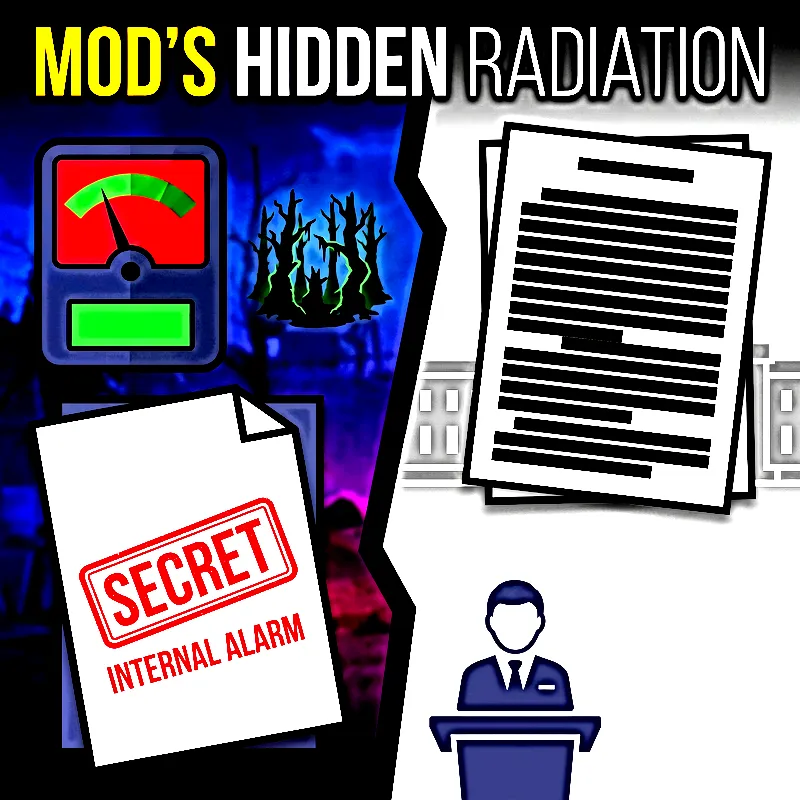
The documentary record supports a narrow but important conclusion: the MoD publicly minimized the incident, while some internal correspondence treated the radiation figure as at least potentially anomalous and unresolved. An early internal MoD note treated the radiation claim as potentially elevated relative to background, but the department later emphasized that no formal radiological assessment existed.
Colonel Charles Halt's 13 January 1981 memorandum recorded a physical-trace claim of radiation associated with the landing-site indentations, stating that beta/gamma readings of 0.1 milliroentgens were recorded in the three depressions and near the center of the triangle, with 0.05–0.07 readings on the side of a nearby tree facing the depressions.
The strongest internal MoD documentation publicly surfaced to date does not show a formal hazard finding, but it does show that at least one early internal MoD loose minute treated Halt's 0.1 value as apparently above expected background, stating that it "seems significantly higher than the average background of about 0.015," while another internal note said DI55 could offer no explanation for the phenomena.
By contrast, the MoD's public line in Parliament was repeatedly dismissive: in 1996 it said the Halt report contained "nothing of defence significance"; in 1997 it said there was "no record of any official assessment" of the readings; and in 2001 it said there was no reason to investigate because nothing of defence significance had occurred.
Measurement Discrepancies and Hardware Limitations
| Measurement issue | Documentary record detail::Impact on Analysis |
|---|---|
| Meter units | AN/PDR-27 ranges are calibrated in `mR/hr`.::Suggests Halt's memo omitted 'per hour' rather than recording a total accumulated dose. |
| MoD interpretation | Internal minute assumed Halt's `0.1` was 'per hour'::Internal analysts understood the hardware constraints and still noted the anomaly. |
| Tape-era readings | Published tape analysis says real-time readings were 'minor,' around `0.03–0.04 mR/h`::Memo figure and tape discussion are not a perfect match. The rounded `0.1` should not be treated as a continuous steady reading. |
Internal MoD papers vs Public Dismissal
A published transcription of the released MoD file states that on 23 February 1981 R. C. Horscroft of ADI/DI52 wrote a loose minute to C. P. Comper at DI55a saying that DI52, like DI55, did not know any serious explanation for the phenomena described in the Halt report.
The transcript of the same minute further says that the variation in local background would not normally be expected to exceed about a factor of two, though it might be greater for specific reasons, and that the wording of the U.S. report suggested 0.1 mr was greater than the Americans expected. A follow-up note from DI55, dated 2 March 1981 said that after canvassing DSTI, "DI55 cannot offer any explanation for the phenomena."
Those internal comments are the clearest documentary basis for saying that MoD staff did, internally, acknowledge the possibility that Halt's reading was above expected background.
Public MoD Dismissals
| Public MoD statement | Public position::Date |
|---|---|
| Commons answer | Halt report contained 'nothing of defence significance' |
| no further action. | 24 Jul 1996 |
| Lords answer | No record of any official assessment of the radiation readings.::14 Oct 1997 |
| Lords answer | No reason to investigate |
| nothing of defence significance occurred. | 30 Jan 2001 |
| Lords answer | Only USAF material held was Halt memo |
| no further MoD questions recorded. | 16 Oct 2001 |
Assessment of the radiation-evidence question
If the question is whether there is documentary support for saying that the MoD internally noticed an elevated radiation figure at Rendlesham, the answer is yes: the internal DI52 minute treated Halt's 0.1 value as apparently above a typical background figure of about 0.015, and DI55 said it had no explanation for the phenomena.
If the question is whether the MoD formally concluded that hazardous radiation exposure had occurred, the available public record does not show that; the official parliamentary answer in 1997 was that there was "no record of any official assessment" of Halt's readings.
If the question is whether the MoD's public dismissals are in tension with its internal paperwork, the answer is also yes: an internal loose minute said the reading "seems significantly higher" than expected background, while the public MoD line was that the case had no defence significance and warranted no further action or investigation.