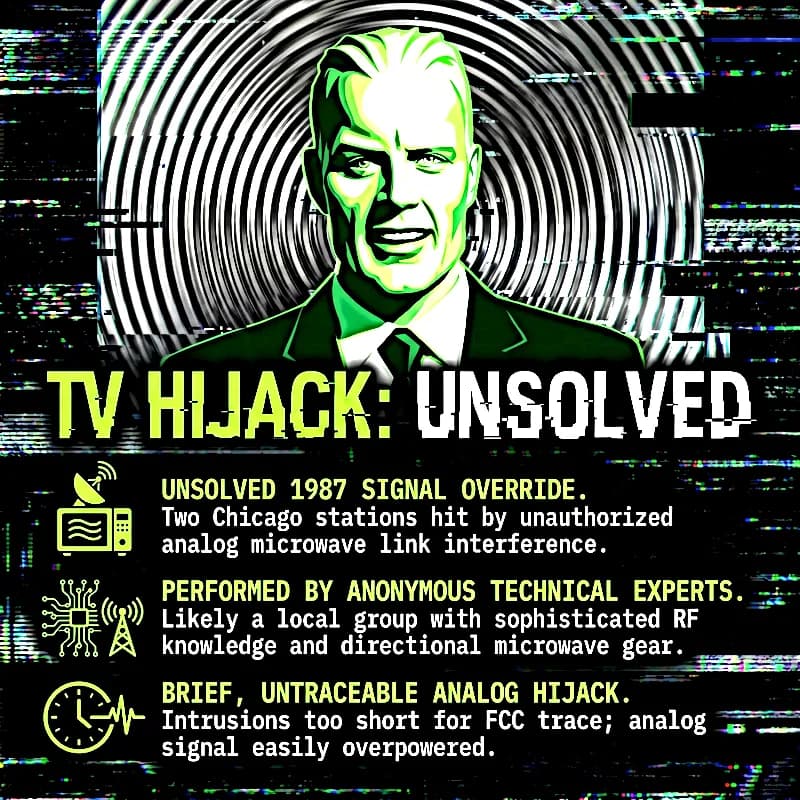
The 1987 Max Headroom Broadcast Hijacking
Bottom line
The public record supports a narrow, technically specific explanation for the 1987 Max Headroom incident: two Chicago television stations were hit by short, unauthorized overrides of their analog studio-to-transmitter microwave links on the night of November 22, 1987.
The released evidence does not support the idea that the perpetrators penetrated either station's internal production systems; instead, contemporary engineers, later FCC investigators, and surviving FBI paperwork all point toward a microwave-path interference or overpowering event.
No publicly released federal record names the perpetrators, and no one was publicly charged.
The strongest inference from the available evidence is that the stunt was carried out by a small local group with real broadcast or RF know-how, probably using directional microwave equipment and a pre-recorded performance tape, but that inference remains just that—an inference, not a proven identification.
Incident Facts
Location
Chicago, IL
Date
November 22, 1987
Stations Affected
WGN-TV, WTTW
Method
Microwave STL Jamming
Investigation Conclusions
Analog Jamming Proven
4
Technical Expertise Evident
3
Internal Breach
0
Perpetrators Identified
0
The Intrusions
| Broadcast | Approximate time::Duration reported in sources::What viewers saw and how the station responded |
|---|---|
| WGN-TV news interruption | About 9:14 p.m.::About 25–30 seconds::A masked Max Headroom impersonator appeared in front of a rotating corrugated-metal backdrop with buzzing or static-like audio |
| WGN engineers broke the intrusion by changing the transmission path or frequency feeding the transmitter, after which Roan came back on air and ad-libbed that he was as confused as viewers were. | - |
| WTTW interruption during Doctor Who | About 11:15–11:20 p.m.::About 82–90 seconds::The same masked character reappeared, this time with garbled audio and a much longer performance |
| WTTW staff said they could not regain control before the pirates stopped on their own. | - |
What happened on the air
The first interruption cut into a sportscast delivered by Dan Roan, and the second hit WTTW during a rerun of Doctor Who; the legitimate transmission paths ran to transmitters atop the John Hancock Center and the Sears Tower, respectively.
The exact durations and minute marks vary modestly across contemporary and retrospective sources, but the sequence is stable: WGN was hit first, WTTW roughly two hours later, and WTTW suffered the longer and more elaborate intrusion.
A contemporary viewer quoted in the Chicago Sun-Times said the WGN material appeared to be the opening portion of the same video later seen in fuller form on WTTW, and later WTTW reporting similarly treated WGN as the shorter interruption and WTTW as the completed hit.
What the pirate transmission actually contained
The WTTW audio was never fully clear, and that ambiguity matters to any serious analysis.
Contemporary WTTW and Sun-Times accounts described much of the speech as nearly unintelligible, while later reconstructions by reporters and hobbyists agreed on several recurring references but not on every line.
One of the few names that comes through consistently is Chuck Swirsky, a Chicago sportscaster at the time, whose name appears to have been used in a taunt.
| Element of the performance | What can be said with confidence |
|---|---|
| Opening visual setup | The performer wore a Max Headroom mask and suit and stood before a spinning corrugated-metal backdrop meant to mimic the character's computer-generated background. |
| Taunts at local media figures | The garbled speech included an insult about a "nerd" and a reference to Chuck Swirsky; later audio reconstructions broadly agree on that point even if they differ on exact wording. |
| Ad and pop-culture references | The performer held up or threw a Pepsi can while saying "Catch the wave," apparently spoofing Max Headroom's then-recent Coca-Cola ads, and also hummed or referenced Clutch Cargo. |
| Dig at WGN/Tribune identity | The speech included a line about a "giant masterpiece" for "world's greatest newspaper" nerds, which later commentators tied to WGN's long-standing association with the Chicago Tribune slogan "World's Greatest Newspaper." |
| Crude finale | The performance ended with exposed buttocks and an accomplice spanking the performer with a fly swatter, which is why contemporary press treated the act as not just illegal but potentially obscene. |
The most defensible way to describe the content is that it was locally referential, intentionally absurd, and only partly intelligible, not that it conveyed a coherent manifesto.
That reading is strengthened by the combination of Chicago-specific jabs, commodity-brand parody, oddball props, and a finale staged more like an off-color prank tape than a political communiqué.
How the hijack was technically possible in 1987
The key technical fact is that local television stations of the era commonly sent their program feed from studio to transmitter over a microwave studio-to-transmitter link, and the surviving evidence shows investigators believed those links were what got overridden.
Former FCC investigator Jim Higgins summarized the basic mechanism very simply years later: if an attacker's signal is stronger than the intended signal at the transmitter end, the attacker's signal goes out instead.
That same mechanical logic appears in the surviving FBI paperwork, which explicitly labeled the matter "MAX HEADROOM INCIDENT MICROWAVE JAMMING."
Contemporary reporting placed WGN's studio at 2501 W. Bradley and WTTW's studio at 5400 N. St. Louis, with their transmitters on the Hancock and Sears towers downtown, and engineers speculated that the pirate operated from somewhere on the North or Northwest Side between those studios and the downtown receivers.
Later reporting based on interviews with former FCC investigator Michael Marcus reached the same broad conclusion: a high-rise roof or apartment with line-of-sight to the receiving end of the STL path could have been enough if the pirates had a strong directional microwave signal and knew where to aim it.
WGN was able to recover first because an engineer changed the path or frequency feeding the Hancock transmitter and thereby broke the pirate's lock on the receiver.
WTTW could not do the same in time because, according to station personnel, there was no engineer on duty at the tower that hour, and one former WTTW engineering chief later said the pirates had such complete control of the path that staff could not even turn the transmitter off until the intrusion ended.
On equipment, the public record is imprecise and even contradictory.
A contemporary Chicago Sun-Times report quoted WGN engineering director Robert Strutzel saying the room for error was very small and that the equipment involved would have been sophisticated microwave gear at high power, estimating roughly $25,000 and saying it could fit in "a few suitcases" or be rented.
A Chicago Tribune report, by contrast, printed a far higher rough estimate—$400,000 to $600,000—for transmitters with that level of power, showing that even at the time there was no single agreed public estimate of the hardware burden.
Marcus later said the gear may not have been especially exotic or enormous, estimating that used equipment and a dish antenna might have been obtainable for around $10,000 rather than the much larger numbers circulating right after the stunt.
WTTW engineering chief Larry Ocher later described the likely setup as something like portable electronic-news-gathering microwave gear with a parabolic antenna aimed at Sears Tower.
The method also belonged to a particular technological moment.
Ars Technica's anniversary coverage summarized the consensus from broadcast engineers by noting that the hack was made possible by the analog television technology of the day, and the FCC notes that full-power U.S. stations ended analog over-the-air broadcasting on June 12, 2009.
That does not mean modern signal interference is impossible, but it does mean that this exact style of analog STL hijack belongs to a more vulnerable broadcast architecture than the one U.S. television uses now.
What the FCC and FBI actually did
WTTW personnel said the station's engineers were trying to understand the incident the next morning, and a later Criminal interview with Al Skierkiewicz stated that by about 9 a.m. the station had already sent its first complaint to the FCC.
Both the FCC and the FBI investigated.
Contemporary press accounts show federal officials immediately treated the matter as a serious violation of federal law, although the publicly quoted penalty exposure was inconsistent.
The Chicago Tribune tied the offense to the generic Communications Act penalty structure, which today still appears in 47 U.S.C. §§ 301 and 501 as unlicensed radio transmission and general criminal penalties, including up to a $10,000 fine and up to one year for a first offense under § 501 when no more specific penalty applies.
The Chicago Sun-Times, however, quoted an FCC spokeswoman saying those involved could face up to $100,000 in fines and a year in jail, and possibly additional federal obscenity charges.
The safest conclusion is therefore that federal authorities conveyed strong criminal exposure to the press, but the public reporting was not fully consistent about the exact charging theory or fine ceiling.
The surviving federal file
The most important documentary development in recent years is the 2023 FBI FOIA release, which confirms that the Bureau still had responsive material under the subject line "Max Headroom Incident (November 22, 1987)."
The FBI's December 13, 2023 response letter said that the Bureau was releasing previously processed pages, that additional responsive records exist, and that some potentially responsive records had been transferred to the National Archives and Records Administration or destroyed under records schedules.
That letter matters because it means the public FBI file is not necessarily complete, and it also explains why some gaps in the federal paper trail may never be filled by FBI holdings alone.
The released technical report is dated December 7, 1988, which shows the case remained active in some form well beyond the initial November 1987 news cycle.
That report states that the FBI examined a Maxell P341 3/4-inch U-matic tape, delivered by an FCC electronics technician on August 10, 1988, and marked in part "Max Headroom 2/17/88."
The FBI used an AIDI CT1500 image recorder to make six 6-by-8-inch dry-silver prints from the tape, but the report says enhancement attempts were negative and notes that the tape was at least a second-generation recording, making a first-generation original "paramount" for better analysis.
In plain terms, the Bureau tried to squeeze visual clues from imperfect copied video, and the copy quality limited what could be learned.
Why the case stalled
One reason the case stayed cold is that the intrusions were too short for the sort of routine monitoring contemporary FCC staff described to reporters.
The Sun-Times quoted an FCC spokesman saying the Commission used monitoring equipment to trace illegal broadcasts, but that this "generally requires an interruption of several minutes," whereas the WGN hit lasted only about 25 seconds and the WTTW hit a minute and a half or less depending on the source.
Another reason is operational: WTTW staff said their control room could do little before the pirates quit on their own, and Ocher later described the event as a complete temporary loss of control over the transmission chain.
A third reason is evidentiary weakness.
Marcus later said the video itself was effectively the main evidentiary clue, especially the rolling industrial-looking backdrop, but he also said the investigation lost momentum because the case lacked evidence, lacked manpower, and did not carry the same public-safety weight as higher-stakes signal interference cases.
Which perpetrator theories fit the evidence best
No publicly released record proves any named suspect.
That means the right way to assess suspect theories is comparative: which theory best matches the method, content, and surviving investigative record, and which theories collapse under closer sourcing.
| Theory | What supports it | What weakens it | Assessment |
|---|---|---|---|
| Disgruntled station insider or recently laid-off engineer | The stunt required real RF knowledge; the pirate used Chicago-broadcast in-jokes; Jim Higgins recalled hearing that recent layoffs may have been discussed as a possible motive; WTTW engineer Larry Ocher later said he thought it had to be an inside job by someone from the TV engineering world. | Marcus also said it did not have to be a station insider specifically and that other technically capable people could have figured it out; no released FBI page names any insider suspect. | Plausible as a skill-set theory, unproven as an identity theory. |
| Chicago hacker/BBS circle, including the later "J and K" brothers story | Vice and WBUR both document an active Chicago BBS/hacker milieu around the case; the "J and K" story became one of the most discussed later theories. | WBUR reported that the original online theorist later said he no longer considered J and K suspects and would not release his claimed new evidence publicly. | Culturally plausible, publicly uncorroborated. |
| Eric Fournier / "Shaye Saint John" style-performance theory | The theory persisted because some viewers saw stylistic similarities between the Max Headroom video and Fournier's later grotesque performance style. | Vice contacted former associates who rejected the theory, with one former bandmate explicitly saying Fournier lacked the needed editing, broadcast access, and Chicago connections for the act as usually described. | Weak on sourced evidence. |
| A small ad hoc prank crew with microwave gear, not necessarily station employees | WTTW's Al Skierkiewicz said the culprit likely needed a mix of broadcast, satellite, or ham experience and probably more than one person; Ocher described a portable parabolic setup; the on-screen video also visibly involves more than one participant. | This theory explains how better than who. | Best fit to the public evidence, but still anonymous. |
The insider theory persists for good reasons: the jokes were so specifically tuned to local broadcasting culture that they feel less like random anti-TV vandalism and more like a prank from people who knew the milieu.
At the same time, "inside" should not be overstated.
The technical record supports "someone with broadcast-adjacent expertise" more firmly than it supports "someone employed by WGN or WTTW."
Historical judgment
The most supportable overall conclusion is that the Max Headroom incident was a local, analog-era RF intrusion staged by more than one technically capable prankster, using a pre-recorded performance tape and a directional microwave setup to overpower vulnerable studio-to-transmitter links for very short windows.
Calling it a "hack" is culturally understandable, but the surviving records point more specifically to signal override or microwave jamming than to a breach of internal studio controls or a computer-network compromise.
The case remains unsolved not because there is hidden proof of an exotic culprit in the released record, but because the incident was fleeting, tracing infrastructure was limited, evidence quality was poor, and the surviving federal file is incomplete.
If prosecutors had relied on the ordinary Communications Act route for unlicensed radio transmission, the statutory framework was rooted in 47 U.S.C. §§ 301 and 501, and any ordinary non-capital federal prosecution would also have been subject to the general five-year federal limitations period in 18 U.S.C. § 3282.
That helps explain why modern discussion of the case is almost entirely historical and interpretive rather than legal.
The archival future of the case is also limited.
Because the FBI has already indicated that some additional responsive records were transferred or destroyed, the odds of a fully satisfying documentary solution are uncertain, and the likeliest path to a definitive answer may still be what Jim Higgins suggested years later: a confession or credible admission from someone who was there.
Sources
- Chicago Tribune 1987-11-24, https://cuttingsarchive.org/images/6/6d/1987-11-24_Chicago_Tribune.pdf
- 2 channels interrupted to the Max, https://cuttingsarchive.org/index.php/2_channels_interrupted_to_the_Max
- To The Max Headroom | WBUR, https://www.wbur.org/endlessthread/2019/11/22/to-the-max-headroom
- 30 Years Later, Notorious Max Headroom Incident Remains Mystery, https://news.wttw.com/2017/11/21/30-years-later-notorious-max-headroom-incident-remains-mystery
- The Max Headroom Hacker | VICE, https://www.vice.com/en/article/headroom-hacker/
- MuckRock FOIA Request File 1, https://cdn.muckrock.com/foia_files/2023/12/13/E1614a7be853f0bba1e9cff241597ce2ed96fbb1447474ad4ac_Q206652_R432036_D165128834.pdf
- MuckRock FOIA Request File 2, https://cdn.muckrock.com/foia_files/2023/12/11/E1614a7be853f0bba1e9cff241597ce2ed96fbb1447474ad4ac_Q206652_D165128966.pdf
- MuckRock FOIA Request File 3, https://cdn.muckrock.com/foia_files/2023/12/13/E1614a7be853f0bba1e9cff241597ce2ed96fbb1447474ad4ac_Q206652_R432036_D165128967.pdf
- The Max Headroom Incident Transcript | This is Criminal, https://thisiscriminal.com/wp-content/uploads/2020/11/Episode-153-The-Max-Headroom-Incident.pdf
- Thirty years later, Max Headroom TV pirate remains at large | Ars Technica, https://arstechnica.com/information-technology/2017/11/thirty-years-later-max-headroom-tv-pirate-remains-at-large/
- 47 U.S. Code § 301, https://www.law.cornell.edu/uscode/text/47/301
- 18 U.S. Code § 3282, https://www.law.cornell.edu/uscode/text/18/3282