Strategic Signal Analysis of Russian Military Shortwave Station UVB-76
The high-frequency (HF) electromagnetic spectrum has long been a domain of strategic competition, serving as a resilient medium for long-range communications that bypass the vulnerabilities of satellite and fiber-optic infrastructures. Among the most enduring enigmas within this spectrum is the station known as UVB-76, colloquially referred to as The Buzzer [1]Ghost Radio Station: UVB-76 – The Buzzer's Enigma - Yücel Kültür Vakfı https://www.yucelkulturvakfi.org/hayalet-radyo-istasyonu-uvb76. Operating primarily on the frequency of 4625 kHz, this station has broadcast a near-continuous, monotonous tone for over four decades, punctuated only by rare, coded voice transmissions [2]UVB-76 (The Buzzer) - HFUnderground https://www.hfunderground.com/wiki/index.php/UVB-76_(The_Buzzer. The station's persistence through the collapse of the Soviet Union and the subsequent restructuring of the Russian Federation's military apparatus suggests a function of vital national security importance. While public fascination often gravitates toward sensationalist theories such as the Dead Hand nuclear trigger, empirical signal analysis and geographical triangulation point toward a more practical role as a sophisticated command, control, and coordination (C3) network for the Western Military District of Russia [3]FAQ ' Other information ' The Buzzer ' Priyom.org https://priyom.org/military-stations/russia/the-buzzer/other-information/faq.
Station Snapshot
Frequency
4625 kHz
Primary Transmitter
Molniya-2M
Estimated Power
10 kW
Antenna Height
20 meters
Transmission Hardware (kW)
Molniya-2M
10
Molniya-3
10
Viaz-M2
2.5
Historical Era and Broadcast Evolution
| Historical Era | Dominant Signal Characteristic::Primary Identification::Operational Context |
|---|---|
| Late 1970s – 1990 | Repeating two-second pip::Unknown (likely numerical)::Cold War Soviet Military Command |
| 1990 – 2010 | 0.8-second buzz tone::UZB-76 (Mistranscribed as UVB-76)::Moscow Military District C2 |
| 2010 – 2015 | 1.2-second buzz tone::MDZhB::Western Military District Consolidation |
| 2015 – 2020 | Continuous buzz with interruptions::ZhUOZ, ANVF::Hybrid Warfare & Regional Tension |
| 2020 – Present | Continuous buzz with frequency parallel::NZhTI::Ukraine Conflict & NATO Posturing |
Historical Trajectory and Broadcast Evolution
The genesis of UVB-76 is rooted in the late Cold War era, a period characterized by the Soviet Union's expansion of clandestine signaling networks. Although some reports suggest the station may have been active as early as 1973, consensus among most radio historians and signal monitors places the definitive start of its broadcasting in either 1976 or 1982 [1]Ghost Radio Station: UVB-76 – The Buzzer's Enigma - Yücel Kültür Vakfı https://www.yucelkulturvakfi.org/hayalet-radyo-istasyonu-uvb76, [4]UVB-76 | Military Wiki - Fandom https://military-history.fandom.com/wiki/UVB-76. In its initial phase, the station did not employ the characteristic buzzing sound that earned it its nickname. Instead, early recordings from 1982 capture a repeating, two-second "pip" or beep [2]UVB-76 (The Buzzer) - HFUnderground https://www.hfunderground.com/wiki/index.php/UVB-76_(The_Buzzer, [2]UVB-76 (The Buzzer) - HFUnderground https://www.hfunderground.com/wiki/index.php/UVB-76_(The_Buzzer. This sonic signature remained largely unchanged for nearly a decade, serving as a consistent marker for the 4625 kHz frequency within the Soviet military's communication hierarchy.
The transition to the "Buzzer" tone occurred in early 1990, a time of immense political upheaval within the Soviet Union [2]UVB-76 (The Buzzer) - HFUnderground https://www.hfunderground.com/wiki/index.php/UVB-76_(The_Buzzer. This shift in signal characteristics coincided with broader military reorganizations that preceded the state's eventual dissolution in 1991. Following the collapse of the USSR, many Soviet-era infrastructures were abandoned or allowed to rust into obsolescence; however, UVB-76 not only survived but appeared to intensify its operational activity during the transition to the Russian Federation [5]Stay tuned Russian UVB-76 radio station, rumored to be run by the https://meduza.io/en/feature/2024/12/17/stay-tuned.
Throughout its history, the station has demonstrated a remarkable ability to adapt its technical parameters. On January 16, 2003, the station briefly altered its tone to a higher-pitched, longer-duration signal at a rate of approximately 20 tones per minute before reverting to its standard pattern [2]UVB-76 (The Buzzer) - HFUnderground https://www.hfunderground.com/wiki/index.php/UVB-76_(The_Buzzer, [4]UVB-76 | Military Wiki - Fandom https://military-history.fandom.com/wiki/UVB-76. Such anomalies suggest periodic technical testing or recalibration of the transmitter hardware by on-duty personnel.
Technical Infrastructure and Signal Propagation
The resilience of UVB-76 is a direct result of its robust technical architecture, which is designed to provide reliable communication over vast distances without reliance on modern network infrastructure. The station broadcasts primarily on 4625 kHz using Upper Sideband (USB) modulation, although it has historically utilized full double-sideband AM (A3E) [1]Ghost Radio Station: UVB-76 – The Buzzer's Enigma - Yücel Kültür Vakfı https://www.yucelkulturvakfi.org/hayalet-radyo-istasyonu-uvb76, [6]UVB-76 - Wikipedia https://en.wikipedia.org/wiki/UVB-76. The choice of frequency is strategically significant; the 4-5 MHz range is highly effective for Near Vertical Incidence Skywave (NVIS) propagation. NVIS allows signals to be reflected nearly vertically from the ionosphere, creating a "dome" of coverage that blankets a large area (typically up to 1,000 km) without the "skip zone" dead spots common in standard HF communications [9](PDF) The Doomsday Pulse: UVB-76, Strategic Ambiguity, and the https://www.researchgate.net/publication/393255059_The_Doomsday_Pulse_UVB-76_Strategic_Ambiguity_and_the_Semiotics_of_Apocalypse.
Transmitter Hardware and Facilities
The hardware responsible for the Buzzer's signal is standardized Russian military equipment. The station utilizes Molniya-2M (PKM-15) and Molniya-3 (PKM-20) transmitters [2]UVB-76 (The Buzzer) - HFUnderground https://www.hfunderground.com/wiki/index.php/UVB-76_(The_Buzzer, [10]Radio Station UVB-76 - Wikipedia, the free encyclopedia http://taggedwiki.zubiaga.org/new_content/0857f22d8853810e13a263d4cc64c215. The Molniya-3 system is part of a larger family of communication technologies developed for both orbital and terrestrial segments [11]Molniya-3 http://www.astronautix.com/m/molniya-3.html. These transmitters typically provide a power output of approximately 10 kW, while a Viaz-M2 system serves as a 2.5 kW backup [2]UVB-76 (The Buzzer) - HFUnderground https://www.hfunderground.com/wiki/index.php/UVB-76_(The_Buzzer.
The antenna array is identified as a Horizontal dipole VGDSh (Nadenenko), suspended at a height of approximately 20 meters [2]UVB-76 (The Buzzer) - HFUnderground https://www.hfunderground.com/wiki/index.php/UVB-76_(The_Buzzer, [10]Radio Station UVB-76 - Wikipedia, the free encyclopedia http://taggedwiki.zubiaga.org/new_content/0857f22d8853810e13a263d4cc64c215. This configuration is optimized for regional NVIS propagation, ensuring that military units across the Western Military District can receive the signal regardless of terrain obstacles. Furthermore, maintenance schedules appear to be fixed, with transmissions often operating at lower power between 07:00 and 07:50 GMT to allow for technical adjustments [2]UVB-76 (The Buzzer) - HFUnderground https://www.hfunderground.com/wiki/index.php/UVB-76_(The_Buzzer.
The Mechanics of the Buzz
The signal itself consists of a buzzing tone repeating at a rate of approximately 21 to 34 times per minute [1]Ghost Radio Station: UVB-76 – The Buzzer's Enigma - Yücel Kültür Vakfı https://www.yucelkulturvakfi.org/hayalet-radyo-istasyonu-uvb76, [12]Russia's "Doomsday Radio" UVB-76 Goes Silent After Drone Strike https://united24media.com/latest-news/russias-doomsday-radio-uvb-76-goes-silent-after-drone-strike-hits-power-grid-13436. A critical observation made by listeners is that the buzz is likely not directly modulated but is instead recorded by an active, live microphone placed in front of a mechanical buzzing device [2]UVB-76 (The Buzzer) - HFUnderground https://www.hfunderground.com/wiki/index.php/UVB-76_(The_Buzzer, [8]The Buzzer (ZhUOZ MDZhB UZB76) - Signal Identification Wiki https://www.sigidwiki.com/wiki/The_Buzzer_(ZhUOZ_MDZhB_UZB76. This is supported by numerous instances of background noise, including conversations between operators, the sound of shuffling feet, and the rhythmic clicking of the mechanical device itself [1]Ghost Radio Station: UVB-76 – The Buzzer's Enigma - Yücel Kültür Vakfı https://www.yucelkulturvakfi.org/hayalet-radyo-istasyonu-uvb76, [13]UVB-76 - QSL.net https://www.qsl.net/ct2fzi/uvb/uvb-76.html. During a malfunction in 2016, a person was heard striking the device to restart it, further confirming its mechanical nature [1]Ghost Radio Station: UVB-76 – The Buzzer's Enigma - Yücel Kültür Vakfı https://www.yucelkulturvakfi.org/hayalet-radyo-istasyonu-uvb76.
Geographic Shift and Military Reorganization
For decades, the transmitter for UVB-76 was located near the small town of Povarovo, approximately 19 miles (40 km) northwest of Moscow [14]The Buzzer: The Strange History Behind Russia's UVB-76 - SlashGear https://www.slashgear.com/1425407/uvb-76-strange-history-radio/. This site, identified as the 143rd Communication Hub, served as a critical node for the former Moscow Military District [7]The Buzzer ' Priyom.org - Military Stations https://priyom.org/military-stations/russia/the-buzzer. The facility was situated near the village of Lozhki and was characterized by a series of radio towers and underground bunkers [10]Radio Station UVB-76 - Wikipedia, the free encyclopedia http://taggedwiki.zubiaga.org/new_content/0857f22d8853810e13a263d4cc64c215.
In 2010, the Russian Federation initiated a massive military district reorganization, consolidating several districts into a unified Western Military District [3]FAQ ' Other information ' The Buzzer ' Priyom.org https://priyom.org/military-stations/russia/the-buzzer/other-information/faq. Coincident with this reorganization, the station's broadcast location moved. Triangulation data and subsequent explorations revealed that the Povarovo site was abandoned, and transmissions were redistributed to at least two separate sites to ensure redundancy and resilience [3]FAQ ' Other information ' The Buzzer ' Priyom.org https://priyom.org/military-stations/russia/the-buzzer/other-information/faq, [12]Russia's "Doomsday Radio" UVB-76 Goes Silent After Drone Strike https://united24media.com/latest-news/russias-doomsday-radio-uvb-76-goes-silent-after-drone-strike-hits-power-grid-13436.
Current Transmission Sites
The network currently utilizes multiple hubs for its 4625 kHz transmissions. The 60th Communication Hub, located in Kerro near Saint Petersburg, is believed to be the primary source, utilizing the callsign Vulcan [3]FAQ ' Other information ' The Buzzer ' Priyom.org https://priyom.org/military-stations/russia/the-buzzer/other-information/faq. A second site is located in Naro-Fominsk, near Moscow [3]FAQ ' Other information ' The Buzzer ' Priyom.org https://priyom.org/military-stations/russia/the-buzzer/other-information/faq. Other identified communication hubs linked to the network include Iskra (the 69th Communication Hub) and Irtysh [7]The Buzzer ' Priyom.org - Military Stations https://priyom.org/military-stations/russia/the-buzzer.
The move from Povarovo was signaled by an unprecedented period of instability in August 2010, when the station went silent for 24 hours on August 25 before resuming with a series of technical anomalies and the eventual broadcast of the new MDZhB callsign on September 7 [14]The Buzzer: The Strange History Behind Russia's UVB-76 - SlashGear https://www.slashgear.com/1425407/uvb-76-strange-history-radio/, [13]UVB-76 - QSL.net https://www.qsl.net/ct2fzi/uvb/uvb-76.html. Urban explorers who entered the abandoned Povarovo facility in 2011 discovered logbooks confirming its role as a military communication site for 4625 kHz, validating the triangulation efforts of the amateur radio community [4]UVB-76 | Military Wiki - Fandom https://military-history.fandom.com/wiki/UVB-76.
Structural Analysis of Voice Messages
UVB-76 is fundamentally a numbers station, a classification of shortwave radio that broadcasts coded messages intended for intelligence officers or military units [13]UVB-76 - QSL.net https://www.qsl.net/ct2fzi/uvb/uvb-76.html. These messages are typically broadcast by live male and female voices and follow rigid formats that suggest they are processed using one-time pads (OTP)—a method of encryption that is mathematically unbreakable if the key is never reused [5]Stay tuned Russian UVB-76 radio station, rumored to be run by the https://meduza.io/en/feature/2024/12/17/stay-tuned.
Standardized Message Formats
The station utilizes three primary message formats, each serving a different urgency or operational scope.
- Monolith: These are the most common and represent urgent command category signals [3]FAQ ' Other information ' The Buzzer ' Priyom.org https://priyom.org/military-stations/russia/the-buzzer/other-information/faq. A Monolith message consists of a callsign (read twice), a five-digit ID group, and message blocks consisting of a codeword followed by eight digits [6]UVB-76 - Wikipedia https://en.wikipedia.org/wiki/UVB-76. For example, the 1997 broadcast stated: "Ya UVB-76, Ya UVB-76. 180 08 BROMAL 74 27 99 14" [4]UVB-76 | Military Wiki - Fandom https://military-history.fandom.com/wiki/UVB-76.
- Uzor: A format consisting of callsigns followed by message blocks with a codeword and four digits [6]UVB-76 - Wikipedia https://en.wikipedia.org/wiki/UVB-76.
- Komanda: General command messages that may contain specific instructions or operational codes [6]UVB-76 - Wikipedia https://en.wikipedia.org/wiki/UVB-76.
| Element | Component Structure | Purpose |
|---|---|---|
| Callsign | Four symbols (letters/digits) [6]UVB-76 - Wikipedia https://en.wikipedia.org/wiki/UVB-76 | Identification of recipient groups |
| ID Group | Five digits [6]UVB-76 - Wikipedia https://en.wikipedia.org/wiki/UVB-76 | Message categorization or sequence |
| Codeword | Phonetic Russian names/words [4]UVB-76 | Military Wiki - Fandom https://military-history.fandom.com/wiki/UVB-76 | Tactical command or "Monolyth" trigger |
| Numerical Data | 4 to 8 digits [6]UVB-76 - Wikipedia https://en.wikipedia.org/wiki/UVB-76 | Payload information or coordinates |
The first voice transmission recorded in December 1997 confirmed the station's identification to the world: "Ya UVB-76... 180 08 BROMAL..." [15]The 10 Most Notable UVB‑76 Cases | Sinapse Diária https://sinapsediaria.com/en/uvb-76-notable-cases/. This message not only established the station's name in the public consciousness but also demonstrated its role in transmitting phonetic-based coded instructions.
Prevailing Theories: The "Dead Hand" vs. Active C2
The purpose of UVB-76 is one of the most debated topics in signal intelligence. Theories generally fall into two categories: the sensational "Doomsday" trigger and the utilitarian military communication network.
The Dead Hand (Perimeter System) Hypothesis
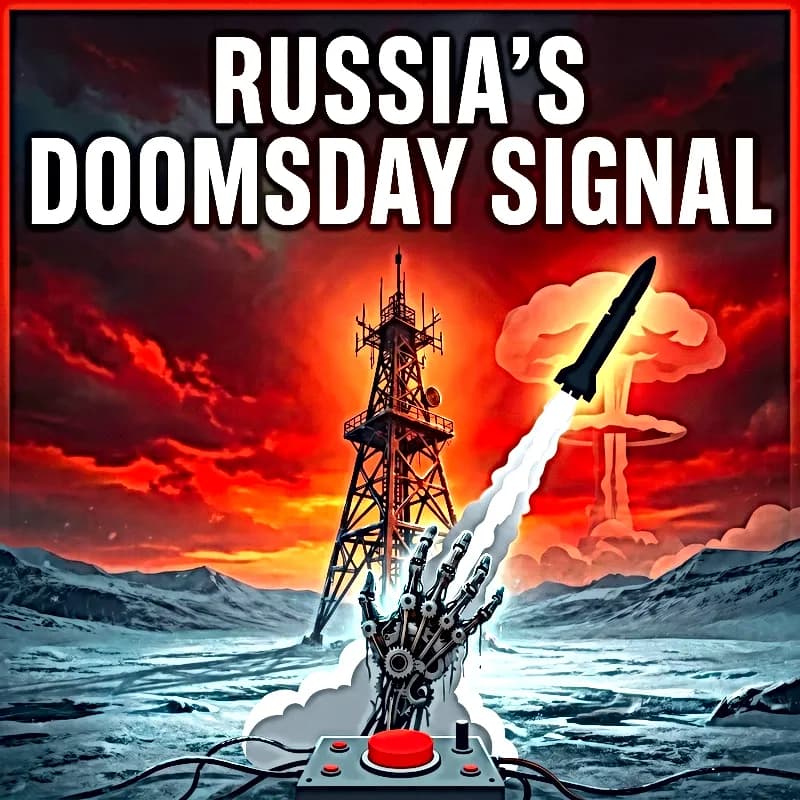
The Dead Hand (or Perimetr) theory posits that UVB-76 is a fail-deadly switch for Russia's nuclear arsenal [1]Ghost Radio Station: UVB-76 – The Buzzer's Enigma - Yücel Kültür Vakfı https://www.yucelkulturvakfi.org/hayalet-radyo-istasyonu-uvb76. According to this hypothesis, the constant buzzing acts as a "heartbeat" signal. Should a nuclear first strike annihilate Russian leadership and destroy Moscow, the signal would stop [9](PDF) The Doomsday Pulse: UVB-76, Strategic Ambiguity, and the https://www.researchgate.net/publication/393255059_The_Doomsday_Pulse_UVB-76_Strategic_Ambiguity_and_the_Semiotics_of_Apocalypse. The absence of the signal would then trigger an automatic launch of a command missile, which would broadcast launch codes to silos and submarines across the country [16]Dead Hand - Wikipedia https://en.wikipedia.org/wiki/Dead_Hand, [5]Stay tuned Russian UVB-76 radio station, rumored to be run by the https://meduza.io/en/feature/2024/12/17/stay-tuned.
The real Perimeter system was developed by the USSR in the 1970s and 1980s [9](PDF) The Doomsday Pulse: UVB-76, Strategic Ambiguity, and the https://www.researchgate.net/publication/393255059_The_Doomsday_Pulse_UVB-76_Strategic_Ambiguity_and_the_Semiotics_of_Apocalypse. It was designed as a backup communication system in case the "Kazbek" command system was destroyed [16]Dead Hand - Wikipedia https://en.wikipedia.org/wiki/Dead_Hand. It relies on a variety of sensors, including seismic detectors to measure nuclear blasts and radiation monitors [16]Dead Hand - Wikipedia https://en.wikipedia.org/wiki/Dead_Hand. While Perimeter exists, most experts agree that UVB-76 is not its primary trigger. The station has stopped transmitting many times—including on June 5, 2010, and November 14, 2025—without any retaliatory nuclear response [6]UVB-76 - Wikipedia https://en.wikipedia.org/wiki/UVB-76, [12]Russia's "Doomsday Radio" UVB-76 Goes Silent After Drone Strike https://united24media.com/latest-news/russias-doomsday-radio-uvb-76-goes-silent-after-drone-strike-hits-power-grid-13436.
Active Military Communication Network
The most plausible theory is that UVB-76 is a channel marker and command network for the Western Military District [3]FAQ ' Other information ' The Buzzer ' Priyom.org https://priyom.org/military-stations/russia/the-buzzer/other-information/faq. In this role, the continuous buzzing ensures that the 4625 kHz frequency is occupied and "reserved," preventing other users from claiming it [1]Ghost Radio Station: UVB-76 – The Buzzer's Enigma - Yücel Kültür Vakfı https://www.yucelkulturvakfi.org/hayalet-radyo-istasyonu-uvb76, [4]UVB-76 | Military Wiki - Fandom https://military-history.fandom.com/wiki/UVB-76. The voice messages are then used to relay orders to military units, such as regional commissariats or naval vessels [8]The Buzzer (ZhUOZ MDZhB UZB76) - Signal Identification Wiki https://www.sigidwiki.com/wiki/The_Buzzer_(ZhUOZ_MDZhB_UZB76. The buzzing serves as a constant check that the transmission line is active; if the buzz stops, receiving operators know to look for technical failures [17]UVB-76 - Hacker News https://news.ycombinator.com/item?id=25213713. This theory is supported by the existence of sister stations like "The Pip" and "The Squeaky Wheel," which follow similar patterns on different frequencies [4]UVB-76 | Military Wiki - Fandom https://military-history.fandom.com/wiki/UVB-76.
Anomalous Events and Malfunctions
The "human element" of UVB-76 has been revealed through numerous accidental transmissions and technical malfunctions over the years. These incidents provide a rare glimpse into the mundane reality behind the "Doomsday Radio."
Accidental Human Interactions
On November 11, 2010, the station accidentally transmitted a 30-minute recording of phone conversations [4]UVB-76 | Military Wiki - Fandom https://military-history.fandom.com/wiki/UVB-76. The conversations mentioned a "brigade operative officer on duty" and communication nodes like Debut, Nadezhda, and Vulkan [4]UVB-76 | Military Wiki - Fandom https://military-history.fandom.com/wiki/UVB-76. In 2003, another leak revealed the sound of a ringing phone and two men discussing a delivery and an address, confirming the station was physically connected to a landline network [15]The 10 Most Notable UVB‑76 Cases | Sinapse Diária https://sinapsediaria.com/en/uvb-76-notable-cases/.
Cultural and Geopolitical Interference
The station has also been a target for "radio pirates." In 2011, hijacking incidents involved the broadcast of techno music and sound effects [15]The 10 Most Notable UVB‑76 Cases | Sinapse Diária https://sinapsediaria.com/en/uvb-76-notable-cases/. In January 2022, as Russian forces amassed on the Ukrainian border, pirates "painted" the station's frequency spectrum with images of the "Trollface" meme and played the K-pop song "Gangnam Style" [6]UVB-76 - Wikipedia https://en.wikipedia.org/wiki/UVB-76. The station operators responded by increasing the density of their signal patterns to drown out the interference [6]UVB-76 - Wikipedia https://en.wikipedia.org/wiki/UVB-76.
One of the most famous musical episodes occurred in late August and early September 2010. During the transition to the new transmission sites, listeners heard snippets of Tchaikovsky's Swan Lake [14]The Buzzer: The Strange History Behind Russia's UVB-76 - SlashGear https://www.slashgear.com/1425407/uvb-76-strange-history-radio/. In Russian culture, Swan Lake is historically associated with leadership changes or national crises, as state media often played it during the deaths of Soviet leaders or the 1991 coup [14]The Buzzer: The Strange History Behind Russia's UVB-76 - SlashGear https://www.slashgear.com/1425407/uvb-76-strange-history-radio/. Its broadcast on UVB-76 suggested a moment of high tension or operational instability during the military's reorganization [15]The 10 Most Notable UVB‑76 Cases | Sinapse Diária https://sinapsediaria.com/en/uvb-76-notable-cases/.
Geopolitical Correlation and Recent Activity
The activity levels of UVB-76 often correlate with Russian military maneuvers and international crises, reinforcing the view that it is an active command network.
The 2022 Ukraine Invasion
In the weeks preceding the invasion of Ukraine on February 24, 2022, monitoring groups noted a massive surge in coded messages [5]Stay tuned Russian UVB-76 radio station, rumored to be run by the https://meduza.io/en/feature/2024/12/17/stay-tuned. Codes like "Nyukhostikh" and "Neuderzhimy" (unstoppable) were broadcast on February 22 [5]Stay tuned Russian UVB-76 radio station, rumored to be run by the https://meduza.io/en/feature/2024/12/17/stay-tuned. On February 23, the station transmitted messages including "Chaykhana" (teahouse) [5]Stay tuned Russian UVB-76 radio station, rumored to be run by the https://meduza.io/en/feature/2024/12/17/stay-tuned. Interestingly, on the day the invasion actually began, the station was completely silent, suggesting that all primary mobilization orders had already been delivered [5]Stay tuned Russian UVB-76 radio station, rumored to be run by the https://meduza.io/en/feature/2024/12/17/stay-tuned.
The 2024 record broadcast
On December 11, 2024, UVB-76 performed its most verbose broadcast in history, transmitting 24 messages in a single day between 9:09 a.m. and 5:14 p.m. Moscow time [5]Stay tuned Russian UVB-76 radio station, rumored to be run by the https://meduza.io/en/feature/2024/12/17/stay-tuned.
| Category | Word Examples | Strategic Implication |
|---|---|---|
| Recognized Objects | Bilyard (Billiards), Banderolka (Parcel) [5]Stay tuned Russian UVB-76 radio station, rumored to be run by the https://meduza.io/en/feature/2024/12/17/stay-tuned | Standard Phonetic Library utilization |
| Abstract Concepts | Neuprugiy (Inelastic), Geenna (Gehenna) [5]Stay tuned Russian UVB-76 radio station, rumored to be run by the https://meduza.io/en/feature/2024/12/17/stay-tuned | Potential codeword triggers |
| Nonsensical Strings | Onyerorust, Vtuzotyuk [5]Stay tuned Russian UVB-76 radio station, rumored to be run by the https://meduza.io/en/feature/2024/12/17/stay-tuned | Encryption/Filler complexity |
2025 and 2026: The "Doomsday Radio" Strikes Back
The station's operations have been directly impacted by the ongoing conflict. On November 14, 2025, the station went silent after a drone strike disabled a power substation near one of its transmission points [12]Russia's "Doomsday Radio" UVB-76 Goes Silent After Drone Strike https://united24media.com/latest-news/russias-doomsday-radio-uvb-76-goes-silent-after-drone-strike-hits-power-grid-13436. The outage was confirmed by the Telegram channel UVB-76 Efir, which tracks the station's health [12]Russia's "Doomsday Radio" UVB-76 Goes Silent After Drone Strike https://united24media.com/latest-news/russias-doomsday-radio-uvb-76-goes-silent-after-drone-strike-hits-power-grid-13436.
In March 2026, the station broadcast an alarming message that explicitly mentioned a NATO member: "NZHTI NZHTI 15854 LATVIA 5894 4167" [18]Has Russia's doomsday radio signaled the start of World War III with https://m.economictimes.com/news/international/us/has-russias-doomsday-radio-signaled-the-start-of-world-war-iii-with-its-cryptic-message-targeting-a-nato-country/articleshow/125481685.cms. This mention of Latvia sparked significant concern among global intelligence agencies, as such transmissions have historically preceded military escalations [18]Has Russia's doomsday radio signaled the start of World War III with https://m.economictimes.com/news/international/us/has-russias-doomsday-radio-signaled-the-start-of-world-war-iii-with-its-cryptic-message-targeting-a-nato-country/articleshow/125481685.cms. Other cryptic terms followed, such as "Bolonskiy" and "Galvanizer," which some analysts interpreted as metaphors for the "Iron Curtain" or regional targeting [18]Has Russia's doomsday radio signaled the start of World War III with https://m.economictimes.com/news/international/us/has-russias-doomsday-radio-signaled-the-start-of-world-war-iii-with-its-cryptic-message-targeting-a-nato-country/articleshow/125481685.cms.
Strategic Conclusions and Future Outlook
UVB-76, "The Buzzer," represents a masterpiece of strategic ambiguity [9](PDF) The Doomsday Pulse: UVB-76, Strategic Ambiguity, and the https://www.researchgate.net/publication/393255059_The_Doomsday_Pulse_UVB-76_Strategic_Ambiguity_and_the_Semiotics_of_Apocalypse. By maintaining a continuous, public broadcast that is simultaneously recognizable and incomprehensible, the Russian military achieves several objectives: frequency ownership, a resilient fallback for C2, and a psychological tool of deterrence. While the "Dead Hand" theory lacks firm evidence, the station remains a vital organ of the Russian Western Military District, capable of transmitting unbreakable instructions to units across the European theater.
The station's survival across the Soviet-Russian divide, its expansion in 2010, and its intense activity during the Ukraine invasion of 2022 and the 2026 Latvian incident highlight its enduring relevance. In an age of cyber warfare and satellite jamming, the "low-tech" reliability of 4625 kHz shortwave radio provides a hardened, indispensable channel for Russia's military leadership. As geopolitical tensions continue to fluctuate, the steady buzz of UVB-76 serves as a persistent reminder that the old mechanisms of the Cold War have not been forgotten; they have simply been repurposed for the 21st century.
Sources
- Ghost Radio Station: UVB-76 – The Buzzer's Enigma - Yücel Kültür Vakfı, https://www.yucelkulturvakfi.org/hayalet-radyo-istasyonu-uvb76
- UVB-76 (The Buzzer) - HFUnderground, https://www.hfunderground.com/wiki/index.php/UVB-76_(The_Buzzer)
- FAQ ' Other information ' The Buzzer ' Priyom.org, https://priyom.org/military-stations/russia/the-buzzer/other-information/faq
- UVB-76 | Military Wiki - Fandom, https://military-history.fandom.com/wiki/UVB-76
- Stay tuned Russian UVB-76 radio station, rumored to be run by the ..., https://meduza.io/en/feature/2024/12/17/stay-tuned
- UVB-76 - Wikipedia, https://en.wikipedia.org/wiki/UVB-76
- The Buzzer ' Priyom.org - Military Stations, https://priyom.org/military-stations/russia/the-buzzer
- The Buzzer (ZhUOZ MDZhB UZB76) - Signal Identification Wiki, https://www.sigidwiki.com/wiki/The_Buzzer_(ZhUOZ_MDZhB_UZB76)
- (PDF) The Doomsday Pulse: UVB-76, Strategic Ambiguity, and the ..., https://www.researchgate.net/publication/393255059_The_Doomsday_Pulse_UVB-76_Strategic_Ambiguity_and_the_Semiotics_of_Apocalypse
- Radio Station UVB-76 - Wikipedia, the free encyclopedia, http://taggedwiki.zubiaga.org/new_content/0857f22d8853810e13a263d4cc64c215
- Molniya-3, http://www.astronautix.com/m/molniya-3.html
- Russia's "Doomsday Radio" UVB-76 Goes Silent After Drone Strike ..., https://united24media.com/latest-news/russias-doomsday-radio-uvb-76-goes-silent-after-drone-strike-hits-power-grid-13436
- UVB-76 - QSL.net, https://www.qsl.net/ct2fzi/uvb/uvb-76.html
- The Buzzer: The Strange History Behind Russia's UVB-76 - SlashGear, https://www.slashgear.com/1425407/uvb-76-strange-history-radio/
- The 10 Most Notable UVB‑76 Cases | Sinapse Diária, https://sinapsediaria.com/en/uvb-76-notable-cases/
- Dead Hand - Wikipedia, https://en.wikipedia.org/wiki/Dead_Hand
- UVB-76 - Hacker News, https://news.ycombinator.com/item?id=25213713
- Has Russia's doomsday radio signaled the start of World War III with ..., https://m.economictimes.com/news/international/us/has-russias-doomsday-radio-signaled-the-start-of-world-war-iii-with-its-cryptic-message-targeting-a-nato-country/articleshow/125481685.cms