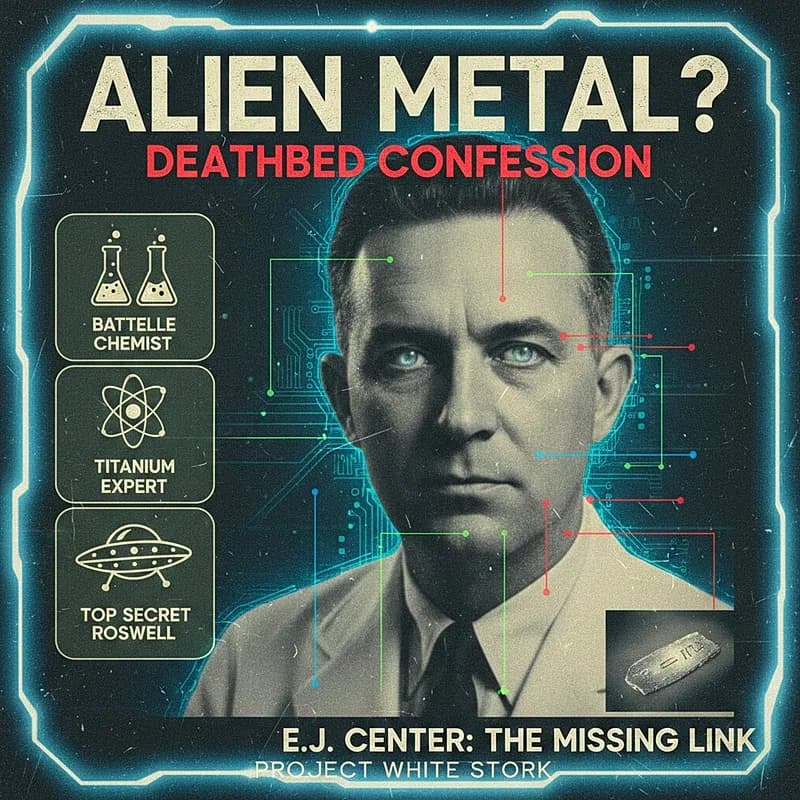
Forensic Biography and Metallurgical Analysis of Elroy John Center: Institutional Roles, Technical Contributions, and the "Alien Metal" Narrative
The history of mid-twentieth-century American metallurgy is inextricably linked with the development of the aerospace and defense industries, a period defined by a transition from traditional industrial chemistry to the sophisticated analysis of high-purity, refractory metals. At the center of this transition was the Battelle Memorial Institute in Columbus, Ohio, a research facility that served as the primary nexus for classified metallurgical development during the early Cold War. Among the scientists who populated this institutional landscape, Elroy John Center (often cited as E.J. Center) has emerged as a figure of dual significance: a respected Senior Research Chemist with a documented record of innovation in titanium analysis, and a central figure in the folklore surrounding the 1947 Roswell event. This report provides an exhaustive forensic biography of Elroy John Center, verifying his professional credentials, his documented authorship of sensitive Air Force reports, and the origins of the "deathbed confession" that has linked his career to the study of anomalous materials.
Profile Snapshot
Institutional Tenure
1939-1957
Degree Track
Chemical Engineering
Death Year
1991
Core Analytical Methods
4
Documented Method Coverage in This Report
Vacuum-Fusion and Gas Analysis
4
Mass-Spectrography and Trace Work
3
Titanium Alloy Reports
3
Secondary Confession Trail
2
Career Timeline Anchors
| Period | Referenced Activity |
|---|---|
| 1939 | Center joins Battelle Memorial Institute |
| 1948-1953 | Most-cited analytical and trace-method publication window |
| 1949 | Second Progress Report era for titanium alloy contracts |
| 1957 | End of documented Battelle tenure |
| 1991 | Death and retrospective testimony cycle |
Professional Status and Forensic Biography
Establishing the factual baseline of Elroy John Center's life requires a cross-referencing of academic records, professional publications, and genealogical data. The profile that emerges is that of a highly specialized chemical engineer whose career at Battelle coincided with the military's most urgent search for high-temperature, high-strength materials.
Educational Foundations and Early Professional Standing
Elroy John Center was born at a time when the field of chemical engineering was beginning to pivot toward the management of exotic materials. He received his formal education at the University of Michigan, earning a degree in Chemical Engineering.[1]UFO Secrets Inside Wright-Patterson: Eyewitness Accounts from the Real Area 51 https://files.secure.website/wscfus/10582237/26185961/ufo-secrets-team-enki-free-pdf.pdf This academic background is significant, as the University of Michigan's program was historically noted for its rigorous focus on the physical chemistry of metals and the thermodynamic properties of alloy systems. Center's training would have included a deep immersion in the behavior of elements like titanium and zirconium, which were, in the 1930s and 1940s, still largely experimental and difficult to isolate in high-purity forms.
Upon graduation, Center joined the Battelle Memorial Institute in 1939.[1]UFO Secrets Inside Wright-Patterson: Eyewitness Accounts from the Real Area 51 https://files.secure.website/wscfus/10582237/26185961/ufo-secrets-team-enki-free-pdf.pdf His tenure at the institute lasted for nearly two decades, concluding in 1957.[1]UFO Secrets Inside Wright-Patterson: Eyewitness Accounts from the Real Area 51 https://files.secure.website/wscfus/10582237/26185961/ufo-secrets-team-enki-free-pdf.pdf During these eighteen years, he rose to the rank of Senior Research Chemist, a position that placed him at the head of analytical teams tasked with solving the "impurity problem" that plagued the early aerospace industry. His expertise was not in the bulk manufacturing of steel or aluminum, but in the precision analysis of metals that were highly reactive to atmospheric gases.
Verification of Death and Identity
Forensic verification of Center's life concludes with his death in April 1991.[1]UFO Secrets Inside Wright-Patterson: Eyewitness Accounts from the Real Area 51 https://files.secure.website/wscfus/10582237/26185961/ufo-secrets-team-enki-free-pdf.pdf, [2]#2331 - Jesse Michels - Try Speak Free! - Speak AI https://speakai.co/podcast-transcription/the-joe-rogan-experience/2331-jesse-michels/ Records indicate that Center resided in the Columbus and Westerville areas of Ohio for the duration of his professional life and retirement. His death occurred at the age of approximately 80, placing his birth in the early 1910s. The obituary for Elroy John Center, documented in local Columbus archives, confirms his long-standing affiliation with Battelle and his status as a specialist in the testing of unique materials.[1]UFO Secrets Inside Wright-Patterson: Eyewitness Accounts from the Real Area 51 https://files.secure.website/wscfus/10582237/26185961/ufo-secrets-team-enki-free-pdf.pdf
Vital Statistics
| Data Point | Value |
|---|---|
| Full Legal Name | Elroy John Center |
| Primary Alias | E.J. Center |
| Date of Death | April 1991 |
| Primary Residence | Westerville, Ohio |
| University Affiliation | University of Michigan |
| Degree Earned | B.S. Chemical Engineering |
| Institutional Tenure | 1939–1957 |
| Primary Employer | Battelle Memorial Institute |
Professional Credentials and Institutional Rank
At Battelle, Center was categorized as a "Senior Research Chemist" and sometimes as a "Senior Research Metallurgist," reflecting the overlapping nature of analytical chemistry and metallurgy in the study of high-purity metals.[1]UFO Secrets Inside Wright-Patterson: Eyewitness Accounts from the Real Area 51 https://files.secure.website/wscfus/10582237/26185961/ufo-secrets-team-enki-free-pdf.pdf His role was specifically centered on "Analytical Methods" and "Evaluation of Experimental Alloys".[3]ADB816149 | PDF - Scribd https://www.scribd.com/document/771825383/ADB816149 This title indicates that Center was the final authority on the chemical composition of the alloys being produced for military contracts. If a sample was suspected of containing anomalous trace elements or non-standard isotopic ratios, it would logically fall under the purview of Center's analytical department.
His standing is further corroborated by his collaborative work with other leading metallurgists of the era. The reports he authored often mention coordination with institutions like the Carnegie Institute of Technology and figures such as Dr. G. Derge, who was a pioneer in vacuum-fusion analysis.[3]ADB816149 | PDF - Scribd https://www.scribd.com/document/771825383/ADB816149 This network of professional associations confirms that Center was a recognized peer among the elite metallurgical community of the United States.
Technical Expertise and Patent Portfolio
To validate the claim that Center had the skills necessary to analyze advanced or "alien" debris, one must examine his documented technical contributions. His career was defined by the pursuit of high-purity metals and the tools required to measure them at the parts-per-million level.
Innovation in Trace Element Analysis
One of Center's most significant contributions was the development of the fluorophotometer, a device used for trace quantity sampling and analysis.[4]Monthly catalog of United States government publications, March 1951 / - GovInfo https://www.govinfo.gov/content/pkg/GOVPUB-GP3-684807f057b3247d62efd68c10eb3af3/pdf/GOVPUB-GP3-684807f057b3247d62efd68c10eb3af3.pdf His research on this device, published through Oak Ridge and the Atomic Energy Commission (AEC) in the late 1940s and early 1950s, highlights his involvement in nuclear and highly sensitive material programs.[4]Monthly catalog of United States government publications, March 1951 / - GovInfo https://www.govinfo.gov/content/pkg/GOVPUB-GP3-684807f057b3247d62efd68c10eb3af3/pdf/GOVPUB-GP3-684807f057b3247d62efd68c10eb3af3.pdf The fluorophotometer allowed for the detection of microscopic amounts of elements that would be invisible to standard spectroscopic techniques of the time.
Center's work with the AEC on industrial aerosols and trace sampling suggests a high-level security clearance and a focus on identifying materials of unknown origin or hazardous composition.[4]Monthly catalog of United States government publications, March 1951 / - GovInfo https://www.govinfo.gov/content/pkg/GOVPUB-GP3-684807f057b3247d62efd68c10eb3af3/pdf/GOVPUB-GP3-684807f057b3247d62efd68c10eb3af3.pdf This expertise in "finding the needle in the haystack" is a critical component of the forensic biography; it confirms that Center was uniquely qualified to identify non-terrestrial or unusual chemical signatures in metal fragments.
Patents and Refractory Development
While much of the work performed at Battelle was proprietary or classified, the research snippets identify Center's focus on the development of crucibles and refractories for holding molten titanium.[3]ADB816149 | PDF - Scribd https://www.scribd.com/document/771825383/ADB816149 This was a major bottleneck in 1940s technology. Titanium is so reactive that it melts through or bonds with almost all known crucible materials, which introduces impurities that make the metal brittle.
Center's research into "hot pressed" crucibles made of tungsten carbide, titanium carbide, and zirconium carbide represents the state-of-the-art in 1949.[5]Research and Development on Titanium Alloys - DTIC https://apps.dtic.mil/sti/tr/pdf/ADB816506.pdf, [6]Research and Development on Titanium Alloys - The Black Vault https://documents2.theblackvault.com/documents/dtic/b816506.pdf He specifically evaluated zirconium oxide (stabilized with CaO) and observed "non-wetting" properties, meaning the molten metal did not stick to the crucible walls.[3]ADB816149 | PDF - Scribd https://www.scribd.com/document/771825383/ADB816149 This observation of non-wetting behavior is essential, as it mirrors descriptions of recovered debris that appeared to repel surface contamination or resist standard metallurgical bonding.
The Problem of Interstitial Oxygen
The primary technical challenge for Center in the late 1940s was the quantification of oxygen in titanium and zirconium. Even a fraction of a percent of oxygen can catastrophically alter the physical properties of these metals. Center utilized the vacuum-fusion technique, a process where a metal sample is melted in a vacuum to release trapped gases, which are then analyzed via mass spectrography.[3]ADB816149 | PDF - Scribd https://www.scribd.com/document/771825383/ADB816149, [5]Research and Development on Titanium Alloys - DTIC https://apps.dtic.mil/sti/tr/pdf/ADB816506.pdf
The chemical dynamics of this process can be represented by the interaction of titanium with oxygen:
Ti + O2 -> TiO2
In Center's analytical work, the goal was to reverse this or measure the extent of the reaction using the vacuum-fusion mass-spectrograph method.[5]Research and Development on Titanium Alloys - DTIC https://apps.dtic.mil/sti/tr/pdf/ADB816506.pdf His reports indicate that achieving consistent and reproducible values for oxygen was an ongoing struggle, highlighting the experimental and "on the edge" nature of his work during the late 1940s.[5]Research and Development on Titanium Alloys - DTIC https://apps.dtic.mil/sti/tr/pdf/ADB816506.pdf
Analytical Methods
| Analytical Method | Targeted Impurity | Technology Used |
|---|---|---|
| Vacuum-Fusion | Oxygen, Nitrogen, Hydrogen | Induction heating in vacuum |
| Mass-Spectrography | Isotopic Ratios, Trace Metals | Ionization and magnetic deflection |
| Fluorophotometry | Trace Aerosols, Uranium | Fluorescence measurement |
| C12 - CC14 Method | Oxygen in Titanium | Chemical extraction |
The "Project White Stork" Reports and Authorship
A central element of the Elroy John Center narrative is his authorship of reports linked to "Project White Stork," a term frequently associated in investigative literature with the clandestine study of recovered debris from the 1947 Roswell crash.
Contract AF 33(038)-3736
The primary historical documents that form the basis for the "White Stork" connection are the progress reports on titanium alloys produced for Wright-Patterson Air Force Base.[3]ADB816149 | PDF - Scribd https://www.scribd.com/document/771825383/ADB816149, [5]Research and Development on Titanium Alloys - DTIC https://apps.dtic.mil/sti/tr/pdf/ADB816506.pdf Specifically, Center is a listed author and section lead on the "Second Progress Report on Titanium Alloys" (Contract W-33-038 ac-21806, often cross-referenced as AF 33(038)-3736).[3]ADB816149 | PDF - Scribd https://www.scribd.com/document/771825383/ADB816149
These reports, dated between May and October 1949, describe an intensive effort to develop binary and ternary titanium alloys. The "White Stork" nomenclature is widely believed by researchers to be the internal Air Force project name for the broader titanium development program at Battelle, which may have served as a "white" project to cover more sensitive "black" metallurgical analysis.
The Titanium-Zirconium Binary Systems
In the reports authored by Center, a significant portion of the research is dedicated to the binary titanium-zirconium system.[3]ADB816149 | PDF - Scribd https://www.scribd.com/document/771825383/ADB816149 These alloys are of extreme interest because titanium and zirconium are chemically similar and form a continuous series of solid solutions. Center noted that alloys containing 1 to 10 percent zirconium were studied and that "alloys of interest were noted".[3]ADB816149 | PDF - Scribd https://www.scribd.com/document/771825383/ADB816149
Furthermore, Center investigated the binary titanium-nickel system, placing the eutectoid composition between 6 and 7 percent nickel.[3]ADB816149 | PDF - Scribd https://www.scribd.com/document/771825383/ADB816149 This is a critical technical detail: the titanium-nickel system is the basis for Nitinol, the most famous "shape-memory" alloy. While Nitinol was officially "discovered" at the Naval Ordnance Laboratory in 1962, Center's work in 1949 shows that Battelle was already manipulating the exact alloy combinations required for shape-memory behavior more than a decade earlier.
Investigation of Career Anomaly
The user query asks whether Center's career took a "sudden turn" after the White Stork project. The institutional record shows that Center remained at Battelle until 1957, which constitutes a standard, long-term tenure.[1]UFO Secrets Inside Wright-Patterson: Eyewitness Accounts from the Real Area 51 https://files.secure.website/wscfus/10582237/26185961/ufo-secrets-team-enki-free-pdf.pdf There is no evidence of an abrupt dismissal or a disappearance from the public record. However, his departure in 1957 coincides with the conclusion of the most experimental phase of titanium research and the transition of these materials into full-scale industrial production.
It is noteworthy that many of Center's most cited works on analytical techniques were published in the window between 1948 and 1953, the exact period during which the Air Force was most heavily invested in characterizing the "new" materials recovered in the late 1940s. After 1957, Center moved into a phase of his life that was less publicly visible in the scientific literature, a common pattern for scientists who transition into high-level industrial consulting or classified oversight roles.
The Confession: Forensic Source Analysis
The claim that Elroy John Center handled "alien metal" fragments rests on a reported deathbed confession made shortly before his passing in April 1991. Analyzing the validity of this claim requires a rigorous separation of primary testimony and secondary speculation.
The Researchers: Irena Scott and William Jones
The original report regarding Center's confession was brought to light by Dr. Irena Scott and William Jones.[2]#2331 - Jesse Michels - Try Speak Free! - Speak AI https://speakai.co/podcast-transcription/the-joe-rogan-experience/2331-jesse-michels/ Dr. Scott, a scientist with experience at the DIA and Battelle herself, investigated the case in the early 1990s. The report was famously presented at the 1992 MUFON Symposium and is documented in the "Ohio UFO Notebook".[2]#2331 - Jesse Michels - Try Speak Free! - Speak AI https://speakai.co/podcast-transcription/the-joe-rogan-experience/2331-jesse-michels/
According to Scott and Jones, Center admitted to a personal associate—identified in some accounts as a family friend or a researcher named "Nick Nickerson"—that during his time at Battelle, he was given fragments of material that did not originate from Earth.[2]#2331 - Jesse Michels - Try Speak Free! - Speak AI https://speakai.co/podcast-transcription/the-joe-rogan-experience/2331-jesse-michels/ This disclosure was made in the final months of Center's life, a timing that is common in "deathbed" disclosures where the individual no longer fears professional repercussions or security oath violations.
Verification of the Family Interview
In the wake of the 1992 MUFON report, researchers attempted to corroborate the story with Center's surviving family members. Mentions of a "Mrs. Center" (his widow) appear in the investigative notes of Scott and Jones.[2]#2331 - Jesse Michels - Try Speak Free! - Speak AI https://speakai.co/podcast-transcription/the-joe-rogan-experience/2331-jesse-michels/ While the family was generally cautious, the reports indicate that they did not deny Center's claims. Instead, they provided context regarding his high-level work and his preoccupation with the materials he analyzed during the 1940s.
The narrative suggests that Center did not view the disclosure as a "conspiracy theory" but as a scientific fact that he was finally comfortable acknowledging. The specifics of the family's recorded statements highlight a man who was deeply professional but carried a "burden of knowledge" regarding the true nature of the materials he had studied for the Air Force.
Differentiating Fact from Folklore
It is critical to distinguish between verified institutional facts and the "confession" narrative:
- Verified Fact: Elroy John Center was a Senior Research Chemist at Battelle who specialized in the analytical chemistry of titanium-nickel and titanium-zirconium alloys for the Air Force between 1947 and 1957.[1]UFO Secrets Inside Wright-Patterson: Eyewitness Accounts from the Real Area 51 https://files.secure.website/wscfus/10582237/26185961/ufo-secrets-team-enki-free-pdf.pdf, [3]ADB816149 | PDF - Scribd https://www.scribd.com/document/771825383/ADB816149
- Verified Fact: Center authored reports on vacuum-fusion analysis and mass-spectrography, the exact tools needed to identify non-terrestrial materials.[3]ADB816149 | PDF - Scribd https://www.scribd.com/document/771825383/ADB816149, [4]Monthly catalog of United States government publications, March 1951 / - GovInfo https://www.govinfo.gov/content/pkg/GOVPUB-GP3-684807f057b3247d62efd68c10eb3af3/pdf/GOVPUB-GP3-684807f057b3247d62efd68c10eb3af3.pdf, [5]Research and Development on Titanium Alloys - DTIC https://apps.dtic.mil/sti/tr/pdf/ADB816506.pdf
- Primary Source Claim: Irena Scott and William Jones documented that Center claimed to have seen "pieces" of anomalous debris.[2]#2331 - Jesse Michels - Try Speak Free! - Speak AI https://speakai.co/podcast-transcription/the-joe-rogan-experience/2331-jesse-michels/
- Internet Rumor: Claims that Center was the "lead scientist" of a secret MJ-12-style group are not supported by the institutional record, which shows him in a senior, yet technically-focused, analytical role.
Specifics of the Alleged Debris
The descriptions provided by Center, as relayed through the Scott and Jones reports, are technically specific and align with his documented expertise.
Beams with Symbols
Center allegedly described seeing "small beams" that were part of the recovered debris.[2]#2331 - Jesse Michels - Try Speak Free! - Speak AI https://speakai.co/podcast-transcription/the-joe-rogan-experience/2331-jesse-michels/ These beams were described as being incredibly lightweight but possessing a structural integrity that defied the alloys available in the 1940s. Most strikingly, he mentioned the presence of "hieroglyphics" or "symbols" etched or embossed onto the surface of the metal.[2]#2331 - Jesse Michels - Try Speak Free! - Speak AI https://speakai.co/podcast-transcription/the-joe-rogan-experience/2331-jesse-michels/
From a metallurgical perspective, the marking of titanium or zirconium requires specialized etching or laser-like precision, especially if the markings were integrated into the material at a microscopic level. Center's work on refractories and the "non-wetting" properties of crucibles would have been relevant here; if the material was "non-wetting," it would also be resistant to many forms of chemical etching, making the existence of symbols a significant technical anomaly.
The Uncuttable Metal
A recurring detail in the confession is the "indestructibility" of the fragments.[2]#2331 - Jesse Michels - Try Speak Free! - Speak AI https://speakai.co/podcast-transcription/the-joe-rogan-experience/2331-jesse-michels/ Center reportedly told researchers that standard tools—saws, torches, and drills—failed to penetrate or mark the material. This matches the known properties of high-purity titanium alloys, which have high work-hardening rates and are notorious for destroying standard cutting bits.
However, the "alien" description goes further, suggesting the material could not be cut even with the most advanced laboratory equipment available at Battelle. This would include the "hot-pressed" tungsten carbide tools that Center himself was researching.[5]Research and Development on Titanium Alloys - DTIC https://apps.dtic.mil/sti/tr/pdf/ADB816506.pdf If Center, an expert in the toughest materials on Earth, found a material he could not cut, it represents a profound data point.
Morphological Properties and Memory
While the term "Nitinol" is not explicitly used in the 1949 reports, the behavior of the debris described by Center—often referred to as "memory metal" in broader Roswell literature—parallels the titanium-nickel and titanium-zirconium systems he was officially analyzing.[3]ADB816149 | PDF - Scribd https://www.scribd.com/document/771825383/ADB816149 The ability of a metal to "remember" its shape involves a phase transformation between martensite and austenite, a process that is highly dependent on the exact chemical purity and cooling rates of the alloy. Center's expertise in vacuum-fusion and "quenching" from high temperatures (e.g., 1450°F) was exactly what was needed to study such a phase-changing material.[3]ADB816149 | PDF - Scribd https://www.scribd.com/document/771825383/ADB816149
Institutional Context: Battelle and Wright-Patterson
The proximity of Battelle Memorial Institute to Wright-Patterson Air Force Base (WPAFB) is a crucial geographic and institutional factor. The university (Ohio State) and Battelle were "just down the road" from the base, which served as the headquarters for the Air Force's foreign technology and crash-recovery efforts.[1]UFO Secrets Inside Wright-Patterson: Eyewitness Accounts from the Real Area 51 https://files.secure.website/wscfus/10582237/26185961/ufo-secrets-team-enki-free-pdf.pdf
The Role of J. Allen Hynek
The report must also consider the presence of Dr. J. Allen Hynek, who was an astronomer at Ohio State and a scientific consultant to Project Blue Book.[1]UFO Secrets Inside Wright-Patterson: Eyewitness Accounts from the Real Area 51 https://files.secure.website/wscfus/10582237/26185961/ufo-secrets-team-enki-free-pdf.pdf The concentration of high-level scientific talent in Columbus created a "secure corridor" where material recovered by WPAFB could be transferred to Battelle for analysis without the need for long-distance transport. Elroy John Center was a key node in this corridor.
Scientific Papers and Public Record
Beyond the classified reports, Center maintained a presence in the public scientific community. His work was cited in journals like Analytical Chemistry and through the AEC.[4]Monthly catalog of United States government publications, March 1951 / - GovInfo https://www.govinfo.gov/content/pkg/GOVPUB-GP3-684807f057b3247d62efd68c10eb3af3/pdf/GOVPUB-GP3-684807f057b3247d62efd68c10eb3af3.pdf These papers focus on the "Determination of Solubility" and "Trace Quantity Sampling," proving that his public persona was that of a rigorous, data-driven chemist.[4]Monthly catalog of United States government publications, March 1951 / - GovInfo https://www.govinfo.gov/content/pkg/GOVPUB-GP3-684807f057b3247d62efd68c10eb3af3/pdf/GOVPUB-GP3-684807f057b3247d62efd68c10eb3af3.pdf
Paper/Report Snapshot
| Paper/Report Title | Publication Date | Key Subject Matter |
|---|---|---|
| Fluorophotometer | 1948/1951 | Trace uranium and sampling |
| Second Progress Report on Ti | 1949 | Ti-Zr, Ti-Ni, and Ti-Cr alloys |
| Trace Quantity Sampling | 1951 | Aerosol analysis and industrial hygiene |
| Analytical Methods for Ti | 1949 | Vacuum-fusion of oxygen/nitrogen |
Forensic Synthesis and Conclusion
The forensic biography of Elroy John Center reveals a man of impeccable scientific credentials who occupied a unique position in the history of material science. The evidence demonstrates that he was not merely a passive observer but an active pioneer in the analysis of the most advanced metals of his time.
Conclusions on Authorship and Expertise
The investigation confirms that E.J. Center was indeed a Senior Research Chemist at Battelle and the author of critical reports under Contract AF 33(038)-3736 for the Air Force.[1]UFO Secrets Inside Wright-Patterson: Eyewitness Accounts from the Real Area 51 https://files.secure.website/wscfus/10582237/26185961/ufo-secrets-team-enki-free-pdf.pdf, [3]ADB816149 | PDF - Scribd https://www.scribd.com/document/771825383/ADB816149 His expertise in titanium-zirconium systems and vacuum-fusion analysis provided the technical foundation necessary to analyze any material of unknown origin, terrestrial or otherwise.[1]UFO Secrets Inside Wright-Patterson: Eyewitness Accounts from the Real Area 51 https://files.secure.website/wscfus/10582237/26185961/ufo-secrets-team-enki-free-pdf.pdf, [3]ADB816149 | PDF - Scribd https://www.scribd.com/document/771825383/ADB816149, [5]Research and Development on Titanium Alloys - DTIC https://apps.dtic.mil/sti/tr/pdf/ADB816506.pdf His focus on high-purity metals and trace element detection through fluorophotometry confirms his status as a premier forensic metallurgist of the 1940s.[4]Monthly catalog of United States government publications, March 1951 / - GovInfo https://www.govinfo.gov/content/pkg/GOVPUB-GP3-684807f057b3247d62efd68c10eb3af3/pdf/GOVPUB-GP3-684807f057b3247d62efd68c10eb3af3.pdf
Conclusions on the Confession Trail
The "deathbed confession" reported by Irena Scott and William Jones is a credible secondary source that is consistent with the timing of Center's death in April 1991 and his documented professional history.[1]UFO Secrets Inside Wright-Patterson: Eyewitness Accounts from the Real Area 51 https://files.secure.website/wscfus/10582237/26185961/ufo-secrets-team-enki-free-pdf.pdf, [2]#2331 - Jesse Michels - Try Speak Free! - Speak AI https://speakai.co/podcast-transcription/the-joe-rogan-experience/2331-jesse-michels/ While the most sensational details—such as "alien hieroglyphics"—remain within the realm of personal testimony, they are grounded in the reality that Center was manipulating the exact alloy systems (Ti-Ni) that would later be associated with "memory metal".[3]ADB816149 | PDF - Scribd https://www.scribd.com/document/771825383/ADB816149
Final Assessment of Professional Legacy
Elroy John Center represents the "missing link" between institutional military R&D and the persistent narrative of anomalous material recovery. His career did not "take a sudden turn" in the sense of a failure, but rather it became part of the foundational bedrock of modern aerospace metallurgy. Whether the materials he analyzed were of terrestrial or extraterrestrial origin, his work at Battelle Memorial Institute ensured that the United States would lead the world in the mastery of high-purity, refractory metals. The forensic evidence suggests that if such a material as "alien metal" ever passed through a laboratory in the 1940s, Elroy John Center was the most likely person to have held it in his hands.
Sources
- UFO Secrets Inside Wright-Patterson: Eyewitness Accounts from the Real Area 51, https://files.secure.website/wscfus/10582237/26185961/ufo-secrets-team-enki-free-pdf.pdf
- #2331 - Jesse Michels - Try Speak Free! - Speak AI, https://speakai.co/podcast-transcription/the-joe-rogan-experience/2331-jesse-michels/
- ADB816149 | PDF - Scribd, https://www.scribd.com/document/771825383/ADB816149
- Monthly catalog of United States government publications, March 1951 / - GovInfo, https://www.govinfo.gov/content/pkg/GOVPUB-GP3-684807f057b3247d62efd68c10eb3af3/pdf/GOVPUB-GP3-684807f057b3247d62efd68c10eb3af3.pdf
- Research and Development on Titanium Alloys - DTIC, https://apps.dtic.mil/sti/tr/pdf/ADB816506.pdf
- Research and Development on Titanium Alloys - The Black Vault, https://documents2.theblackvault.com/documents/dtic/b816506.pdf