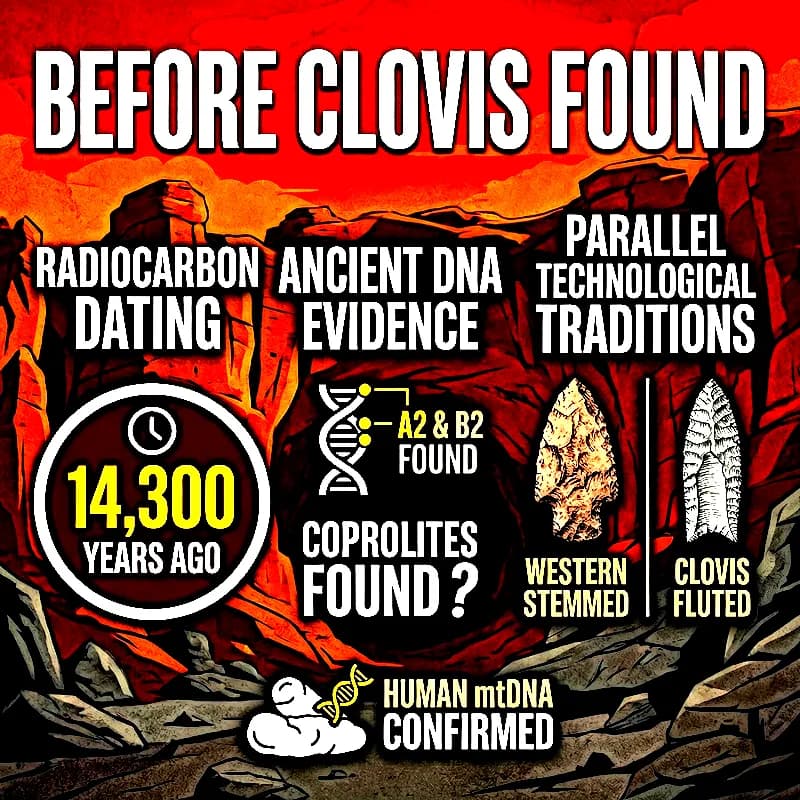
The Paisley Caves Records: A Comprehensive Forensic Investigation into the Pre-Clovis Occupation of the Northern Great Basin and the Reconfiguration of Paleoamerican Migration Narratives
The archaeological record of the Paisley Five Mile Point Caves in south-central Oregon represents one of the most significant challenges to the mid-twentieth-century consensus regarding the peopling of the Americas. For decades, the "Clovis First" model served as the foundational paradigm of North American archaeology, positing that the first human inhabitants arrived approximately 13,000 years ago via a terrestrial route from Beringia through an ice-free corridor.[1](PDF) DNA from Pre-Clovis Human Coprolites in Oregon, North https://www.researchgate.net/publication/5464810_DNA_from_Pre-Clovis_Human_Coprolites_in_Oregon_North_America[2]The Solutrean Hypothesis. Did Ice Age Europeans Discover America? - Institut für Anglistik/Amerikanistik - Universität Rostock https://www.iaa.uni-rostock.de/forschung/laufende-forschungsprojekte/american-antiquities-prof-mackenthun/project/stories/solutrean-h However, the meticulous re-excavation of the Paisley Caves beginning in 2002 has unearthed a suite of biological, technological, and chronological evidence that fundamentally disrupts this timeline.[3]"Geochronology, Archaeological Context, and DNA at the Paisley https://digitalcommons.usf.edu/kip_articles/2036/[4]Paisley Caves - The Oregon Encyclopedia https://www.oregonencyclopedia.org/articles/paisley_caves/ By integrating high-precision radiocarbon dating of human mitochondrial DNA (mtDNA) recovered from coprolites, the identification of a contemporary but distinct lithic tradition known as the Western Stemmed Tradition (WST), and the analysis of fecal biomarkers to verify stratigraphic integrity, the Paisley Caves provide a definitive forensic case for a pre-Clovis presence in North America.[1](PDF) DNA from Pre-Clovis Human Coprolites in Oregon, North https://www.researchgate.net/publication/5464810_DNA_from_Pre-Clovis_Human_Coprolites_in_Oregon_North_America[5]Pre-Clovis occupation of the Americas identified by human fecal https://pmc.ncbi.nlm.nih.gov/articles/PMC7363456/[6]Clovis age Western Stemmed projectile points and human coprolites at the Paisley Caves - PubMed https://pubmed.ncbi.nlm.nih.gov/22798611/ This investigation documents the material evidence found at Paisley Five Mile Point, examines the technological and genetic divergence it implies, and explores the broader implications for alternative migration theories, including maritime-based coastal routes and the regional folklore surrounding anomalous prehistoric inhabitants.
Dossier Snapshot
Year Span
1900-2008
Word Count
4,088
Source Entries
45
Citation Calls
85
Report Signal Profile
Section Headings
22
Table Lines
25
Unique Citations
45
Source Entries
45
Verification Metrics
| Metric | Value |
|---|---|
| Document ID | drr_paisley_caves_additional_information |
| Section Headings | 22 |
| Table Lines | 25 |
| Year Span | 1900-2008 |
| Citation Coverage | 45/45 |
Geological Context and the Formation of the Paisley Caves
The Paisley Caves are situated within the Summer Lake basin of the Northern Great Basin, approximately 220 miles southeast of Eugene, Oregon.[7]The Paisley Caves complex - when did people first reach North https://donsmaps.com/coproliteevidence.html Geologically, the site is characterized by 5-Mile Point Butte, a scoriaceous basalt fault block butte located in the southeastern part of the basin.[8]Late glacial through Early Holocene environments inferred using pollen from coprolites and sediments recovered from Paisley Caves, Oregon | Quaternary Research - Cambridge University Press & Assessment https://www.cambridge.org/core/journals/quaternary-researc The caves themselves consist of eight westward-facing, wave-cut shelters etched into a ridge of Miocene and Pliocene era basalts, interspersed with soft volcanic tuffs and breccias.[7]The Paisley Caves complex - when did people first reach North https://donsmaps.com/coproliteevidence.html[9]Paisley Caves - Wikipedia https://en.wikipedia.org/wiki/Paisley_Caves These shelters were formed by the high-energy wave action of pluvial Lake Chewaucan during periods of stable high lake stands in the Pleistocene.[7]The Paisley Caves complex - when did people first reach North https://donsmaps.com/coproliteevidence.html[8]Late glacial through Early Holocene environments inferred using pollen from coprolites and sediments recovered from Paisley Caves, Oregon | Quaternary Research - Cambridge University Press & Assessment https://www.cambridge.org/core/journals/quaternary-researc At its maximum extent, Lake Chewaucan covered an area of roughly 1,243 km
2
(460 to 480 square miles), reaching depths of up to 118 meters (375 feet) and maintaining a surface elevation of approximately 1,381 meters above sea level.[7]The Paisley Caves complex - when did people first reach North https://donsmaps.com/coproliteevidence.html[8]Late glacial through Early Holocene environments inferred using pollen from coprolites and sediments recovered from Paisley Caves, Oregon | Quaternary Research - Cambridge University Press & Assessment https://www.cambridge.org/core/journals/quaternary-researc[10]History, tranquility await in Summer Lake Basin - Bend Bulletin https://bendbulletin.com/2019/01/27/history-tranquility-await-in-summer-lake-basin/
The hydrological history of the basin is central to the archaeological preservation found within the caves. During the late Pleistocene Bølling-Allerød (BA) period, spanning roughly 14,700 to 12,900 calendar years before present (cal BP), lake levels reached their last major high stand by 14,500 cal BP.[8]Late glacial through Early Holocene environments inferred using pollen from coprolites and sediments recovered from Paisley Caves, Oregon | Quaternary Research - Cambridge University Press & Assessment https://www.cambridge.org/core/journals/quaternary-researc As the climate shifted and the lake subsequently receded, the caves began to accumulate terrestrial sediments through a combination of aeolian processes, gravity-driven rockfalls, water-borne deposits, and biological accumulation.[8]Late glacial through Early Holocene environments inferred using pollen from coprolites and sediments recovered from Paisley Caves, Oregon | Quaternary Research - Cambridge University Press & Assessment https://www.cambridge.org/core/journals/quaternary-researc[11]Paisley Caves yield 13000-year old Western Stemmed points, more human DNA https://pages.uoregon.edu/digital/uonews-archive/archive/news-release/2012/7/paisley-caves-yield-13000-year-old-western-stemmed-points-more-human-dna.html The desiccation of the basin led to the formation of the Paisley Fan at the south end of Summer Lake, hydrologically separating it from the rest of the Chewaucan basin by 13,230 cal BP.[8]Late glacial through Early Holocene environments inferred using pollen from coprolites and sediments recovered from Paisley Caves, Oregon | Quaternary Research - Cambridge University Press & Assessment https://www.cambridge.org/core/journals/quaternary-researc This transition from a lacustrine to a terrestrial environment provided a dry, stable sanctuary for human occupation, while the arid conditions facilitated the exceptional preservation of organic materials, including perishable fibers and subfossilized fecal matter, which are rarely recovered in the more humid environments of the eastern United States.[7]The Paisley Caves complex - when did people first reach North https://donsmaps.com/coproliteevidence.html[12]Lovelock Cave - Wikipedia https://en.wikipedia.org/wiki/Lovelock_Cave[13]University of Nevada, Reno An Examination of Western Stemmed Tradition Settlement-Subsistence, Territoriality, and Lithic Techno - ResearchGate https://www.researchgate.net/profile/Derek-Reaux/publication/350410997_An_Examination_of_Western_Stemmed_Tradition_S
Historical Overview of Investigative Efforts: From Cressman to Jenkins
The antiquity of human presence at the Paisley Caves was first proposed in the late 1930s by Luther Cressman of the University of Oregon. During the summers of 1938 and 1939, Cressman's team conducted initial excavations, reporting the discovery of cultural materials in direct association with the remains of extinct Pleistocene megafauna, including camels, horses, and mastodons.[4]Paisley Caves - The Oregon Encyclopedia https://www.oregonencyclopedia.org/articles/paisley_caves/[14]Paisley Caves | The Oregon Encyclopedia https://www.oregonencyclopedia.org/articles/paisley_caves/pdf/ At the time, such a claim was revolutionary, as it suggested humans were present in North America much earlier than the then-emerging Clovis consensus allowed. However, the archaeological community of the mid-twentieth century remained largely skeptical. Critics argued that the stratigraphic layers within the caves might have been jumbled or "churned" by geological processes or the burrowing activities of rodents, thereby creating a false association between younger human artifacts and older animal bones.[7]The Paisley Caves complex - when did people first reach North https://donsmaps.com/coproliteevidence.html[14]Paisley Caves | The Oregon Encyclopedia https://www.oregonencyclopedia.org/articles/paisley_caves/pdf/[15](PDF) P Geochronology, Archaeological Context, and DNA at the Paisley Caves https://www.researchgate.net/publication/269996034_P_Geochronology_Archaeological_Context_and_DNA_at_the_Paisley_Caves
The site remained largely dormant for decades until 2002, when Dennis L. Jenkins resumed excavations using modern forensic standards.[14]Paisley Caves | The Oregon Encyclopedia https://www.oregonencyclopedia.org/articles/paisley_caves/pdf/ The Jenkins-led teams employed state-of-the-art stratigraphic recording, identifying successive deposits of soils, sands, and gravels with high spatial precision.[4]Paisley Caves - The Oregon Encyclopedia https://www.oregonencyclopedia.org/articles/paisley_caves/[14]Paisley Caves | The Oregon Encyclopedia https://www.oregonencyclopedia.org/articles/paisley_caves/pdf/ This renewed effort aimed to address the primary criticisms leveled against Cressman: stratigraphic integrity and the reliability of dating. By obtaining over 280 radiocarbon dates and performing exhaustive geoarchaeological analyses, Jenkins's work established that the organic deposits were remarkably stable despite occasional rodent holes.[3]"Geochronology, Archaeological Context, and DNA at the Paisley https://digitalcommons.usf.edu/kip_articles/2036/[15](PDF) P Geochronology, Archaeological Context, and DNA at the Paisley Caves https://www.researchgate.net/publication/269996034_P_Geochronology_Archaeological_Context_and_DNA_at_the_Paisley_Caves The breakthrough came with the recovery of human coprolites from the deepest layers of the cave, providing a direct biological link to the early inhabitants that could be dated with absolute precision.[1](PDF) DNA from Pre-Clovis Human Coprolites in Oregon, North https://www.researchgate.net/publication/5464810_DNA_from_Pre-Clovis_Human_Coprolites_in_Oregon_North_America[7]The Paisley Caves complex - when did people first reach North https://donsmaps.com/coproliteevidence.html[15](PDF) P Geochronology, Archaeological Context, and DNA at the Paisley Caves https://www.researchgate.net/publication/269996034_P_Geochronology_Archaeological_Context_and_DNA_at_the_Paisley_Caves
The Biological Evidence: DNA Profiling and Fecal Biomarkers
The recovery of human coprolites at Paisley Caves provided a unique opportunity to apply forensic genetic analysis to the pre-Clovis timeline. In 2008, a study published in Science detailed the recovery of human mitochondrial DNA (mtDNA) from coprolites directly dated by accelerator mass spectrometry (AMS).[1](PDF) DNA from Pre-Clovis Human Coprolites in Oregon, North https://www.researchgate.net/publication/5464810_DNA_from_Pre-Clovis_Human_Coprolites_in_Oregon_North_America[16]DNA from pre-Clovis human coprolites in Oregon, North America - PubMed https://pubmed.ncbi.nlm.nih.gov/18388261/ This evidence was pivotal in establishing a human presence in south-central Oregon by at least 12,300 14
C years BP, which corresponds to approximately 14,270 to 14,000 cal BP.[1](PDF) DNA from Pre-Clovis Human Coprolites in Oregon, North https://www.researchgate.net/publication/5464810_DNA_from_Pre-Clovis_Human_Coprolites_in_Oregon_North_America
Genetic Findings and Haplogroup Identification
The genetic material extracted from the coprolites was identified as belonging to Native American founding haplogroups A2 and B2.[1](PDF) DNA from Pre-Clovis Human Coprolites in Oregon, North https://www.researchgate.net/publication/5464810_DNA_from_Pre-Clovis_Human_Coprolites_in_Oregon_North_America[15](PDF) P Geochronology, Archaeological Context, and DNA at the Paisley Caves https://www.researchgate.net/publication/269996034_P_Geochronology_Archaeological_Context_and_DNA_at_the_Paisley_Caves These findings were verified through a rigorous "blind testing" protocol involving multiple international laboratories to ensure the results were not the product of modern contamination or laboratory error.[1](PDF) DNA from Pre-Clovis Human Coprolites in Oregon, North https://www.researchgate.net/publication/5464810_DNA_from_Pre-Clovis_Human_Coprolites_in_Oregon_North_America[6]Clovis age Western Stemmed projectile points and human coprolites at the Paisley Caves - PubMed https://pubmed.ncbi.nlm.nih.gov/22798611/[15](PDF) P Geochronology, Archaeological Context, and DNA at the Paisley Caves https://www.researchgate.net/publication/269996034_P_Geochronology_Archaeological_Context_and_DNA_at_the_Paisley_Caves
| Sample Identifier | Haplogroup | Radiocarbon Date (14C BP) | Laboratory | Calibrated Age (cal BP) |
|---|---|---|---|---|
| 1374-PC-5/5D-31 | B2 | 12,400±60 | Beta Analytic | 14,270 - 14,000 |
| 1294-PC-5/7C-31 | B | 12,290±60 | Beta Analytic | 14,150 - 13,900 |
| 1294-PC-5/6B-50 | A2 | 12,260±60 | Beta Analytic | 14,100 - 13,850 |
| 1294-PC-5/6B-40 | B2 | 10,050±50 | Beta Analytic | 11,200 - 10,950 |
| 1374-PC-1/2A-28 | B2 | 6,640±40 | Beta Analytic | 7,600 - 7,450 |
The presence of haplogroup A2 in sample 1294-PC-5/6B-50 and haplogroup B2 in samples 1374-PC-5/5D-31 and 1374-PC-1/2A-28 establishes a direct genetic lineage between the pre-Clovis occupants and modern Native American populations.[1](PDF) DNA from Pre-Clovis Human Coprolites in Oregon, North https://www.researchgate.net/publication/5464810_DNA_from_Pre-Clovis_Human_Coprolites_in_Oregon_North_America Because these dates are more than 1,000 years older than the earliest confirmed Clovis sites (typically dated to 11,000-10,800 14
C BP), the Paisley Caves evidence successfully shatters the "Clovis First" paradigm.[1](PDF) DNA from Pre-Clovis Human Coprolites in Oregon, North https://www.researchgate.net/publication/5464810_DNA_from_Pre-Clovis_Human_Coprolites_in_Oregon_North_America[16]DNA from pre-Clovis human coprolites in Oregon, North America - PubMed https://pubmed.ncbi.nlm.nih.gov/18388261/
Forensic Verification via Lipid Analysis
Despite the rigorous DNA testing, some critics proposed the "leaching hypothesis," suggesting that human DNA from younger stratigraphic layers might have been transported downward by water, contaminating older non-human coprolites.[5]Pre-Clovis occupation of the Americas identified by human fecal https://pmc.ncbi.nlm.nih.gov/articles/PMC7363456/[7]The Paisley Caves complex - when did people first reach North https://donsmaps.com/coproliteevidence.html[9]Paisley Caves - Wikipedia https://en.wikipedia.org/wiki/Paisley_Caves To address this, Thomas Stafford and other researchers conducted a "tea bag" experiment, soaking coprolite samples in distilled water to extract potentially mobile carbon and dating both the water-soluble and insoluble fractions. In 11 out of 12 cases, the water-soluble material was older than or the same age as the coprolite itself, refuting the idea of younger DNA leaching into older layers.[7]The Paisley Caves complex - when did people first reach North https://donsmaps.com/coproliteevidence.html
To provide definitive proof of origin, researchers turned to fecal biomarkers—specifically 5β-stanols and bile acids.[5]Pre-Clovis occupation of the Americas identified by human fecal https://pmc.ncbi.nlm.nih.gov/articles/PMC7363456/ Unlike DNA, these lipids are hydrophobic and chemically stable, meaning they do not move through sediments via water and can persist for millions of years.[5]Pre-Clovis occupation of the Americas identified by human fecal https://pmc.ncbi.nlm.nih.gov/articles/PMC7363456/ The analysis used gas chromatography-mass spectrometry (GC-MS) to identify the specific producer organism based on its gut biochemistry.[5]Pre-Clovis occupation of the Americas identified by human fecal https://pmc.ncbi.nlm.nih.gov/articles/PMC7363456/
| Organism Group | Diagnostic Lipid Ratios | Key Bile Acids |
|---|---|---|
| Humans | Coprostanol/Cholesterol > 1 | Deoxycholic, Lithocholic acids |
| Carnivores (Canids) | Coprostanol/Cholesterol < 1 | Cholic, Chenodeoxycholic acids |
| Herbivores | Low sterols, high 5β-stigmastanol | Specific plant-derived stanols |
The results unequivocally confirmed that the pre-Clovis coprolites containing human DNA also contained human-specific lipid profiles.[5]Pre-Clovis occupation of the Americas identified by human fecal https://pmc.ncbi.nlm.nih.gov/articles/PMC7363456/ Of the 18 samples previously identified as human by mtDNA, 10 were confirmed as human by lipid analysis, while six were re-attributed to carnivores and one to a mixed human-carnivore origin (suggesting coprophagy, where a carnivore consumed human feces).[5]Pre-Clovis occupation of the Americas identified by human fecal https://pmc.ncbi.nlm.nih.gov/articles/PMC7363456/ This dual-proxy confirmation provides the highest level of forensic certainty currently possible in archaeological science, validating the presence of humans at Paisley Caves by approximately 14,200 years ago.[5]Pre-Clovis occupation of the Americas identified by human fecal https://pmc.ncbi.nlm.nih.gov/articles/PMC7363456/
Technological Traditions: The Western Stemmed Tradition vs. Clovis
A central pillar of the Clovis First theory was the belief that the fluted Clovis point was the original technological innovation of the first Americans. The Paisley Caves discovery challenges this by introducing a contemporaneous and potentially older lithic technology: the Western Stemmed Tradition (WST).[6]Clovis age Western Stemmed projectile points and human coprolites at the Paisley Caves - PubMed https://pubmed.ncbi.nlm.nih.gov/22798611/[17]As old as Clovis sites, but not Clovis: Paisley Caves, Oregon yields Western Stemmed points, more human DNA | ScienceDaily https://www.sciencedaily.com/releases/2012/07/120712141916.htm[18]The Clovis First Theory is put to rest at Paisley Caves - HeritageDaily https://www.heritagedaily.com/2012/07/the-clovis-first-theory-is-put-to-rest-at-paisley-caves/47187
Morphological and Technological Distinctions
The Western Stemmed Tradition is characterized by projectile points with narrow bifaces, sloping shoulders, and relatively thick, contracting bases.[3]"Geochronology, Archaeological Context, and DNA at the Paisley https://digitalcommons.usf.edu/kip_articles/2036/[6]Clovis age Western Stemmed projectile points and human coprolites at the Paisley Caves - PubMed https://pubmed.ncbi.nlm.nih.gov/22798611/[19]Oregon's Paisley Caves as old as Clovis sites - but not Clovis https://news.oregonstate.edu/news/oregons-paisley-caves-old-clovis-sites-not-clovis This is fundamentally different from the Clovis tradition, which utilizes a distinctive "fluting" technique—the removal of a large flake from the base to facilitate hafting on a spear.[19]Oregon's Paisley Caves as old as Clovis sites - but not Clovis https://news.oregonstate.edu/news/oregons-paisley-caves-old-clovis-sites-not-clovis
| Feature | Western Stemmed Tradition (WST) | Clovis Tradition |
|---|---|---|
| Hafting Element | Constricted or straight stemmed bases | Concave bases with a distinct notch |
| Thinning Method | Broad collateral percussion/pressure flaking | Removal of a large longitudinal flute flake |
| Production Source | Often manufactured from smaller flakes | Often reduced from larger rocks/cores |
| Geographic Core | Western North America/Great Basin | Central/Southeastern North America |
| Evolutionary Origin | Links to Northeast Asia/Siberian patterns | Indigenous development in the New World |
At Paisley Caves, Western Stemmed points were recovered from deposits dating to 11,070 to 11,340 14
C BP (approximately 13,000 to 13,200 cal BP).[6]Clovis age Western Stemmed projectile points and human coprolites at the Paisley Caves - PubMed https://pubmed.ncbi.nlm.nih.gov/22798611/[17]As old as Clovis sites, but not Clovis: Paisley Caves, Oregon yields Western Stemmed points, more human DNA | ScienceDaily https://www.sciencedaily.com/releases/2012/07/120712141916.htm[19]Oregon's Paisley Caves as old as Clovis sites - but not Clovis https://news.oregonstate.edu/news/oregons-paisley-caves-old-clovis-sites-not-clovis There is no diagnostic Clovis technology found anywhere within the cave's stratigraphic column.[6]Clovis age Western Stemmed projectile points and human coprolites at the Paisley Caves - PubMed https://pubmed.ncbi.nlm.nih.gov/22798611/[7]The Paisley Caves complex - when did people first reach North https://donsmaps.com/coproliteevidence.html[20]Oregon caves yield evidence of 13000-year-old darts and spearheads - University of York https://www.york.ac.uk/news-and-events/news/2012/research/darts-and-spearheads/ This implies that WST was not a descendant of Clovis, but a parallel technological development. Lead researcher Dennis Jenkins notes that it is "impossible to derive Western Stemmed points from a proto-Clovis tradition," suggesting that the Americas were settled by multiple founding groups with divergent technologies.[6]Clovis age Western Stemmed projectile points and human coprolites at the Paisley Caves - PubMed https://pubmed.ncbi.nlm.nih.gov/22798611/[17]As old as Clovis sites, but not Clovis: Paisley Caves, Oregon yields Western Stemmed points, more human DNA | ScienceDaily https://www.sciencedaily.com/releases/2012/07/120712141916.htm[20]Oregon caves yield evidence of 13000-year-old darts and spearheads - University of York https://www.york.ac.uk/news-and-events/news/2012/research/darts-and-spearheads/
Chronological Overlap and Cultural Enclaves
The radiocarbon dating of WST artifacts at Paisley Caves to a period contemporary with Clovis suggests that the two traditions co-existed for centuries without blending.[7]The Paisley Caves complex - when did people first reach North https://donsmaps.com/coproliteevidence.html[19]Oregon's Paisley Caves as old as Clovis sites - but not Clovis https://news.oregonstate.edu/news/oregons-paisley-caves-old-clovis-sites-not-clovis While Clovis points have been found below WST points at other sites like Hell Gap, Wyoming, the Paisley evidence shows that WST is at least as old as Clovis in the Northern Great Basin.[17]As old as Clovis sites, but not Clovis: Paisley Caves, Oregon yields Western Stemmed points, more human DNA | ScienceDaily https://www.sciencedaily.com/releases/2012/07/120712141916.htm[20]Oregon caves yield evidence of 13000-year-old darts and spearheads - University of York https://www.york.ac.uk/news-and-events/news/2012/research/darts-and-spearheads/ This spatial and technological segregation points to the presence of distinct cultural enclaves. The Clovis culture may have originated in the Southeast and moved west, while the WST began in the West and moved east.[17]As old as Clovis sites, but not Clovis: Paisley Caves, Oregon yields Western Stemmed points, more human DNA | ScienceDaily https://www.sciencedaily.com/releases/2012/07/120712141916.htm[20]Oregon caves yield evidence of 13000-year-old darts and spearheads - University of York https://www.york.ac.uk/news-and-events/news/2012/research/darts-and-spearheads/ This multi-group colonization model replaces the unilinear "Clovis-to-everyone" evolutionary model that dominated archaeology for half a century.[6]Clovis age Western Stemmed projectile points and human coprolites at the Paisley Caves - PubMed https://pubmed.ncbi.nlm.nih.gov/22798611/[19]Oregon's Paisley Caves as old as Clovis sites - but not Clovis https://news.oregonstate.edu/news/oregons-paisley-caves-old-clovis-sites-not-clovis
Chronology and Stratigraphic Integrity
The reliability of the Paisley Caves as a pre-Clovis site rests on the integrity of its stratigraphy. The site contains a rich archaeological record spanning from 14,300 to 6,000 cal BP, with evidence of intermittent use up to the historic period.[3]"Geochronology, Archaeological Context, and DNA at the Paisley https://digitalcommons.usf.edu/kip_articles/2036/[8]Late glacial through Early Holocene environments inferred using pollen from coprolites and sediments recovered from Paisley Caves, Oregon | Quaternary Research - Cambridge University Press & Assessment https://www.cambridge.org/core/journals/quaternary-researc The stratigraphic units, primarily LU1 (Pleistocene) and LU2 (Early Holocene), contain well-dated deposits of cultural and paleontological remains.[3]"Geochronology, Archaeological Context, and DNA at the Paisley https://digitalcommons.usf.edu/kip_articles/2036/
A significant feature of the late Pleistocene environment in North America is the "black mat"—an organic-rich layer associated with the Younger Dryas (YD) climate reversal approximately 12,800 years ago.[21]Younger Dryas "black mats" and the Rancholabrean termination in North America - PMC https://pmc.ncbi.nlm.nih.gov/articles/PMC2373324/ While many sites across North America exhibit this layer, which is often linked to the extinction of megafauna and controversial extraterrestrial impact theories, the Paisley Caves show a more nuanced environmental transition.[21]Younger Dryas "black mats" and the Rancholabrean termination in North America - PMC https://pmc.ncbi.nlm.nih.gov/articles/PMC2373324/[22](PDF) Younger Dryas Archaeology and Human Experience at the https://www.researchgate.net/publication/304010612_Younger_Dryas_Archaeology_and_Human_Experience_at_the_Paisley_Caves_in_the_Northern_Great_Basin[23]Chronological evidence fails to support claim of an isochronous widespread layer of cosmic impact indicators dated to 12,800 years ago - PMC - PubMed Central https://pmc.ncbi.nlm.nih.gov/articles/PMC4040610/ Stratigraphic analysis indicates that as the Bølling-Allerød warming ended and the Younger Dryas cooling began, the local hydrology shifted, but human occupation continued.[7]The Paisley Caves complex - when did people first reach North https://donsmaps.com/coproliteevidence.html[8]Late glacial through Early Holocene environments inferred using pollen from coprolites and sediments recovered from Paisley Caves, Oregon | Quaternary Research - Cambridge University Press & Assessment https://www.cambridge.org/core/journals/quaternary-researc[22](PDF) Younger Dryas Archaeology and Human Experience at the https://www.researchgate.net/publication/304010612_Younger_Dryas_Archaeology_and_Human_Experience_at_the_Paisley_Caves_in_the_Northern_Great_Basin
The discovery of a human-made bulrush shaft (possibly part of a basket or mat) in Cave 5 further confirms stratigraphic stability. The shaft was dated to 12,273±56 14
C BP and was found directly above a human coprolite dated to 12,290±60 14
C BP.[7]The Paisley Caves complex - when did people first reach North https://donsmaps.com/coproliteevidence.html[9]Paisley Caves - Wikipedia https://en.wikipedia.org/wiki/Paisley_Caves The "S-twist" (clockwise) twined fiber is not natural to the cave deposits, providing clear evidence of cultural activity and confirming that the materials remained in their original chronological context for over 12,000 years.[7]The Paisley Caves complex - when did people first reach North https://donsmaps.com/coproliteevidence.html
Subsistence Patterns and Paleoecology
The occupants of Paisley Caves were broad-range foragers who adapted to the dynamic natural ecologies of the Summer Lake basin.[3]"Geochronology, Archaeological Context, and DNA at the Paisley https://digitalcommons.usf.edu/kip_articles/2036/[15](PDF) P Geochronology, Archaeological Context, and DNA at the Paisley Caves https://www.researchgate.net/publication/269996034_P_Geochronology_Archaeological_Context_and_DNA_at_the_Paisley_Caves Unlike the traditional view of Paleoindians as specialized mammoth hunters, the Paisley data suggests a more opportunistic and diverse subsistence strategy.[9]Paisley Caves - Wikipedia https://en.wikipedia.org/wiki/Paisley_Caves[24]America, in the Beginning - Paisley Caves - Archaeology Magazine - September/October 2014 https://archaeology.org/issues/september-october-2014/collection/peopling-the-americas-paisely-caves/america-in-the-beginning/
Dietary Evidence from Coprolites
Analysis of the coprolites' contents revealed an omnivorous diet that fluctuated with the seasons. Pollen and plant minerals extracted from the samples suggest the caves were primarily inhabited during the spring and early summer.[22](PDF) Younger Dryas Archaeology and Human Experience at the https://www.researchgate.net/publication/304010612_Younger_Dryas_Archaeology_and_Human_Experience_at_the_Paisley_Caves_in_the_Northern_Great_Basin[24]America, in the Beginning - Paisley Caves - Archaeology Magazine - September/October 2014 https://archaeology.org/issues/september-october-2014/collection/peopling-the-americas-paisely-caves/america-in-the-beginning/
- Flora: Foraged plants, seeds, and edible roots, including saltbush (Atriplex sp.) and sagebrush (Artemisia sp.).[3]"Geochronology, Archaeological Context, and DNA at the Paisley https://digitalcommons.usf.edu/kip_articles/2036/[9]Paisley Caves - Wikipedia https://en.wikipedia.org/wiki/Paisley_Caves[24]America, in the Beginning - Paisley Caves - Archaeology Magazine - September/October 2014 https://archaeology.org/issues/september-october-2014/collection/peopling-the-americas-paisely-caves/america-in-the-beginning/
- Fauna: Small mammals (rodents, rabbits), insects (beetles), fish, and a variety of waterfowl.[7]The Paisley Caves complex - when did people first reach North https://donsmaps.com/coproliteevidence.html[9]Paisley Caves - Wikipedia https://en.wikipedia.org/wiki/Paisley_Caves[24]America, in the Beginning - Paisley Caves - Archaeology Magazine - September/October 2014 https://archaeology.org/issues/september-october-2014/collection/peopling-the-americas-paisely-caves/america-in-the-beginning/
- Megafauna: Remains of extinct camel, horse, and bison were intermingled with cultural materials, suggesting these large animals were utilized, though whether through active hunting or scavenging remains a point of investigation.[9]Paisley Caves - Wikipedia https://en.wikipedia.org/wiki/Paisley_Caves[15](PDF) P Geochronology, Archaeological Context, and DNA at the Paisley Caves https://www.researchgate.net/publication/269996034_P_Geochronology_Archaeological_Context_and_DNA_at_the_Paisley_Caves[24]America, in the Beginning - Paisley Caves - Archaeology Magazine - September/October 2014 https://archaeology.org/issues/september-october-2014/collection/peopling-the-americas-paisely-caves/america-in-the-beginning/
The Role of Pluvial Lakes
The subsistence patterns at Paisley Caves are inextricably linked to the "limnosedentary" lifestyle common in the Great Basin. This theory suggests that early populations were highly mobile but tethered to rich wetland resources.[12]Lovelock Cave - Wikipedia https://en.wikipedia.org/wiki/Lovelock_Cave[13]University of Nevada, Reno An Examination of Western Stemmed Tradition Settlement-Subsistence, Territoriality, and Lithic Techno - ResearchGate https://www.researchgate.net/profile/Derek-Reaux/publication/350410997_An_Examination_of_Western_Stemmed_Tradition_S[25]The Radiocarbon Record of the Western Stemmed Tradition on the Southern Columbia Plateau of Western North America - PDXScholar https://pdxscholar.library.pdx.edu/cgi/viewcontent.cgi?article=1202&context=anth_fac As Lake Chewaucan began to dry up at the close of the Pleistocene, human occupants moved with the receding shorelines, utilizing the "wave-cut shelters" as seasonal base camps.[7]The Paisley Caves complex - when did people first reach North https://donsmaps.com/coproliteevidence.html[8]Late glacial through Early Holocene environments inferred using pollen from coprolites and sediments recovered from Paisley Caves, Oregon | Quaternary Research - Cambridge University Press & Assessment https://www.cambridge.org/core/journals/quaternary-researc The presence of fish and waterfowl bones in the pre-Clovis layers reinforces the importance of aquatic ecosystems to the earliest Americans, a finding that supports the Pacific Coast migration route where travelers followed productive coastal and inland waterways.[9]Paisley Caves - Wikipedia https://en.wikipedia.org/wiki/Paisley_Caves[26]The Oldest Fishhooks in the Americas - Texas A&M College of Liberal Arts https://liberalarts.tamu.edu/csfa/wp-content/uploads/sites/14/2021/07/34-3-book-Reduced.pdf
Obsidian Sourcing and Regional Mobility
The use of obsidian for tool manufacture at Paisley Caves provides forensic evidence of the geographic range and social networks of the early inhabitants. Obsidian artifacts at the site were analyzed using energy-dispersive X-ray fluorescence (EDXRF) to identify their geological provenance.[27]X-Ray Fluorescence Analysis and Obsidian Hydration Rim - NPS History https://npshistory.com/publications/usfs/newberry/nroslr-98-96.pdf[28]Source Provenance of Obsidian Artifacts from Sites on Colorado National Monument, Western Colorado - SciSpace https://scispace.com/pdf/source-provenance-of-obsidian-artifacts-from-sites-on-4lzwz3dfsf.pdf
Trace Element Fingerprinting
Each obsidian source possesses a unique chemical composition of trace elements such as rubidium (Rb), strontium (Sr), and zirconium (Zr).[27]X-Ray Fluorescence Analysis and Obsidian Hydration Rim - NPS History https://npshistory.com/publications/usfs/newberry/nroslr-98-96.pdf[29]XRF OF OBSIDIAN: ANALYSIS OF THE VESTER COLLECTION - Deschutes Meridian https://www.deschutesmeridian.com/IAOS/pdf/brito_2021.pdf By comparing the ratios of these elements in artifacts to known geological quarries, researchers can map prehistoric travel and trade routes.[29]XRF OF OBSIDIAN: ANALYSIS OF THE VESTER COLLECTION - Deschutes Meridian https://www.deschutesmeridian.com/IAOS/pdf/brito_2021.pdf[30]Obsidian sourcing by X-ray fluorescence analysis - OSF https://osf.io/khpx9_v1/[31]Obsidian Sourcing by X-Ray Fluorescence Analysis - OUCI https://ouci.dntb.gov.ua/en/works/loOw6enl/
Broader Implications: Migration Models and Alternative History
The evidence from Paisley Caves does more than just push back the date of human arrival; it necessitates a complete rethink of the migration routes used by the first Americans.
The Seafarer Hypothesis and Coastal Migration
If humans were in Oregon by 14,200 years ago, they arrived before the "ice-free corridor" between the Laurentide and Cordilleran ice sheets was biologically viable for a terrestrial crossing.[25]The Radiocarbon Record of the Western Stemmed Tradition on the Southern Columbia Plateau of Western North America - PDXScholar https://pdxscholar.library.pdx.edu/cgi/viewcontent.cgi?article=1202&context=anth_fac[34]People and Processes in Quaternary Pacific Northwest - University of Washington https://depts.washington.edu/amqua14/amquafiles/AMQUA2014_Abstracts-Program.pdf[35]Clovis Culture | PDF - Scribd https://www.scribd.com/document/670173090/Clovis-culture This strongly supports the Pacific Coastal Route, or "Kelp Highway" hypothesis, which proposes that maritime-adapted groups moved south along the coastline in skin-covered boats, utilizing the rich marine and lacustrine resources.[9]Paisley Caves - Wikipedia https://en.wikipedia.org/wiki/Paisley_Caves[26]The Oldest Fishhooks in the Americas - Texas A&M College of Liberal Arts https://liberalarts.tamu.edu/csfa/wp-content/uploads/sites/14/2021/07/34-3-book-Reduced.pdf[36]Archaeological survey and testing in the Willapa River Valley of southwest Washington https://search.proquest.com/openview/92e88e47599768acb9a369410ed58359/1?pq-origsite=gscholar&cbl=18750 The findings at Paisley Caves, located just inland from the coast and connected via river systems like the Chewaucan, suggest these seafarers moved into the interior hinterlands quite early.[9]Paisley Caves - Wikipedia https://en.wikipedia.org/wiki/Paisley_Caves
Critiques of the Solutrean Hypothesis
The displacement of the Clovis First model has occasionally been used to support the "Solutrean Hypothesis," which suggests an Atlantic crossing from Europe to North America by the Solutrean culture of the Iberian Peninsula.[2]The Solutrean Hypothesis. Did Ice Age Europeans Discover America? - Institut für Anglistik/Amerikanistik - Universität Rostock https://www.iaa.uni-rostock.de/forschung/laufende-forschungsprojekte/american-antiquities-prof-mackenthun/project/stories/solutrean-h[37]Solutrean Settlement of North America? A Review of Reality | Request PDF - ResearchGate https://www.researchgate.net/publication/251991254_Solutrean_Settlement_of_North_America_A_Review_of_Reality Proponents like Dennis Stanford point to morphological similarities between Solutrean and Clovis tools.[2]The Solutrean Hypothesis. Did Ice Age Europeans Discover America? - Institut für Anglistik/Amerikanistik - Universität Rostock https://www.iaa.uni-rostock.de/forschung/laufende-forschungsprojekte/american-antiquities-prof-mackenthun/project/stories/solutrean-h[38]The Solutrean Hypothesis Meets Mainstream Science: A False Response to a Real Problem vs. A Real Response to a False Problem - Anthropogenesis http://anthropogenesis.kinshipstudies.org/blog/2014/11/29/the-solutrean-hypothesis-meets-mainstream-science-a-false-r However, forensic evidence from Paisley Caves and other sites contradicts this:
- Genetics: The Paisley coprolites contain haplogroups A2 and B2, which are unambiguously Asian in origin, not European.[1](PDF) DNA from Pre-Clovis Human Coprolites in Oregon, North https://www.researchgate.net/publication/5464810_DNA_from_Pre-Clovis_Human_Coprolites_in_Oregon_North_America[39]Problematic science journalism: Native American ancestry and the Solutrean hypothesis https://violentmetaphors.com/2014/03/10/problematic-science-journalism-native-american-ancestry-and-the-solutrean-hypothesis/
- Temporal Gaps: The Solutrean culture ended roughly 16,500 years ago, leaving a massive temporal gap before Clovis.[37]Solutrean Settlement of North America? A Review of Reality | Request PDF - ResearchGate https://www.researchgate.net/publication/251991254_Solutrean_Settlement_of_North_America_A_Review_of_Reality
- Technological Context: There is no evidence that Solutreans possessed the deep-sea navigation or marine mammal hunting capacities necessary for a transatlantic crossing.[37]Solutrean Settlement of North America? A Review of Reality | Request PDF - ResearchGate https://www.researchgate.net/publication/251991254_Solutrean_Settlement_of_North_America_A_Review_of_Reality The genetic and technological data from Paisley Caves consistently points toward a Western/Asian origin, reinforcing the consensus that Native American ancestors arrived via a Pacific/Beringian route, albeit much earlier than previously thought.[38]The Solutrean Hypothesis Meets Mainstream Science: A False Response to a Real Problem vs. A Real Response to a False Problem - Anthropogenesis http://anthropogenesis.kinshipstudies.org/blog/2014/11/29/the-solutrean-hypothesis-meets-mainstream-science-a-false-r[39]Problematic science journalism: Native American ancestry and the Solutrean hypothesis https://violentmetaphors.com/2014/03/10/problematic-science-journalism-native-american-ancestry-and-the-solutrean-hypothesis/
Anomalous History and Regional Folklore
The investigation into the Paisley Caves and the broader Summer Lake basin inevitably intersects with regional folklore regarding "anomalous" prehistoric inhabitants. While scientific inquiry focuses on material evidence, these legends provide a cultural layer to the regional history.
The Si-Te-Cah and the Red-Haired Giants
Northern Paiute oral history tells of the Si-Te-Cah (meaning "tule-eaters"), a legendary tribe of red-haired giants who fought with the Paiutes and were eventually trapped and burned in Lovelock Cave, Nevada.[40]Si-Te-Cah - Wikipedia https://en.wikipedia.org/wiki/Si-Te-Cah[41]Legends of Si-Te-Cah Giants in Nevada Folklore - Kevin Pierce https://authorkevinpierce.com/exploring-the-origins-of-si-te-cah-giants-in-nevada-folklore/[42]The Giants of Lovelock Cave - Outer Realmz https://outerrealmz.com/lovelock-caves/ Reports from the early 1900s claimed that miners found mummified remains of individuals standing 6'6" to 8' tall with distinctly red hair.[40]Si-Te-Cah - Wikipedia https://en.wikipedia.org/wiki/Si-Te-Cah[42]The Giants of Lovelock Cave - Outer Realmz https://outerrealmz.com/lovelock-caves/ Modern archaeological review of these claims suggests a more grounded reality. While human remains were found in Lovelock Cave, they were within the normal size range of the era, though some were tall by contemporary standards.[12]Lovelock Cave - Wikipedia https://en.wikipedia.org/wiki/Lovelock_Cave[43]The Giants of Lovelock Cave: Myth or Prehistoric Reality? - Discovery UK https://www.discoveryuk.com/mysteries/the-giants-of-lovelock-cave-myth-or-prehistoric-reality/ The "red" hair color is widely attributed to taphonomic changes, as dark hair pigment breaks down over thousands of years in alkaline cave environments, often turning reddish or yellowish.[43]The Giants of Lovelock Cave: Myth or Prehistoric Reality? - Discovery UK https://www.discoveryuk.com/mysteries/the-giants-of-lovelock-cave-myth-or-prehistoric-reality/ These individuals were likely members of the Lovelock culture, a highly specialized wetland-adapted group similar in lifestyle to the early inhabitants of Paisley Caves.[12]Lovelock Cave - Wikipedia https://en.wikipedia.org/wiki/Lovelock_Cave[43]The Giants of Lovelock Cave: Myth or Prehistoric Reality? - Discovery UK https://www.discoveryuk.com/mysteries/the-giants-of-lovelock-cave-myth-or-prehistoric-reality/
The Calkins Skeleton and Seafarer Legends
Similar stories of oversized remains exist in the Oregon coastal region. In 1931 and 1932, Elmer Calkins reported finding an "enormous" 8-foot skeleton buried in a shellfish midden at Cascade Head, Lincoln City.[44]Giant skeleton hinted at legend of pirate treasure - Offbeat Oregon History http://www.offbeatoregon.com/1204e-giant-skeleton-evidence-of-pirate-treasure-legend.html[45]Oregon Coast Mystery Involves Giant Skeleton, Pirate Ship near Lincoln City https://www.beachconnection.net/news/skelet021914_809.php According to local legend, a "winged canoe" (ship) had wrecked on the coast in the late 1700s, and its crew—including a "gigantic black man"—were initially worshiped but later killed by local tribes.[44]Giant skeleton hinted at legend of pirate treasure - Offbeat Oregon History http://www.offbeatoregon.com/1204e-giant-skeleton-evidence-of-pirate-treasure-legend.html[45]Oregon Coast Mystery Involves Giant Skeleton, Pirate Ship near Lincoln City https://www.beachconnection.net/news/skelet021914_809.php Historical photographs from the North Lincoln County Historical Museum show Calkins and Dr. John Horner of Oregon State University examining the burial.[45]Oregon Coast Mystery Involves Giant Skeleton, Pirate Ship near Lincoln City https://www.beachconnection.net/news/skelet021914_809.php While these accounts are often sensationalized and the bones themselves have since been lost, they reflect a deep-seated regional memory of "outsiders" or technologically distinct groups arriving by sea.[44]Giant skeleton hinted at legend of pirate treasure - Offbeat Oregon History http://www.offbeatoregon.com/1204e-giant-skeleton-evidence-of-pirate-treasure-legend.html[45]Oregon Coast Mystery Involves Giant Skeleton, Pirate Ship near Lincoln City https://www.beachconnection.net/news/skelet021914_809.php In the context of the Paisley Caves discovery, these legends, while perhaps not literally accurate regarding "giants," may be folkloric echoes of the multiple, technologically divergent founding groups that settled the western coast of North America.[6]Clovis age Western Stemmed projectile points and human coprolites at the Paisley Caves - PubMed https://pubmed.ncbi.nlm.nih.gov/22798611/[43]The Giants of Lovelock Cave: Myth or Prehistoric Reality? - Discovery UK https://www.discoveryuk.com/mysteries/the-giants-of-lovelock-cave-myth-or-prehistoric-reality/
Forensic Synthesis and Future Research Directions
The forensic investigation of the Paisley Five Mile Point Caves has successfully documented a multi-layered case for the pre-Clovis occupation of North America. The convergence of three distinct categories of evidence—direct radiocarbon dating of human biological remains, the identification of a distinct technological tradition (WST), and the chemical validation of stratigraphic integrity through fecal biomarkers—provides an empirical foundation that is no longer in doubt within the professional archaeological community.[3]"Geochronology, Archaeological Context, and DNA at the Paisley https://digitalcommons.usf.edu/kip_articles/2036/[15](PDF) P Geochronology, Archaeological Context, and DNA at the Paisley Caves https://www.researchgate.net/publication/269996034_P_Geochronology_Archaeological_Context_and_DNA_at_the_Paisley_Caves The Paisley Caves record demonstrates that the first Americans were not a monolithic cultural group, but a diverse set of populations. The Western Stemmed Tradition, found in the deepest layers alongside human DNA, suggests a migration that was contemporaneous with, but culturally and technologically separate from, the Clovis expansion.[6]Clovis age Western Stemmed projectile points and human coprolites at the Paisley Caves - PubMed https://pubmed.ncbi.nlm.nih.gov/22798611/[19]Oregon's Paisley Caves as old as Clovis sites - but not Clovis https://news.oregonstate.edu/news/oregons-paisley-caves-old-clovis-sites-not-clovis This divergence points toward a settlement history involving both terrestrial and maritime routes, with the Northern Great Basin serving as a critical meeting ground for these early peoples.[9]Paisley Caves - Wikipedia https://en.wikipedia.org/wiki/Paisley_Caves[34]People and Processes in Quaternary Pacific Northwest - University of Washington https://depts.washington.edu/amqua14/amquafiles/AMQUA2014_Abstracts-Program.pdf Future research at the site and within the Summer Lake basin will likely focus on higher-resolution environmental modeling to understand the impact of the Younger Dryas on human mobility. Additionally, the continued refinement of ancient DNA (aDNA) techniques may eventually allow for the sequencing of the nuclear genome from these early coprolites, providing even deeper insights into the genetic relationship between the pre-Clovis "seafarers" and the subsequent populations that defined the American landscape. The Paisley Caves stand as a testament to the resilience and sophistication of the earliest Americans, whose arrival predates the previously accepted boundaries of history.
Sources
- (PDF) DNA from Pre-Clovis Human Coprolites in Oregon, North ..., https://www.researchgate.net/publication/5464810_DNA_from_Pre-Clovis_Human_Coprolites_in_Oregon_North_America
- The Solutrean Hypothesis. Did Ice Age Europeans Discover America? - Institut für Anglistik/Amerikanistik - Universität Rostock, https://www.iaa.uni-rostock.de/forschung/laufende-forschungsprojekte/american-antiquities-prof-mackenthun/project/stories/solutrean-hypothesis/
- "Geochronology, Archaeological Context, and DNA at the Paisley ..., https://digitalcommons.usf.edu/kip_articles/2036/
- Paisley Caves - The Oregon Encyclopedia, https://www.oregonencyclopedia.org/articles/paisley_caves/
- Pre-Clovis occupation of the Americas identified by human fecal ..., https://pmc.ncbi.nlm.nih.gov/articles/PMC7363456/
- Clovis age Western Stemmed projectile points and human coprolites at the Paisley Caves - PubMed, https://pubmed.ncbi.nlm.nih.gov/22798611/
- The Paisley Caves complex - when did people first reach North ..., https://donsmaps.com/coproliteevidence.html
- Late glacial through Early Holocene environments inferred using pollen from coprolites and sediments recovered from Paisley Caves, Oregon | Quaternary Research - Cambridge University Press & Assessment, https://www.cambridge.org/core/journals/quaternary-research/article/late-glacial-through-early-holocene-environments-inferred-using-pollen-from-coprolites-and-sediments-recovered-from-paisley-caves-oregon/B22CC4637DA61BB2E7DB5FEEA7DEB09B
- Paisley Caves - Wikipedia, https://en.wikipedia.org/wiki/Paisley_Caves
- History, tranquility await in Summer Lake Basin - Bend Bulletin, https://bendbulletin.com/2019/01/27/history-tranquility-await-in-summer-lake-basin/
- Paisley Caves yield 13000-year old Western Stemmed points, more human DNA, https://pages.uoregon.edu/digital/uonews-archive/archive/news-release/2012/7/paisley-caves-yield-13000-year-old-western-stemmed-points-more-human-dna.html
- Lovelock Cave - Wikipedia, https://en.wikipedia.org/wiki/Lovelock_Cave
- University of Nevada, Reno An Examination of Western Stemmed Tradition Settlement-Subsistence, Territoriality, and Lithic Techno - ResearchGate, https://www.researchgate.net/profile/Derek-Reaux/publication/350410997_An_Examination_of_Western_Stemmed_Tradition_Settlement-Subsistence_Territoriality_and_Lithic_Technological_Organization_in_the_Northwestern_Great_Basin/links/605e2bc692851cd8ce6c142c/An-Examination-of-Western-Stemmed-Tradition-Settlement-Subsistence-Territoriality-and-Lithic-Technological-Organization-in-the-Northwestern-Great-Basin.pdf
- Paisley Caves | The Oregon Encyclopedia, https://www.oregonencyclopedia.org/articles/paisley_caves/pdf/
- (PDF) P Geochronology, Archaeological Context, and DNA at the Paisley Caves, https://www.researchgate.net/publication/269996034_P_Geochronology_Archaeological_Context_and_DNA_at_the_Paisley_Caves
- DNA from pre-Clovis human coprolites in Oregon, North America - PubMed, https://pubmed.ncbi.nlm.nih.gov/18388261/
- As old as Clovis sites, but not Clovis: Paisley Caves, Oregon yields Western Stemmed points, more human DNA | ScienceDaily, https://www.sciencedaily.com/releases/2012/07/120712141916.htm
- The Clovis First Theory is put to rest at Paisley Caves - HeritageDaily, https://www.heritagedaily.com/2012/07/the-clovis-first-theory-is-put-to-rest-at-paisley-caves/47187
- Oregon's Paisley Caves as old as Clovis sites - but not Clovis ..., https://news.oregonstate.edu/news/oregons-paisley-caves-old-clovis-sites-not-clovis
- Oregon caves yield evidence of 13000-year-old darts and spearheads - University of York, https://www.york.ac.uk/news-and-events/news/2012/research/darts-and-spearheads/
- Younger Dryas "black mats" and the Rancholabrean termination in North America - PMC, https://pmc.ncbi.nlm.nih.gov/articles/PMC2373324/
- (PDF) Younger Dryas Archaeology and Human Experience at the ..., https://www.researchgate.net/publication/304010612_Younger_Dryas_Archaeology_and_Human_Experience_at_the_Paisley_Caves_in_the_Northern_Great_Basin
- Chronological evidence fails to support claim of an isochronous widespread layer of cosmic impact indicators dated to 12,800 years ago - PMC - PubMed Central, https://pmc.ncbi.nlm.nih.gov/articles/PMC4040610/
- America, in the Beginning - Paisley Caves - Archaeology Magazine - September/October 2014, https://archaeology.org/issues/september-october-2014/collection/peopling-the-americas-paisely-caves/america-in-the-beginning/
- The Radiocarbon Record of the Western Stemmed Tradition on the Southern Columbia Plateau of Western North America - PDXScholar, https://pdxscholar.library.pdx.edu/cgi/viewcontent.cgi?article=1202&context=anth_fac
- The Oldest Fishhooks in the Americas - Texas A&M College of Liberal Arts, https://liberalarts.tamu.edu/csfa/wp-content/uploads/sites/14/2021/07/34-3-book-Reduced.pdf
- X-Ray Fluorescence Analysis and Obsidian Hydration Rim - NPS History, https://npshistory.com/publications/usfs/newberry/nroslr-98-96.pdf
- Source Provenance of Obsidian Artifacts from Sites on Colorado National Monument, Western Colorado - SciSpace, https://scispace.com/pdf/source-provenance-of-obsidian-artifacts-from-sites-on-4lzwz3dfsf.pdf
- XRF OF OBSIDIAN: ANALYSIS OF THE VESTER COLLECTION - Deschutes Meridian, https://www.deschutesmeridian.com/IAOS/pdf/brito_2021.pdf
- Obsidian sourcing by X-ray fluorescence analysis - OSF, https://osf.io/khpx9_v1/
- Obsidian Sourcing by X-Ray Fluorescence Analysis - OUCI, https://ouci.dntb.gov.ua/en/works/loOw6enl/
- Early and Middle Holocene Archaeology in the Northern Great Basin: Dynamic Natural and Cultural Ecologies - ResearchGate, https://www.researchgate.net/publication/255484029_Early_and_Middle_Holocene_Archaeology_in_the_Northern_Great_Basin_Dynamic_Natural_and_Cultural_Ecologies
- The Prehistoric Occupation of Northern Warner Valley, Oregon - ScholarWolf - University of Nevada, Reno, https://scholarwolf.unr.edu/bitstreams/967fd2ca-7c12-480e-9fe1-30ce49174561/download
- People and Processes in Quaternary Pacific Northwest - University of Washington, https://depts.washington.edu/amqua14/amquafiles/AMQUA2014_Abstracts-Program.pdf
- Clovis Culture | PDF - Scribd, https://www.scribd.com/document/670173090/Clovis-culture
- Archaeological survey and testing in the Willapa River Valley of southwest Washington, https://search.proquest.com/openview/92e88e47599768acb9a369410ed58359/1?pq-origsite=gscholar&cbl=18750
- Solutrean Settlement of North America? A Review of Reality | Request PDF - ResearchGate, https://www.researchgate.net/publication/251991254_Solutrean_Settlement_of_North_America_A_Review_of_Reality
- The Solutrean Hypothesis Meets Mainstream Science: A False Response to a Real Problem vs. A Real Response to a False Problem - Anthropogenesis, http://anthropogenesis.kinshipstudies.org/blog/2014/11/29/the-solutrean-hypothesis-meets-mainstream-science-a-false-response-to-a-real-problem-vs-a-real-response-to-a-false-problem/
- Problematic science journalism: Native American ancestry and the Solutrean hypothesis, https://violentmetaphors.com/2014/03/10/problematic-science-journalism-native-american-ancestry-and-the-solutrean-hypothesis/
- Si-Te-Cah - Wikipedia, https://en.wikipedia.org/wiki/Si-Te-Cah
- Legends of Si-Te-Cah Giants in Nevada Folklore - Kevin Pierce, https://authorkevinpierce.com/exploring-the-origins-of-si-te-cah-giants-in-nevada-folklore/
- The Giants of Lovelock Cave - Outer Realmz, https://outerrealmz.com/lovelock-caves/
- The Giants of Lovelock Cave: Myth or Prehistoric Reality? - Discovery UK, https://www.discoveryuk.com/mysteries/the-giants-of-lovelock-cave-myth-or-prehistoric-reality/
- Giant skeleton hinted at legend of pirate treasure - Offbeat Oregon History, http://www.offbeatoregon.com/1204e-giant-skeleton-evidence-of-pirate-treasure-legend.html
- Oregon Coast Mystery Involves Giant Skeleton, Pirate Ship near Lincoln City, https://www.beachconnection.net/news/skelet021914_809.php