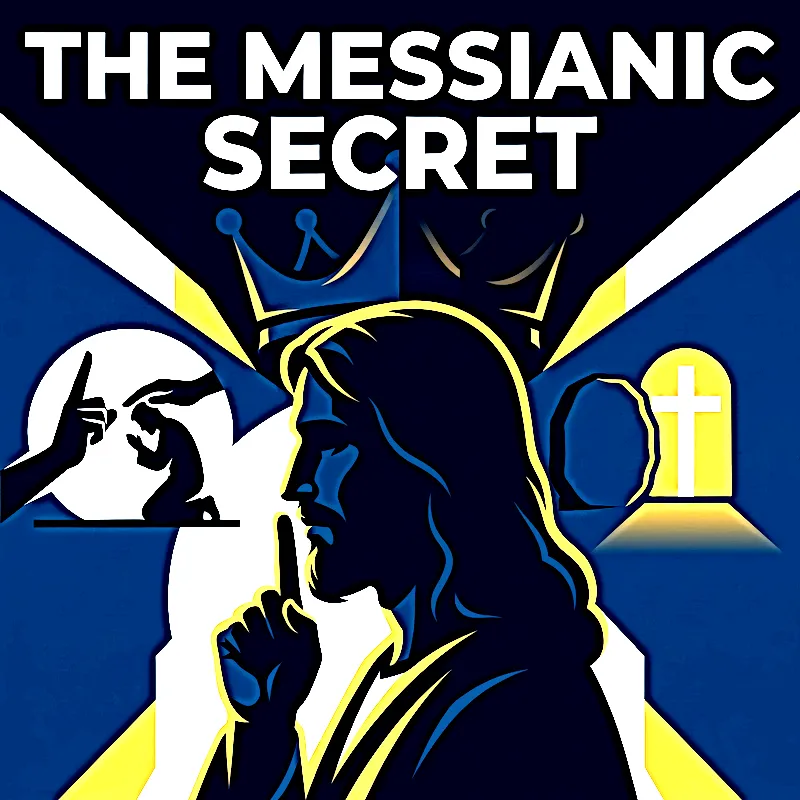
William Wrede's "Messianic Secret": Theory, Evidence, Critique, and Legacy in Markan and Historical-Jesus Scholarship
Messianic Secret Profile
Published
1901
Author
William Wrede
Key Focus
Gospel of Mark
Prominence of Markan Secrecy Phenomena
Demons know Jesus and are silenced
5
Peter confesses and is silenced
5
Healed persons told to remain silent
4
Jesus seeks privacy or concealment
4
Transfiguration temporarily restricted
3
Analyst Note
Wrede did not simply say that "Mark invented the Messianic Secret." He expressly rejected the idea that a single evangelist created the entire conception from nothing; he thought the idea had circulated in Christian circles before Mark, while allowing Mark a substantial role in giving those inherited motifs their concrete literary form. Wrede's theory is simultaneously a theory of pre-Markan tradition, Markan composition, and post-Easter christological development.
William Wrede's 1901 study was one of the decisive interventions in modern Gospel criticism because it challenged the then-common use of Mark as a comparatively transparent historical outline of Jesus' life and insisted that Mark is a theologically shaped narrative. The core of Wrede's argument was that the recurring commands to demons, healed persons, and disciples not to disclose Jesus' identity or deeds, together with private revelation and the disciples' incomprehension, form a theological mechanism explaining why Jesus could retrospectively be the Messiah even though his public ministry had not actually been messianic in self-presentation.
The historical conclusion Wrede drew was that the earliest Christians came to regard Jesus as Messiah in connection with the resurrection and then projected that status backward into his earthly life, explaining the absence of an openly remembered messianic claim by saying that Jesus had deliberately kept the truth secret.
Markan Textual Evidence
| Markan phenomenon | Why it helped Wrede's argument::Why it does not prove Wrede's historical conclusion |
|---|---|
| Demons know Jesus and are silenced | Supernatural beings can recognize an identity hidden from ordinary characters, creating a 'revelation yet concealment' structure.::A literary pattern demonstrates Mark's storytelling, but the conclusion that Jesus made no messianic claims requires a separate historical argument. |
| Peter confesses Jesus as Messiah and is immediately silenced | This is Wrede's strongest example because the concealed content is explicitly messianic rather than merely a miracle.::Immediately afterward Jesus teaches openly about rejection and death, meaning what needs control is not messiahship but its proper, suffering-oriented meaning. |
| Transfiguration revelation is temporarily restricted | The explicit 'until after resurrection' limitation fits Wrede's proposed link between secret messiahship and Easter revelation.::The temporal qualification can be read narratively as postponing proclamation until Jesus' death has redefined his identity. |
Scholarly Impact and Progeny
Wrede's historical conclusion became disputable; his methodological revolution became foundational. Modern Gospel scholarship routinely combines acknowledgment of authorial theological shaping with attempts to investigate earlier traditions and historical memories.
Canonical Pre-Easter Messianic Evidence
| Gospel | Representative pre-Easter messianic evidence::Relationship to Wrede |
|---|---|
| Mark | Peter identifies him as Messiah |
| Jesus imposes silence | - |
| at the trial the high priest asks explicitly about Messiahship and Jesus responds affirmatively. | This is the Gospel Wrede must explain by distinguishing its overtly messianic theological framework from what he reconstructs as an originally non-messianic ministry. |
| Matthew | Peter declares Jesus 'the Messiah' |
| Jesus affirms the revelation, and then orders silence. | Matthew demonstrates that secrecy and a strong messianic Christology are not mutually exclusive. |
| John | Andrew announces he has found the Messiah |
| Jesus openly declares his identity to the Samaritan woman | - |
| the Gospel openly states its purpose is belief that Jesus is Messiah. | John decisively shows that the canonical tradition as a whole does not preserve a uniformly secret messiahship, which Wrede incorporated by arguing that later tradition made Jesus' messiahship progressively more open. |
Wrede helped prepare the intellectual ground for Form Criticism, treating biblical texts as products of an oral-traditional period. He had already made it necessary to distinguish the narrated Gospel from the earlier tradition lying behind it. Redaction Criticism subsequently shifted attention back to the evangelists as purposeful theological editors, where Wrede again looked strikingly prescient in his recognition of creative authorial contribution.
The later literary and narrative turn transformed the question again, allowing Mark's secrecy to be investigated for what it accomplishes for readers—controlling disclosure, producing irony, differentiating insiders and outsiders, and connecting Christology to the Passion—without first assuming that the motif was created to conceal an historical absence.