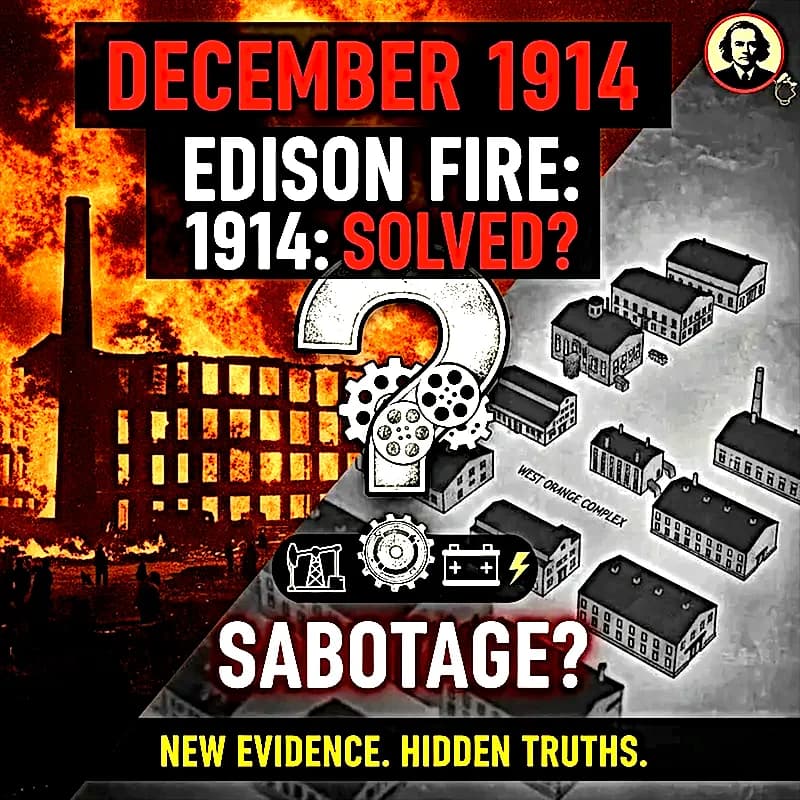
The December 1914 Edison Fire: A Comprehensive Historical Analysis
On December 9, 1914, at approximately 5:15 p.m., a catastrophic fire erupted at Thomas Edison's West Orange laboratory complex in New Jersey, destroying or severely damaging 15 of 22 buildings and causing damages estimated between $1-7 million. The fire originated from an explosion of highly combustible nitrate film in Building 41 (the Film Inspection Department), though alternative theories involving industrial sabotage have persisted into modern times. Edison's iconic response—"Although I am over 67 years old, I'll start all over again tomorrow"—captured his resilience, and within three weeks, partial operations had resumed. [2]Ogden Standard newspaper (December 10, 1914) https://chroniclingamerica.loc.gov/lccn/sn85058396/1914-12-10/ed-1/seq-3/, [6]New York Times - TimesMachine (December 10, 1914) https://www.nytimes.com/1914/12/10/archives/edison-sees-his-vast-plant-burn-inventor-and-wife-dire, [7]Fire Engineering magazine (December 23, 1914) https://www.fireengineering.com/1914/12/23/307391/the-edison-plant-fire-at-west-orange/, [8]Newspapers.com multiple titles (December 1914) https://www.newspapers.com
Incident Snapshot
Event Date
Dec 9, 1914
Ignition Time
5:15 PM
Buildings Damaged
15 of 22
Estimated Loss
$1M-$7M
Operational Scale Indicators Cited in This Report
Total Site Buildings
22
Buildings Damaged
15
On-Site Workers During Fire
250
Employees Reporting Next Day
7000
Fire Progress Benchmarks (Dec 9, 1914)
| Time | Status |
|---|---|
| 5:15 PM | Fire erupts in Building 41 from nitrate film explosion |
| 6:20 PM | Six additional buildings on fire (7 total) |
| 7:40 PM | Six more buildings engaged (13 total) |
| 9:00-9:30 PM | Fire reaches climax |
| chemical explosions send flames 100 feet aloft | - |
| Midnight | Fire brought under control |
The West Orange complex represented Edison's greatest achievement in industrial research
Thomas Edison purchased 14 acres on Main Street in West Orange, New Jersey in January 1887, commissioning architect Henry Hudson Holly to design what would become the world's first modern industrial research laboratory. Construction began in Spring 1887 under supervisor Charles Batchelor, with the main laboratory building (Building 5) completed by September 1887. Operations commenced by November/December 1887 after equipment was transferred from Edison's lamp factory in Harrison, NJ. [4]NPS Park Cultural Landscapes documentation (2014) https://npsparkclp.tumblr.com/post/104770948102/fire, [5]Smithsonian "Never Touched Me!" photo (1914) https://americanhistory.si.edu/edison/ed_d16.htm
The complex cost approximately $180,000 (equivalent to over $2 million by 1987 dollars) and was designed to be ten times larger than Edison's famous Menlo Park laboratory. The original configuration included: [4]NPS Park Cultural Landscapes documentation (2014) https://npsparkclp.tumblr.com/post/104770948102/fire, [5]Smithsonian "Never Touched Me!" photo (1914) https://americanhistory.si.edu/edison/ed_d16.htm
- Building 5 (Main Laboratory): Three stories, 250 feet × 50 feet, containing Edison's office, research library, machine shops, experimental rooms, and power house
- Building 1 (Physics Laboratory): Galvanometer room on deep brick/cement foundation for sensitive electrical measurements
- Building 2 (Chemistry Laboratory): Described in 1888 as "one of the best-equipped chemistry laboratories in the world"
- Building 3: Chemical storage and pattern shop
- Building 4 (Metallurgical Laboratory): Ore analysis, later phonograph experiments
By May 1888, Edison had broken ground on the adjacent Edison Phonograph Works, which by 1914 had expanded to 22 buildings employing approximately 7,000 workers. More than half of Edison's 1,093 U.S. patents resulted from work at West Orange, including developments in phonographs, motion pictures, the nickel-iron storage battery, and Portland cement. [4]NPS Park Cultural Landscapes documentation (2014) https://npsparkclp.tumblr.com/post/104770948102/fire, [5]Smithsonian "Never Touched Me!" photo (1914) https://americanhistory.si.edu/edison/ed_d16.htm
No major prior incidents preceded the December 1914 fire
Research into historical records reveals no documented major fires, explosions, or significant accidents at the West Orange laboratory complex before December 1914. However, Edison maintained awareness of fire risks, as evidenced by several precautionary measures: [4]NPS Park Cultural Landscapes documentation (2014) https://npsparkclp.tumblr.com/post/104770948102/fire, [8]Newspapers.com multiple titles (December 1914) https://www.newspapers.com
Edison employed a 72-man employee fire department at the complex. Photographs from 1912 document workers conducting fire drills with fire hoses in the laboratory courtyard. In 1912-1913, Edison constructed Vault 8 specifically for "fireproof storage of films" for his Educational Motion Picture Department—an acknowledgment of the volatile nature of nitrate film stock. [4]NPS Park Cultural Landscapes documentation (2014) https://npsparkclp.tumblr.com/post/104770948102/fire, [8]Newspapers.com multiple titles (December 1914) https://www.newspapers.com
The broader Edison enterprise did experience fire incidents elsewhere. Edison's former property at Menlo Park saw his home destroyed by fire in 1914 and his office/library building burned in 1919—but these occurred at the abandoned Menlo Park site, not West Orange. Earlier in 1914, Edison's Bronx motion picture studio experienced a fire attributed to "a short circuit inside a lighting switchboard." [8]Newspapers.com multiple titles (December 1914) https://www.newspapers.com
The year 1914 proved particularly devastating for the film industry regarding nitrate fires: the Eclair studio fire in Fort Lee, NJ (March 1914, $750,000 damage), Universal Pictures fire (May 1914), and the Lubin vault fire in Philadelphia (June 1914) all preceded Edison's December disaster. [8]Newspapers.com multiple titles (December 1914) https://www.newspapers.com
The fire spread with terrifying speed through volatile chemicals
The disaster began at approximately 5:15-5:17 p.m. on Wednesday, December 9, 1914, when an explosion ripped through Building 41, the Film Inspection Department. Approximately 250 workers were present in the buildings at this hour. The fire spread with extraordinary speed due to the highly combustible materials stored throughout the complex: [2]Ogden Standard newspaper (December 10, 1914) https://chroniclingamerica.loc.gov/lccn/sn85058396/1914-12-10/ed-1/seq-3/, [7]Fire Engineering magazine (December 23, 1914) https://www.fireengineering.com/1914/12/23/307391/the-edison-plant-fire-at-west-orange/, [8]Newspapers.com multiple titles (December 1914) https://www.newspapers.com
Fire Engineering magazine reported on December 23, 1914: "An explosion in the film testing building, a one-story frame structure in the centre of the yard, at 5.17 p.m., caused the fire." The publication identified responding fire chiefs: Chief W.H. Matthews (Orange), Chief James Sheehan (West Orange), Chief G.E. Koeber (Bloomfield), Chief W.E. Markwith (East Orange), and Chief William Ash (South Orange). Chief Sheehan's "face and hands were badly burned by a back draft while fighting to save the laboratory." [7]Fire Engineering magazine (December 23, 1914) https://www.fireengineering.com/1914/12/23/307391/the-edison-plant-fire-at-west-orange/
The fire claimed one life: employee William H. Troeber, who "rushed back into a burning building with a fire extinguisher because he erroneously believed that some of his coworkers were still inside." One worker, reportedly John Ciccone, was hurled 40 feet into the air by an explosion and broke his spine, never walking again. Up to 10,000 spectators gathered to witness the conflagration, which caused secondary fires as far as five blocks away. [7]Fire Engineering magazine (December 23, 1914) https://www.fireengineering.com/1914/12/23/307391/the-edison-plant-fire-at-west-orange/, [8]Newspapers.com multiple titles (December 1914) https://www.newspapers.com
Multiple entities investigated the fire's causes and structural failures
The investigation of the December 1914 fire involved several organizations and extended into 1915. The Thomas Edison Papers at Rutgers University (folder E1483-F) preserves 132 documents including investigation-related correspondence: [1]Edison Papers Project (Rutgers) - Fire documents https://edisondigital.rutgers.edu/folder/E1483-F
American Concrete Institute: Architect Cass Gilbert participated in a special committee formed by the American Concrete Institute to investigate the fire. A letter dated December 19, 1914 (Document E1483DL) documents this involvement. The investigation focused on why buildings constructed of reinforced concrete—designed under Edison's personal supervision and thought to be fireproof—failed to prevent catastrophic damage. Fire Engineering noted: "Six were recently constructed of reinforced concrete and were erected from plans of Mr. Edison and under his personal supervision. Until the fire the plant was supposed to be fireproof." [1]Edison Papers Project (Rutgers) - Fire documents https://edisondigital.rutgers.edu/folder/E1483-F, [7]Fire Engineering magazine (December 23, 1914) https://www.fireengineering.com/1914/12/23/307391/the-edison-plant-fire-at-west-orange/
Condron Company of Chicago: This structural engineering firm was engaged via telegram on December 10, 1914 (Document E1483AW) to conduct appraisal work on fire damage. [1]Edison Papers Project (Rutgers) - Fire documents https://edisondigital.rutgers.edu/folder/E1483-F
Newark Board of Fire Commissioners: Edison sent correspondence to this body on December 16, 1914 (Document E1483DC). [1]Edison Papers Project (Rutgers) - Fire documents https://edisondigital.rutgers.edu/folder/E1483-F
The Edison Papers archive contains additional investigation documentation including "lists of employees who worked during the night of the fire," "reports regarding the condition of tools and machinery," and "two scrapbooks of newspaper and journal clippings relating to the fire (Cat. 44,509 and Cat. 44,510)." [1]Edison Papers Project (Rutgers) - Fire documents https://edisondigital.rutgers.edu/folder/E1483-F
Authorities attributed the fire to nitrate film—a known industrial hazard
The official cause determined by investigators was an explosion of nitrate film stored in Building 41. Nitrate film (nitrocellulose, also known as cellulose nitrate or "gun cotton") was identical in composition to a major ingredient in naval munitions. According to contemporary accounts, this material was "highly combustible," could "produce its own oxygen," and was known to "even burn underwater." The material becomes increasingly unstable as it ages. [3]Edison Phonograph Monthly - Fire Edition (January 1915) https://archive.org/stream/edisonphonograph13moor/edisonphonograph13moor_djvu.txt, [7]Fire Engineering magazine (December 23, 1914) https://www.fireengineering.com/1914/12/23/307391/the-edison-plant-fire-at-west-orange/
Fire Engineering magazine (December 23, 1914) stated definitively: "An explosion in the film testing building, a one-story frame structure in the centre of the yard, at 5.17 p.m., caused the fire." The publication estimated total damage at "about $1,000,000" with insurance coverage of only "$258,700." [7]Fire Engineering magazine (December 23, 1914) https://www.fireengineering.com/1914/12/23/307391/the-edison-plant-fire-at-west-orange/
The New York Times (December 10, 1914) reported damages "reached seven million dollars, with only two million covered by insurance." This discrepancy likely reflects different accounting methods—some estimates covered only immediate physical damage while others included lost inventory, research materials, and business interruption costs. [6]New York Times - TimesMachine (December 10, 1914) https://www.nytimes.com/1914/12/10/archives/edison-sees-his-vast-plant-burn-inventor-and-wife-dire
The exact ignition source within Building 41 was never definitively established in contemporary reporting, even though nitrate film was consistently identified as the proximate fuel and hazard. [7]Fire Engineering magazine (December 23, 1914) https://www.fireengineering.com/1914/12/23/307391/the-edison-plant-fire-at-west-orange/, [8]Newspapers.com multiple titles (December 1914) https://www.newspapers.com
Modern conspiracy theories lack substantial historical evidence
The Rockefeller-Pinkerton Theory: Douglas Brunt's 2023 New York Times bestseller The Mysterious Case of Rudolf Diesel (Simon & Schuster/Atria Books) posits that John D. Rockefeller used the Pinkerton National Detective Agency to deliberately burn down Edison's laboratory. According to Brunt, the fire targeted the Edison-Ford electric car battery project, which "aimed to capture a market that was presently served by Rockefeller's petroleum." [8]Newspapers.com multiple titles (December 1914) https://www.newspapers.com
The theory draws on documented Pinkerton-Rockefeller connections (Pinkertons served as union-busters and corporate spies for Standard Oil) and the timing coincidence with Ford's public announcement in January 1914 of an electric vehicle collaboration with Edison. [8]Newspapers.com multiple titles (December 1914) https://www.newspapers.com
Critical Problems with the Theory: Hagerty Media's December 2023 analysis ("The Rockefeller/Rudolf Diesel murder theory is full of holes") systematically debunks the conspiracy theory: [8]Newspapers.com multiple titles (December 1914) https://www.newspapers.com
- Edison's storage battery plant and R&D laboratory were NOT destroyed in the fire—the buildings most critical to electric vehicle development survived
- The electric Model T was developed in Michigan, not New Jersey—Edison supplied batteries only
- Ford had already purchased 100,000+ batteries before the fire
- The project failed due to low energy-density and long charging times—technical limitations, not sabotage
- When Ford discovered his R&D team had replaced Edison batteries with lead-acid cells for better performance, Ford himself killed the project
- Electric cars constituted a tiny market fraction by 1914—Ford was selling 200,000+ Model Ts annually
Other Conspiracy Claims: Websites like Iron Core Batteries and The Vintage News repeat claims that "oil cartels" pressured Edison and Ford to abandon electric vehicles, but these sources provide no citations or documentation. These appear to be modern internet speculation with no basis in contemporary historical records. [8]Newspapers.com multiple titles (December 1914) https://www.newspapers.com
No investigation found evidence of arson. No threats or warnings to Edison were documented before the fire. Edison himself showed no indication of suspecting sabotage, immediately focusing on rebuilding and making no public accusations. Henry Ford loaned Edison $750,000 to rebuild—evidence of continued partnership rather than abandonment. [1]Edison Papers Project (Rutgers) - Fire documents https://edisondigital.rutgers.edu/folder/E1483-F, [6]New York Times - TimesMachine (December 10, 1914) https://www.nytimes.com/1914/12/10/archives/edison-sees-his-vast-plant-burn-inventor-and-wife-dire, [8]Newspapers.com multiple titles (December 1914) https://www.newspapers.com
Primary sources document Edison's remarkable resilience
The Thomas Edison Papers Project at Rutgers University preserves Edison's handwritten note from the night of the fire: "Am pretty well burned out -- but tomorrow there will be some rapid mobilizing when I find out where I am at." An inscription indicates this was "written by T.A.E. for Press at height of fire." [1]Edison Papers Project (Rutgers) - Fire documents https://edisondigital.rutgers.edu/folder/E1483-F
The Ogden Standard (December 10, 1914, freely accessible via Library of Congress Chronicling America) quoted Edison: "I am pretty well burned out tonight, but tomorrow there will be a mobilization and the debris will be cleared away if it is cooled sufficiently, and I will go right to work to reconstruct the plant." [2]Ogden Standard newspaper (December 10, 1914) https://chroniclingamerica.loc.gov/lccn/sn85058396/1914-12-10/ed-1/seq-3/
The New York Times (December 10, 1914) reported Edison's famous statement: "Although I am over 67 years old, I'll start all over again tomorrow." [6]New York Times - TimesMachine (December 10, 1914) https://www.nytimes.com/1914/12/10/archives/edison-sees-his-vast-plant-burn-inventor-and-wife-dire
Charles Edison's 1961 Reminiscence: In Reader's Digest, Edison's son recalled his father's words that night: "Find her [Mina Edison]. Bring her here. She will never see anything like this as long as she lives." And later: "It's all right. We've just got rid of a lot of rubbish." [1]Edison Papers Project (Rutgers) - Fire documents https://edisondigital.rutgers.edu/folder/E1483-F, [8]Newspapers.com multiple titles (December 1914) https://www.newspapers.com
The Edison Papers archive contains 132 documents related to the fire, including correspondence with Nikola Tesla (whose telegram stated: "It is not only a personal and national loss, but a world loss, for you have been one of its greatest benefactors"), Andrew Carnegie, George Eastman, President Woodrow Wilson, and executives from General Electric. [1]Edison Papers Project (Rutgers) - Fire documents https://edisondigital.rutgers.edu/folder/E1483-F
Rebuilding Timeline: All 7,000 employees reported for duty the morning after the fire. Edison directed a crew of 1,500 men to clear debris. Within two days, Edison had finalized designs for a battery-powered searchlight. By New Year's Day 1915 (three weeks later), factory buildings were partially restored and employees were back at work. Within six months, Edison was demonstrating his new searchlight invention. By 1915, Thomas Edison Industries achieved $10 million in revenue. Within three years, nearly all destroyed buildings had been reconstructed. [1]Edison Papers Project (Rutgers) - Fire documents https://edisondigital.rutgers.edu/folder/E1483-F, [3]Edison Phonograph Monthly - Fire Edition (January 1915) https://archive.org/stream/edisonphonograph13moor/edisonphonograph13moor_djvu.txt, [8]Newspapers.com multiple titles (December 1914) https://www.newspapers.com
Sources
- Edison Papers Project (Rutgers) - Fire documents, https://edisondigital.rutgers.edu/folder/E1483-F
- Ogden Standard newspaper (December 10, 1914), https://chroniclingamerica.loc.gov/lccn/sn85058396/1914-12-10/ed-1/seq-3/
- Edison Phonograph Monthly - Fire Edition (January 1915), https://archive.org/stream/edisonphonograph13moor/edisonphonograph13moor_djvu.txt
- NPS Park Cultural Landscapes documentation (2014), https://npsparkclp.tumblr.com/post/104770948102/fire
- Smithsonian "Never Touched Me!" photo (1914), https://americanhistory.si.edu/edison/ed_d16.htm
- New York Times - TimesMachine (December 10, 1914), https://www.nytimes.com/1914/12/10/archives/edison-sees-his-vast-plant-burn-inventor-and-wife-dire
- Fire Engineering magazine (December 23, 1914), https://www.fireengineering.com/1914/12/23/307391/the-edison-plant-fire-at-west-orange/
- Newspapers.com multiple titles (December 1914), https://www.newspapers.com