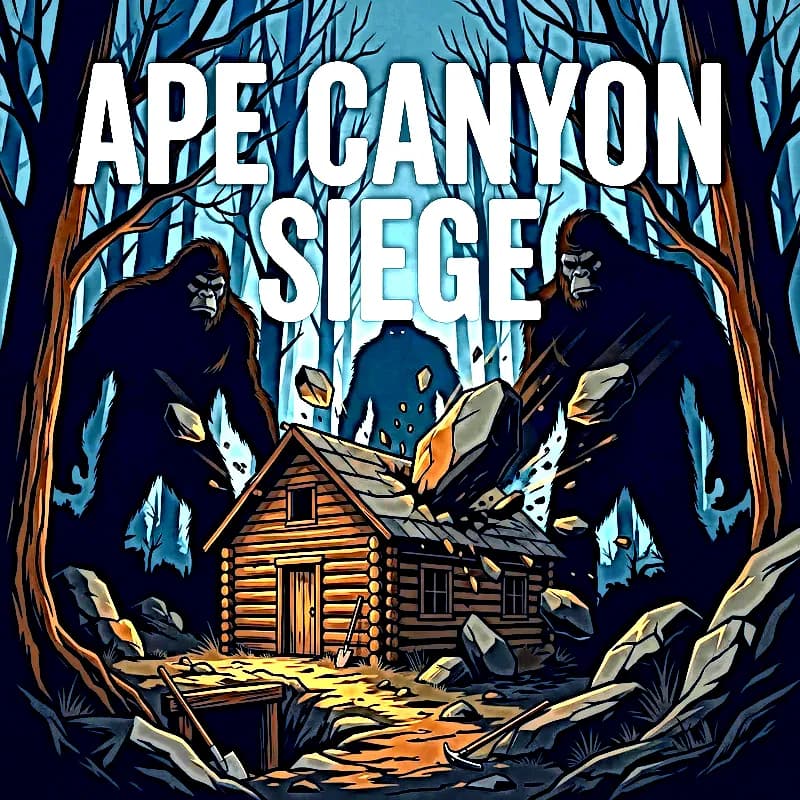
This document provides a comprehensive forensic and historical analysis of the 1924 Ape Canyon incident, a pivotal event where five gold miners reported being besieged by aggressive, bipedal creatures near Mount St. Helens. The text explores the transition of indigenous "Mountain Devil" legends into modern Bigfoot folklore while examining the specific geographic features and eyewitness testimonies that define the encounter. By juxtaposing the miners' accounts of a nighttime rock-throwing assault with skeptical theories—such as YMCA camp pranks and official Forest Service dismissals—the source evaluates the lasting impact of the narrative on Pacific Northwest history. Ultimately, the analysis highlights how the abandonment of a lucrative mining claim and subsequent spiritualist interpretations transformed a physical confrontation into a seminal cultural myth that persists despite the geological changes caused by the 1980 volcanic eruption.
Case Snapshot
Subject
1924 Ape Canyon Incident
Source Entries
14
Location
Mt. St. Helens, WA
Prospectors
Fred Beck, Marion Smith, and 3 others
Event Date
July 10, 1924
Evidence Distribution
Section Headings
14
Markdown Tables
5
Unique Citations
14
Inline References
65
Core Timeline Anchors
| Date | Milestone |
|---|---|
| July 1924 | Five miners besieged by creatures at Ape Canyon |
| July 13, 1924 | The Oregonian publishes 'Fight With Big Apes Reported By Miners' |
| 1924 | Forest Service Rangers Huffman and Welch investigate site |
| May 1950 | Mountaineer Jim Carter vanishes near Ape Canyon |
| 1967 | Fred Beck publishes I Fought the Apemen of Mt. St. Helens |
| May 18, 1980 | Mt. St. Helens eruption alters the canyon landscape |
| 2013 | Researcher Marc Myrsell identifies original cabin foundation |
Geological and Geographic Profile of the Mount St. Helens Environment
The volcanic landscape of the Cascade Range has long served as a repository for both geological and folkloric upheaval, but few events have crystallized the intersection of these two forces as profoundly as the encounter in July 1924 at Ape Canyon.[1] This incident, characterized by a reported multi-hour siege of a miners' cabin by bipedal, hair-covered entities, transcends simple cryptozoological curiosity to function as a seminal moment in the transition of indigenous "Mountain Devil" legends into the modern Bigfoot phenomenon.[2] The site of the encounter, a narrow gorge on the southeastern shoulder of Mount St. Helens, was significantly impacted by the 1980 eruption, yet the narrative persists as a primary case study in eyewitness testimony, media sensationalism, and scientific skepticism.[3]
The setting for the 1924 incident, specifically known as Ape Canyon, is a steep-walled gorge located along the eastern edge of the Plains of Abraham.[3] Before the catastrophic eruption of May 18, 1980, the topography was defined by rugged volcanic ridges, glacial systems, and dense coniferous forests that offered substantial isolation for industrial prospecting.[4] The canyon itself is noted for its dramatic narrowing, reaching widths as restricted as eight feet at specific bottlenecks, which creates a natural funnel for both auditory resonance and physical movement.[3]
| Physical Characteristics of the Ape Canyon Site | ||
|---|---|---|
| Geographic Variable | Specification | Reference |
| Location | Southeast shoulder of Mount St. Helens | [3] |
| Elevation (Summit pre-1980) | 9,677 feet (approximate) | [4] |
| Canyon Depth | Approximately 200 feet of sheer rock wall | [1] |
| Narrowest Width | 8 feet (2.4 meters) | [3] |
| Primary Drainage | Muddy River system | [5] |
| Distance from Spirit Lake | 8 miles | [6] |
The geological composition of the area is primarily dacitic and andesitic, a result of the volcano's relatively young age of less than 40,000 years.[4] This environment provided the miners with ample deposits of volcanic stone, including pumice, which would later play a central role in skeptical theories regarding the nature of the "missiles" used in the attack.[7] The ruggedness of the terrain, specifically the 400-foot-deep gorge where one creature supposedly fell, contributed to the miners' claims of inaccessibility—a claim that would be rigorously tested by federal investigators.[8]
The Prospecting Party: Biographies and Reputations
The group at the center of the controversy consisted of five men from the Kelso and Lexington areas of Washington: Fred Beck, Marion Smith, Roy Smith (Marion's son), Gabe Lefever, and John Peterson.[6] These individuals were not transient adventurers but experienced prospectors who had been working the Mount St. Helens area for approximately six years.[5] Their investment in the region was significant, centering on the Vander White Mine, a claim named after a spiritual entity Fred Beck alleged had guided him to the gold deposit.[9]
| Identification of the Prospecting Quintet | |||
|---|---|---|---|
| Participant Name | Role in Encounter | Post-Incident Status | Reference |
| Fred Beck | Witness and chronicler; firing participant | Author of "I Fought The Apemen of Mt. St. Helens" | [10] |
| Marion Smith | Lead prospector; initiator of defensive fire | Reputed for "sterling reputation" in Kelso | [11] |
| Roy Smith | Witness of charging animal at the spring | Described as "badly frightened" in 1924 reports | [5] |
| Gabe Lefever | Defensive support; braced the cabin door | Witness to footprints and physical bombardment | [8] |
| John Peterson | Defensive support; armed with revolver | Identified as part of the group in The Oregonian | [2] |
Contemporary accounts emphasized that the men, particularly Fred Beck and the elder Smith, were regarded by their community as sober and reliable individuals whose testimony was not easily dismissed as drunken hallucination.[11] This social standing proved critical when they returned to civilization "glassy-eyed" and visibly traumatized, a state that prompted immediate concern and eventual investigation by the United States Forest Service.[2]
Precursory Anomalies and Initial Hostilities
The actual siege on the night of July 10, 1924, was the culmination of at least a week of escalating disturbances that had already placed the prospectors on a high state of alert.[8] The men reported hearing rhythmic thumping noises that they likened to a large man striking his chest with a closed fist, as well as a variety of loud, echoing whistles that seemed to serve as a form of communication between unseen entities in the forest.[8]
During this week, the discovery of 14-inch, human-like footprints around the spring and trails—some sunk four inches deep into the soil—began to unnerve the group, leading them to carry their rifles during even the most mundane chores.[8] The first visual sighting occurred when Fred Beck and Marion Smith encountered a seven-foot-tall, hair-covered creature standing near a pine tree during a morning water run.[8] When the creature peered from behind the tree, Marion Smith fired three shots at it, though it did not appear to be hit; Beck fired three more shots as it reappeared 200 yards down a small canyon.[8]
Sequence of Hostile Escalation
The hostilities further increased when Roy Smith encountered a creature charging out of the alders, waving its arms and striking its chest.[5] He fired his pistol at the entity, which came within fifteen feet before retreating into the brush.[5] Later that same afternoon, Fred Beck and Peterson encountered another creature as they returned to the cabin; Beck reportedly struck the animal with a final shot from his rifle, which appeared to cause it to topple over the precipice into the deep gorge.[5] This specific act of violence—the perceived killing of one of the entities—is often cited as the catalyst for the retaliatory siege that followed.[2]
The Siege: A Detailed Reconstruction of the Nighttime Attack
As darkness fell, the five prospectors retreated into their hand-built log cabin, which had been completed only six to eight weeks prior.[11] The cabin served as their primary fortification, constructed of heavy logs but still vulnerable at the seams where "chinking" (filling material) was placed.[8] Around midnight, the group was startled by a massive impact against the exterior wall—a thud so powerful it dislodged the chinking and allowed the men to peer through the gaps into the darkness.[8]
Outside, the miners observed at least three large, hairy creatures, which immediately began a systematic bombardment of the structure using rocks and boulders.[8] The entities also pounded on the walls and door with their fists, producing a sound that echoed the drumming they had heard earlier in the week.[8] The vulnerability of the cabin was highlighted when rocks began falling through the hole in the roof that functioned as a smokestack.[5] One of these rocks struck Fred Beck, rendering him unconscious for approximately two hours.[6]
| Defensive Actions and Breaches | |||
|---|---|---|---|
| Time/Phase | Defensive Response | Outcome | Reference |
| Midnight | Men braced the door with bunk bed boards | Prevented immediate entry by ramming | [8] |
| Roof Assault | Fired rifles through the roof structure | Forced the creature to jump back to the ground | [8] |
| Wall Breach | Fred Beck wrestled for an axe grabbed by a creature | Prevented the entity from using the tool inside | [8] |
| Window/Gaps | Aimed rifles through holes in the logs | Kept creatures at a distance; discouraged close contact | [1] |
The struggle for the axe became a centerpiece of the narrative, with a creature reportedly reaching its arm through a gap in the logs to seize a tool leaning against the interior wall.[8] Marion Smith allegedly shot at the creature's arm, forcing it to release the axe and pull back into the darkness.[8] The psychological pressure of the siege was immense, with the men refraining from indiscriminate fire to conserve ammunition in case of a total breach.[5] The assault continued unabated until the first signs of dawn began to appear in the canyon.[8]
Analysis of 1924 Newspaper Coverage and Public Impact
The return of the prospectors to civilization triggered a media frenzy that spread their story across the Pacific Northwest and eventually to national outlets.[8] The Oregonian was the primary vehicle for the initial reports, publishing "Fight With Big Apes Reported By Miners" on July 13, 1924.[12] These articles were not merely reporting facts but were participating in a burgeoning regional obsession with hidden wildlife and "wild man" legends.[2]
The descriptions provided to the press were remarkably specific for a period before the "Bigfoot" archetype was solidified.[2] The men described creatures approximately seven feet tall, covered in long black or blackish-brown hair, with ears about four inches long that stood "straight up."[2] Notably, they observed that the tracks had four toes—short and stubby—and estimated the weight of each individual at 400 pounds.[2]
| Comparative Media Perspectives (July 1924) | |||
|---|---|---|---|
| Date | Publication | Key Narrative Contribution | Reference |
| July 13, 1924 | The Oregonian | Detailed the physical confrontation and rock attack | [12] |
| July 16, 1924 | Seattle Daily Times | Linked "gorilla men" to a potential lost race of giants | [12] |
| July 17, 1924 | Portland Journal | Reported the finding of rocks inside the cabin at Spirit Lake | [12] |
| July 17, 1924 | The Real American | Identified entities as "Seeahtik Indians" | [12] |
| July 21, 1924 | Daily Journal | Introduced skeptical angle involving "Portland lads" | [12] |
The influence of Jorg Totsgi's article in The Real American cannot be overstated, as it connected the prospectors' account with a specialized indigenous tradition of the "Seeahtik." Totsgi claimed that the Clallam and other Northwest tribes had kept the secret of these "half-animal" beings because they were ashamed of them, yet they resided in the Cascade caves and were known to seek vengeance if harmed. This cultural synthesis helped the story transition from a mere miner's tall tale into a legitimate regional mystery that demanded government attention.[5], [8]
The Forest Service Inquest: Rangers Huffman and Welch
Intrigued by the public furor and the apparent trauma of the miners, the U.S. Forest Service authorized an official investigation into the Ape Canyon incident.[6] Rangers J.H. Huffman and William Welch were dispatched to the site, guided by Fred Beck, who led them back to the scene of the purported battle.[2] This investigation remains the only contemporaneous official survey of the site after the event.[13]
The results of the survey were almost entirely negative. Ranger Huffman descended into the "inaccessible" canyon where Beck claimed the wounded ape-man had fallen but found no trace of a body, blood, or disturbed vegetation.[3] Upon reaching the cabin, the rangers noted the presence of large boulders, but they remained deeply skeptical, concluding that the prospectors had likely placed the stones themselves to "bolster their tale."[3]
The most damaging blow to the miners' credibility came from Huffman's demonstration regarding the 14-inch footprints. Using the knuckles and palm of his right hand, Huffman successfully replicated the shape and depth of the prints described by the miners. Based on these observations, the Forest Service officially deemed the incident a prank or a hoax. Despite this dismissal, the story's momentum was such that many local residents continued to believe the men, citing their fear and the abrupt abandonment of their gold claim as evidence of a genuine encounter.[2], [6]
Skeptical Theories: From Pranks to Psychological Archetypes
Skepticism regarding Ape Canyon has coalesced around several specific theories that attempt to explain the incident without recourse to unknown primates. One of the most prominent theories was championed by William Halliday, Director of the Western Speleological Survey, who suggested that the "ape-men" were in fact local youths from YMCA Camp Meehan on nearby Spirit Lake.[7]
The YMCA Camp Meehan / Pumice Stone Hypothesis
| Skeptical Element | Theoretical Explanation | Mechanism of Deception | Reference |
|---|---|---|---|
| Rock Bombardment | Campers throwing pumice stones into the gorge | Pumice is lightweight, volcanic, and abundant nearby | [7] |
| Visual Distortion | Moonlit figures on the canyon rim | High angle and poor lighting transformed silhouettes into "giants" | [7] |
| Auditory Distortion | Narrow canyon walls (8-foot bottleneck) | Echoing and vocal distortion turned human voices into "shrieks" | [7] |
| Motive | Rowdy youths engaged in a nighttime prank | Unaware that miners were camped at the bottom | [14] |
Halliday's theory is supported by a long-standing fireside tradition at the YMCA camp, where generations of counselors have related the story as a prank gone wrong.[11] Critics of this theory, however, point out that it fails to account for the physical struggle for the axe or the specific shooting incidents at close range.[7] Other skeptical explanations have suggested that rival miners were attempting to scare the group off their claim, or that the entire episode was a byproduct of the men's interests in spiritualism—specifically Fred Beck's belief in guiding spirits like "Vander White."[11]
Subsequent Anomalies: The Disappearance of Jim Carter (1950)
The legacy of Ape Canyon as a location of "strangeness" was revitalized twenty-six years later by the disappearance of Jim Carter, a skilled mountaineer and skier.[9] In May 1950, while on an excursion with twenty other climbers, Carter vanished near the "Dog's Head" landmark at the 8,000-foot level.[7] The subsequent search revealed an alarming sequence of tracks that suggested Carter had undergone a "wild, death-defying dash" down the mountain, taking risks that searchers believed were only possible if he were being pursued.[7]
The tracks led directly into the precipitous walls of Ape Canyon, which Carter had seemingly descended with a speed and disregard for safety that "no skier of his calibre would take unless something was terribly wrong." Despite extensive searches, no trace of Carter was ever recovered. This incident provided a modern, lethal context to the 1924 reports, leading prominent mountaineers like Bob Lee to suggest that the "apes" had finally claimed a victim.[7]
Fred Beck's Metaphysical Evolution and the 1967 Booklet
The transition of the Ape Canyon story from a biological encounter to a metaphysical one occurred primarily through the later writings of Fred Beck.[14] In 1967, Beck published a self-published booklet titled I Fought the Apemen of Mt. St. Helens, which introduced elements far removed from his initial 1924 testimony.[10] In this later narrative, Beck theorized that the "mountain devils" were not merely undiscovered primates but interdimensional beings that existed on a different plane of consciousness.[7]
| Comparison of Beck's Narratives | ||
|---|---|---|
| Attribute | 1924 Testimony | 1967 Booklet Narrative |
| Biological Nature | Hairy, 400lb, four-toed animals | Supernatural, interdimensional beings |
| Origin of Mine | Standard prospecting in a known area | Discovered via the spirit of "Vander White" |
| Physical Permanence | Creatures that can be shot and killed | Entities that vanish or "remain blurry" |
| Symmetry with Myth | Compared to gorillas or bears | Linked to psychic phenomena and "Mountain Devils" |
This shift in perspective reflected a broader trend in high-strangeness research, where the lack of physical evidence for Sasquatch—such as carcasses or bones—led some witnesses to adopt spiritual or metaphysical explanations.[14] Despite these mystical additions, comparative analysis by researchers like Marc Myrsell has shown that the core details of the 1924 attack remained "highly congruent" in Beck's retellings, with only minor discrepancies regarding timing (e.g., whether the final shot was Thursday afternoon or Friday morning).[11]
Modern Status and Geological Context After the 1980 Eruption
The landscape of Ape Canyon was permanently altered by the 1980 eruption of Mount St. Helens.[3] While the canyon was not destroyed, it was heavily impacted by volcanic mudslides (lahars) and significant ash deposition.[3] The eruption's scale—equivalent to 26 megatons of TNT—obliterated much of the local infrastructure and arguably any physical remains of the original miner's cabin.[3]
In 2013, however, researcher Marc Myrsell conducted a field survey and claimed to have identified the exact foundation of the 1924 cabin, verified by square nails and foundation cross-sections that matched the building techniques of the era.[9] This site is located near Pumy Butte, providing a tangible geographic link to the legend.[8] Today, the area is a popular recreational site, featuring the Ape Canyon Trail, which is used extensively by hikers and mountain bikers who pass within sight of the narrow gorge that gave the legend its name.[3]
Forensic Analysis of Physical Evidence and Testimonies
The physical evidence of the Ape Canyon incident remains a subject of intense scrutiny. The 14-inch footprints, while dismissible by Ranger Huffman's hand-print demonstration, were described by the miners as being deeply impressed into hard ground, which some researchers argue would require significantly more weight than a human hand could exert.[8] Furthermore, the "Proof of Labor" mining records filed by Fred Beck and witnessed by Marion Smith on July 10, 1924, provide a critical bureaucratic corroboration of their story.[11]
These records show that the men officially completed their work for the year on the very day of the attack, effectively abandoning their claim despite having months of favorable weather remaining in the season. This abandonment represents a financial loss and a professional retreat that lends a layer of sincerity to their claims of extreme terror. While the Forest Service investigation was unable to find biological proof, the combination of survivor trauma, consistent testimony, and the sudden cessation of labor suggests that an event of significant psychological and physical impact did occur at the Vander White Mine in July 1924.[11]
The synthesis of primary newspaper accounts, indigenous lore, and geological history establishes Ape Canyon not merely as a site of a potential cryptid encounter, but as a cultural landmark that bridged the gap between ancient myths and modern cryptozoology.[1] The narrative remains a cornerstone of Pacific Northwest history, reflecting the enduring human fascination with the "wild" and the unexplained in the shadow of the Cascades.[1]
Sources
- Siege of the Sasquatch: Ape Canyon Bigfoot Encounter - Hangar 1 Publishing, https://hangar1publishing.com/blogs/cryptids/ape-canyon-bigfoot-attack
- How a 1924 Bigfoot Battle on Mount St. Helens Helped Launch a Legend - The Chronicle, http://www.chronline.com/stories/how-a-1924-bigfoot-battle-on-mount-st-helens-helped-launch-a-legend,19803
- Ape Canyon - Wikipedia, https://en.wikipedia.org/wiki/Ape_Canyon
- Mount St. Helens - Wikipedia, https://en.wikipedia.org/wiki/Mount_St._Helens
- Bigfoot 1924 - The Columbia County Historian, https://twrps.com/history/news-from-the-past/bigfoot/
- 8 Unnerving Bigfoot Stories That Will Make Believers Out Of Skeptics, https://allthatsinteresting.com/bigfoot-sightings/7
- An Ape-tley Named Legend: 99 Years of Ape Canyon - Black Beasts and Boogeymen, https://blackbeastsandboogeymen.com/2023/07/16/an-ape-tley-named-legend-99-years-of-ape-canyon/
- Cryptid History: Ape Canyon - The Pine Barrens Institute, https://pinebarrensinstitute.com/cryptids/2018/8/18/cryptid-history-ape-canyon
- 1924 Ape Canyon incident discussion - Reddit r/Cryptozoology, https://www.reddit.com/r/Cryptozoology/comments/17knfs0/in_1924_the_infamous_ape_canyon_incident_occurred/
- I Fought the Apemen of Mt. St. Helens - Burnside Rare Books, https://www.burnsiderarebooks.com/pages/books/140948691/fred-beck-everett-davenport-r-a-beck-artist/i-fought-the-apemen-of-mt-st-helens
- Ape Canyon — Did They Shoot One? - Bigfoot Forums, https://bigfootforums.com/topic/51084-ape-canyon-did-they-shoot-one/page/3/
- 1924 Ape Canyon Bibliography - Netzwerk für Kryptozoologie, https://netzwerk-kryptozoologie.de/wp-content/uploads/2020/01/1924-Ape-Canyon-Bibliograpy.pdf
- TBP Ep:18 Ape Canyon - Spreaker, https://www.spreaker.com/episode/tbp-ep-18-ape-canyon--58268988
- Creepy Mysteries: Ape Canyon Attack - Funk's House of Geekery, https://houseofgeekery.com/2021/11/23/creepy-mysteries-ape-canyon-attack/