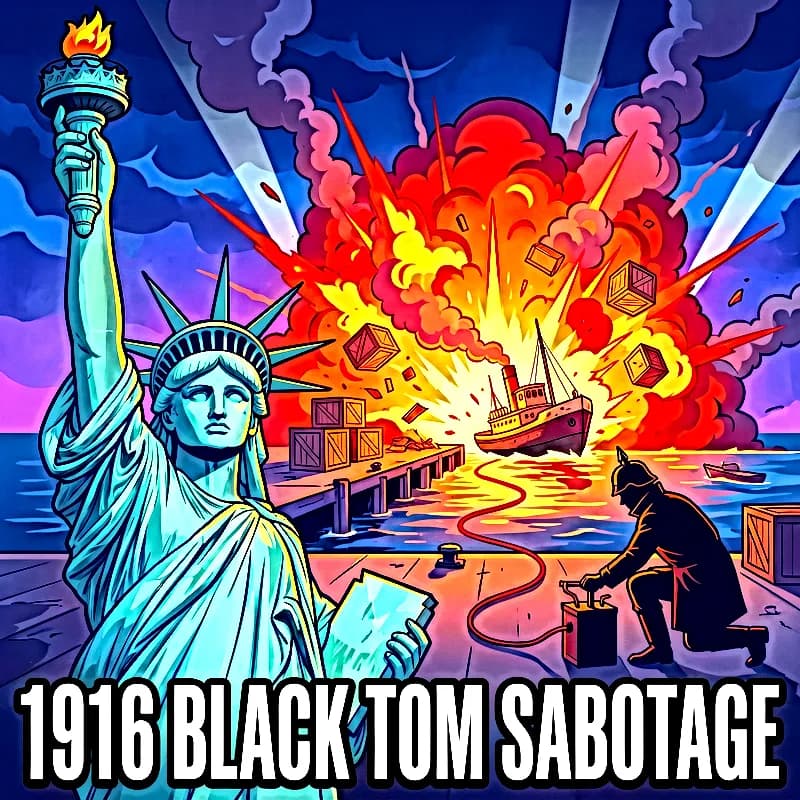
Black Tom Explosion and German Sabotage in New York Harbor
Incident Baseline
Target
Black Tom, Jersey City
Date
July 30, 1916
Munitions Exploded
~2 million lbs
Final Settlement Award
$21,157,227.01
Evidentiary Proof & Impact
German Sabotage Network in US
5
Black Tom as Campaign Target
5
Fraudulent Defense Testimony
4
Initial Domestic Investigation
1
Analyst Note
The official evidence chain rests on three layers: proof of a general German sabotage campaign in the United States, proof that Black Tom fit the pattern and target set of that campaign, and finally proof tying the destruction to specific German agents and falsified German defenses in the interwar claims litigation.
The Black Tom explosion was a deliberately caused destruction of a major New York Harbor munitions complex in the early hours of July 30, 1916, at a Lehigh Valley Railroad depot on Black Tom in Jersey City. The surviving official record overwhelmingly supports the conclusion that it was part of Imperial Germany’s sabotage campaign against American war supplies bound for the Allies while the United States was still neutral.
Black Tom was a prime target for saboteurs because by 1916 it had become a busy harbor complex of warehouses, piers, tracks, and loading areas handling huge quantities of war materiel for Allied customers. The wider reason was strategic. Britain’s blockade made it effectively impossible for Germany to buy American war supplies, and Berlin responded by authorizing sabotage against "every kind of factory for supplying munitions of war."
Physical Impact and Damage
| Damage zone | Supported finding |
|---|---|
| Black Tom terminal | The FBI says about two million pounds of war materials exploded there. |
| Lower Manhattan and Jersey City | The blast broke thousands of windows and rocked structures across the harbor. |
| Statue of Liberty | Shrapnel struck the statue, the torch arm was forced against the crown, and the torch has been closed ever since. |
| Ellis Island | Windows were blown out, the main building roof collapsed, and evacuees were ferried away. |
The first investigations and the public story in 1916
The immediate public narrative was not "German attack proved." Authorities quickly blamed lax safety procedures by Lehigh Valley Railroad and National Dock and Storage, arrested top company officials within a day, and the possibility of sabotage was immediately dismissed.
President Woodrow Wilson publicly downplayed the event, calling it "a regrettable incident at a private railroad terminal." The broader implication is that the event’s first public meaning was shaped less by hard proof than by political caution, the normality of industrial accidents, and the still-fragmentary state of American counterintelligence.
The Evidence Linking Black Tom to German Intelligence
The CIA history states that Berlin authorized sabotage against U.S. munitions production, sent Franz von Rintelen to New York under false cover, and that his network used harbor operatives and incendiary devices to attack Allied supply shipping. After a 1916 dragnet disrupted the ship-bombing campaign, surviving conspirators shifted toward factories and production sites, explicitly calling the conflagration at Black Tom pier their "most spectacular success."
The Sabotage Network Evidence
| Evidence category | What the official record supports |
|---|---|
| German policy | Berlin authorized sabotage against U.S. munitions production during American neutrality. |
| Rintelen’s role | Rintelen arrived under false Swiss cover to run sabotage, recruit operatives, and use incendiaries. |
| Named operatives | The RIAA record ties the decisive proof to Hinsch, Hilken, Herrmann, Kristoff, and Wozniak, with the Herrmann message as a key exhibit. |
| Fraud finding | The 1939 reopening depended in part on a finding that prior German evidence and testimony had been false or fraudulent. |
What the Mixed Claims Commission decided in 1939
In the reopened sabotage cases, the Mixed Claims Commission reviewed evidence showing that Germany had already been conducting authorized sabotage activities in the United States by an organized group of German agents.
A critical piece was the so-called Herrmann message. The decoded text refers to "Jersey City Terminal," and mentions Hinsch, Kristoff, and other operatives by name. By 1939 the American Commissioner concluded that Germany’s pleadings had been false and that important defense witnesses had committed perjury and fraud.
The Umpire, Owen J. Roberts, concurred, and the commission’s June 15, 1939 order stated in plain language that "the liability of Germany in both the Black Tom and Kingsland cases has been established." Pursuant to the decision, the commission handed down 153 awards in the sabotage claims totaling $21,157,227.01 plus interest.
Historical significance
Black Tom mattered not only because of the physical damage, but because it became a forcing event in the development of U.S. counterintelligence and domestic national-security law. After U.S. entry into the war, Congress passed the Espionage Act and later the Sabotage Act, and the Bureau took primary jurisdiction over those investigations.
The event also left an unusually durable material scar on the most famous symbol in the harbor; the Statue of Liberty's internal framework was damaged and the torch has never reopened to visitors since 1916.