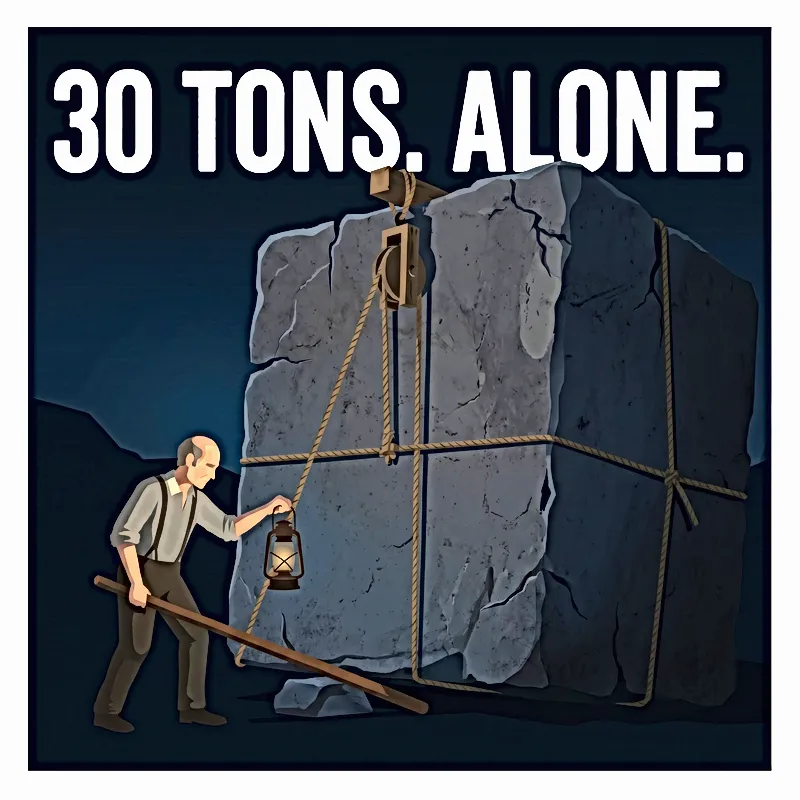
This forensic analysis examines the remarkable engineering feat of Edward Leedskalnin, a diminutive Latvian immigrant who solo-constructed the massive Coral Castle complex using over 1,100 tons of limestone. The text bridges the gap between Leedskalnin’s eccentric "Magnetic Current" hypothesis, which posited that all matter is governed by microscopic magnets, and the likely reality of his mastery of classical mechanics, such as leverage and the block and tackle. By detailing specific megalithic features like the nine-ton revolving gate and astronomical instruments, the report illustrates how a single individual could move immense weights through patience and precision rather than supernatural forces. Ultimately, the source serves as an investigative bridge between the mystical "vortex" theories favored by fringe researchers and the documented stonemasonry traditions that allowed Leedskalnin to transform a personal heartbreak into a permanent architectural marvel.
Case Snapshot
Subject
Coral Castle (Rock Gate)
Location
Homestead, Florida
Builder
Edward Leedskalnin
Time Period
1923–1951
Materials
1,100+ Tons of Oolite Limestone
Key Feature
9-Ton Revolving Gate
Theoretical Model
Magnetic Current Hypothesis
Engineering Basis
Classical Mechanics & Leverage
Evidence Distribution
Section Headings
12
Markdown Tables
3
Unique Citations
39
Historical Context References
28
Chronological Timeline of Edward Leedskalnin and Coral Castle
| Year | Event::Geographic Location |
|---|---|
| 1887 | Birth of Edward Leedskalnin::Stāmeriena Parish, Latvia |
| 1912 | Arrival at Ellis Island, New York::New York City, USA |
| 1916-1920 | Employment in logging and lumber industry::Canada and Oregon, USA |
| 1923 | Purchase of one acre for $10 from Ruben Moser::Florida City, Florida |
| 1923-1936 | Construction of 'Ed's Place' (original site)::Florida City, Florida |
| 1936 | Decision to move to Homestead for privacy::Homestead, Florida |
| 1937-1939 | Relocation of over 1,000 tons of stone::Florida City to Homestead |
| 1940 | Completion of final perimeter walls::Homestead, Florida |
| 1945 | Publication of 'Magnetic Current'::Homestead, Florida |
| 1951 | Death of Edward Leedskalnin from kidney failure::Miami, Florida |
The construction of the Coral Castle complex in Homestead, Florida, represents a significant anomaly in the history of structural engineering and architectural sculpture.[1], [2] Between the years 1923 and 1951, a Latvian immigrant named Edward Leedskalnin single-handedly quarried, sculpted, and positioned more than 1,100 short tons of oolite limestone without the aid of modern heavy machinery, electrical power grids, or a supporting workforce.[3], [4], [5] This monumental task was accomplished by a man standing approximately 5 feet tall and weighing between 100 and 120 pounds, whose formal education did not exceed the fourth grade.[3], [4], [6] The resulting complex is not merely a residence but an intricate array of astronomical instruments, functional furniture, and defensive fortifications, all carved from single blocks of stone weighing up to 30 tons each.[7], [8], [9] The investigative scope of this report focuses on the intersection of Leedskalnin’s self-published theories on magnetism and cosmic forces with modern engineering assessments that emphasize the application of classical mechanics and traditional stonemasonry techniques.[2], [10], [11]
Biographical Origins and Formative Influences
Edward Leedskalnin was born on January 12, 1887, in Stāmeriena Parish, Latvia, which was then part of the Governorate of Livonia in the Russian Empire.[3], [4] He was the fifth son of Mina and Andrejs Liedskalniņš, a family of farmers who reportedly struggled with poverty.[4] While little is documented regarding his early childhood, it is widely understood that he received a primary education at a Sakumskola school before being inducted into the family trade of stonemasonry.[3], [4] This early exposure to the physical properties of stone and the traditional tools of the mason provided the technical foundation for his later endeavors.[4], [12] The lineage of Latvian masons to which he belonged operated within a tradition that predated modern mechanized construction, relying instead on high-precision manual techniques and an intimate understanding of material behavior.[4], [12]
The pivotal event of Leedskalnin’s life occurred when he was 26 years old and became engaged to Agnes Skuvst, a girl ten years his junior whom he referred to as his "Sweet Sixteen".[1], [3], [4] Skuvst broke off the engagement just one day before the wedding ceremony, a rejection that would serve as the lifelong impetus for the construction of Coral Castle.[1], [13], [14] Dejected and seeking a new start, Leedskalnin emigrated to North America, arriving in New York City on April 6, 1912, aboard the SS Pennsylvania.[3], [4] He spent the following decade working in lumber camps and logging booms across Canada, Washington, and Oregon.[3], [4], [14] In 1917, he was registered as an axe-handle manufacturer in Elkton, Oregon, a profession that required significant manual strength and an understanding of structural leverage.[3], [4] During this period, he allegedly contracted tuberculosis, leading him to seek the warmer climate of South Florida on the advice of a physician.[3], [11], [14]
Geological Profile of Oolite Limestone
The primary building material utilized by Leedskalnin was oolite limestone, a sedimentary rock frequently found just beneath the topsoil in Southern Florida.[2], [3], [17] Despite being commonly called "coral rock," the material is actually composed of ooids—spherical grains of calcium carbonate formed in concentric layers.[2], [17], [18] This material was ideal for Leedskalnin’s purposes due to several critical physical properties.[3] Oolitic limestone is highly porous, which significantly reduces its density compared to other building materials like granite or basalt.[13], [18] The density of oolite is approximately 125 pounds per cubic foot.[18] While still massive, this porosity allowed for easier quarrying using hand tools.[3], [11]
Leedskalnin’s quarrying technique was a model of efficiency and economy.[15] The pits and pools visible today on the Homestead property were the original sources of his stone, meaning the horizontal transport required for many of the monoliths was minimal—often less than a few hundred feet.[2], [15], [17] He utilized traditional methods of splitting stone, which involved drilling holes into the bedrock and using wedges to force the material apart.[3], [7], [14] Witnesses and photographic evidence suggest he employed primitive chisels and hammers fashioned from salvaged automobile parts, such as truck axles and springs.[3], [14], [19]
The Architecture of "Rock Gate"
Leedskalnin’s complex, which he originally named "Rock Gate" and was later dubbed "Coral Castle" by its subsequent owners, is an open-air sculpture garden enclosed by an 8-foot-tall perimeter wall.[2] Each section of this wall is carved from single blocks of stone weighing as much as 58 tons in aggregate, though individual vertical slabs typically weigh between 10 and 15 tons.[9], [18] The precision of the joints is such that no mortar was required; the stones are held in place by their own immense weight and are fitted with such accuracy that no light passes between them.[2], [17], [20]
| Feature | Estimated Weight | Unique Characteristics |
|---|---|---|
| The Obelisk | 28 - 30 Tons | Stands 25 - 40 feet tall; carved from a single piece [7], [8], [17] |
| The Revolving Gate | 9 Tons | Balanced on a truck bearing; rotatable with one finger [2], [5], [9] |
| The Moon Fountain | 23 Tons | Center fountain piece with two 18-ton crescent moons [8], [21] |
| The Throne Room | 5 Tons | Includes the "Mad Rocker" and smaller thrones [7], [8] |
| The Polaris Telescope | 28 - 30 Tons | 25 feet tall; aligned precisely with the North Star [5], [8], [9] |
| Florida Table | 13 Tons | Carved in the shape of the state of Florida [8] |
| Feast of Love Table | 2.5 Tons | Heart-shaped table dedicated to his lost love [8], [9] |
The two-story tower located in the corner of the site served as Leedskalnin’s living quarters and workshop.[2], [5], [8] The walls of the tower consist of 8-foot-high blocks of stone.[2] Inside, Leedskalnin lived without running water or electricity, subsisting on a diet primarily composed of sardines and crackers, as well as vegetables he grew on the property.[4], [8], [14] The lower floor was utilized for the storage of his hand-made tools and equipment for experiments in physics and astronomy.[5], [8]
The Relocation Phase: 1936 to 1939
In 1935, a planned land development in Florida City prompted Leedskalnin to seek greater privacy.[2], [3], [15] He purchased a 10-acre plot in Homestead and began the gargantuan task of moving his existing sculptures 10 miles north.[2], [6], [15] This relocation is often cited as the strongest evidence for his mastery of unconventional engineering.[5], [6] While he worked alone at night to load and unload the stones, he required a tractor and trailer for the horizontal transport.[3], [15], [18] He hired a neighbor, Bob Biggers, to provide the heavy-duty trailer.[3]
The operational protocol was strictly enforced: Leedskalnin would load the trailer alone under the cover of night, Biggers would return in the morning to haul the loaded trailer to the new site, and Leedskalnin would then unload the stones alone after Biggers departed.[3], [18] Despite the 20-ton loads, Biggers never witnessed the loading process.[3], [18] When questioned about how he managed to load the massive blocks, Leedskalnin repeatedly stated that he understood the laws of leverage and weight, often adding that he knew the "secrets of the pyramids".[2], [3], [13]
Theoretical Framework: The "Magnetic Current" Hypothesis
In August 1945, Leedskalnin published a pamphlet titled Magnetic Current, which outlined his idiosyncratic views on the nature of matter and energy.[16], [22] He rejected the standard electromagnetic theories of his time, proposing instead that all matter is composed of individual "North and South pole magnets".[5], [10], [22] According to Leedskalnin, these magnets are tiny particles that circulate in the air, the Earth, and all living organisms.[10], [23] He argued that electricity was simply the movement of these magnets through a conductor.[22]
Core Tenets of Leedskalnin’s Magnetic Theory
Leedskalnin’s worldview was based on a particle-based model of magnetism rather than the field-based model of Maxwell and Faraday.[10], [22] He asserted that the Earth itself is a giant magnet where the North Pole individual magnets emerge from the South Pole and flow to the North Pole, while South Pole magnets do the reverse.[5], [10] He believed that by guiding these streams of magnets, one could achieve "perpetual power".[10]
His secondary pamphlet, Mineral, Vegetable and Animal Life, expanded these theories into the realm of biology.[23], [24] He claimed that "mineral life" is what holds inorganic matter together, while "vegetable" and "animal" life involve the same magnetic particles performing growth and movement.[23] He went so far as to claim that photosynthesis was not a chemical process but the physical capture of sunlight by North and South pole magnets.[23] He also posited that the human body functions via these magnetic currents, suggesting that thinking and talking are purely physical processes of muscle contraction driven by magnets.[23]
The Perpetual Motion Holder (PMH)
The most famous physical artifact of Leedskalnin’s theoretical work is the "Perpetual Motion Holder" (PMH).[2], [11], [25] This device demonstrates a phenomenon where a magnetic field can be "locked" into an iron circuit.[25], [26] The physical construction, as described in his writings and observed in experimental recreations, is relatively simple [27]:
- Iron Core: A U-shaped iron bar or a series of aligned iron nuts is used to form a loop.[25], [27]
- Conductive Winding: Thick gauge wire is wrapped around the iron core.[27]
- Crossbar Application: A flat iron bar is placed across the ends of the "U" to close the magnetic circuit.[23], [25]
- Electrical Activation: A brief pulse of current from a 12-volt battery is sent through the wire, "charging" the circuit.[25], [27]
- Magnetic Lock: After the battery is disconnected, the crossbar remains magnetically bound to the U-shaped bar indefinitely, as long as the circuit remains closed.[23], [25], [26]
Modern physics interprets the PMH as a magnetic analog to a capacitor, where the magnetic domains in the iron remain aligned in a stable, closed-loop configuration.[26] While it does not generate energy from nothing—violating the laws of thermodynamics—it illustrates the persistence of magnetism in high-permeability materials.[26], [28] Speculative theories propose that Leedskalnin believed he could scale this effect to neutralize the gravitational pull on large stones, potentially creating a localized "anti-gravity" field.[5], [11], [29]
Engineering Analysis: Leverage and Classical Mechanics
The majority of contemporary engineers and structural analysts contend that Leedskalnin’s success was rooted in a sophisticated application of classical mechanics rather than "reverse magnetism".[2], [11], [19] Despite his secretive nature and cryptic claims, the physical evidence of his tools points toward a mastery of the block and tackle, the lever, and the tripod.[3], [7], [14]
The Mechanical Advantage of the Block and Tackle
Leedskalnin utilized several multi-pulley block and tackle systems, many of which he constructed himself from salvaged car and truck parts.[3], [11], [14] A standard block and tackle system provides a mechanical advantage (MA) equal to the number of rope segments supporting the moving load.[7], [9] For example, a system with a mechanical advantage of 10 would allow a 100-pound man to lift 1,000 pounds with 100 pounds of force (ignoring friction).[7], [9]
Photographic evidence from 1944 shows Leedskalnin using massive 25-foot pine tripods equipped with these pulley systems to hoist monoliths.[2], [3], [19] By using a series of compound pulleys and winches, he could theoretically multiply his own body weight hundreds of times.[9], [11] Furthermore, the use of shims and wedges allowed him to raise stones incrementally; by rocking a stone and inserting a thin piece of wood underneath, a single person can slowly "jack" a multi-ton object upward.[30], [31]
The Wally Wallington "Walking" Technique
The feasibility of moving massive stones single-handedly has been proven in the modern era by Wallace "Wally" Wallington.[30], [32] Wallington has demonstrated that a single person can "walk" a 20-ton concrete block by placing a small, rounded rock under its center of gravity to serve as a pivot.[32], [33], [34] By rotating the block on this central point and rocking it back and forth, he can move it horizontally with minimal effort.[30], [31] Wallington’s methods use no rollers, no pulleys, and no power tools, relying entirely on the principles of center of mass and leverage—the very principles Leedskalnin claimed to understand well.[6], [30], [32]
Forensic Analysis of the 9-Ton Revolving Gate
The 9-ton revolving gate is often cited as the greatest engineering marvel of Coral Castle.[2], [5], [9] This 8-foot-tall stone block was so perfectly balanced that it could be rotated with the push of a child's finger for over forty years.[2], [5], [13] The "mystery" of its construction remained intact until the gate failed in 1986.[2], [5], [35]
When a team of engineers used a 50-ton crane to remove the gate for repairs, they discovered the following internal mechanism [2], [5], [9]:
- Vertical Bore: Leedskalnin had drilled a hole precisely through the vertical center of the 9-ton block.[2], [9], [17]
- Central Shaft: A metal rod was inserted into this bore to act as a central axle.[2], [9]
- Truck Bearing: The base of the shaft rested on an old truck bearing from a Ford Model T or a similar vehicle.[2], [5]
- Cause of Failure: The iron bearing had rusted out after decades of exposure, causing the gate to bind.[2]
The discovery of the truck bearing provided a definitive link between Leedskalnin’s "ancient secrets" and contemporary industrial components.[2], [5] It demonstrated that his "secret" involved not just understanding leverage, but also being a highly skilled amateur mechanical engineer who could precisely identify and align the center of gravity of a massive, irregular stone.[5], [11]
Astronomical and Scientific Instruments
Coral Castle is as much an observatory as it is a garden.[36] Leedskalnin’s designs incorporate high levels of astronomical precision that would have required sophisticated calculations.[5], [9]
The Polaris Telescope
The Polaris telescope is a 25-foot vertical stone shaft weighing approximately 28 tons.[5], [8], [11] It is precisely aligned with Polaris, the North Star.[9], [11], [29] The telescope features a wire crosshair at the top; when an observer looks through the eyepiece at the base, Polaris is centered in the crosshairs.[7], [9] The design accounts for the seasonal movement of the star, with the crosshairs calibrated to different quadrants depending on the time of year.[7] This level of precision suggests Leedskalnin possessed a deep understanding of celestial navigation and the Earth's axial tilt.[5], [11]
The Sundial
The stone sundial at Coral Castle is designed to indicate both the hour of the day and the seasons.[8], [36] It is accurate to within two minutes of true solar time.[9], [29] The sundial’s design requires knowledge of the specific latitude of the Homestead site (approximately 25 degrees North), indicating that Leedskalnin performed the necessary trigonometric calculations to orient the stone correctly.[9], [36]
Cultural and Fringe Interpretations: Acoustic Levitation and Vortex Theories
While engineers point to pulleys and bearings, a parallel narrative persists involving more esoteric forces.[5], [11] Some researchers, such as Ray Stoner, have proposed that Coral Castle was built on an "energy vortex" or a "ley line".[5], [6] Stoner argues that Leedskalnin relocated the castle from Florida City specifically because a surveying error had placed the original site ten miles away from a primary Earth energy intersection.[6]
Stoner’s "Vortex" and Gematrian Analysis
The vortex theory suggests that the Earth is covered by an invisible grid of telluric energy.[5], [6] According to Stoner and subsequent researchers like Michael Lawrence Morton, the coordinates of Coral Castle can be linked to ancient "Gematrian" numbers—mathematical constants supposedly used by the builders of the pyramids and Stonehenge.[6], [37], [38]
| Coordinate Parameter | Value / Calculation | Significance |
|---|---|---|
| Grid Longitude | 111 deg x 34 min x 41.238 sec | Linked to Great Pyramid height / 100 [6] |
| Grid Latitude | 25 deg x 29 min x 58.809 sec | Equivalent to 4320 x Pi Squared [6] |
| Solar Year Link | Grid Point Value 3.6502 | Decimal harmonic of the solar year in days [6] |
Proponents of this theory believe that at these specific grid intersections, gravitational forces are weakened, or "anti-gravity" effects can be achieved through the manipulation of harmonic frequencies.[5], [6], [11] They often cite the "Hutchison Effect" or alleged accounts of Tibetan monks using sound to levitate heavy stones as historical precedents for Leedskalnin’s work.[5], [6], [11]
Acoustic Levitation and Sound Frequency
Acoustic levitation involves using sound waves to create a standing wave that can support physical objects.[5], [11] While this is a proven scientific phenomenon at the microscopic scale, applying it to 30-ton stones would require decibel levels that would likely be lethal to a human operator.[11] Nevertheless, the legend persists due to accounts of teenagers who claimed to have seen Leedskalnin "singing" to the stones or moving them as if they were "light like hydrogen balloons".[2], [15], [18], [19]
Socio-Psychological Context: "A Book in Every Home"
Leedskalnin’s third pamphlet, A Book in Every Home, offers a window into his personal philosophy and potentially his construction secrets.[22], [39] The book is ostensibly a guide for young people on how to form healthy domestic and political lives, but many researchers believe it contains a code or a "cipher" for his technical methods.[12], [20], [22]
The book is notable for its blank pages and repetitive, highly specific advice regarding "fresh boys" and the behavior of sixteen-year-old girls.[22], [39] Leedskalnin’s focus on Agnes, his "Sweet Sixteen," is the central theme.[22], [39], [40] He writes that "male and female are never friends" and that love making should be reserved for permanent partners.[39] This obsession with his lost love provided the psychological stamina required for nearly 30 years of solitary, nocturnal labor.[3], [9], [11]
Modern Engineering Assessments and Reproducibility
In an episode of the television program In Search Of, a modern construction crew attempted to replicate Leedskalnin’s quarrying and lifting of a large coral slab.[7] Despite using a 600-horsepower crane and a diamond-tipped power saw, they found the process difficult and unwieldy.[7] This contrast highlights the fact that while Leedskalnin used "conventional" tools, he used them with a level of precision and patience that is rarely found in modern industrial construction.[9], [11]
The "secret" of Coral Castle may lie in the combination of:
- Stonemasonry Tradition: Inherited knowledge of how to read the grain of a stone to split it with minimal effort.[4], [12]
- Mechanical Advantage: Mastery of compound pulley systems and long-arm levers.[7], [9], [14]
- Low Friction Bearings: Utilizing industrial artifacts like truck bearings to balance massive weights.[2], [5]
- Temporal Commitment: A timeframe of nearly three decades, allowing for incremental progress that would be economically impossible for a commercial crew.[2], [11]
Conclusion: The Synthesis of Science and Mystery
The construction of Coral Castle is a testament to the intersection of human will and physical law.[5], [11] While the "magnetic current" and "vortex" theories provide a compelling narrative for those seeking a link to lost ancient technologies, the physical evidence of Leedskalnin’s workshop strongly favors the application of classical mechanics.[2], [5], [11], [19] Edward Leedskalnin was not necessarily a wizard of anti-gravity, but he was a master of the center of mass—a man who understood that with a long enough lever and a sturdy enough fulcrum, any stone could be moved.[3], [9], [13], [30] His legacy remains etched in the oolite limestone of Florida, a permanent monument to a "Sweet Sixteen" and the enduring capacity of a single individual to reshape the world through patience, precision, and the fundamental laws of weight and leverage.[1], [2], [3], [9]
Sources
- "Edward Leedsklanin Rock Gate 1" by James Smith Pierce - UND Scholarly Commons, https://commons.und.edu/fast-films/50/
- Coral Castle - Wikipedia, https://en.wikipedia.org/wiki/Coral_Castle
- About Edward Leedskalnin - Coral Castle, https://coralcastle.com/home/about-edward-leedskalnin/
- Edward Leedskalnin - Wikipedia, https://en.wikipedia.org/wiki/Edward_Leedskalnin
- Edward Leedskalnin's Coral Castle, Homestead, Florida, https://danieljfuller.com/edward-leedskalnins-coral-castle-homestead-florida/
- Ed Leedskalnin Magnetism | PDF | Magnet | Nikola Tesla - Scribd, https://www.scribd.com/doc/55687383/Ed-Leedskalnin-Magnetism
- Coral Castle — THE BITTER SOUTHERNER, https://bittersoutherner.com/coral-castle-a-haunting-monument-to-love-or-aliens-or-limestone-coral-castle
- Homestead's Coral Castle: Monument by Edward Leedskalnin - Visit Florida, https://www.visitflorida.com/travel-ideas/articles/homesteads-coral-castle-monument-by-edward-leedskalnin/
- Coral Castle Museum Homestead Florida: Unlocking the Mystery of Edward Leedskalnin's Impossible Creation, https://www.wonderfulmuseums.com/museum/coral-castle-museum-homestead-florida/
- Magnetic Current - by Edward Leedskalnin (c)1945 - Google Groups, https://groups.google.com/g/sci.astro.amateur/c/rt1pIituofQ
- Coral Castle Museum: Unraveling the Enigma of Edward Leedskalnin's Stone Marvel in Homestead, Florida, https://www.wonderfulmuseums.com/museum/coral-castle-museum/
- Coral Castle: A Modern Engineering Mystery | by Zymatica - Medium, https://medium.com/@freediscountinfo/coral-castle-a-modern-engineering-mystery-bb45250cc104
- Random Florida Fact: The mystery of 'Coral Castle' - WKMG, https://www.clickorlando.com/features/2025/07/09/random-florida-fact-the-mystery-of-coral-castle/
- Rock Gate, Ed's Place, and Coral Castle - Spaces Archives, https://spacesarchives.org/assets/Uploads/NRHP/rock-gate-coral-castle.pdf
- Coral Castle Facts for Kids, https://kids.kiddle.co/Coral_Castle
- How To Read His Writings: The Unauthorized Guide to Decoding Edward Leedskalnin's Works 1 - DOKUMEN.PUB, https://dokumen.pub/how-to-read-his-writings-the-unauthorized-guide-to-decoding-edward-leedskalnins-works-1.html
- (DOC) MOS Presentation Report - Academia.edu, https://www.academia.edu/35611394/MOS_Presentation_Report
- Magnetic Levitation at Coral Castle | Visual Individual - 120Pearls, https://120pearls.wordpress.com/2016/01/05/magnetic-levitation-at-coral-castle/
- CORAL CASTLE | urbancoroner, https://www.urbancoroner.com/coral-castle
- Coral Castle - Ed Leedskalnin : r/HighStrangeness - Reddit, https://www.reddit.com/r/HighStrangeness/comments/10knqn6/coral_castle_ed_leedskalnin/
- Coral Castle - The Electronic Nomad, https://lennyflank.wordpress.com/2018/01/15/coral-castle/
- A Book in Every Home: Containing Three Subjects: Ed's Sweet Sixteen, Domestic and Political Views by Edward Leedskalnin, Paperback | Barnes & Noble®, https://www.barnesandnoble.com/w/a-book-in-every-home-edward-leedskalnin/1111193505
- Mineral Vegetable and Animal Life | PDF | Magnet | Earth - Scribd, https://www.scribd.com/document/13977332/Mineral-Vegetable-and-Animal-Life
- Collected Writings of Edward Leedskalnin: Magnetic Current & A Book in Every Home - Audiobooks.com, https://www.audiobooks.com/audiobook/collected-writings-of-edward-leedskalnin-magnetic-current-and-a-book-in-every-home/695508
- Edward Leedskalnin Perpetual Motion Holder (How it Works) - YouTube, https://www.youtube.com/watch?v=H5q-LOhBHSI
- Ed Leedskalnin's "Perpetual Motion Holder" (PMH) - Physics Stack Exchange, https://physics.stackexchange.com/questions/167356/ed-leedskalnins-perpetual-motion-holder-pmh
- “Oh Nuts!” Magnetic Lock.Your Going To Like! Using The Principles Of Ed Leedskalnin PMH.Must Watch, https://www.youtube.com/watch?v=YhiAIsJCS9Y
- What can we learn from Ed Leedskalnin, of Coral Castle, about perpetual motion? - Quora, https://www.quora.com/What-can-we-learn-from-Ed-Leedskalnin-of-Coral-Castle-about-perpetual-motion
- Discover the Mystery of Coral Castle – A Fascinating Architectural Wonder - Nitsa Holidays, https://nitsaholidays.in/blog/coral-castle
- Forgotten Technology: How Wallace Wallington Moved the World?, https://essayhub.com/blog/forgotten-technology-give-me-a-lever-and-i-will-move-the-world
- TIL a man named Wally Wallington proved that with rudimentary tools it is possible to move thousands of pounds of stone and even entire buildings single-handed, and is constructing Stonehenge: RELOADED in his Flint, Michigan backyard. : r/todayilearned - Reddit, https://www.reddit.com/r/todayilearned/comments/2s5yh8/til_a_man_named_wally_wallington_proved_that_with/
- Wally Wallington - Wikipedia, https://en.wikipedia.org/wiki/Wally_Wallington
- How Stonehenge was built! Man moves 20 ton block by hand(s?)! No machinery needed, just a dude, his fulcrums, pivot points, and (insert anything else that makes me sound like I'm an engineering prodigy!! : r/EngineeringPorn - Reddit, https://www.reddit.com/r/EngineeringPorn/comments/6wvonq/how_stonehenge_was_built_man_moves_20_ton_block/
- Wondering why this guy gets so much praise? 'Wally Slab Of Concrete' - Reddit, https://www.reddit.com/r/AlternativeHistory/comments/1dnkw1c/wondering_why_this_guy_gets_so_much_praise_wally/
- How did Edward Leedsklin build the coral castle? : r/UnresolvedMysteries - Reddit, https://www.reddit.com/r/UnresolvedMysteries/comments/5lwuqn/how_did_edward_leedsklin_build_the_coral_castle/
- The Engineering Mystery of Coral Castle: Florida's Most Enigmatic Historic Structure, https://www.easternengineeringgroup.com/the-engineering-mystery-of-coral-castle-floridas-most-enigmatic-historic-structure/
- The Code of The Ancient Gematrian Numbers | PDF | Longitude | Latitude - Scribd, https://www.scribd.com/doc/191852793/The-Code-of-the-Ancient-Gematrian-Numbers
- Carl Munck - Hrastović Inženjering, https://www.hrastovic-inzenjering.hr/primjena-energije/energetski-clanci/alternativne-tehnologije/item/1094-carl-munck.html
- Edward Leedskalnin-A-Book-in-Every-Home | PDF - Scribd, https://www.scribd.com/doc/121367079/Edward-Leedskalnin-A-Book-in-Every-Home
- A Book in Every Home: Containing Three... book by Edward Leedskalnin - ThriftBooks, https://www.thriftbooks.com/w/a-book-in-every-home-containing-three-subjects-eds-sweet-sixteen-domestic-and-political-views_edward-leedskalnin/13497422/