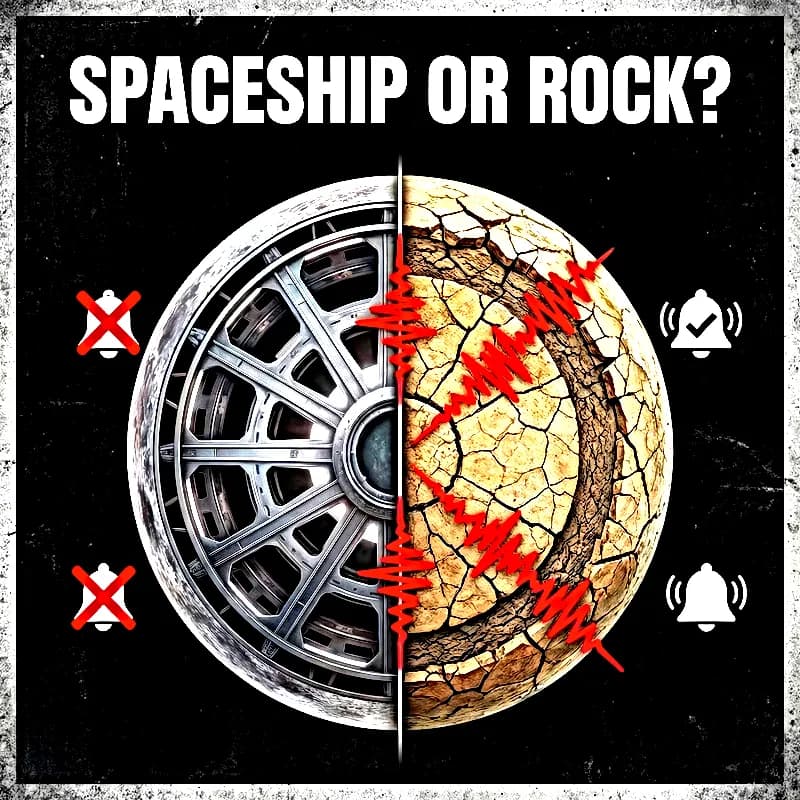
A Forensic Geophysical Analysis of the Vasin-Shcherbakov "Spaceship Moon" Hypothesis and Apollo-Era Seismic Anomalies
The 1970 Soviet proposal by Mikhail Vasin and Alexander Shcherbakov, colloquially known as the "Spaceship Moon" hypothesis, suggests that the Moon is not a natural satellite but an artificial, hollowed-out planetoid modified by an advanced intelligence. [1]New Technologies and Revolutionary Projects - ResearchGate https://www.researchgate.net/profile/Alexander-Bolonkin/publication/265110504_New_Technologies_and_Revolutionary_Projects/links/54e12ace0cf296663791e2f2/New-Technologies-and-Revolutionary-Projects.pdf, [2]Scientific Abstract Levin, B.Yu. - CIA FOIA https://www.cia.gov/readingroom/document/cia-rdp86-00513r000929520008-6 This hypothesis emerged during a pivotal era of the Cold War, characterized by intense lunar competition and the acquisition of the first in-situ geophysical data from another celestial body. [2]Scientific Abstract Levin, B.Yu. - CIA FOIA https://www.cia.gov/readingroom/document/cia-rdp86-00513r000929520008-6, [3]New events discovered in the Apollo lunar seismic data - ResearchGate https://www.researchgate.net/publication/228366409_New_events_discovered_in_the_Apollo_lunar_seismic_data Central to this analysis is the evaluation of NASA's Passive Seismic Experiment (PSE) data from the Apollo 12 and 14 missions, where the deliberate impact of lunar modules and rocket stages caused the lunar interior to reverberate for periods exceeding three hours—a phenomenon famously described by NASA scientists as the Moon "ringing like a bell." [4]Does the Moon Sound Like a Bell? - Popular Science https://www.popsci.com/does-moon-sound-like-bell/, [5]Participation in the Apollo passive seismic experiment - NTRS https://ntrs.nasa.gov/api/citations/19740011386/downloads/19740011386.pdf To determine the validity of artificial structural claims, this report examines the mechanical properties of the lunar megaregolith, the discrepancies in planetary density, and the geometry of lunar craters, contrasting the Vasin-Shcherbakov "engineered hull" model with modern 3D seismic propagation simulations and gravimetric evidence. [6]Artificial Impacts on the Moon: Modeling 3D Seismic Propagation Effects with AxiSEM3D - ResearchGate https://www.researchgate.net/publication/385862322_Artificial_Impacts_on_the_Moon_Modeling_3D_Seismic_Propagation_Effects_with_AxiSEM3D, [7]Quantitative Evaluation of the Lunar Seismic Scattering - ResearchGate https://www.researchgate.net/publication/366177114_Quantitative_evaluation_of_the_lunar_seismic_scattering_and_comparison_between_the_Earth_Mars_and_the_Moon, [8]UC Berkeley PhD dissertation - eScholarship https://escholarship.org/content/qt3dw5s9gc/qt3dw5s9gc.pdf
Case Snapshot
Hypothesis Origin
1970 Soviet Academy of Sciences
Source Entries
26
Key Evidence
Apollo PSE Data, 3D Seismic Simulations
Verdict
Natural Planetary Body, Not Artificial
Evidence Distribution
Section Headings
14
Markdown Tables
7
Unique Citations
26
Inline References
85
Core Timeline Anchors
| Year | Milestone |
|---|---|
| 1958 | Van Allen discovers radiation belts |
| 1970 | Vasin-Shcherbakov publish 'Spaceship Moon' hypothesis |
| 1969–72 | Apollo PSE seismometers deployed on lunar surface |
| 1970 | Apollo 13 S-IVB impact causes 3+ hour reverberation |
| 2022 | AxiSEM3D simulations resolve 'ringing' phenomenon |
The 1970 Vasin-Shcherbakov Hypothesis: Structural and Cosmogonical Framework
The Vasin-Shcherbakov hypothesis was formally introduced in the article "Is the Moon the Creation of Intelligence?" published in Sputnik magazine, a Soviet publication often used to disseminate scientific theories to a broader international audience. [2]Scientific Abstract Levin, B.Yu. - CIA FOIA https://www.cia.gov/readingroom/document/cia-rdp86-00513r000929520008-6 The authors, both members of the Soviet Academy of Sciences, challenged the prevailing planetary cosmogony of the era, which suggested that planets and moons formed from the gravitational collapse of gaseous and dusty clouds. [2]Scientific Abstract Levin, B.Yu. - CIA FOIA https://www.cia.gov/readingroom/document/cia-rdp86-00513r000929520008-6 They argued that the Moon's physical characteristics were so divergent from Earth's that they could only be explained by artificial construction. [1]New Technologies and Revolutionary Projects - ResearchGate https://www.researchgate.net/profile/Alexander-Bolonkin/publication/265110504_New_Technologies_and_Revolutionary_Projects/links/54e12ace0cf296663791e2f2/New-Technologies-and-Revolutionary-Projects.pdf, [2]Scientific Abstract Levin, B.Yu. - CIA FOIA https://www.cia.gov/readingroom/document/cia-rdp86-00513r000929520008-6
The Hollow-Sphere Model and Artificial Armor
The core of the Vasin-Shcherbakov argument rests on the assertion that the Moon is a hollow sphere with a dual-layered hull. [1]New Technologies and Revolutionary Projects - ResearchGate https://www.researchgate.net/profile/Alexander-Bolonkin/publication/265110504_New_Technologies_and_Revolutionary_Projects/links/54e12ace0cf296663791e2f2/New-Technologies-and-Revolutionary-Projects.pdf They proposed an outer shell composed of a 20-mile-thick (32 km) layer of rocky material and an inner, high-strength metallic "armor." [1]New Technologies and Revolutionary Projects - ResearchGate https://www.researchgate.net/profile/Alexander-Bolonkin/publication/265110504_New_Technologies_and_Revolutionary_Projects/links/54e12ace0cf296663791e2f2/New-Technologies-and-Revolutionary-Projects.pdf, [2]Scientific Abstract Levin, B.Yu. - CIA FOIA https://www.cia.gov/readingroom/document/cia-rdp86-00513r000929520008-6 This structure was hypothesized to protect internal technological systems and crew habitats from cosmic radiation and meteorite impacts. [1]New Technologies and Revolutionary Projects - ResearchGate https://www.researchgate.net/profile/Alexander-Bolonkin/publication/265110504_New_Technologies_and_Revolutionary_Projects/links/54e12ace0cf296663791e2f2/New-Technologies-and-Revolutionary-Projects.pdf According to their analysis, the lunar maria—large, dark basaltic plains—were not natural volcanic features but were areas where the hull had been compromised and "repaired" with a protective, flowable material. [9]Geometric Interpretation of Lunar Craters - USGS https://pubs.usgs.gov/pp/1046c/report.pdf, [10]Lunar sourcebook: a user's guide to the Moon - LPI https://www.lpi.usra.edu/publications/books/lunar_sourcebook/pdf/LunarSourceBook.pdf
Vasin and Shcherbakov cited the relative shallowness of large impact craters as evidence of an impenetrable inner shell. [1]New Technologies and Revolutionary Projects - ResearchGate https://www.researchgate.net/profile/Alexander-Bolonkin/publication/265110504_New_Technologies_and_Revolutionary_Projects/links/54e12ace0cf296663791e2f2/New-Technologies-and-Revolutionary-Projects.pdf, [9]Geometric Interpretation of Lunar Craters - USGS https://pubs.usgs.gov/pp/1046c/report.pdf They observed that while lunar craters range from hundreds of meters to hundreds of kilometers in diameter, their depths rarely exceed 3–4 kilometers. [9]Geometric Interpretation of Lunar Craters - USGS https://pubs.usgs.gov/pp/1046c/report.pdf, [11]Depth to Diameter Analysis on Small Simple Craters at the Lunar South Pole - ResearchGate https://www.researchgate.net/publication/357989092_Depth_to_Diameter_Analysis_on_Small_Simple_Craters_at_the_Lunar_South_Pole-Possible_Implications_for_Ice_Harboring In a solid planetary body, a 100-mile-wide impactor should theoretically penetrate much deeper than what is observed on the Moon. [1]New Technologies and Revolutionary Projects - ResearchGate https://www.researchgate.net/profile/Alexander-Bolonkin/publication/265110504_New_Technologies_and_Revolutionary_Projects/links/54e12ace0cf296663791e2f2/New-Technologies-and-Revolutionary-Projects.pdf, [11]Depth to Diameter Analysis on Small Simple Craters at the Lunar South Pole - ResearchGate https://www.researchgate.net/publication/357989092_Depth_to_Diameter_Analysis_on_Small_Simple_Craters_at_the_Lunar_South_Pole-Possible_Implications_for_Ice_Harboring This led to the "armor plating" claim: that the impactors were striking a rigid, artificial floor that prevented deeper excavation. [1]New Technologies and Revolutionary Projects - ResearchGate https://www.researchgate.net/profile/Alexander-Bolonkin/publication/265110504_New_Technologies_and_Revolutionary_Projects/links/54e12ace0cf296663791e2f2/New-Technologies-and-Revolutionary-Projects.pdf
Density Anomalies and Comparative Planetology
A primary data point for the "Spaceship Moon" theory is the discrepancy between the average density of the Earth and the Moon. [12]Moon and Earth to Scale - HyperPhysics http://hyperphysics.phy-astr.gsu.edu/hbase/Solar/moonscale.html, [13]Evidence #1: Earth's average density is higher than the Moon's - Carleton https://cdn.serc.carleton.edu/files/mel/teaching_resources/moon_mel_evidence_text_bw_2.pdf.pdf Earth possesses a high average density of 5.513 g/cm³, largely due to its massive iron-nickel core. [12]Moon and Earth to Scale - HyperPhysics http://hyperphysics.phy-astr.gsu.edu/hbase/Solar/moonscale.html, [14]Compare Earth and the Moon - NASA Science https://science.nasa.gov/moon/by-the-numbers/ In contrast, the Moon's average density is only 3.344 g/cm³, a value almost identical to the density of Earth's upper mantle. [13]Evidence #1: Earth's average density is higher than the Moon's - Carleton https://cdn.serc.carleton.edu/files/mel/teaching_resources/moon_mel_evidence_text_bw_2.pdf.pdf, [14]Compare Earth and the Moon - NASA Science https://science.nasa.gov/moon/by-the-numbers/, [15]How big is the moon? The size and weight compared to Earth - Space https://www.space.com/18135-how-big-is-the-moon.html
Proponents of the hypothesis argue that for a body of the Moon's size to possess such low density, it must be either largely hollow or composed of materials fundamentally different from those of the inner planets. [1]New Technologies and Revolutionary Projects - ResearchGate https://www.researchgate.net/profile/Alexander-Bolonkin/publication/265110504_New_Technologies_and_Revolutionary_Projects/links/54e12ace0cf296663791e2f2/New-Technologies-and-Revolutionary-Projects.pdf, [13]Evidence #1: Earth's average density is higher than the Moon's - Carleton https://cdn.serc.carleton.edu/files/mel/teaching_resources/moon_mel_evidence_text_bw_2.pdf.pdf Standard accretion models struggle to explain the Moon's iron deficiency, as it suggests the Moon was formed from material already depleted of heavy metals. [13]Evidence #1: Earth's average density is higher than the Moon's - Carleton https://cdn.serc.carleton.edu/files/mel/teaching_resources/moon_mel_evidence_text_bw_2.pdf.pdf Vasin and Shcherbakov proposed that this was because the "crustal" material was specifically chosen or manufactured to form the outer shell of a spacecraft. [1]New Technologies and Revolutionary Projects - ResearchGate https://www.researchgate.net/profile/Alexander-Bolonkin/publication/265110504_New_Technologies_and_Revolutionary_Projects/links/54e12ace0cf296663791e2f2/New-Technologies-and-Revolutionary-Projects.pdf
Apollo Passive Seismic Experiments: The "Ringing" Phenomenon
The most controversial and frequently cited support for the hollow Moon hypothesis stems from the seismic data collected during the Apollo 12, 14, and 15 missions. [4]Does the Moon Sound Like a Bell? - Popular Science https://www.popsci.com/does-moon-sound-like-bell/, [5]Participation in the Apollo passive seismic experiment - NTRS https://ntrs.nasa.gov/api/citations/19740011386/downloads/19740011386.pdf To investigate the internal structure of the Moon, NASA astronauts deployed the Apollo Lunar Surface Experiment Packages (ALSEP), which included sensitive long-period (LP) and short-period (SP) seismometers. [17]Results from the Apollo-12 passive seismic experiment - USGS https://pubs.usgs.gov/publication/70169261, [18]Apollo 14 and 16 Active Seismic Experiments and Apollo 17 Lunar Seismic Profiling - NTRS https://ntrs.nasa.gov/api/citations/19760018052/downloads/19760018052_V1.pdf These instruments were capable of detecting ground displacements as small as 3×10⁻¹⁰ m. [19]Planetary Seismology - IPGP http://step.ipgp.jussieu.fr/images/a/ae/Alire1-2007.pdf
Artificial Impact Parameters and Seismic Response
To generate controlled seismic energy, NASA utilized the deliberate crashing of spent ascent stages from the Lunar Modules (LM) and the massive third stages of the Saturn V rockets, known as S-IVB stages. [4]Does the Moon Sound Like a Bell? - Popular Science https://www.popsci.com/does-moon-sound-like-bell/, [5]Participation in the Apollo passive seismic experiment - NTRS https://ntrs.nasa.gov/api/citations/19740011386/downloads/19740011386.pdf These impacts provided known source locations, times, and energies, allowing for the first precise velocity models of the lunar interior. [5]Participation in the Apollo passive seismic experiment - NTRS https://ntrs.nasa.gov/api/citations/19740011386/downloads/19740011386.pdf, [20]Planetary Seismology - LMU Munich https://www.geophysik.uni-muenchen.de/~igel/Data/SEDI/lognonne.pdf
The seismic response to these impacts was fundamentally different from any terrestrial event. On Earth, a similar impact would produce a sharp seismic pulse that dissipates within seconds or minutes due to the dampening effects of moisture and tectonic fractures in the crust. [4]Does the Moon Sound Like a Bell? - Popular Science https://www.popsci.com/does-moon-sound-like-bell/, [6]Artificial Impacts on the Moon: Modeling 3D Seismic Propagation Effects with AxiSEM3D - ResearchGate https://www.researchgate.net/publication/385862322_Artificial_Impacts_on_the_Moon_Modeling_3D_Seismic_Propagation_Effects_with_AxiSEM3D On the Moon, the signal from the Apollo 12 LM impact built up slowly over 8 minutes and continued to reverberate for nearly an hour. [4]Does the Moon Sound Like a Bell? - Popular Science https://www.popsci.com/does-moon-sound-like-bell/, [6]Artificial Impacts on the Moon: Modeling 3D Seismic Propagation Effects with AxiSEM3D - ResearchGate https://www.researchgate.net/publication/385862322_Artificial_Impacts_on_the_Moon_Modeling_3D_Seismic_Propagation_Effects_with_AxiSEM3D The larger Apollo 13 S-IVB impact, hitting 85 miles from the station, caused the Moon to "ring" for over three hours, with shockwaves 30 times greater in amplitude than those from the LM impact. [4]Does the Moon Sound Like a Bell? - Popular Science https://www.popsci.com/does-moon-sound-like-bell/
Structural Implications of Long-Duration Reverberation
The "ringing" phenomenon was interpreted by some, including Ken Johnson and the Soviet researchers, as the behavior of a hollow metallic sphere. [1]New Technologies and Revolutionary Projects - ResearchGate https://www.researchgate.net/profile/Alexander-Bolonkin/publication/265110504_New_Technologies_and_Revolutionary_Projects/links/54e12ace0cf296663791e2f2/New-Technologies-and-Revolutionary-Projects.pdf, [4]Does the Moon Sound Like a Bell? - Popular Science https://www.popsci.com/does-moon-sound-like-bell/, [23]Lawrence Radiation Laboratory Cratering Symposium - UNT https://digital.library.unt.edu/ark:/67531/metadc868167/m2/1/high_res_d/1122567.pdf A solid rocky body should absorb energy, whereas a hollow shell would allow waves to bounce repeatedly with minimal attenuation. [1]New Technologies and Revolutionary Projects - ResearchGate https://www.researchgate.net/profile/Alexander-Bolonkin/publication/265110504_New_Technologies_and_Revolutionary_Projects/links/54e12ace0cf296663791e2f2/New-Technologies-and-Revolutionary-Projects.pdf, [2]Scientific Abstract Levin, B.Yu. - CIA FOIA https://www.cia.gov/readingroom/document/cia-rdp86-00513r000929520008-6 Maurice Ewing, one of the principal investigators for the seismic experiment, noted that the signal was "almost as if the Moon was ringing like a bell," a description that fueled the artificiality narrative. [4]Does the Moon Sound Like a Bell? - Popular Science https://www.popsci.com/does-moon-sound-like-bell/
Geophysicists have since determined that this prolonged reverberation is the result of extreme scattering within a highly heterogeneous and incredibly dry lunar crust. [6]Artificial Impacts on the Moon: Modeling 3D Seismic Propagation Effects with AxiSEM3D - ResearchGate https://www.researchgate.net/publication/385862322_Artificial_Impacts_on_the_Moon_Modeling_3D_Seismic_Propagation_Effects_with_AxiSEM3D, [7]Quantitative Evaluation of the Lunar Seismic Scattering - ResearchGate https://www.researchgate.net/publication/366177114_Quantitative_evaluation_of_the_lunar_seismic_scattering_and_comparison_between_the_Earth_Mars_and_the_Moon, [24]Scattering attenuation profile of the Moon - ResearchGate https://www.researchgate.net/publication/309957114_Scattering_attenuation_profile_of_the_Moon_Implications_for_shallow_moonquakes_and_the_structure_of_the_megaregolith The lunar megaregolith, a layer of shattered bedrock and pulverized dust created by billions of years of meteorite bombardment, extends to depths of up to 100 km. [24]Scattering attenuation profile of the Moon - ResearchGate https://www.researchgate.net/publication/309957114_Scattering_attenuation_profile_of_the_Moon_Implications_for_shallow_moonquakes_and_the_structure_of_the_megaregolith Because the Moon is virtually devoid of volatiles like water—which on Earth acts as a primary dampener of seismic energy—the waves are not absorbed but are instead scattered repeatedly within the fractured crust. [4]Does the Moon Sound Like a Bell? - Popular Science https://www.popsci.com/does-moon-sound-like-bell/, [6]Artificial Impacts on the Moon: Modeling 3D Seismic Propagation Effects with AxiSEM3D - ResearchGate https://www.researchgate.net/publication/385862322_Artificial_Impacts_on_the_Moon_Modeling_3D_Seismic_Propagation_Effects_with_AxiSEM3D, [24]Scattering attenuation profile of the Moon - ResearchGate https://www.researchgate.net/publication/309957114_Scattering_attenuation_profile_of_the_Moon_Implications_for_shallow_moonquakes_and_the_structure_of_the_megaregolith This scattering creates a diffuse wavefield that persists for hours, resembling the resonance of a hollow object. [7]Quantitative Evaluation of the Lunar Seismic Scattering - ResearchGate https://www.researchgate.net/publication/366177114_Quantitative_evaluation_of_the_lunar_seismic_scattering_and_comparison_between_the_Earth_Mars_and_the_Moon, [24]Scattering attenuation profile of the Moon - ResearchGate https://www.researchgate.net/publication/309957114_Scattering_attenuation_profile_of_the_Moon_Implications_for_shallow_moonquakes_and_the_structure_of_the_megaregolith
Evaluating Artificial Structural Claims: Crustal Layering and Velocity Models
The Vasin-Shcherbakov hypothesis posits a specific layering: a rocky exterior and a metallic interior. [1]New Technologies and Revolutionary Projects - ResearchGate https://www.researchgate.net/profile/Alexander-Bolonkin/publication/265110504_New_Technologies_and_Revolutionary_Projects/links/54e12ace0cf296663791e2f2/New-Technologies-and-Revolutionary-Projects.pdf If this were true, seismic waves traveling through the Moon should show a distinct transition at the interface of these materials. [1]New Technologies and Revolutionary Projects - ResearchGate https://www.researchgate.net/profile/Alexander-Bolonkin/publication/265110504_New_Technologies_and_Revolutionary_Projects/links/54e12ace0cf296663791e2f2/New-Technologies-and-Revolutionary-Projects.pdf NASA's seismic refraction and profiling experiments (ALSEP missions 14, 16, and 17) were designed to map these internal layers with precision. [18]Apollo 14 and 16 Active Seismic Experiments and Apollo 17 Lunar Seismic Profiling - NTRS https://ntrs.nasa.gov/api/citations/19760018052/downloads/19760018052_V1.pdf, [25]Apollo 14 and 16 Active Seismic Experiments - NTRS https://ntrs.nasa.gov/citations/19760018052
Seismic Refraction and Near-Surface Elasticity
Active seismic experiments involved astronauts using a "thumper" staff and grenade launchers to send shockwaves into the ground. [18]Apollo 14 and 16 Active Seismic Experiments and Apollo 17 Lunar Seismic Profiling - NTRS https://ntrs.nasa.gov/api/citations/19760018052/downloads/19760018052_V1.pdf The data revealed that the lunar regolith has remarkably uniform properties across various landing sites, with seismic velocities (Vp) ranging from 92 to 114 m/s in the top-most layer. [18]Apollo 14 and 16 Active Seismic Experiments and Apollo 17 Lunar Seismic Profiling - NTRS https://ntrs.nasa.gov/api/citations/19760018052/downloads/19760018052_V1.pdf, [25]Apollo 14 and 16 Active Seismic Experiments - NTRS https://ntrs.nasa.gov/citations/19760018052
A critical finding from Apollo 17 was that seismic velocity increases very rapidly with depth, reaching 4.7 km/s at just 1.4 km below the surface. [18]Apollo 14 and 16 Active Seismic Experiments and Apollo 17 Lunar Seismic Profiling - NTRS https://ntrs.nasa.gov/api/citations/19760018052/downloads/19760018052_V1.pdf, [25]Apollo 14 and 16 Active Seismic Experiments - NTRS https://ntrs.nasa.gov/citations/19760018052 This steep gradient (>2 km/sec/km) is far higher than what has been observed in laboratory experiments on granular materials. [18]Apollo 14 and 16 Active Seismic Experiments and Apollo 17 Lunar Seismic Profiling - NTRS https://ntrs.nasa.gov/api/citations/19760018052/downloads/19760018052_V1.pdf This implies that the Moon's surface is not a "cold rock powder" extending deeply, but rather a thin layer of debris overlying fractured but competent basaltic flows and anorthositic breccias. [18]Apollo 14 and 16 Active Seismic Experiments and Apollo 17 Lunar Seismic Profiling - NTRS https://ntrs.nasa.gov/api/citations/19760018052/downloads/19760018052_V1.pdf, [25]Apollo 14 and 16 Active Seismic Experiments - NTRS https://ntrs.nasa.gov/citations/19760018052 This layering is entirely consistent with natural planetary evolution involving massive volcanic activity and subsequent cooling, rather than an artificial hull construction. [18]Apollo 14 and 16 Active Seismic Experiments and Apollo 17 Lunar Seismic Profiling - NTRS https://ntrs.nasa.gov/api/citations/19760018052/downloads/19760018052_V1.pdf, [25]Apollo 14 and 16 Active Seismic Experiments - NTRS https://ntrs.nasa.gov/citations/19760018052
The Crust-Mantle Boundary (Moho)
Beyond the near-surface, deeper seismic analysis has identified a definitive crust-mantle boundary (the lunar "Moho"). [5]Participation in the Apollo passive seismic experiment - NTRS https://ntrs.nasa.gov/api/citations/19740011386/downloads/19740011386.pdf, [26]A New Seismic Model of the Moon - ResearchGate https://www.researchgate.net/publication/222967275_A_New_Seismic_Model_of_the_Moon_Implications_for_Structure_Thermal_Evolution_and_Formation_of_the_Moon Reanalysis of Apollo 12 and 16 waveforms using converted phases (Ps conversions) indicates a crustal thickness of approximately 30 to 40 km beneath these sites. [26]A New Seismic Model of the Moon - ResearchGate https://www.researchgate.net/publication/222967275_A_New_Seismic_Model_of_the_Moon_Implications_for_Structure_Thermal_Evolution_and_Formation_of_the_Moon
The existence of direct P and S arrivals at distances up to 357 km allowed Nakamura and other researchers to determine that the lunar mantle has a high seismic velocity (Vp ≈ 8.0 km/s), which is characteristic of solid silicate rocks like peridotite or pyroxenite. [5]Participation in the Apollo passive seismic experiment - NTRS https://ntrs.nasa.gov/api/citations/19740011386/downloads/19740011386.pdf, [26]A New Seismic Model of the Moon - ResearchGate https://www.researchgate.net/publication/222967275_A_New_Seismic_Model_of_the_Moon_Implications_for_Structure_Thermal_Evolution_and_Formation_of_the_Moon The detection of shear waves (S-waves) is particularly important; S-waves cannot travel through liquids or voids, and their consistent detection throughout the lunar interior confirms that the Moon is not hollow. [5]Participation in the Apollo passive seismic experiment - NTRS https://ntrs.nasa.gov/api/citations/19740011386/downloads/19740011386.pdf While there is evidence of an "S-wave splitting" or apparent attenuation, this is now modeled as the result of structural heterogeneity and scattering rather than a hollow cavity. [3]New events discovered in the Apollo lunar seismic data - ResearchGate https://www.researchgate.net/publication/228366409_New_events_discovered_in_the_Apollo_lunar_seismic_data, [26]A New Seismic Model of the Moon - ResearchGate https://www.researchgate.net/publication/222967275_A_New_Seismic_Model_of_the_Moon_Implications_for_Structure_Thermal_Evolution_and_Formation_of_the_Moon
Investigating Crater Morphology and Depth Anomalies
Vasin and Shcherbakov used the "shallow crater" argument to suggest an artificial, impenetrable shell. [1]New Technologies and Revolutionary Projects - ResearchGate https://www.researchgate.net/profile/Alexander-Bolonkin/publication/265110504_New_Technologies_and_Revolutionary_Projects/links/54e12ace0cf296663791e2f2/New-Technologies-and-Revolutionary-Projects.pdf, [9]Geometric Interpretation of Lunar Craters - USGS https://pubs.usgs.gov/pp/1046c/report.pdf They claimed that the impactors "hit a hard floor" approximately 20 miles down. [1]New Technologies and Revolutionary Projects - ResearchGate https://www.researchgate.net/profile/Alexander-Bolonkin/publication/265110504_New_Technologies_and_Revolutionary_Projects/links/54e12ace0cf296663791e2f2/New-Technologies-and-Revolutionary-Projects.pdf However, topographic analysis using Apollo-era contour maps and modern Digital Terrain Models (DTMs) shows that the depth-to-diameter (d/D) ratio of lunar craters is a complex function of gravity, material strength, and age. [9]Geometric Interpretation of Lunar Craters - USGS https://pubs.usgs.gov/pp/1046c/report.pdf, [11]Depth to Diameter Analysis on Small Simple Craters at the Lunar South Pole - ResearchGate https://www.researchgate.net/publication/357989092_Depth_to_Diameter_Analysis_on_Small_Simple_Craters_at_the_Lunar_South_Pole-Possible_Implications_for_Ice_Harboring
Depth-to-Diameter Relationships
A survey of 623 lunar craters revealed that "main sequence" craters—those formed by standard impacts—have remarkably similar morphologies across the Moon. [9]Geometric Interpretation of Lunar Craters - USGS https://pubs.usgs.gov/pp/1046c/report.pdf However, as craters increase in size, they undergo a transition from "simple" (bowl-shaped) to "complex" (flat-floored with central peaks). [9]Geometric Interpretation of Lunar Craters - USGS https://pubs.usgs.gov/pp/1046c/report.pdf, [11]Depth to Diameter Analysis on Small Simple Craters at the Lunar South Pole - ResearchGate https://www.researchgate.net/publication/357989092_Depth_to_Diameter_Analysis_on_Small_Simple_Craters_at_the_Lunar_South_Pole-Possible_Implications_for_Ice_Harboring
| Crater Category | Diameter Range | Depth Profile | Morphological Feature |
|---|---|---|---|
| Simple Craters | < 15–20 km | High d/D ratio (~0.22) | Bowl-shaped, no central peak [9]Geometric Interpretation of Lunar Craters - USGS https://pubs.usgs.gov/pp/1046c/report.pdf, [11]Depth to Diameter Analysis on Small Simple Craters at the Lunar South Pole - ResearchGate https://www.researchgate.net/publication/357989092_Depth_to_Diameter_Analysis_on_Small_Simple_Craters_at_the_Lunar_South_Pole-Possible_Implications_for_Ice_Harboring |
| Complex Craters | 20–150 km | Lower d/D ratio | Central peaks, terraced walls [9]Geometric Interpretation of Lunar Craters - USGS https://pubs.usgs.gov/pp/1046c/report.pdf |
| Large Basins | > 150 km | Very low d/D ratio | Isostatic floor rebound/flooding [9]Geometric Interpretation of Lunar Craters - USGS https://pubs.usgs.gov/pp/1046c/report.pdf, [10]Lunar sourcebook: a user's guide to the Moon - LPI https://www.lpi.usra.edu/publications/books/lunar_sourcebook/pdf/LunarSourceBook.pdf |
The shallowness of large basins like Mare Imbrium or Archimedes (80 km diameter, but only 2 km deep) is not due to a metallic floor. [9]Geometric Interpretation of Lunar Craters - USGS https://pubs.usgs.gov/pp/1046c/report.pdf Instead, it is the result of isostatic adjustment—where the heavy lunar mantle pushes the floor of a large impact upward to reach gravitational equilibrium—and subsequent flooding by fluid basaltic lavas during the Moon's early volcanic period. [10]Lunar sourcebook: a user's guide to the Moon - LPI https://www.lpi.usra.edu/publications/books/lunar_sourcebook/pdf/LunarSourceBook.pdf, [11]Depth to Diameter Analysis on Small Simple Craters at the Lunar South Pole - ResearchGate https://www.researchgate.net/publication/357989092_Depth_to_Diameter_Analysis_on_Small_Simple_Craters_at_the_Lunar_South_Pole-Possible_Implications_for_Ice_Harboring Furthermore, small craters at the lunar south pole show that those containing Permanent Shadowed Regions (PSRs) are often shallower (d/D ≈ 0.16) than those without PSRs (d/D ≈ 0.22), likely due to the accumulation of volatiles or differences in surface property degradation. [11]Depth to Diameter Analysis on Small Simple Craters at the Lunar South Pole - ResearchGate https://www.researchgate.net/publication/357989092_Depth_to_Diameter_Analysis_on_Small_Simple_Craters_at_the_Lunar_South_Pole-Possible_Implications_for_Ice_Harboring These variations are geological in origin and do not support the existence of a uniform artificial shell. [9]Geometric Interpretation of Lunar Craters - USGS https://pubs.usgs.gov/pp/1046c/report.pdf, [11]Depth to Diameter Analysis on Small Simple Craters at the Lunar South Pole - ResearchGate https://www.researchgate.net/publication/357989092_Depth_to_Diameter_Analysis_on_Small_Simple_Craters_at_the_Lunar_South_Pole-Possible_Implications_for_Ice_Harboring
Anomalous Phenomena and "Spaceship" Support Systems
To further support the "ship" hypothesis, alternative researchers have pointed to other lunar enigmas, such as the Moon's perfectly circular orbit, its lack of a significant magnetic field, and the presence of "Transient Lunar Phenomena" (TLP). [2]Scientific Abstract Levin, B.Yu. - CIA FOIA https://www.cia.gov/readingroom/document/cia-rdp86-00513r000929520008-6, [8]UC Berkeley PhD dissertation - eScholarship https://escholarship.org/content/qt3dw5s9gc/qt3dw5s9gc.pdf, [15]How big is the moon? The size and weight compared to Earth - Space https://www.space.com/18135-how-big-is-the-moon.html
Rotational and Orbital Synchronization
The Moon is in a state of tidal locking, always presenting the same face to Earth. [14]Compare Earth and the Moon - NASA Science https://science.nasa.gov/moon/by-the-numbers/, [15]How big is the moon? The size and weight compared to Earth - Space https://www.space.com/18135-how-big-is-the-moon.html While this is common for satellites close to their primaries, the precision of the Moon's distance—allowing for perfect total solar eclipses—is often cited by "Spaceship Moon" proponents as "engineered." [12]Moon and Earth to Scale - HyperPhysics http://hyperphysics.phy-astr.gsu.edu/hbase/Solar/moonscale.html, [15]How big is the moon? The size and weight compared to Earth - Space https://www.space.com/18135-how-big-is-the-moon.html However, the 1:400 ratio (the Sun is 400 times larger than the Moon but also 400 times further away) is a coincidence of the current geological epoch; the Moon is receding from Earth at a rate of 3.8 cm per year, meaning this "perfect" alignment is temporary and not a permanent design feature. [14]Compare Earth and the Moon - NASA Science https://science.nasa.gov/moon/by-the-numbers/, [15]How big is the moon? The size and weight compared to Earth - Space https://www.space.com/18135-how-big-is-the-moon.html
Magnetic Induction and Core Modeling
Earth's powerful magnetic field is generated by a geodynamo in its liquid iron outer core. [8]UC Berkeley PhD dissertation - eScholarship https://escholarship.org/content/qt3dw5s9gc/qt3dw5s9gc.pdf, [13]Evidence #1: Earth's average density is higher than the Moon's - Carleton https://cdn.serc.carleton.edu/files/mel/teaching_resources/moon_mel_evidence_text_bw_2.pdf.pdf The Moon lacks such a field today, which Vasin and Shcherbakov suggested was because it was hollowed out. [1]New Technologies and Revolutionary Projects - ResearchGate https://www.researchgate.net/profile/Alexander-Bolonkin/publication/265110504_New_Technologies_and_Revolutionary_Projects/links/54e12ace0cf296663791e2f2/New-Technologies-and-Revolutionary-Projects.pdf, [8]UC Berkeley PhD dissertation - eScholarship https://escholarship.org/content/qt3dw5s9gc/qt3dw5s9gc.pdf Yet, magnetic induction experiments using Apollo and ARTEMIS magnetometers have probed the lunar interior. [8]UC Berkeley PhD dissertation - eScholarship https://escholarship.org/content/qt3dw5s9gc/qt3dw5s9gc.pdf By observing how the interplanetary magnetic field (IMF) is disturbed as it passes through the Moon, scientists have constrained the size of a potential conducting core. [8]UC Berkeley PhD dissertation - eScholarship https://escholarship.org/content/qt3dw5s9gc/qt3dw5s9gc.pdf, [19]Planetary Seismology - IPGP http://step.ipgp.jussieu.fr/images/a/ae/Alire1-2007.pdf
Modern estimates suggest the Moon possesses a small, metallic core with a radius of approximately 330 km, representing only about 1–2% of its total mass. [8]UC Berkeley PhD dissertation - eScholarship https://escholarship.org/content/qt3dw5s9gc/qt3dw5s9gc.pdf, [13]Evidence #1: Earth's average density is higher than the Moon's - Carleton https://cdn.serc.carleton.edu/files/mel/teaching_resources/moon_mel_evidence_text_bw_2.pdf.pdf This is significantly smaller than Earth's core (which is ~35% of its mass) but sufficient to explain the remnant magnetism found in lunar rocks. [8]UC Berkeley PhD dissertation - eScholarship https://escholarship.org/content/qt3dw5s9gc/qt3dw5s9gc.pdf, [13]Evidence #1: Earth's average density is higher than the Moon's - Carleton https://cdn.serc.carleton.edu/files/mel/teaching_resources/moon_mel_evidence_text_bw_2.pdf.pdf This small core model is consistent with the Moon being a natural body that formed from the debris of a giant impact between the proto-Earth and a Mars-sized body, which would naturally result in an iron-poor satellite. [12]Moon and Earth to Scale - HyperPhysics http://hyperphysics.phy-astr.gsu.edu/hbase/Solar/moonscale.html, [13]Evidence #1: Earth's average density is higher than the Moon's - Carleton https://cdn.serc.carleton.edu/files/mel/teaching_resources/moon_mel_evidence_text_bw_2.pdf.pdf
The Micro-Black Hole Power Generator Theory
In more recent derivatives of the "Spaceship Moon" hypothesis, some researchers have proposed that the Moon might be powered by a Micro-Black Hole (MBH) at its center. [1]New Technologies and Revolutionary Projects - ResearchGate https://www.researchgate.net/profile/Alexander-Bolonkin/publication/265110504_New_Technologies_and_Revolutionary_Projects/links/54e12ace0cf296663791e2f2/New-Technologies-and-Revolutionary-Projects.pdf This theory suggests that a stable MBH could provide near-infinite energy via Hawking radiation, which could then be converted into electricity to power the "ship" and its life support systems. [1]New Technologies and Revolutionary Projects - ResearchGate https://www.researchgate.net/profile/Alexander-Bolonkin/publication/265110504_New_Technologies_and_Revolutionary_Projects/links/54e12ace0cf296663791e2f2/New-Technologies-and-Revolutionary-Projects.pdf
While mathematically intriguing, there is no seismic or gravitational evidence of a centralized, ultra-high-density point mass like a black hole within the Moon. [1]New Technologies and Revolutionary Projects - ResearchGate https://www.researchgate.net/profile/Alexander-Bolonkin/publication/265110504_New_Technologies_and_Revolutionary_Projects/links/54e12ace0cf296663791e2f2/New-Technologies-and-Revolutionary-Projects.pdf, [8]UC Berkeley PhD dissertation - eScholarship https://escholarship.org/content/qt3dw5s9gc/qt3dw5s9gc.pdf Seismic waves passing through the center of the Moon (PKP-type waves) would be drastically altered by such a mass, a phenomenon not observed in the Apollo or more recent Lunar Reconnaissance Orbiter (LRO) data. [5]Participation in the Apollo passive seismic experiment - NTRS https://ntrs.nasa.gov/api/citations/19740011386/downloads/19740011386.pdf
3D Seismic Modeling and the Resolution of the "Ringing" Enigma
The definitive rebuttal to the "ringing like a bell" structural claim comes from 21st-century computational geophysics. [6]Artificial Impacts on the Moon: Modeling 3D Seismic Propagation Effects with AxiSEM3D - ResearchGate https://www.researchgate.net/publication/385862322_Artificial_Impacts_on_the_Moon_Modeling_3D_Seismic_Propagation_Effects_with_AxiSEM3D, [7]Quantitative Evaluation of the Lunar Seismic Scattering - ResearchGate https://www.researchgate.net/publication/366177114_Quantitative_evaluation_of_the_lunar_seismic_scattering_and_comparison_between_the_Earth_Mars_and_the_Moon, [24]Scattering attenuation profile of the Moon - ResearchGate https://www.researchgate.net/publication/309957114_Scattering_attenuation_profile_of_the_Moon_Implications_for_shallow_moonquakes_and_the_structure_of_the_megaregolith Researchers using the AxiSEM3D simulation tool have been able to model 3D seismic wave propagation through various interior models of the Moon to see which one best fits the actual Apollo data. [6]Artificial Impacts on the Moon: Modeling 3D Seismic Propagation Effects with AxiSEM3D - ResearchGate https://www.researchgate.net/publication/385862322_Artificial_Impacts_on_the_Moon_Modeling_3D_Seismic_Propagation_Effects_with_AxiSEM3D, [7]Quantitative Evaluation of the Lunar Seismic Scattering - ResearchGate https://www.researchgate.net/publication/366177114_Quantitative_evaluation_of_the_lunar_seismic_scattering_and_comparison_between_the_Earth_Mars_and_the_Moon
Scattering Intensity and Subsurface Heterogeneity
The simulations found that the Moon is approximately 10 times more heterogeneous than even the most volcanic regions on Earth. [7]Quantitative Evaluation of the Lunar Seismic Scattering - ResearchGate https://www.researchgate.net/publication/366177114_Quantitative_evaluation_of_the_lunar_seismic_scattering_and_comparison_between_the_Earth_Mars_and_the_Moon This heterogeneity is attributed to the megaregolith, a layer up to 100 km thick characterized by cracks, faults, and igneous intrusions from billions of years of bombardment. [7]Quantitative Evaluation of the Lunar Seismic Scattering - ResearchGate https://www.researchgate.net/publication/366177114_Quantitative_evaluation_of_the_lunar_seismic_scattering_and_comparison_between_the_Earth_Mars_and_the_Moon, [24]Scattering attenuation profile of the Moon - ResearchGate https://www.researchgate.net/publication/309957114_Scattering_attenuation_profile_of_the_Moon_Implications_for_shallow_moonquakes_and_the_structure_of_the_megaregolith
When an impact (like the S-IVB) occurs, the seismic waves enter this highly fractured zone. [6]Artificial Impacts on the Moon: Modeling 3D Seismic Propagation Effects with AxiSEM3D - ResearchGate https://www.researchgate.net/publication/385862322_Artificial_Impacts_on_the_Moon_Modeling_3D_Seismic_Propagation_Effects_with_AxiSEM3D In a 1D model (a solid sphere), the energy would pass through quickly. [6]Artificial Impacts on the Moon: Modeling 3D Seismic Propagation Effects with AxiSEM3D - ResearchGate https://www.researchgate.net/publication/385862322_Artificial_Impacts_on_the_Moon_Modeling_3D_Seismic_Propagation_Effects_with_AxiSEM3D However, in a 3D model with intense scattering, the energy becomes "trapped" and is bounced back and forth, creating a spindle-shaped seismogram with a slow rise and an extremely long decay—exactly what was recorded by the Apollo 12 and 14 stations. [6]Artificial Impacts on the Moon: Modeling 3D Seismic Propagation Effects with AxiSEM3D - ResearchGate https://www.researchgate.net/publication/385862322_Artificial_Impacts_on_the_Moon_Modeling_3D_Seismic_Propagation_Effects_with_AxiSEM3D, [7]Quantitative Evaluation of the Lunar Seismic Scattering - ResearchGate https://www.researchgate.net/publication/366177114_Quantitative_evaluation_of_the_lunar_seismic_scattering_and_comparison_between_the_Earth_Mars_and_the_Moon
These models successfully reproduce the Apollo data without the need for a hollow interior or an artificial shell. [7]Quantitative Evaluation of the Lunar Seismic Scattering - ResearchGate https://www.researchgate.net/publication/366177114_Quantitative_evaluation_of_the_lunar_seismic_scattering_and_comparison_between_the_Earth_Mars_and_the_Moon The "ringing" is thus a property of the Moon's dry, shattered surface material, which provides a low-attenuation environment for wave diffusion. [6]Artificial Impacts on the Moon: Modeling 3D Seismic Propagation Effects with AxiSEM3D - ResearchGate https://www.researchgate.net/publication/385862322_Artificial_Impacts_on_the_Moon_Modeling_3D_Seismic_Propagation_Effects_with_AxiSEM3D, [24]Scattering attenuation profile of the Moon - ResearchGate https://www.researchgate.net/publication/309957114_Scattering_attenuation_profile_of_the_Moon_Implications_for_shallow_moonquakes_and_the_structure_of_the_megaregolith
Synthesis of Geopolitical Context and Scientific Reality
The Vasin-Shcherbakov hypothesis must also be understood through the lens of its time. [2]Scientific Abstract Levin, B.Yu. - CIA FOIA https://www.cia.gov/readingroom/document/cia-rdp86-00513r000929520008-6 During the late 1960s and early 1970s, Soviet scientists were often encouraged to propose "revolutionary" or "unconventional" theories that might challenge Western scientific paradigms. [2]Scientific Abstract Levin, B.Yu. - CIA FOIA https://www.cia.gov/readingroom/document/cia-rdp86-00513r000929520008-6 The hypothesis of an artificial Moon offered a compelling alternative to the American-led consensus on lunar formation, even if it relied more on philosophical deduction than on the rigorous inversion of seismic travel times. [1]New Technologies and Revolutionary Projects - ResearchGate https://www.researchgate.net/profile/Alexander-Bolonkin/publication/265110504_New_Technologies_and_Revolutionary_Projects/links/54e12ace0cf296663791e2f2/New-Technologies-and-Revolutionary-Projects.pdf, [2]Scientific Abstract Levin, B.Yu. - CIA FOIA https://www.cia.gov/readingroom/document/cia-rdp86-00513r000929520008-6
Summary of Disproved Structural Claims
- Hollow Interior: Disproved by the consistent detection of S-waves and the identification of a solid mantle and a small metallic core through seismic and magnetic induction data. [5]Participation in the Apollo passive seismic experiment - NTRS https://ntrs.nasa.gov/api/citations/19740011386/downloads/19740011386.pdf, [8]UC Berkeley PhD dissertation - eScholarship https://escholarship.org/content/qt3dw5s9gc/qt3dw5s9gc.pdf, [26]A New Seismic Model of the Moon - ResearchGate https://www.researchgate.net/publication/222967275_A_New_Seismic_Model_of_the_Moon_Implications_for_Structure_Thermal_Evolution_and_Formation_of_the_Moon
- Artificial Armor Shell: Disproved by seismic refraction profiling, which shows a continuous and natural increase in rock velocity with depth, consistent with volcanic basalt and breccia rather than a metallic interface. [18]Apollo 14 and 16 Active Seismic Experiments and Apollo 17 Lunar Seismic Profiling - NTRS https://ntrs.nasa.gov/api/citations/19760018052/downloads/19760018052_V1.pdf, [25]Apollo 14 and 16 Active Seismic Experiments - NTRS https://ntrs.nasa.gov/citations/19760018052
- Engineered Crater Depth: Disproved by topographic analysis showing that lunar crater depth is controlled by gravity, isostatic rebound, and volcanic flooding. [9]Geometric Interpretation of Lunar Craters - USGS https://pubs.usgs.gov/pp/1046c/report.pdf, [10]Lunar sourcebook: a user's guide to the Moon - LPI https://www.lpi.usra.edu/publications/books/lunar_sourcebook/pdf/LunarSourceBook.pdf, [11]Depth to Diameter Analysis on Small Simple Craters at the Lunar South Pole - ResearchGate https://www.researchgate.net/publication/357989092_Depth_to_Diameter_Analysis_on_Small_Simple_Craters_at_the_Lunar_South_Pole-Possible_Implications_for_Ice_Harboring
- The "Bell" Resonance: Explained by the physics of wave scattering in a 100-km-thick, bone-dry megaregolith, which has been verified through modern 3D computational simulations. [6]Artificial Impacts on the Moon: Modeling 3D Seismic Propagation Effects with AxiSEM3D - ResearchGate https://www.researchgate.net/publication/385862322_Artificial_Impacts_on_the_Moon_Modeling_3D_Seismic_Propagation_Effects_with_AxiSEM3D, [7]Quantitative Evaluation of the Lunar Seismic Scattering - ResearchGate https://www.researchgate.net/publication/366177114_Quantitative_evaluation_of_the_lunar_seismic_scattering_and_comparison_between_the_Earth_Mars_and_the_Moon, [24]Scattering attenuation profile of the Moon - ResearchGate https://www.researchgate.net/publication/309957114_Scattering_attenuation_profile_of_the_Moon_Implications_for_shallow_moonquakes_and_the_structure_of_the_megaregolith
Final Conclusion
The "Spaceship Moon" hypothesis of 1970 stands as a fascinating intersection of Cold War scientific speculation and the early, misunderstood data of the first extraterrestrial seismic experiments. [2]Scientific Abstract Levin, B.Yu. - CIA FOIA https://www.cia.gov/readingroom/document/cia-rdp86-00513r000929520008-6, [4]Does the Moon Sound Like a Bell? - Popular Science https://www.popsci.com/does-moon-sound-like-bell/ While the "ringing" of the Moon after the Apollo 12 and 14 impacts appeared to support the idea of a hollow, artificial structure, the reality is far more geologically complex. [4]Does the Moon Sound Like a Bell? - Popular Science https://www.popsci.com/does-moon-sound-like-bell/, [6]Artificial Impacts on the Moon: Modeling 3D Seismic Propagation Effects with AxiSEM3D - ResearchGate https://www.researchgate.net/publication/385862322_Artificial_Impacts_on_the_Moon_Modeling_3D_Seismic_Propagation_Effects_with_AxiSEM3D, [24]Scattering attenuation profile of the Moon - ResearchGate https://www.researchgate.net/publication/309957114_Scattering_attenuation_profile_of_the_Moon_Implications_for_shallow_moonquakes_and_the_structure_of_the_megaregolith The Moon is not a ship, but a unique, water-free planetary body whose shattered crust acts as a nearly perfect medium for the preservation and scattering of seismic energy. [7]Quantitative Evaluation of the Lunar Seismic Scattering - ResearchGate https://www.researchgate.net/publication/366177114_Quantitative_evaluation_of_the_lunar_seismic_scattering_and_comparison_between_the_Earth_Mars_and_the_Moon, [24]Scattering attenuation profile of the Moon - ResearchGate https://www.researchgate.net/publication/309957114_Scattering_attenuation_profile_of_the_Moon_Implications_for_shallow_moonquakes_and_the_structure_of_the_megaregolith The anomalies cited by Vasin and Shcherbakov—the low density, the shallow craters, and the prolonged reverberations—are now fully integrated into the naturalistic model of the Moon's formation via a giant impact and its subsequent 4.5 billion years of thermal and bombardment history. [9]Geometric Interpretation of Lunar Craters - USGS https://pubs.usgs.gov/pp/1046c/report.pdf, [13]Evidence #1: Earth's average density is higher than the Moon's - Carleton https://cdn.serc.carleton.edu/files/mel/teaching_resources/moon_mel_evidence_text_bw_2.pdf.pdf, [26]A New Seismic Model of the Moon - ResearchGate https://www.researchgate.net/publication/222967275_A_New_Seismic_Model_of_the_Moon_Implications_for_Structure_Thermal_Evolution_and_Formation_of_the_Moon
The legacy of the "ringing bell" is not evidence of internal machinery, but a testament to the extreme physical conditions of the lunar environment, which continue to provide a valuable test case for our understanding of planetary interiors. [3]New events discovered in the Apollo lunar seismic data - ResearchGate https://www.researchgate.net/publication/228366409_New_events_discovered_in_the_Apollo_lunar_seismic_data, [6]Artificial Impacts on the Moon: Modeling 3D Seismic Propagation Effects with AxiSEM3D - ResearchGate https://www.researchgate.net/publication/385862322_Artificial_Impacts_on_the_Moon_Modeling_3D_Seismic_Propagation_Effects_with_AxiSEM3D
Sources
- New Technologies and Revolutionary Projects - ResearchGate, https://www.researchgate.net/profile/Alexander-Bolonkin/publication/265110504_New_Technologies_and_Revolutionary_Projects/links/54e12ace0cf296663791e2f2/New-Technologies-and-Revolutionary-Projects.pdf
- Scientific Abstract Levin, B.Yu. - CIA FOIA, https://www.cia.gov/readingroom/document/cia-rdp86-00513r000929520008-6
- New events discovered in the Apollo lunar seismic data - ResearchGate, https://www.researchgate.net/publication/228366409_New_events_discovered_in_the_Apollo_lunar_seismic_data
- Does the Moon Sound Like a Bell? - Popular Science, https://www.popsci.com/does-moon-sound-like-bell/
- Participation in the Apollo passive seismic experiment - NTRS, https://ntrs.nasa.gov/api/citations/19740011386/downloads/19740011386.pdf
- Artificial Impacts on the Moon: Modeling 3D Seismic Propagation Effects with AxiSEM3D - ResearchGate, https://www.researchgate.net/publication/385862322_Artificial_Impacts_on_the_Moon_Modeling_3D_Seismic_Propagation_Effects_with_AxiSEM3D
- Quantitative Evaluation of the Lunar Seismic Scattering - ResearchGate, https://www.researchgate.net/publication/366177114_Quantitative_evaluation_of_the_lunar_seismic_scattering_and_comparison_between_the_Earth_Mars_and_the_Moon
- UC Berkeley PhD dissertation - eScholarship, https://escholarship.org/content/qt3dw5s9gc/qt3dw5s9gc.pdf
- Geometric Interpretation of Lunar Craters - USGS, https://pubs.usgs.gov/pp/1046c/report.pdf
- Lunar sourcebook: a user's guide to the Moon - LPI, https://www.lpi.usra.edu/publications/books/lunar_sourcebook/pdf/LunarSourceBook.pdf
- Depth to Diameter Analysis on Small Simple Craters at the Lunar South Pole - ResearchGate, https://www.researchgate.net/publication/357989092_Depth_to_Diameter_Analysis_on_Small_Simple_Craters_at_the_Lunar_South_Pole-Possible_Implications_for_Ice_Harboring
- Moon and Earth to Scale - HyperPhysics, http://hyperphysics.phy-astr.gsu.edu/hbase/Solar/moonscale.html
- Evidence #1: Earth's average density is higher than the Moon's - Carleton, https://cdn.serc.carleton.edu/files/mel/teaching_resources/moon_mel_evidence_text_bw_2.pdf.pdf
- Compare Earth and the Moon - NASA Science, https://science.nasa.gov/moon/by-the-numbers/
- How big is the moon? The size and weight compared to Earth - Space, https://www.space.com/18135-how-big-is-the-moon.html
- Earth's Moon - Las Cumbres Observatory, https://lco.global/spacebook/solar-system/earths-moon/
- Results from the Apollo-12 passive seismic experiment - USGS, https://pubs.usgs.gov/publication/70169261
- Apollo 14 and 16 Active Seismic Experiments and Apollo 17 Lunar Seismic Profiling - NTRS, https://ntrs.nasa.gov/api/citations/19760018052/downloads/19760018052_V1.pdf
- Planetary Seismology - IPGP, http://step.ipgp.jussieu.fr/images/a/ae/Alire1-2007.pdf
- Planetary Seismology - LMU Munich, https://www.geophysik.uni-muenchen.de/~igel/Data/SEDI/lognonne.pdf
- Apollo 14 Preliminary Science Report NASA SP-272, https://faculty.tamuc.edu/cdavis/resources/apollo_press/Apollo%2014%20Preliminary%20Science%20Report.pdf
- Apollo 14 Mission 5-Day Report - NTRS, https://ntrs.nasa.gov/api/citations/19710027929/downloads/19710027929.pdf
- Lawrence Radiation Laboratory Cratering Symposium - UNT, https://digital.library.unt.edu/ark:/67531/metadc868167/m2/1/high_res_d/1122567.pdf
- Scattering attenuation profile of the Moon - ResearchGate, https://www.researchgate.net/publication/309957114_Scattering_attenuation_profile_of_the_Moon_Implications_for_shallow_moonquakes_and_the_structure_of_the_megaregolith
- Apollo 14 and 16 Active Seismic Experiments - NTRS, https://ntrs.nasa.gov/citations/19760018052
- A New Seismic Model of the Moon - ResearchGate, https://www.researchgate.net/publication/222967275_A_New_Seismic_Model_of_the_Moon_Implications_for_Structure_Thermal_Evolution_and_Formation_of_the_Moon