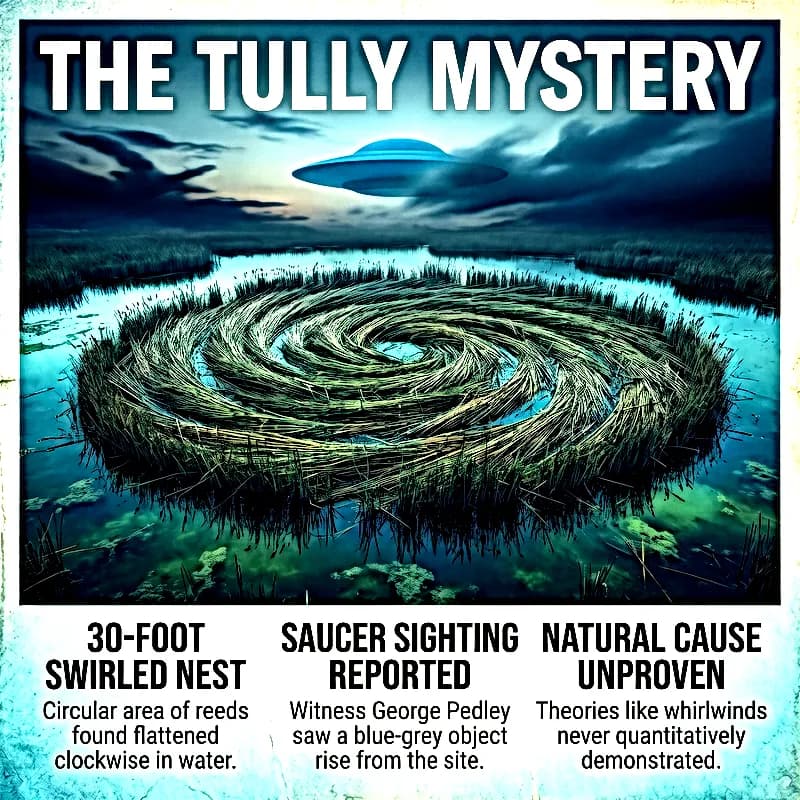
The Tully "Saucer Nest": Physical Trace Evidence, Reed Uprooting, and the Willy-Willy Hypothesis
Tully Saucer Nest Profile
Date
19 January 1966
Location
Horseshoe Lagoon, Tully
Diameter
~30 feet
Direction
Clockwise
Evidentiary Strength of Reported Features
Clockwise Swirl
5
Sharp Vegetation Boundary
5
Floating Weight-Bearing Platform
4
Whole-Root Extraction (Unquantified)
3
Demonstrated Textile Weaving
1
Analyst Note
The willy-willy hypothesis is physically plausible at the level of producing a circular or spiral flattening pattern, because atmospheric vortices produce rotary flow, inflow, uplift, and debris entrainment. The hypothesis is not quantitatively demonstrated for the reported uprooting, because uprooting requires fluid forces to exceed the resistance of the plant roots and rhizomes, and no Tully-specific values for either side of that inequality were measured.
On 19 January 1966, banana grower George Pedley reported seeing a blue-grey, saucer-like object rise from Horseshoe Lagoon near Tully, Queensland, at approximately 9:00 a.m., accompanied by a loud hissing noise and rapid rotation.
The strongest securely documented physical trace was an approximately 30-foot-wide area of reeds flattened or swirled clockwise, sharply bordered by standing green vegetation. A more detailed July 1966 account stated that the reeds were bent beneath water level, dead or brown, and arranged clockwise, while investigators reportedly found no rooted stubble beneath the formation, with roots coming up whole and the lagoon floor smooth.
The University of Queensland reportedly found nothing unnatural in submitted plant samples and advised that the nests could have resulted from severe turbulence associated with North Queensland line squalls or thunderstorms. The Department of Air consequently accepted a downdraft, willy-willy, or waterspout as a possible cause, while explicitly stating that it had no explanation for the visible aerial phenomenon Pedley reported.
Reported Features vs Evidence
| Reported feature | Earliest or strongest source wording::Evidential status |
|---|---|
| Approximately 30-foot diameter | About 30 feet in diameter.::Strongly documented as an approximate contemporary estimate. |
| Clockwise orientation | Reeds flattened in a clockwise direction.::Strongly documented for the principal nest. |
| No scorching | Reeds had not been scorched or burnt.::Strong evidence against a simple high-temperature burn mechanism. |
| Whole-root extraction | Macdonald reportedly found no stubble, whole roots removed.::Important testimony, but without quantified botanical documentation. |
| 'Woven' construction | Modern ABC wording says 'almost woven,' while early sources say flattened or swirled.::Interpretive and not demonstrated as a deliberate over-under weave. |
University and Official Investigations
The Department of Air expanded the university's severe-turbulence suggestion into a model in which a whirling tropical air mass reached the surface, created a dust eddy, waterspout, or related vortex, and flattened reeds into a circular pattern. The Department described this as an accepted possible cause, not as an experimentally reproduced or uniquely established cause.
The official summary did not state that the university demonstrated whole-root extraction by a vortex, reproduced a floating mat, or measured the forces needed to remove the vegetation.
Investigative Conclusions vs Gaps
| Investigative question | What was actually reported::What was not established |
|---|---|
| Were the reeds chemically or physically abnormal? | University of Queensland reportedly found nothing unnatural in submitted samples.::The cited correspondence does not provide the original laboratory data or methods. |
| Could a vortex create a circular pattern? | The Department of Air considered severe turbulence or willy-willies possible.::No Tully-specific vortex was observed, measured, or reconstructed. |
| Could the proposed vortex uproot the entire root system? | The cited official correspondence does not report a root-pullout calculation.::Required force, species, rooting depth, sediment strength, and actual wind speed remain unknown. |
| Was the aerial object identified? | The Department stated there was no explanation for the reported visible phenomenon.::No independent instrument record or second simultaneous witness established the object's physical nature. |
Willy-Willy Mechanics versus the Evidence
The available dynamic pressure in a flow scales with the square of the wind speed. Those pressures cannot be converted directly into Tully root-pullout force because the effective projected stem area, drag coefficient, wind profile, vertical flow, water motion, plant reconfiguration, and number of stems sharing the load are unknown.
Flexible aquatic vegetation reduces drag by bending and reconfiguring with the flow, which can allow it to survive forces that would act more strongly on a rigid object of equivalent upright area. A valid Tully calculation would require identification of the reed species, stem density, average stem dimensions, rooting depth, rhizome connectivity, sediment cohesion, sediment saturation, pullout direction, and peak wind and water velocities.
The claim that the vortex required a mechanically extraordinary or impossible force is therefore unproven, but the contrary claim that an ordinary willy-willy had demonstrably sufficient force is also unproven. The evidence therefore supports a conclusion of unresolved physical trace with a credible natural-vortex candidate, rather than proof either of an extraterrestrial vehicle or of a successfully demonstrated whirlwind mechanism.