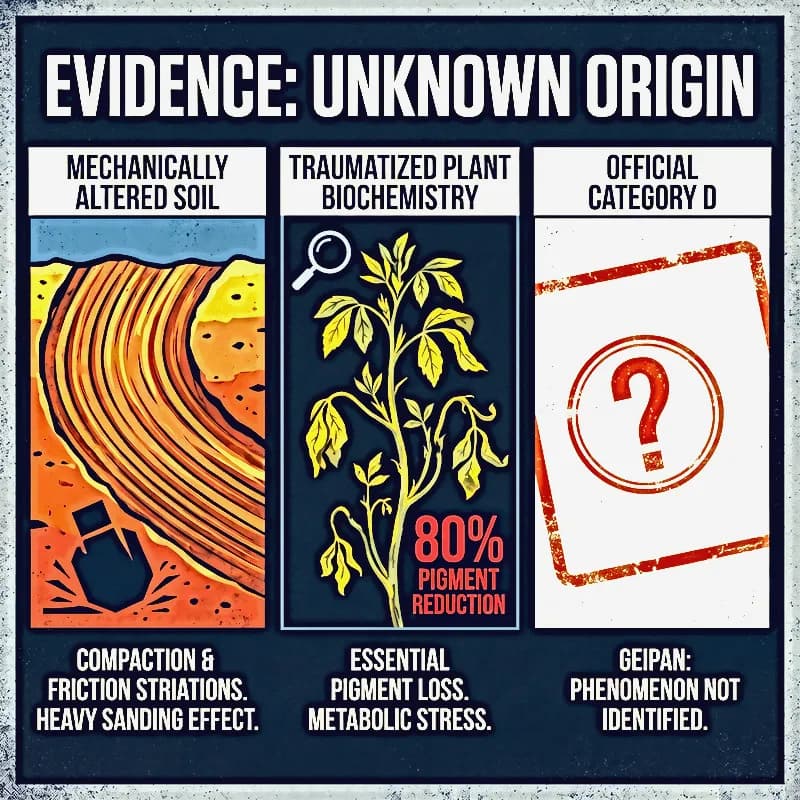
Trans-en-Provence, 1981: Physical and Botanical Evidence in the Official Record
On January 8, 1981, in the commune of Trans-en-Provence (Var, France), 55-year-old farmer and mason Renato Nicolaï reported observing a small, disc-shaped metallic object land briefly on a terraced path on his property before accelerating away [1]GEPAN. (1983, March 1). *Note Technique No. 16: Enquête 81/01 — Analyse d'une trace (Trans-en-Provence)*. Centre National d'Études Spatiales (CNES) https://www.cnes-geipan.fr/sites/default/files/Note%20techn16-R.pdf, [2]GEIPAN. *Trans-en-Provence (83) — 08.01.1981 (Cas D)*. Centre National d'Études Spatiales https://www.cnes-geipan.fr/fr/recherche/cas?field_agregation_index_value=Trans+en+Provence+. The French Gendarmerie documented the site the following day, photographed physical ground impressions, and collected soil and biological samples that were transferred into the official investigative custody of GEPAN (Groupe d'Études des Phénomènes Aérospatiaux Non Identifiés) under the French space agency CNES [1]GEPAN. (1983, March 1). *Note Technique No. 16: Enquête 81/01 — Analyse d'une trace (Trans-en-Provence)*. Centre National d'Études Spatiales (CNES) https://www.cnes-geipan.fr/sites/default/files/Note%20techn16-R.pdf, [3]CNES. *GEIPAN: Management and Study of Unidentified Aerospace Phenomena* https://cnes.fr/en/projects/geipan.
Trans-en-Provence Incident Profile
Incident Date
January 8, 1981
Witness
Renato Nicolaï (Farmer)
Investigating Agency
GEPAN / CNES (Note Tech. 16)
Botanical Analysis
INRA Biochemistry (Dr. M. Bounias)
Official Status
GEIPAN Category D (Unexplained)
Evidentiary Assessment of Findings
Physical Soil Compaction & Striations
5
Alfalfa Biochemical Alteration (INRA)
5
GEPAN Category D Classification
5
Hypothesized Electromagnetic / Microwave Field
2
Proven Extraterrestrial Craft Origin
1
Physical & Botanical Evidence: Laboratory Findings vs. Claims
| Evidence Category | Official Laboratory / GEPAN Finding (Note Tech. 16)::Popular Ufological Claim::Scientific Assessment |
|---|---|
| Soil Compaction | 6–7 mm crust, curved striations, abraded flint, monocrystalline state in P1::4–5 ton craft hydraulic pressure footprint::Authentic mechanical compression documented |
| exact tonnage is model-dependent | - |
| Soil Temperature | Carbonate analysis indicated peak heating did not exceed ~600°C::Measured 300°C–600°C intense baking of soil::600°C is an upper-bound limit from friction, not a confirmed thermometer reading |
| Botanical Chlorophyll | 33% drop in Chl A, 28% drop in Chl B, increased pheophytin ratio near trace::Complete destruction of plant chlorophyll by radiation::Selective degradation and accelerated senescence |
| not complete destruction | - |
| Carotenoids & Pigments | 50%–57% loss of beta-carotene |
| 80% drop in violaxanthin in young leaves | Unique extraterrestrial biochemical radiation fingerprint::Significant biochemical anomaly |
| distance-correlated across sampled transects | - |
| Energy Mechanism | Nuclear/gamma radiation ruled non-analogous |
| electrical field proposed conditionally | Proven high-power pulsed microwave propulsion beam::Electromagnetic field was an unverified hypothesis |
| no direct field measurement made | - |
Analyst Note
Trans-en-Provence is widely regarded as one of the most thoroughly investigated physical-trace UAP encounters in history due to the prompt intervention of the French Gendarmerie and rigorous multi-laboratory testing under GEPAN. While authentic mechanical soil trauma and profound distance-dependent botanical biochemistry disruptions were scientifically documented, the official report maintained that these anomalies constituted an event of 'large amplitude' without proving an extraterrestrial origin.
Chronology of Evidence Collection
The investigation unfolded across multiple sampling phases [1]GEPAN. (1983, March 1). *Note Technique No. 16: Enquête 81/01 — Analyse d'une trace (Trans-en-Provence)*. Centre National d'Études Spatiales (CNES) https://www.cnes-geipan.fr/sites/default/files/Note%20techn16-R.pdf:
- January 9, 1981 (J+1): The Gendarmerie of Draguignan surveyed the landing footprint, measuring two concentric circles (2.20 m inner, 2.40 m outer diameter) with two diametrically opposed arcuate friction zones. They retrieved primary soil core P1 and wild alfalfa (Medicago minima) samples N4 and N8 at 1.5 m from the center [1]GEPAN. (1983, March 1). *Note Technique No. 16: Enquête 81/01 — Analyse d'une trace (Trans-en-Provence)*. Centre National d'Études Spatiales (CNES) https://www.cnes-geipan.fr/sites/default/files/Note%20techn16-R.pdf.
- January 23, 1981 (J+15): Gendarmes gathered control vegetation N11 and N15 at a distance of 20 meters [1]GEPAN. (1983, March 1). *Note Technique No. 16: Enquête 81/01 — Analyse d'une trace (Trans-en-Provence)*. Centre National d'Études Spatiales (CNES) https://www.cnes-geipan.fr/sites/default/files/Note%20techn16-R.pdf.
- February 17, 1981 (J+40): GEPAN investigators took control soil P2 (3–4 m away) and a radial distance series of eight plant specimens extending up to 10 meters [1]GEPAN. (1983, March 1). *Note Technique No. 16: Enquête 81/01 — Analyse d'une trace (Trans-en-Provence)*. Centre National d'Études Spatiales (CNES) https://www.cnes-geipan.fr/sites/default/files/Note%20techn16-R.pdf.
┌────────────────────────────────────────────────────────────────────────┐
│                   Trans-en-Provence Investigation Chain                │
├───────────────────┬────────────────────────────────────────────────────┤
│ Jan. 8, 1981      │ Visual sighting by Renato Nicolaï (~17:00)         │
│ Jan. 9, 1981      │ Gendarmerie site mapping; samples P1, N4, N8       │
│ Jan. 23, 1981     │ Secondary control plant collection (N11, N15)      │
│ Feb. 17, 1981     │ GEPAN multi-distance transect sampling             │
│ March 1, 1983     │ GEPAN Technical Note No. 16 officially published   │
└───────────────────┴────────────────────────────────────────────────────┘
Physical and Chemical Soil Analysis
Laboratory analysis of soil sample P1 and control P2 was coordinated across several French research institutions [1]GEPAN. (1983, March 1). *Note Technique No. 16: Enquête 81/01 — Analyse d'une trace (Trans-en-Provence)*. Centre National d'Études Spatiales (CNES) https://www.cnes-geipan.fr/sites/default/files/Note%20techn16-R.pdf:
- Mechanical Compaction & Striations: Trace soil formed a hard, consolidated 6–7 mm crust, whereas control soil was loose and friable. Microscopy revealed curved striations, surface abrasion, and a flint fragment driven downward into the calcareous matrix and abraded level with the surface [1]GEPAN. (1983, March 1). *Note Technique No. 16: Enquête 81/01 — Analyse d'une trace (Trans-en-Provence)*. Centre National d'Études Spatiales (CNES) https://www.cnes-geipan.fr/sites/default/files/Note%20techn16-R.pdf.
- Thermal Constraints: The preservation of carbonate structures indicated that peak heating did not exceed approximately 600°C (1112°F); GEPAN noted this heating likely occurred as a consequence of mechanical friction rather than sustained thermal radiation [1]GEPAN. (1983, March 1). *Note Technique No. 16: Enquête 81/01 — Analyse d'une trace (Trans-en-Provence)*. Centre National d'Études Spatiales (CNES) https://www.cnes-geipan.fr/sites/default/files/Note%20techn16-R.pdf.
- Crystallization: Electron diffraction revealed a monocrystalline constituent in P1 not present in P2; an experimental attempt to reproduce this structure by heating soil to 1000°C for two hours failed [1]GEPAN. (1983, March 1). *Note Technique No. 16: Enquête 81/01 — Analyse d'une trace (Trans-en-Provence)*. Centre National d'Études Spatiales (CNES) https://www.cnes-geipan.fr/sites/default/files/Note%20techn16-R.pdf.
- Surface Deposits: Electron microprobe and mass spectrometry identified trace deposits of iron/iron oxide, phosphate, zinc, and a carbonaceous polymeric matrix along the striations [1]GEPAN. (1983, March 1). *Note Technique No. 16: Enquête 81/01 — Analyse d'une trace (Trans-en-Provence)*. Centre National d'Études Spatiales (CNES) https://www.cnes-geipan.fr/sites/default/files/Note%20techn16-R.pdf.
Botanical Analysis and Rapid Senescence
The biological investigation was conducted by Dr. Michel Bounias, head of the Biochemistry and Toxicology Laboratory at INRA (Institut National de la Recherche Agronomique) [1]GEPAN. (1983, March 1). *Note Technique No. 16: Enquête 81/01 — Analyse d'une trace (Trans-en-Provence)*. Centre National d'Études Spatiales (CNES) https://www.cnes-geipan.fr/sites/default/files/Note%20techn16-R.pdf, [4]Source entry missing for citation [4]:
Dr. Bounias observed that the molecular damage was inversely proportional to distance from the center and resembled an accelerated physiological aging process (rapid senescence) [1]GEPAN. (1983, March 1). *Note Technique No. 16: Enquête 81/01 — Analyse d'une trace (Trans-en-Provence)*. Centre National d'Études Spatiales (CNES) https://www.cnes-geipan.fr/sites/default/files/Note%20techn16-R.pdf, [4]Source entry missing for citation [4].
                [Trans-en-Provence Landing Center (0.0 m)]
                               │
                      (Radial Distance)
                               ▼
        ┌───────────────────────────────────────────────┐
        │  1.5 m (Trace Edge):                          │
        │    • Chlorophyll (a+b) reduced by 30% - 50%   │
        │    • Beta-Carotene reduced by 57%             │
        │    • Violaxanthin reduced by 80%              │
        │    • High Pheophytin / Chlorophyll Ratio      │
        └──────────────────────┬────────────────────────┘
                               │
                      (Radial Attenuation)
                               ▼
        ┌───────────────────────────────────────────────┐
        │  10.0 m - 20.0 m (Peripheral Baseline):       │
        │    • Normal pigment profiles (100% baseline)  │
        │    • Standard carbohydrate metabolism         │
        └───────────────────────────────────────────────┘
Evaluation of Energy Hypotheses
- Ionizing Radiation: Bounias explicitly compared the damage profile against gamma-irradiated Arabidopsis thaliana seeds and concluded that nuclear/gamma radiation did not match the observed energetic profile [1]GEPAN. (1983, March 1). *Note Technique No. 16: Enquête 81/01 — Analyse d'une trace (Trans-en-Provence)*. Centre National d'Études Spatiales (CNES) https://www.cnes-geipan.fr/sites/default/files/Note%20techn16-R.pdf.
- Electromagnetic / Microwave Fields: To explain the magnesium dechelation without external tissue incineration, Bounias proposed that an electrical-type or high-frequency pulsed electromagnetic field could theoretically account for the selective molecular stress [1]GEPAN. (1983, March 1). *Note Technique No. 16: Enquête 81/01 — Analyse d'une trace (Trans-en-Provence)*. Centre National d'Études Spatiales (CNES) https://www.cnes-geipan.fr/sites/default/files/Note%20techn16-R.pdf. However, GEPAN did not perform direct electromagnetic field measurements at the scene [1]GEPAN. (1983, March 1). *Note Technique No. 16: Enquête 81/01 — Analyse d'une trace (Trans-en-Provence)*. Centre National d'Études Spatiales (CNES) https://www.cnes-geipan.fr/sites/default/files/Note%20techn16-R.pdf.
Official Classification and Skeptical Reassessment
GEPAN (and its successor GEIPAN) classifies the Trans-en-Provence incident as a Category D phenomenon ("unidentified after investigation") [2]GEIPAN. *Trans-en-Provence (83) — 08.01.1981 (Cas D)*. Centre National d'Études Spatiales https://www.cnes-geipan.fr/fr/recherche/cas?field_agregation_index_value=Trans+en+Provence+, [3]CNES. *GEIPAN: Management and Study of Unidentified Aerospace Phenomena* https://cnes.fr/en/projects/geipan. In its final synthesis in Technical Note No. 16, GEPAN concluded that the physical and biological traces confirmed an event of "large amplitude," while emphasizing that the exact origin and propulsion mechanism remained unproven [1]GEPAN. (1983, March 1). *Note Technique No. 16: Enquête 81/01 — Analyse d'une trace (Trans-en-Provence)*. Centre National d'Études Spatiales (CNES) https://www.cnes-geipan.fr/sites/default/files/Note%20techn16-R.pdf.
Skeptical analyses (notably by the Observatoire Zététique) have suggested alternative hypotheses, including agricultural machinery, concrete mixer tire skids, or vehicle maneuvering during ongoing masonry work on Nicolaï's property [5]Rossoni, D., Maillot, É., & Déguillaume, É. (2007). *Les Ovnis du CNES: 30 ans d'études officielles (1977–2007) — Chapitre 13: Trans-en-Provence*. Observatoire Zététique https://www.zetetique.fr/wp-content/uploads/2019/03/OvniDuCnes_chapitre13.pdf. However, later soil re-examinations (including a 1988 analysis reported by Jacques Vallée) found no residues of cement powder, motor oil, or heavy hydrocarbons, leaving the case unresolved [6]Vallée, J. (1990). *Return to Trans-en-Provence*. Journal of Scientific Exploration, 4(1), 19–25 https://noufors.com/Documents/Books%2C%20Manuals%20and%20Published%20Papers/Specialty%20UFO%20Publications/Journal%20of%20Scientific%20Exploration/jse_04_1_vallee_.
Sources
- GEPAN. (1983, March 1). Note Technique No. 16: Enquête 81/01 — Analyse d'une trace (Trans-en-Provence). Centre National d'Études Spatiales (CNES). https://www.cnes-geipan.fr/sites/default/files/Note%20techn16-R.pdf
- GEIPAN. Trans-en-Provence (83) — 08.01.1981 (Cas D). Centre National d'Études Spatiales. https://www.cnes-geipan.fr/fr/recherche/cas?field_agregation_index_value=Trans+en+Provence+
- CNES. GEIPAN: Management and Study of Unidentified Aerospace Phenomena. https://cnes.fr/en/projects/geipan
- Bounias, M. (1990). Biochemical Chromatographic Analysis of Plant Leaves Exposed to an Unidentified Aerial Phenomenon. Journal of Scientific Exploration, 4(1), 27–42.
- Rossoni, D., Maillot, É., & Déguillaume, É. (2007). Les Ovnis du CNES: 30 ans d'études officielles (1977–2007) — Chapitre 13: Trans-en-Provence. Observatoire Zététique. https://www.zetetique.fr/wp-content/uploads/2019/03/OvniDuCnes_chapitre13.pdf
- Vallée, J. (1990). Return to Trans-en-Provence. Journal of Scientific Exploration, 4(1), 19–25. https://noufors.com/Documents/Books%2C%20Manuals%20and%20Published%20Papers/Specialty%20UFO%20Publications/Journal%20of%20Scientific%20Exploration/jse_04_1_vallee_1.pdf
- COMETA. (1999). UFOs and Defense: What Should We Prepare For?. Special Edition, VSD Magazine. https://ia801803.us.archive.org/27/items/pdfy-NRIQie2ooVehep7K/The%20Cometa%20Report%20%5BUFO%27s%20And%20Defense%20-%20What%20Should%20We%20Prepare%20For%5D.pdf