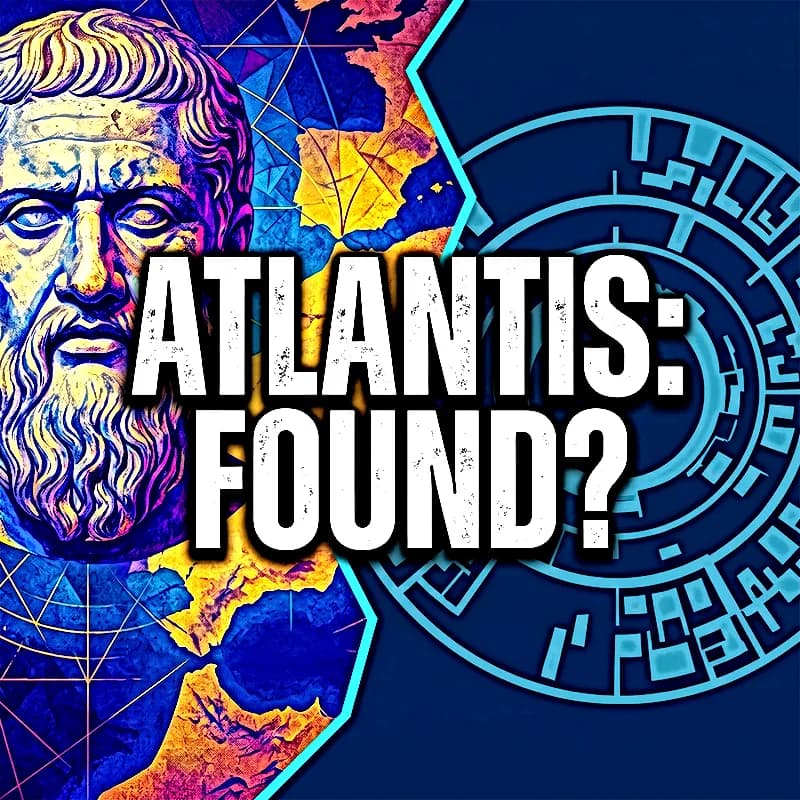
The Atlantis Enigma
Plato's Timeline
War Date
9,000 years before Solon
Solon's Visit to Sais
~600 BCE
Publication
~360 BCE
Capital Shape
Concentric rings
Leading Atlantis Theories Support
Santorini/Thera (Bronze Age)
4
Tartessos / SW Iberia (Iron Age)
3
Spartel Bank (Pleistocene)
2
Richat Structure (Natural Geology)
1
Overall Assessment
Atlantis is primarily a textual and philosophical problem based entirely on Plato's dialogues Timaeus and Critias. While real geographical and catastrophic elements likely inspired Plato, no proposed site commands scholarly consensus as a literal historical match for the 9,000-year-old advanced maritime empire he described.
Plato’s account is unusually concrete: it gives a transmission chain through Solon and Egyptian priests at Sais, places Atlantis at or beyond the Pillars of Heracles, describes a capital made of concentric rings of land and water, and dates the war with primeval Athens to 9,000 years before Solon.
That concreteness is why Atlantis keeps attracting location claims, but no proposed site commands scholarly consensus, and no accepted excavation has demonstrated the existence of a lost, technologically advanced maritime empire matching Plato’s description and chronology.
The most defensible modern position is that Plato may have woven together real ingredients—earthquakes, tsunamis, submerged coastlines, western Mediterranean geography, and memories of Bronze Age collapse or volcanic catastrophe—into a deliberately moralized and idealized narrative, but that this is not the same as proving a literal Atlantis.
Core Assessment Questions
| Question | Best-supported answer |
|---|---|
| Did Plato describe Atlantis as if it were a real place? | Yes. He framed it as a true tradition relayed from Egyptian priests to Solon and then through Critias’ family. |
| Do modern classicists generally accept Atlantis as literal history? | No. The dominant scholarly reading treats it as a Platonic myth/allegory with moral and political purpose. |
| Could real events have influenced the story? | Possibly. Santorini/Thera, western Mediterranean polities, earthquakes, tsunamis, and postglacial flooding are all plausible ingredients. |
| Do the July 2025 Cádiz claims prove Atlantis? | No. They are geographically interesting, but the public source trail is media coverage and documentary promotion rather than a peer-reviewed excavation report. |
| Does the Richat Structure fit Atlantis well? | Poorly. Its concentric form is real, but the geological consensus identifies it as a natural eroded dome, and its elevation is far above Holocene sea level. |
Plato’s original account
Plato introduces the story in Timaeus through Critias, who says the tale came from Solon, who had heard it from Egyptian priests at Sais.
The Egyptian priest tells Solon that the Athenians who fought Atlantis lived 9,000 years before Solon’s time, while the sacred registers of the Egyptian city were said to be 8,000 years old.
In Timaeus, Atlantis is placed “in front of” the straits called the Pillars of Heracles, in a then-navigable Atlantic, and the island is said to be larger than “Libya and Asia” together.
The Atlantean power is said to have expanded over parts of Libya as far as Egypt and over Europe as far as Tyrrhenia, before being defeated by primeval Athens and her allies.
Plato then says that, after violent earthquakes and floods, Atlantis sank, and the sea became blocked by an impassable shoal or barrier of mud.
In Critias, Plato provides the famous morphology of the capital: Poseidon encircled a central hill with two rings of land and three rings of water, “turned as with a lathe,” each ring centered precisely on the middle.
Plato also gives engineering-style dimensions: a canal from the sea to the outer ring was 300 feet wide, 100 feet deep, and 50 stadia long, while the largest water ring was three stadia wide, the next water ring two stadia, and the innermost water ring one stadium wide.
He further describes bridges, gates, stone walls of different colored stone, double docks, a monumental temple of Poseidon, hot and cold springs, a racecourse, and a very large rectangular agricultural plain measuring 3,000 by 2,000 stadia.
One especially important Iberian detail appears when Critias says that one royal allotment faced the region of Gades, linking part of Atlantis conceptually with the southwestern Iberian world near modern Cádiz.
Elements of Plato's Account
| Element in Plato | What the text says::Why it matters for modern theories |
|---|---|
| Chronology | War occurred 9,000 years before Solon.::Pushes Atlantis far earlier than Bronze Age candidates such as Tartessos or Santorini. |
| Location | Atlantis lay at or beyond the Pillars of Heracles in the Atlantic approach.::Favors Gibraltar/Atlantic proposals over eastern Mediterranean ones. |
| Capital form | Two land rings and three water rings around a central island.::Drives fascination with circular geomorphology such as Cádiz sonar targets or Richat. |
| Harbor engineering | Large sea canal, bridges, walls, docks, ship passages.::Encourages interpretation of linear or curving underwater anomalies as artificial works. |
| End of Atlantis | Destroyed in earthquakes and floods |
| left muddy shoals. | Makes tsunami and earthquake-prone regions attractive to theorists. |
Modern leading location theories
The Santorini/Thera theory remains popular because the Minoan eruption was a real cataclysm that devastated Akrotiri and generated tsunamis across the Aegean, but it fits Plato’s geography poorly because Santorini lies in the eastern Mediterranean, not beyond Gibraltar.
The Spartel Bank theory, just west of Gibraltar, is stronger geographically because it places a former island in the right maritime corridor, and geological work has argued that a paleoisland there was overtaken by postglacial sea-level rise and tsunami-prone tectonics.
The southwest Iberia / Tartessos / Doñana / Cádiz family of theories is attractive because Plato explicitly links one Atlantean dynast’s territory to Gades, and because southwestern Iberia really did host the wealthy polity of Tartessos in the first millennium BCE.
The problem is that Tartessos is first-millennium BCE, not a 9,000-years-before-Solon civilization, so it can only work as a possible inspiration for Plato, not as a literal fit to his chronology.
The Richat Structure in Mauritania became popular because its concentric rings look strikingly Atlantean from space, but scientific work identifies it as a natural eroded geologic dome related to igneous intrusion, uplift, hydrothermal processes, and differential erosion.
Current Status of Location Theories
| Theory | Main attraction::Main problem::Current evidentiary standing |
|---|---|
| Santorini / Thera | Real Bronze Age island catastrophe with tsunamis and a ring-like volcanic setting.::Wrong side of the Mediterranean relative to Plato’s Pillars of Heracles.::Best seen as a possible inspiration, not a literal match. |
| Spartel Bank | Close to Gibraltar |
| a real paleoisland existed and the region is tsunami-prone. | Little evidence for a large complex civilization there, and chronology/cultural fit remain weak.::Geologically interesting, archaeologically unproven. |
| Tartessos / Doñana / Cádiz | Southwest Iberia matches the Gades/Gibraltar horizon and preserves a real prosperous polity.::Tartessos belongs to the first millennium BCE, not deep prehistory.::Plausible source material for Plato’s imagination, not a literal Atlantis. |
| Richat Structure | Concentric morphology resembles Plato’s rings.::Natural geology, inland desert location, high elevation, no accepted city remains.::Popular fringe theory, not accepted geology or archaeology. |
The July 2025 Cádiz claims by Michael Donnellan
In July 2025, Michael Donnellan publicly claimed that sonar and LiDAR work off the coast of Cádiz, near Rota/Punta Candor, had revealed submerged circular walls, a central rectangular monument he associated with a Temple of Poseidon, and other features he believed matched Plato “verbatim.”
The public reporting stated that Donnellan presented the material at the Cosmic Summit in North Carolina after about eight years of fieldwork, and linked the destruction of the site to a catastrophe around 11,600 years ago, often framed in relation to the Younger Dryas.
Geographically, the Cádiz theory is not absurd on its face, because Plato’s text places Atlantis in the Atlantic approach to the Pillars of Heracles, and also associates one Atlantean royal territory with Gades, the ancient Cádiz area. The Gulf of Cádiz is also a real tsunami and earthquake province, making southwest Iberia one of the more textually and geologically plausible broad regions.
But the evidentiary problem is severe: the source trail for the July 2025 claim consists of media reports, conference summaries, social posts, and documentary production pages, not a peer-reviewed excavation report or published site plan.
A second caution is contextual: the Cádiz-Rota coast already preserves stone tidal fishing structures known as corrales, built as low dry-stone walls that trap fish with the tides, demonstrating that curving or linear stone constructions are part of the historical coastal landscape there.
The strongest fair-minded verdict is that the Cádiz claim is interesting because it sits in the right broad geographic theater, but it is not demonstrated because the public evidence does not yet establish dating, cultural attribution, site extent, or artificiality to normal archaeological standards.
Donnellan Claims Analysis
| Donnellan claim | What supports it::What is still missing |
|---|---|
| Concentric underwater architecture off Cádiz matches Plato | Media reports describe sonar/LiDAR images of circular forms and a central rectangular feature.::Publicly accessible peer-reviewed mapping, excavation, dating, artifact assemblages, and independent replication. |
| A catastrophe destroyed the site around 11,600 years ago | The Gulf of Cádiz is demonstrably tsunami-prone, and great earthquakes do occur there.::A securely dated destruction horizon tied to this specific site. |
| The location fits Plato well | Plato places Atlantis at/beyond the Pillars and links an Atlantean allotment to the region of Gades.::Fit to Plato’s chronology and to the specific ring-plan dimensions still remains unproven. |
The Richat Structure and the Eye of the Sahara theory
The Richat Structure is a real, spectacular circular feature in Mauritania that is about 40–50 kilometers across. Modern geologists do not interpret Richat as an impact crater or the remains of a city; the consensus explanation is that it is a deeply eroded geological dome associated with igneous intrusion, uplift, hydrothermal alteration, and differential erosion of rock layers.
ESA notes that the outer rim reaches about 485 meters above sea level. That elevation is devastating for the Atlantis-Richat equation, because even the new global sea-level reconstruction for the early Holocene shows tens of meters of sea-level rise after 11 ka, not the hundreds of meters needed to make Richat a marine harbor.
The structure does preserve rich prehistoric traces—Paleolithic tools and Neolithic remains—but those are not evidence for an urban, high-technology maritime capital.
The associated Younger Dryas impact hypothesis also remains highly contested: the major 2023 refutation concluded that the hypothesis lacks a self-consistent scenario and that no crater securely dated to the onset of the Younger Dryas has been identified. That means Richat theorists typically stack one disputed hypothesis on top of another.
Evidence for and against a historical core behind Atlantis
There is real evidence that ancient people lost coastal territory to postglacial sea-level rise (e.g., Doggerland). There is also real evidence that catastrophic natural disasters—such as the Thera eruption and tsunamis in the Gulf of Cádiz—were capable of affecting complex societies and leaving deep cultural memories.
Those facts make it reasonable to think that Plato could have been drawing on real classes of events. But the case against a literal Atlantis is still stronger. Plato is the only actual ancient authorial source for the story under review, and the dominant scholarly interpretation is that he shaped Atlantis for moral and political purposes.
The chronology is also a major problem: if one takes Plato literally, Atlantis belongs roughly in the 10th millennium BCE, but archaeology of that era does not show literate, metal-using, imperial maritime states with monumental harbors and trireme-like canal engineering. The best-known monumental site near that horizon, Göbekli Tepe, was built by Stone Age hunter-gatherers.
Arguments for a Historical Core
| Argument | Evidence in favor::Evidence against |
|---|---|
| Atlantis preserves memory of real catastrophes | Thera was real |
| Gulf of Cádiz tsunamis were real | - |
| many coasts were inundated after the Ice Age. | None of those events, by themselves, reproduce Plato’s exact place, date, and city plan. |
| A real western maritime polity inspired Plato | Southwest Iberia hosted Tartessos, and Plato’s text gestures toward Gades.::Tartessos is much too late to be Plato’s literal Atlantis. |
| A 10th-millennium-BCE advanced empire once existed and was lost | Monumentality in deep prehistory is real at sites like Göbekli Tepe.::Urbanism, writing, and Bronze Age-style political economies appear millennia later. |
Open questions and limitations
The largest unresolved issue in the Cádiz case is not geography but data access: the public record does not include a formal archaeological report, complete georeferenced survey release, published artifact assemblage, or independent laboratory chronology for the alleged structures.
The largest unresolved issue in the broader Atlantis debate is conceptual: even if future work showed that Plato drew on real western Mediterranean settlements, tsunamis, or drowned landscapes, that would still not establish the literal existence of Plato’s fully described Atlantis empire.
The highest-confidence conclusion, therefore, is that Plato’s Atlantis is best understood as a philosophically shaped story that may contain fragments of real geological and historical experience, but modern “discovery” claims—especially the 2025 Cádiz claim and the Richat theory—do not currently meet the evidentiary threshold required to turn Atlantis from literary construct into demonstrated lost civilization.