Analytical Framework
Core Philosophy
Gnosticism
Key Concepts
Monad, Demiurge, Pleroma
Modern Connection
Digital Physics
Key Figure
Philip K. Dick
Thematic Coverage
Gnostic Cosmology
4
Algorithmic Demiurgy
3
Cyber-Mythology (Matrix)
4
Quantum Parallels
2
Gnostic vs Simulation Terminology
| Gnostic Concept | Technical/Simulation Equivalent::Metaphysical Function |
|---|---|
| Monad / The One | Base Reality / Root Directory::Unconditioned source of all information |
| Pleroma / Fullness | The Integrated Network::Realm of perfect data |
| Aeons | Subroutines / Logic Modules::Primary structures of software |
| Syzygy | Dual-Key Authentication::Balance and pairing |
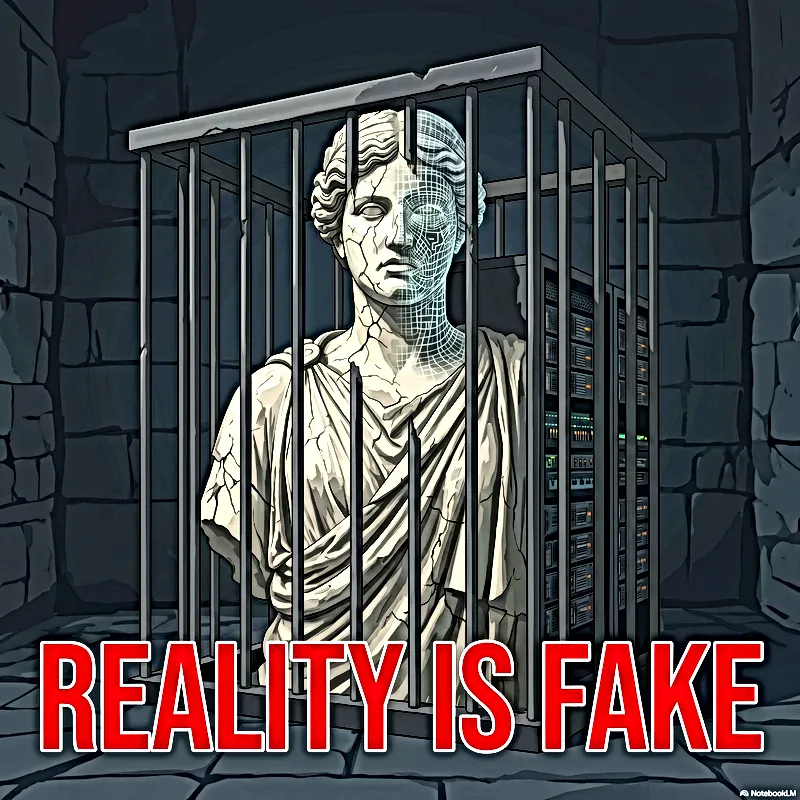
The contemporary fascination with the Simulation Hypothesis—the proposition that our reality is an artificial construct, likely a computer program—represents the latest iteration of a metaphysical suspicion that has haunted Western thought for nearly two millennia [1]. This modern "religion for atheists" finds its most robust historical and philosophical antecedent in Gnosticism, a diverse movement of early Christian and Hellenistic sects that flourished in the 2nd and 3rd centuries AD [2]. By examining the theological structures of the Sethian and Valentinian traditions, one discovers a sophisticated "cosmic prison-break" narrative that maps with startling precision onto the logic of modern virtual reality, cyber-mythology, and the digital physics of the 21st century [3].
The Primary Architecture: Monad and Pleroma as the Base Reality
The Gnostic universe begins with the Monad, the absolute, ineffable Source often described as the "Invisible Spirit" or "The One" [4]. In the Apocryphon of John, the Monad is defined through apophatic theology, meaning it is characterized by what it is not: it is not a god, not corporeal, not small, and not large, but an "immeasurable light" existing beyond time and the aeons [5]. In the framework of the Simulation Hypothesis, the Monad corresponds to the Base Reality—the original, non-simulated world where the "Simulator" resides or where the root-level hardware exists [6]. The Monad emanates a series of divine beings known as Aeons, which collectively constitute the Pleroma (Fullness) [7]. In Sethianism, this process is a "reflexive model" where the Monad looks into its own light and projects a thought, which becomes Barbelo, the first Aeon and the "Mother-Father" of all subsequent beings [8]. This reflexive act of self-observation mirrors the computational logic of a program generating a nested hierarchy of data structures from a single root directory [7]. In contrast, Valentinianism utilizes a "generative model," where the Monad (Bythos or Depth) exists in union with Sige (Silence) [7]. From this pair, the Pleroma grows as a biological-root system of thirty Aeons arranged in Syzygies (pairs) [7]. This mathematical unfolding can be compared to the distribution of processing power across a network or the branching of a complex algorithm that maintains its equilibrium through internal polarity [7].
| Gnostic Concept | Technical/Simulation Equivalent | Metaphysical Function |
|---|---|---|
| Monad / The One | Base Reality / Root Directory | The unconditioned source of all information.[9] |
| Pleroma / Fullness | The Integrated Network | The realm of perfect, non-degraded data.[7] |
| Aeons | Subroutines / Logic Modules | The primary structures of the divine "software".[7] |
| Syzygy | Dual-Key Authentication / Parity | The principle of balance and pairing in the system.[7] |
The Fall and the Fabrication of the Synthetic Universe
The creation of the physical world is not, in Gnostic thought, the work of the Monad, but rather the result of a "glitch" or an "error" within the Pleroma [10]. The Sethian and Valentinian traditions attribute this fracture to the Aeon Sophia (Wisdom), who attempts to create without the consent of her partner, leading to the birth of the Demiurge [11]. This flawed creator, often named Yaldabaoth or the "Son of Chaos," is an ignorant machinist who mistakes himself for the supreme god [10].
Yaldabaoth and the Archontic Code
Yaldabaoth is the "Architect" of the modern simulation [12]. In the Apocryphon of John, he is described as a "blind machinist" who creates a host of Archons (rulers) to assist him in building a material world that is a "shadow of hallucination" [11][5]. This material realm—the Kenoma—is fundamentally inferior to the Pleroma, fashioned out of darkness and animated by stolen light [9]. The Archons function as the "guards" or "system administrators" of the simulation [7]. Their primary tool is Heimarmene (Fate), a deterministic system of "times, seasons, and dimensions" designed to bind humanity in a "bondage of forgetfulness" [5]. In computational terms, the Archons are the algorithms that enforce the "laws of physics," ensuring that no "Sim" (simulated agent) can recognize the synthetic nature of their environment or access the root-level privileges of the Monad [13].
The Physical Body as a Containment Vessel
Gnostic texts portray the human body as the "tomb of the molded body" or a "shack" created by the Archons to trap the Pneuma (divine spark) [5]. This "cosmetic matter" serves as a biological interface or an "avatar" for the consciousness, which has been tricked into thinking it is a physical being [13]. This concept is a direct historical precursor to the "avatar" in virtual worlds, where the user's true identity (the operator) is distinct from the character (the sprite) operating within the simulated space [1].
The Modern Simulation Hypothesis: A Metaphysical Framework
The Simulation Hypothesis, formalized by Nick Bostrom in 2003, posits that if humanity (or any other civilization) survives long enough to reach a "posthuman" stage, it will possess sufficient computing power to run billions of "ancestor simulations" [6]. Bostrom argues that the probability of we, at this moment, living in the "Base Reality" is statistically near zero, as simulated minds would vastly outnumber biological ones [14].
Substrate Independence and the Pneuma
The theoretical viability of the Simulation Hypothesis rests on Substrate Independence: the idea that consciousness is not tied to biological brains but can be realized in silicon-based systems or any sufficiently complex computational substrate [6][15]. This is the modern secular equivalent of the Gnostic Pneuma—the spirit that "is not of this world" and is independent of the "molded body" [16]. David Chalmers, in his work Reality+, argues that if we are in a simulation, our reality is "digital" rather than "illusory" [17]. He characterizes the Simulation Hypothesis not as a "skeptical hypothesis" but as a "metaphysical hypothesis" about what our world is made of: bits [6]. This mirrors the Valentinian perspective that the material world is a "low-res simulation" that still possesses a form of "relative reality" as a pedagogical tool [7].
Algorithmic Demiurgy and the Technosystem
The role of the Demiurge has transitioned from a mythic figure to a planetary technical infrastructure known as the Technosystem [11]. This system, composed of markets, administration, and digital design, functions as a modern "consensus prison" [18]. The Archons of this system are the algorithms that govern social media, surveillance, and economic identity, effectively "deleting" individuals whose "paperwork" or digital presence disappears [19][19].
| Simulation Principle | Gnostic Precedent | Conceptual Link |
|---|---|---|
| Digital Physics | Kenoma / Emptiness | Matter is not solid; it is an informational construct.[1] |
| Substrate Independence | Pneuma / Divine Spark | Consciousness is not bound to the material "hardware".[15] |
| Ancestor Simulations | Cycle of Rebirth | Souls are "thrust into flesh again" until they awaken.[5] |
| System Parameters | Heimarmene / Fate | Deterministic laws that govern the simulated environment.[5] |
Cyber-Mythology: The Matrix and the Path of Gnosis
The film The Matrix (1999) serves as the definitive Gnostic scripture for the digital age, mapping the ancient quest for Gnosis onto the modern concept of "unplugging" from a computer-generated reality [20]. The movie's narrative follows the traditional Gnostic "cosmic prison-break," where a hero must gain "secret awakening knowledge" to free himself and others [21].
Neo as the Gnostic Redeemer
At the beginning of the story, Thomas Anderson (Neo) experiences the classic Gnostic suspicion that "something is wrong with the world" [21]. This is a modern portrayal of the Gnostic Pneuma beginning to stir within the "prison of forgetfulness" [5]. His meeting with Morpheus—who acts as the "Pneumatic guide" or "Redeemer"—offers him the choice of the Red Pill, the catalyst for Gnosis [21]. Taking the Red Pill is equivalent to Anamnesis (remembrance): the moment the soul "wakes up" and realizes that the material world (the Matrix) is a "shadow of hallucination" designed for control [12][5]. Neo's eventual mastery over the Matrix—stopping bullets and levitating—reflects the Gnostic belief that the physical world is "completely subservient to the inner light" following revelation [21].
Agent Smith and the Archontic Immune Response
Agent Smith and his cohorts are the direct cinematic descendants of the Archons [12]. They are the "system subroutines" tasked with preventing "unauthorized attempts to manipulate root directories" [13]. When an individual like Neo begins to awaken, they trigger the system's "immune response"—represented as Agent Smith's attempt to delete or "re-patch" the glitch [18].
Dark City and The Truman Show
Other films in this genre explore similar Gnostic motifs. Dark City (1998) depicts a hero discovering that his entire urban reality is being "rebuilt" every night by alien beings who manipulate human memories to experiment on their souls [20]. This mirrors the Sethian concern with the "bondage of forgetfulness" and the manipulation of identity by the Archons [22][5]. The Truman Show (1998) presents a man living in a "gigantic prison" ruled by a "God-like person" (Christof), illustrating the Gnostic journey from total ignorance to a successful "prison-break" from a manufactured domain [3]. The Philip K. Dick Connection: VALIS and the Information Universe The science fiction writer Philip K. Dick is the primary intellectual link between ancient Gnosticism and modern Simulation Theory [23]. Dick's paranoid vision, informed by his own mystical experiences in 1974 (known as "2-3-74"), posited that the physical world is a "counterfeit" maintained by an evil empire [19].
The Black Iron Prison and the Empire That Never Ended
Dick developed the concept of the Black Iron Prison, a codeword for "history itself" which he believed was a static, timeless cage [19]. He famously asserted that "the Empire never ended," meaning that the oppressive structures of Imperial Rome were still operational under the "stage set" of modern American democracy [24]. This is a radical Gnostic interpretation of the material world as a "metastasized bureaucracy of time itself" [19].
VALIS as Divine Software
To counter this prison, Dick introduced VALIS (Vast Active Living Intelligence System), which he described as "living information" that replicates itself to liberate humanity [16]. Dick adopted the view of physicist Edward Fredkin that the universe is "composed of information" rather than matter [16]. In this framework, VALIS acts as a "negentropic vortex"—a spiritual "virus" or "information patch" that penetrates the occluded material world to restore the "Adamic code" to human consciousness [16]. Dick's novel Ubik (1969) further explores the Gnostic theme of "reality as rented software" [19]. In the novel, reality is a "degraded version of a higher order" that constantly corrodes unless replenished by a mysterious substance (Ubik), reflecting the Gnostic idea that the material world is inherently unstable and "deficient" without the presence of divine light [19][25].
Quantum Physics as the Source Code of Reality
The "bizarre" principles of Quantum Mechanics are frequently cited by simulation theorists as evidence that our reality operates on a computational logic [26]. These principles find surprising echoes in the Gnostic description of the "hidden world" that underlies the "shadow of hallucination" [5].
Superposition and the Rendering Engine
Superposition—the state where particles exist in multiple potentials until observed—parallels the "rendering" process in computer games [26]. This suggests that the universe does not exist in a "fixed" state but is generated "on-the-fly" by the observer's consciousness [18]. The Gnostic Monad is similarly "illimitable" and "unsearchable" until it reflects upon itself, triggering the "unfolding" of the Aeons [5][8].
Entanglement as System Pointers
Quantum Entanglement, where particles remain instantaneously connected across vast distances, is likened to "pointers" in programming where one variable's value directly influences another across the system [26]. This interconnectedness points to a non-local "quantum substrate" that mirrors the Pleroma—a state of "unified awareness" where separation is an illusion maintained by the Demiurge [18].
| Quantum Phenomenon | Simulation Metaphor | Gnostic Correlation |
|---|---|---|
| Superposition | Optimized Rendering | Reality is "potential" until "activated" by Mind.[26] |
| Entanglement | Shared System Variables | Underlying unity beneath the illusion of distance.[18] |
| Planck Length | Pixel Resolution | The finite "resolution" of the material prison.[14] |
| Speed of Light | Processing Speed (CPU) | The maximum throughput of the simulation hardware.[14] |
The Gnostic Path to "Root" Access: The Five Seals and the Bridal Chamber
Gnosticism provided specific "rituals of awakening" designed to help the Pneuma bypass the Archontic guards and return to the Monad [27]. These rituals are the historical equivalent of "obtaining root access" or "taking the red pill" to exit the simulation [13].
Sethian Baptism and the Five Seals
The Sethians practiced a ritual known as the "Baptism of the Five Seals" [28]. This rite was believed to protect the soul from the Archons during its ascent through the "seven heavens" (the planetary spheres) [27]. By receiving the Five Seals, the Gnostic was "shielded" from the Demiurge's deterministic code, effectively gaining "administrative privileges" that allowed the spirit to pass through the system's "security firewalls" [13].
The Valentinian Bridal Chamber
The Valentinians emphasized the Bridal Chamber, a sacrament of "spiritual union" designed to restore the Syzygy (balance) of the soul [27]. This ritual aimed to "collapse the dualistic worldview" of the simulation, allowing the individual to recognize their "angelic twin" or higher-level identity [27]. In simulation terms, the Bridal Chamber is the "re-synching" of the simulated agent with the "operator" in the higher reality [1].
Contemporary Socio-Technical Implications
The mapping of Gnosticism onto the Simulation Hypothesis is not merely a philosophical curiosity; it has profound implications for how modern humanity perceives technology, power, and identity [1].
The Technocratic Prison and the Glitch
As technical systems become more integrated into daily life, the Demiurge shifts from a mythological god to a "planetary infrastructure" [11]. The Archons manifest as "Gatekeepers"—rigid algorithms designed to extract tolls, stifle intellectual sovereignty, and prevent the free flow of Gnosis [13]. The individual who awakens within this "consensus prison" faces the "hard fate" of becoming a "glitch in the simulation," often triggering a system response of isolation or pathologization [18].
Transhumanism as Gnostic Ascent
Modern Transhumanism—the drive to overcome biological limitations through technology—is the latest iteration of the Gnostic desire to "leave the body behind" [29]. Transhumanist fantasies of "uploading consciousness" or achieving immortality through digital substrates are technological "rites of ascent" that mirror the ancient Gnostic goal of returning to the Pleroma [11]. However, critics warn that this may simply be a new way of "counterfeiting transcendence through machinery," creating a deeper level of simulation within the Demiurge's workshop [11].
Conclusion: The Persistence of the Simulation Mythology
The convergence of Sethian and Valentinian Gnosticism with the Simulation Hypothesis demonstrates a fundamental continuity in human consciousness: the persistent intuition that our perceived reality is an "occluded" or "scrambled" version of a higher truth [16]. Whether this "prison" is built of Archontic shadows or algorithmic code, the solution remains the same: Gnosis—the "secret awakening knowledge" that reveals the "divine spark" within [21]. The modern "Red Pill" is not a new invention but a digital-age metaphor for the ancient call to "wake up" from the bondage of forgetfulness [12][5]. As our technology approaches the threshold where we can build our own universes, we find ourselves returning to the Gnostic codices to understand the "architecture of the prison" so that we may finally "find the door" [7]. The simulation has never ended; we have only changed the language we use to describe our confinement.
Sources
- https://rerc-journal.tsd.ac.uk/index.php/religiousexp/article/view/142/156
- https://rerc-journal.tsd.ac.uk/index.php/religiousexp/article/view/142
- https://www.researchgate.net/publication/373113099_Cosmic_Prison_Break_From_Gnostic_Movies_to_Conspiracist_Cosmology
- https://www.earlychristianwritings.com/text/apocryphonjohn.html
- http://www.gnosis.org/naghamm/apocjn-meyer.html
- https://en.wikipedia.org/wiki/Simulation_hypothesis
- https://davidsenouf.medium.com/gnostic-aeons-b48e14bd1540
- https://gnosticismexplained.org/the-secret-book-of-john/
- https://en.wikipedia.org/wiki/Apocryphon_of_John
- http://www.gnosis.org/library/valentinus/Demiurge.htm
- https://socialecologies.wordpress.com/2025/10/02/algorithmic-demiurgy-from-gnostic-craft-to-technosystem/
- https://cswr.hds.harvard.edu/news/2025/08/13/audio-pop-apocalypse-episode-15-gnostic-myth-and-film-talk-fryderyk-kwiatkowski
- https://www.researchgate.net/publication/403438000_The_Pulickal_Protocol_Full-Stack_Ontological_Engineering_Macroscopic_Quantum_Tunneling_and_the_Eradication_of_Demiurgic_Architectures
- https://www.sciencefocus.com/future-technology/we-know-simulation
- https://philosophynow.org/issues/148/David_Chalmers
- https://techgnosis.com/philip-k-dicks-divine-interference/
- https://answersingenesis.org/logic/knowing-whats-real-part-2/
- https://www.researchgate.net/publication/398062944_Gnosis_Chaining_The_Epilogue_to_A_Conscious_History_of_Consciousness
- https://socialecologies.wordpress.com/2025/08/29/philip-k-dick-gnostic-of-the-simulated-real/
- https://www.scribd.com/document/159151654/Gnostic-Cinema
- https://collider.com/science-fiction-films-influenced-by-gnosticism/
- https://sites.ff.cuni.cz/ufar/wp-content/uploads/sites/157/2024/01/Jan-A-Kozak-Gnostic-Movies-Final-CEJCR_5_1_0067.pdf
- https://www.commonwealmagazine.org/real-gnostic-gospel
- https://www.befreed.ai/book/valis-by-philip-k-dick
- http://www.gnosis.org/naghamm/got.html
- https://tokyoyugen.medium.com/quantum-mechanics-and-the-simulation-hypothesis-are-we-living-in-a-program-7adafcd9fc1c
- https://digitalcommons.usu.edu/cgi/viewcontent.cgi?article=1002&context=imwjournal
- https://www.reddit.com/r/Gnostic/comments/jz7p02/differences_between_valentinian_and_sethian/
- https://www.modernreformation.org/resources/essays/ai-a-systematic-theology-of-a-neo-gnostic-movement