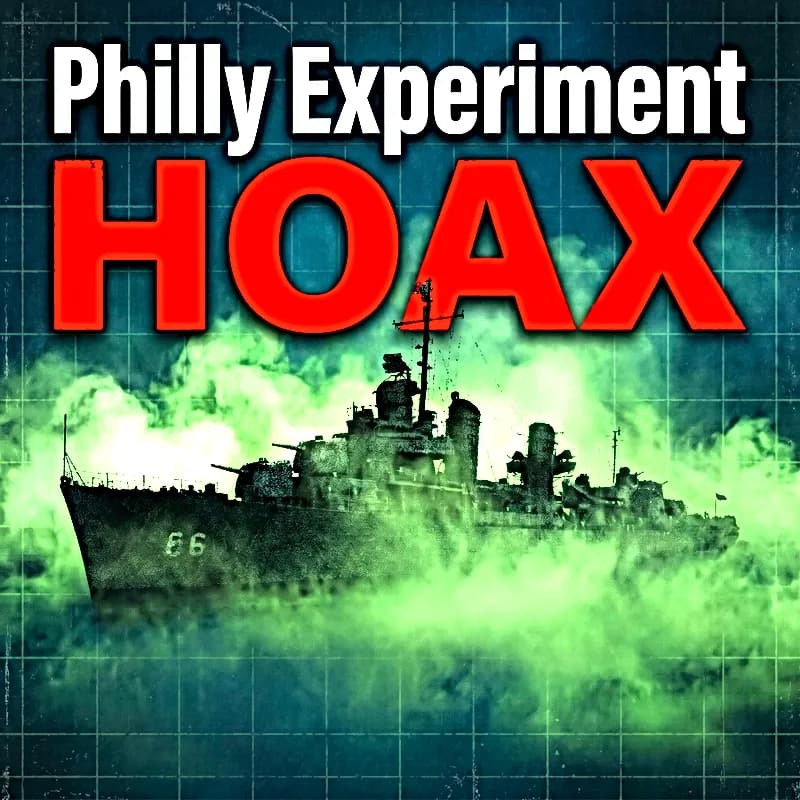
The Philadelphia Experiment and Project Rainbow
Experiment Overview
Ship
USS Eldridge
Alleged Year
1943
Distance (miles)
~250 (Philly to Norfolk)
Source Material
1950s Letters
Evidentiary Focus
Naval Discrepancies
3
Allende Letters
2
Degaussing Explanations
1
UFO Lore Evolution
1
Claims vs. Documentation
| Element | Conspiracy Claim::Documented Reality |
|---|---|
| Mechanism | Unified Field Theory teleportation::Degaussing to counter magnetic mines |
| Witnesses | Andrew Furuseth crew saw disappearance::Ship was at sea |
| master denied claims | - |
| Casualties | Sailors fused to hull/driven mad::No casualties |
| 'fused' motif from 1978 sci-fi novel | - |
| Location | Teleported Philly to Norfolk::Logs show ship was never in Philly during Oct 1943 |
Executive finding
The strongest documentary evidence does not support a real 1943 Navy experiment that made USS Eldridge invisible or teleported it from Philadelphia to Norfolk; instead, the surviving record supports a story that surfaced after the 1955 publication of The Case for the UFO, then spread through the letters and annotations of Carlos Allende to Morris K. Jessup, and was later contradicted by Navy archival records.
The most evidence-based conclusion, stated as an inference from those sources, is that the Philadelphia Experiment is a postwar legend or hoax whose imagery was likely helped by real wartime magnetic-signature reduction work such as degaussing, not by a documented teleportation or unified-field military program.
Where the story enters the record
The Case for the UFO was published in 1955 by Citadel.
The Navy's own information sheet says the myth's documented genesis begins with that 1955 publication and with subsequent correspondence sent to Morris K. Jessup by Carlos Allende, who described an alleged secret Navy experiment in 1943.
The same Navy information sheet says that in 1956 an anonymous annotated copy of Jessup's book was mailed to the Office of Naval Research, and that two officers personally arranged for 25 retyped copies to be produced.
The American Heritage Center's finding aid confirms that the later Carlos Allende papers preserve correspondence, writings, and printed matter relating to the "Philadelphia Experiment," unified field theory, and UFOs, which shows that the legend generated a real archival afterlife even if the alleged 1943 event itself did not leave a verified wartime record.
What the Allende letters actually claim
The reproduced letters in the Varo edition are the core primary texts for the original story as it reached Jessup.
| Element | What the reproduced letters allege |
|---|---|
| Mechanism | Allende says a re-check of Albert Einstein's unified field theory produced the complete invisibility of a destroyer-type ship and all its crew in October 1943, and he says the field had an oblate-spheroidal shape extending roughly 100 yards from the ship. |
| Human effects | The letters describe officers and sailors going mad, men getting "stuck" or "frozen," a man walking through a wall and vanishing, and two men allegedly catching fire after carrying small-boat compasses. |
| Witness platform | Allende points Jessup to the crew of the SS Andrew Furuseth and says that ship's men were witnesses. |
| Transit claim | In the follow-up note, he says the experimental ship disappeared from its Philadelphia dock and appeared minutes later in the Norfolk/Newport News/Portsmouth area before returning. |
| Proof problem | Allende also tells Jessup that he cannot provide "positive proof" without hypnosis and sodium pentothal to retrieve names, dates, and newspaper details from memory. |
Those letters are important not only for what they claim, but for what they fail to fix with confidence. Allende says he cannot remember the newspaper name, date, page number, or complete witness details without hypnosis and "truth serum," which means the original witness narrative arrives already burdened by admitted memory gaps.
The letters are also internally unstable. One passage frames the event as an at-sea invisibility test in October 1943, while another frames it as a dockside Philadelphia-to-Norfolk disappearance and return, and Allende even says of one newspaper memory that it may have been "1956 after Experiments were discontinued," showing obvious chronological confusion inside the source itself.
A key source-critical point is that the reproduced letters refer to an "Experimental D-E" or "experimental ship," but I did not find the name USS Eldridge in the reproduced letter text itself; the Navy FAQ, by contrast, addresses the later popular claim that the ship was supposedly Eldridge.
What the Navy archives and operational records say
The Navy's historical FAQ says repeated archival searches found no documents confirming the event or any Navy interest in achieving such a result.
The same FAQ says Operational Archives reviewed Eldridge's deck log and war diary from its commissioning on 27 August 1943 through December 1943.
That archival summary places Eldridge in New York and Long Island Sound after commissioning, then sailing to Bermuda on 16 September, remaining near Bermuda through 15 October, returning to New York on 18 October, remaining there until 1 November, entering Norfolk with convoy UGS-23 on 2 November, and leaving for Casablanca on 3 November; the FAQ states plainly that during this time frame Eldridge was never in Philadelphia.
The same official FAQ says the movement report cards for the alleged witness ship, SS Andrew Furuseth, show it leaving Norfolk with convoy UGS-15 on 16 August 1943, reaching Casablanca on 2 September, leaving Casablanca on 19 September, reaching off Cape Henry on 4 October, leaving Norfolk with UGS-22 on 25 October, and reaching Oran on 12 November.
The FAQ also says the archives possess a letter from Lieutenant Junior Grade William S. Dodge, master of Andrew Furuseth in 1943, categorically denying that he or his crew observed any unusual event in Norfolk, and it adds that Eldridge and Andrew Furuseth were not even in Norfolk at the same time.
| Question | Documentary record |
|---|---|
| Was ONR the 1943 sponsor? | The official ONR information sheet says ONR was established in 1946 and has never conducted investigations on invisibility, either in 1943 or at any other time. |
| Was Eldridge in Philadelphia? | The Navy historical FAQ says Operational Archives reviewed the logs and concluded that Eldridge was never in Philadelphia during the relevant 1943 period. |
| Could Andrew Furuseth have seen Eldridge in Norfolk? | The same FAQ says the movement cards do not place the ships together in Norfolk and cites a denial from Andrew Furuseth's 1943 master. |
| Was "Project Rainbow" a teleportation program? | The Navy historical FAQ says archival searches found no Project Rainbow records about teleportation or disappearance, and that wartime RAINBOW referred instead to U.S. war plans against the Axis powers. |
| Was Einstein involved in invisibility research? | The FAQ says Einstein's unified field theory was never completed, and that in 1943–1944 he was a part-time consultant to the Navy's Bureau of Ordnance on explosives and explosions, with no indication of work on invisibility or teleportation. |
A general scientific reference from Britannica likewise says that unified field theory was and remains an attempt to describe all fundamental forces in one framework, and that Albert Einstein and others failed to complete such a theory.
Taken together, those records do not merely leave gaps around the legend; they contradict the story at the level of ship location, witness location, sponsoring office, codename, and physical mechanism.
Degaussing and the Navy's mundane explanation
The official ONR information sheet says personnel in the Fourth Naval District believed the questions surrounding the Philadelphia Experiment grew out of routine World War II research at the Philadelphia Naval Shipyard, and that the apocryphal stories were long thought to have arisen from degaussing experiments.
The official Navy FAQ explains degaussing in concrete engineering terms: electrical cables were installed around the ship's hull, from bow to stern on both sides, and a measured current was passed through them to cancel out the ship's magnetic field.
That same FAQ says degaussing equipment was installed in Navy ships and could be turned on whenever a ship was in waters that might contain magnetic mines.
The critical point is semantic: the FAQ says degaussing could be described as making a ship "invisible" to the sensors of magnetic mines, but that the ship remained visible to the human eye, radar, and underwater listening devices.
An independent naval museum description from the National Museum of the Royal New Zealand Navy gives the same basic explanation: a steel ship behaves like a large magnet, magnetic-sensitive ordnance can detect distortions of Earth's field, and degaussing uses hull cables and current to cancel that signature without making the ship optically disappear.
The ONR information sheet also offers another possible seed for later weird details: it notes 1950s tests on the destroyer USS Timmerman using a 1,000 Hz high-frequency generator that produced corona discharges and other known high-frequency phenomena, although ONR says none of the crew suffered the effects attributed to the Philadelphia Experiment.
As an inference from those explanations, the Navy's mundane theory works because it explains how wartime sailors and later storytellers could attach the dramatic word "invisible" to a very real magnetic-signature procedure without requiring teleportation, unified-field breakthroughs, or bodies fused into steel.
How the tragic lore grew beyond the letters
A crucial distinction in the source record is that the earliest reproduced letters do contain gruesome material, but the specific image of sailors fused to bulkheads does not appear in the letter text I reviewed.
What the letters do contain are claims of madness, immobilization, spontaneous burning, a man walking through a wall and vanishing, and men walking into "nothingness."
Later popular summaries broaden the horror. Discovery's overview of the legend says later versions describe crew members suffering nausea, disorientation, insanity, burns, mysterious illnesses, and being found fused to parts of the ship, some still alive.
That means the fused-sailor motif is best treated as a later amplification of the legend, built on the letters' vaguer language about men becoming stuck, frozen, or lost, rather than as a detail securely rooted in the letters themselves.
The story was strongly popularized in book form by Charles Berlitz and William L. Moore in 1979 with The Philadelphia Experiment: Project Invisibility.
Google Books' bibliographic and descriptive entries for that 1979 book repeat the green-fog disappearance and Philadelphia-to-Norfolk teleportation motifs, showing that the now-familiar version of the story had become a polished, mass-market narrative by that point.
The "Project Rainbow" label likewise belongs to the later legend rather than to a verified wartime teleportation file, because the Navy archives explicitly say they found no such Rainbow project records related to making ships disappear.
Bottom line
If the question is whether the letters from Carlos Allende prove that the U.S. Navy used Albert Einstein's unified field theory to make USS Eldridge invisible and teleport it to Norfolk, the answer from the surviving record is no.
The letters are extraordinary but vague, memory-dependent, and internally inconsistent; the Navy's operational records place Eldridge elsewhere; the movement records of SS Andrew Furuseth do not line up with the witness claim; ONR says it did not even exist in 1943; and the only "invisibility" process firmly anchored in wartime naval practice is degaussing against magnetic mines.
The tragic image of sailors fused to bulkheads belongs more to the evolving folklore of the Philadelphia Experiment than to its earliest documentary core.
In the primary letters, the horrors are madness, freezing, fire, vanishing, and impossible motion; in the archival Navy record, there is no documented experiment at all.