The Keweenaw Peninsula, projecting into the western reaches of Lake Superior, serves as the primary terrestrial window into one of Earth's most significant geological failures: the Midcontinent Rift System (MCRS). Approximately 1.1 billion years ago, the North American continent began to tear itself apart along a 1,864-mile scar [1]. For reasons still debated by geologists, the rifting process stopped before a new ocean could form, leaving behind massive deposits of flood basalts and conglomerates [2]. These volcanic flows, similar in composition to modern Hawaiian basalt, created the unique conditions for the precipitation of native copper, pure metallic copper found directly within the rock [1].
Dossier Snapshot
Year Span
5000 BCE-2007 CE
Word Count
2,197
Source Entries
31
Citation Calls
72
Report Signal Profile
Section Headings
10
Table Blocks
4
Unique Citations
31
Source Entries
31
Verification Metrics
| Metric | Value |
|---|---|
| Section Headings | 10 |
| Table Blocks | 4 |
| Citation Coverage | 31/31 |
| Format | MDX |
Geological Foundations of the Midcontinent Rift System
Unlike the copper sulfide or oxide ores found in the Andes or the Mediterranean, which require complex smelting and refining, the copper of the Keweenaw and Isle Royale is often 99.9% pure in its natural state [3]. This geological antiquity and purity made the region the target of a massive, prehistoric industrial effort that defies conventional hunter-gatherer models [3]. The copper occurs in various forms, from microscopic particles in "stamp copper" to "mass copper," solid boulders weighing up to hundreds of tons [4].
Mineralogical Profile of the Keweenaw Peninsula
| Mineral Group | Species and Characteristics | Context of Occurrence |
|---|---|---|
| Primary Lava Minerals | Plagioclase feldspars, olivine, pyroxenes | Form the base basaltic rock (trap rock) [5] |
| Hydrothermal Minerals | Native Copper, Native Silver, Quartz, Prehnite, Calcite | Precipitated by hot water in fractures and vesicles [5] |
| "Halfbreed" Copper | Copper with inclusions of pure silver | Mechanically enclosed, not alloyed; a unique Great Lakes signature [6] |
| Secondary Weathering | Chrysocolla, Malachite, Tenorite | Surface oxidation products of the native copper [5] |
The Tonnage Paradox: Engineering the Missing Millions
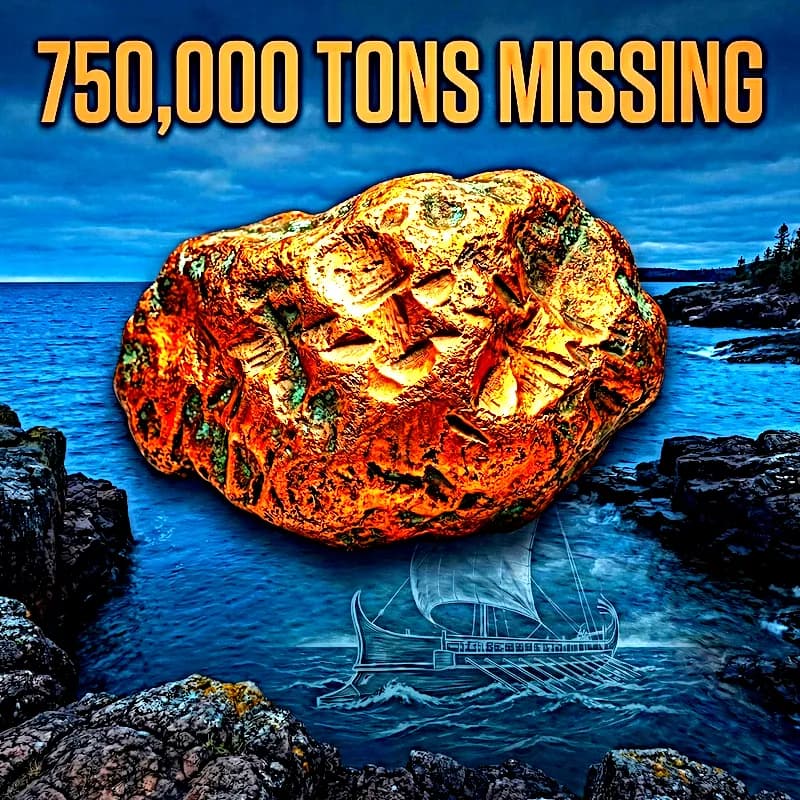
The central mystery of the Keweenaw Anomaly is the sheer scale of ancient extraction compared to the sparse archaeological record. Between 5000 BCE and 1200 BCE, thousands of open-pit mines were excavated across the peninsula and on Isle Royale [4], [7]. In 1961, Roy Ward Drier and Octave Joseph Du Temple published a seminal study estimating that as much as 1.5 billion pounds (750,000 tons) of copper were removed from these pits during the Archaic period [3], [8]. This estimate was derived from the total volume of rock excavated from thousands of pits, multiplied by the average percentage of copper content expected in the native veins [8].
The engineering required to move this amount of metal with "Stone Age" tools is staggering. Ancient miners utilized fire-setting, heating the rock face with large fires and then drenching it with cold water to crack the matrix through thermal shock [9]. Thousands of grooved hammerstones, weighing from a few pounds to over fifty, have been found at the pit sites, many showing evidence of being lashed to wooden handles for greater leverage [9]. At the Minong Mine on Isle Royale, researchers have documented one of the largest concentrations of these mining pits, which served as a guided map for industrial-era prospectors in the 1800s [10].
Comparative Copper Tonnages and Inventory Discrepancies
| Data Metric | Estimated Quantity | Source Context |
|---|---|---|
| Total Mined (Drier & Du Temple) | 1.5 Billion Pounds (750,000 Tons) | Calculated from pit volume and ore density [8], [11] |
| Total Mined (Conservative) | 500,000 Tons | Alternative engineering estimate [7] |
| Ancient Pits (Isle Royale) | 4,000+ | Documented by early explorers [7] |
| Wisconsin Artifact Inventory | ~20,000 items | Compiled from museums and private collections [8] |
| Total Artifact Weight | < 1% of mined tonnage | Disparity between extraction and local usage [3], [12] |
The lack of corresponding artifacts in North America is the strongest piece of evidence for the "export" theory. The Milwaukee Public Museum, one of the primary repositories for Old Copper Culture items, holds roughly 1,500 pieces, ranging from small beads to axes [8]. Even when accounting for all known collections across the Great Lakes, the total amount of copper used for local tools and ornaments represents a fraction of one percent of the estimated output from the mines [3], [12]. This mathematical deficit suggests that the vast majority of Michigan's copper was moved out of the region, potentially fueling the Bronze Age in the Old World [6].
The Mediterranean Connection and Oxhide Ingots
A compelling argument for trans-Atlantic trade involves the chemical and isotopic matching of Michigan copper to artifacts found in Europe and the Mediterranean. During the Late Bronze Age (1550-1100 BCE), copper was traded in the form of "oxhide ingots," large, flat slabs weighing between 10 and 37 kg, shaped to facilitate transport [13], [14]. While mainstream Lead Isotope Analysis (LIA) suggests a Cypriot origin for many of these ingots, the extraordinary purity of certain finds, such as those on the Uluburun shipwreck, raises questions [6].
The Uluburun ingots are reportedly over 99.5% pure, described as "blister copper" that was not produced through standard smelting from contaminated ores [6]. Furthermore, pieces of Michigan native copper often contain microscopic silver inclusions, a hallmark feature not found in European ores [6]. Some researchers have noted that Mediterranean artifacts showing "halfbreed" silver nodules provide a direct link back to Lake Superior [6].
While LIA is often used to debunk these links, the methodology has limitations when applied to native copper. Because native copper contains negligible lead, its isotopic signature is easily masked when it is melted or alloyed with lead-rich materials from other sources [6]. This allows the Michigan metal to effectively disappear into the metallurgical background of the Old World [6].
Epigraphy and the Newberry Tablet Controversy
In 1896, the discovery of the Newberry Tablet provided potential linguistic evidence of an ancient Mediterranean presence in Michigan. Uncovered by lumberjacks under a fallen tree, the clay tablet features 140 characters in a grid [15], [16]. Modern epigraphical analysis has identified a stunning 75% similarity between the Newberry symbols and the Cyprominoan script of the Late Bronze Age [17].
Epigraphical Analysis: Newberry Tablet Symbols
| Metric | Analysis Result | Reference |
|---|---|---|
| Total Symbols | 137 | [17] |
| Unique Symbols | 39 | [17] |
| Cyprominoan Match | 23 of 39 (approx. 60%) | [17] |
| Linear A/B Ideograms | 7 symbols present | [17] |
| Script Type | Syllabic (Estimated 59 characters total) | [17] |
| Potential Reading | ka-mi-ri-ta-wi (Rhodes/Kamiros reference) | [17] |
The argument against the tablet being a hoax rests on the fact that when it was discovered, many of the Cyprominoan symbols were not yet published or known to the general public, making it an unlikely target for a 19th-century forger [17]. Critics point to the concurrent "Michigan Relics" hoax by James Scotford as a reason for skepticism, yet the Newberry Tablet lacks the "mystic symbol" (IH/) found on Scotford's crude forgeries and displays a much higher degree of linguistic sophistication [18], [19].
Maritime Anomalies: Walrus Skin and Ballast Stones
Evidence of a maritime connection is further supported by reports of out-of-place organic materials and geological anomalies at the mine sites. One recurring report describes the discovery of a "walrus-skin bag" found deep in a prehistoric pit alongside stone hammers and wooden tools [20], [6]. Walruses are not native to the Great Lakes, but their skins were commonly used for maritime gear by northern sea-faring cultures [21].
Furthermore, "ballast stones," foreign rocks not matching the local geology, have been observed along the Keweenaw shoreline. Maritime historians note that sailing vessels typically loaded stones at their departure point to maintain stability when traveling without cargo; these would be jettisoned when taking on heavy freight like copper [22]. The presence of flint or polished pebbles similar to those found in European chalk formations implies that large cargo ships were once active in these waters [22], [23].
Evidence of Maritime Presence in Ancient Michigan
| Evidence Type | Finding / Description | Implication |
|---|---|---|
| Walrus-Skin Bag | Found in deep mining pit with wood tools | Suggests contact with Arctic or Atlantic traders [6], [20] |
| Oak Timbers | 1400 BCE carbon-dated support cradles | Matches Late Bronze Age Mediterranean peak [7], [20] |
| Ballast Stones | Non-local flint/pebbles on shoreline | Implies docking of large ocean-going vessels [22] |
| Axe Marks | 1.75-inch sharp metal axe marks on copper masses | Indicates use of metal tools not present in local record [24] |
Submerged Prehistory and Underwater Structures
The high-strangeness of the Lake Superior region extends beneath the surface of the Great Lakes. In 2007, underwater archaeologists scanning Grand Traverse Bay in Lake Michigan found a mile-long line of stones 40 feet below the surface [25]. These stones, dated to approximately 9,000 years ago, include one with a possible carving of a mastodon, implying human activity when the lake levels were significantly lower after the Ice Age [25], [26].
In Lake Huron, the Alpena-Amberley Ridge features complex stone drive lanes and hunting blinds used for caribou [27]. These structures show a level of social organization and environmental engineering that parallels the effort required for the Keweenaw copper mines [27]. The existence of such large-scale terrestrial modifications, now submerged, raises the possibility that early coastal mining installations or trading posts remain hidden on the lakebed of Lake Superior, where deep-water anomalies have also been detected by sonar [28].
Regional High-Strangeness and Oral Traditions
The mystery is rounded out by persistent folklore regarding the "shaking copper hills" and the "Paulding Light." Indigenous oral traditions speak of the earth groaning and vibrating near the copper veins, a phenomenon geologists link to tectonic stresses on the Midcontinent Rift but which locals associate with the "energy" of the mines [3].
The Paulding Light, a glowing orb appearing nightly in a remote valley, has been attributed to everything from ghostly brakemen to atmospheric refraction of car headlights [29]. While Michigan Tech students used telescopes to identify vehicles on a highway 5 miles away, many visitors report the light moving in ways inconsistent with cars, maintaining its status as a regional unsolved mystery [30], [31].
Crucially, the oral traditions of the Anishinaabe (Ojibwe) describe "marine men" or "fair-skinned traders" who arrived in ships and conducted the mining [20]. According to these legends, the mining was abandoned abruptly, coinciding with the "divine warnings" that mark the end of the prehistoric mining era around 1200 BCE [3].
Synthesis and Conclusion
The convergence of engineering math, metallurgical purity, epigraphic evidence, and maritime anomalies suggests that the Keweenaw Peninsula was not merely a local source of copper but a vital industrial hub for an ancient, potentially global, network. The 1.5-billion-pound discrepancy between extracted ore and local artifacts [3], [8] remains the most powerful indicator of a massive prehistoric export industry. When paired with the 75% script similarity of the Newberry Tablet to Cyprominoan characters [17] and the chronological alignment with the Mediterranean Bronze Age collapse [7], [12], the "Keweenaw Anomaly" presents a compelling case for a forgotten chapter of trans-Atlantic trade. The legacy of these ancient miners, preserved in the anaerobic depths of the copper pits and the oral histories of the Great Lakes tribes, points to a sophisticated industrial past that science is only beginning to decode.
Sources
- Using Lake Superior parks to explain the Midcontinent Rift (U.S. National Park Service), https://www.nps.gov/articles/parkscience32_1_19-29_stein_et_al_3817.htm
- Eagle Harbor Lake Shore Traps, https://geo.mtu.edu/MiTEP/EarthCache/EagleHarbor/
- Prehistoric Copper Heist in Michigan's Keweenaw - The Inn at Stonecliffe, https://www.theinnatstonecliffe.com/blog/prehistoric-copper-heist-the-vanished-billions-of-the-keweenaw-peninsula
- Copper mining in Michigan - Wikipedia, https://en.wikipedia.org/wiki/Copper_mining_in_Michigan
- Keweenaw Minerals, https://www.geo.mtu.edu/KeweenawGeoheritage/BlackLavas/Mineralogy.html
- Michigan Copper in the Mediterranean – Book of Mormon Evidence, https://bookofmormonevidence.org/michigan-copper-in-the-mediterranean/
- Michigan Back Roads Copper Country Mystery, https://www.michiganbackroads.com/copper.html
- Old Copper Culture | Milwaukee Public Museum, https://www.mpm.edu/index.php/research-collections/anthropology/online-collections-research/old-copper-culture
- Page 1 of 1 WONDER WHERE THE COPPER WENT, https://www.michigan.gov/-/media/Project/Websites/egle/Documents/Programs/GRMD/Catalog/04/GIMDL-GGCUW.PDF?rev=7e36ce484bb040cba4c409cd32d88f7d
- Indigenous Mining (U.S. National Park Service), https://www.nps.gov/articles/000/indigenous-mining.htm
- Prehistoric Copper Mining in the Lake Superior Region: A Collection of Reference Articles - Google Books, https://books.google.com/books/about/Prehistoric_Copper_Mining_in_the_Lake_Su.html?id=cCwHAQAAIAAJ
- Bronze Age Part II: The Case of the Missing Copper - Chapelboro.com, https://chapelboro.com/town-square/columns/common-science/bronze-age-part-ii-the-case-of-the-missing-copper
- COPPER OXHIDE INGOT MARKS: A DATABASE AND COMPARATIVE ANALYSIS - Cornell eCommons, https://ecommons.cornell.edu/server/api/core/bitstreams/7dff847b-ce64-41f6-ab6d-36d46d320ea4/content
- Antiquity Representations of oxhide ingots in Scandinavian rock art: the sketchbook of a Bronze Age traveller? - Ancient Coastal Settlements, Ports and Harbours, https://ancientportsantiques.com/wp-content/uploads/Documents/PLACES/UK-EUNorth/CopperScandinavia-Ling2015.pdf
- Newberry Tablet - Straits Cultural Center, https://www.michmackhs.org/sponsor-an-artifact/newberry-tablet
- The Mystery of the Newberry Tablet - Lost In Michigan, https://lostinmichigan.net/newberry-tablet/
- (PDF) THE NEWBERRY TABLE It's a Cyprominoan Script in 75 ..., https://www.researchgate.net/publication/386540228_THE_NEWBERRY_TABLE_It's_a_Cyprominoan_Script_in_75_paste
- Mormonism's Encounter with the Michigan Relics - BYU Studies, https://byustudies.byu.edu/article/mormonisms-encounter-with-the-michigan-relics
- Michigan relics - Wikipedia, https://en.wikipedia.org/wiki/Michigan_relics
- North American Copper-2450 B.C. - Book of Mormon Evidence, https://bookofmormonevidence.org/north-american-copper-2450-b-c/
- The Ancient Origins of Scandinavia - ResearchGate, https://www.researchgate.net/profile/Eric_Hinrichs/publication/331653467_The_Ancient_Origins_of_Scandinavia/links/5c86c519458515b59e452bd0/The-Ancient-Origins-of-Scandinavia.pdf
- Ballast Stones - José Zendrera - Mindat, https://www.mindat.org/a/ballast_stones
- Sourcing a Stone Paver from the Colonial St. Inigoes Manor, Maryland - Dickinson College, https://www.dickinson.edu/download/downloads/id/7534/key_milliman_smolek_and_hurry.pdf
- Nephite/Jaredite Copper Industry – Book of Mormon Evidence, https://bookofmormonevidence.org/nephite-jaredite-copper-industry/
- The Mysterious Prehistoric Underwater Structure Beneath Lake Michigan - Arkeonews, https://arkeonews.net/the-mysterious-prehistoric-underwater-structure-beneath-lake-michigan/
- STRANGE STONE STRUCTURE BENEATH LAKE MICHIGAN | The Proof Is Out There | #Shorts | History - YouTube, https://www.youtube.com/shorts/pIqpBXQ5B8k
- Archaeologists Have Found Prehistoric Rock Structures Under the Great Lakes. Here's What the Stones Can Tell Us | Discover Magazine, https://www.discovermagazine.com/archaeologists-have-found-prehistoric-rock-structures-under-the-great-lakes-42339
- Bizarre Theories About Lake Superior Underwater Structure Near Minnesota, https://b105country.com/bizarre-out-of-this-world-theories-about-lake-superior-underwater-structure/
- Paulding Light - Wikipedia, https://en.wikipedia.org/wiki/Paulding_Light
- Paulding Light Mystery in Michigan's Upper Peninsula - The Inn at Stonecliffe, https://www.theinnatstonecliffe.com/blog/the-paulding-light-michigans-official-unsolved-mystery
- The Paulding Light - Michigan Blue Magazine, https://www.mibluemag.com/state-of-mine/the-paulding-light/