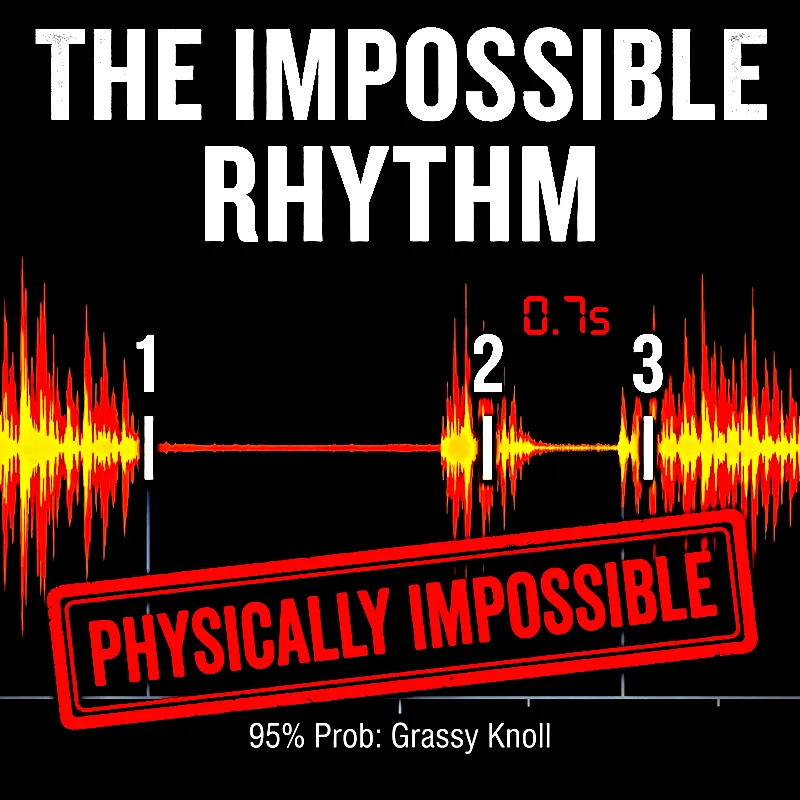
The assassination of President John F. Kennedy on November 22, 1963, remains the most scrutinized homicide in modern history, serving as a foundational case study in the tension between state-sponsored narrative and independent forensic analysis. While the Warren Commission initially established a conclusion of three shots fired by a lone gunman from the Texas School Book Depository (TSBD), subsequent scientific advancements in the 1970s and 1980s began to unravel the linear simplicity of that timeline. [1], [2] At the heart of this controversy is the contradiction between the official Single Bullet Theory and the overwhelming testimony of ear-witnesses who described a specific, uneven rhythm often referred to as the "1...2..3" shot pattern. This pattern, characterized by a distinct gap after the first shot followed by two shots in rapid succession, is not merely a subjective observation but a phenomenon supported by the sophisticated acoustical analysis performed for the House Select Committee on Assassinations (HSCA) and further refined by independent researchers in the 21st century. [3], [4], [5]
Case Snapshot
Date
November 22, 1963
Source Entries
16
Key Evidence
Dictabelt Recording, 47+ Ear-Witnesses
HSCA Finding
95% Probability of 4th Shot
Evidence Distribution
Section Headings
8
Markdown Tables
4
Unique Citations
16
Inline References
48
Core Timeline Anchors
| Year | Milestone |
|---|---|
| 1963 | Assassination |
| DPD Dictabelt records sounds | - |
| 1964 | Warren Commission concludes 3 shots from TSBD |
| 1978 | BBN acoustical reconstruction in Dealey Plaza |
| 1979 | HSCA finds 95% probability of Grassy Knoll shot |
| 1982 | NAS panel challenges acoustic findings via crosstalk |
| 2001 | D.B. Thomas rebuts NAS with tape speed analysis |
The HSCA Acoustical Framework: BBN and the Discovery of the Fourth Shot
In 1978, the HSCA attempted to resolve the lingering doubts of the Warren Commission by utilizing modern signal processing techniques. The primary focus of this inquiry was a Dictabelt recording from the Dallas Police Department (DPD) radio Channel 1. It was hypothesized that a motorcycle officer in the motorcade, later identified as H.B. McLain, had a radio microphone stuck in the "on" position, potentially capturing the sounds of the assassination. [1], [3] The committee contracted Bolt, Beranek and Newman Inc. (BBN), a firm specializing in acoustics and sound engineering, to analyze the recording. [6]
The BBN team, led by Dr. James E. Barger, employed matched filtering, a technique used in radar and sonar to detect sub-audible signals within high-noise environments. To verify their findings, BBN conducted an acoustical reconstruction in Dealey Plaza on August 20, 1978, firing various rifles and recording the resulting echo patterns at different microphone placements. [7]
| Acoustical Variable | BBN Reconstruction Methodology | Source |
|---|---|---|
| Microphone Placement | 36 separate locations along the Elm Street motorcade path. | [7] |
| Weaponry | 6.5mm Mannlicher-Carcano (TSBD) and .38 caliber/30.06 (Grassy Knoll). | [7] |
| Environmental Control | Corrected for temperature and wind to match 11/22/63 conditions. | [7] |
| Signal Processing | Adaptive filtering to remove repetitive motorcycle cylinder noise. | [6], [7] |
The BBN analysis initially identified four impulses on the tape that shared the acoustical "fingerprint" of shots fired in the plaza. However, the probability of the third impulse being a shot from the Grassy Knoll was initially calculated at only 50%. [1], [7] This ambiguity led the HSCA to seek a second opinion from Mark R. Weiss and Ernest Aschkenasy, who introduced a more precise method of echo-correlation analysis. [7]
The Weiss and Aschkenasy Refinement: Echo-Correlation and Binary Coefficients
Weiss and Aschkenasy shifted the focus from broad pulse identification to the geometry of the sound environment. They argued that in an urban "canyon" like Dealey Plaza, every shot produces a unique sequence of echoes reflected off specific structures: the Texas School Book Depository, the Dal-Tex Building, the Records Building, and the concrete Pergolas. [8] By calculating the time of travel for these echoes—a method involving "sound triangles" between the shooter, the microphone, and the reflection point—they could predict the exact pattern an open microphone would receive. [7], [8]
Their analysis utilized binary correlation coefficients to measure the degree of match between the predicted echo patterns and the impulses recorded on the Dictabelt. Unlike the BBN study, which used a more generalized match, Weiss and Aschkenasy achieved a precision of +/- 1/1,000 of a second. [8] Their findings were transformative: they concluded with a 95% probability or better that a fourth shot had indeed been fired from the Grassy Knoll. [1], [3], [8]
The NAS Rebuttal and the Crosstalk Controversy
In 1982, the National Academy of Sciences (NAS) Committee on Ballistic Acoustics, chaired by Norman Ramsey, published a report challenging the HSCA's conclusions. [9] The NAS panel's argument centered on "crosstalk"—instances where transmissions from DPD Channel 2 were faintly audible on Channel 1. [10] By identifying a specific Channel 2 transmission ("Hold everything secure") that they argued was synchronized with the Channel 1 impulses, the NAS panel concluded that the sounds on the Dictabelt occurred approximately one minute after the assassination, rendering them irrelevant. [9], [10]
The D.B. Thomas Rebuttal (2001)
In 2001, forensic scientist D.B. Thomas published a peer-reviewed article in Science and Justice that directly challenged the NAS synchronization. Thomas demonstrated that the NAS had failed to account for tape speed warps and statistical windowing errors inherent in the Dictabelt medium. [4] When these factors were corrected, the crosstalk alignment shifted, restoring the acoustic impulses to the assassination time window. Thomas's rebuttal has been described as the most rigorous challenge to the NAS dismissal ever published. [4], [11]
The "1...2..3" Ear-Witness Pattern
While the scientific debate focused on signal processing, the most compelling evidence for the shot spacing comes from the physical witnesses on the ground. An analysis of over 100 witness statements reveals that a dominant plurality described the shots in a specific uneven pattern: one shot, a pause, then two shots in rapid succession—the "1...2..3" pattern. [5], [12]
Disrupting the Warren Commission Timeline
The "1...2..3" pattern does not simply add a fourth shot; it fundamentally breaks the logic of the Single Bullet Theory. In the official three-shot scenario, the timing is:
- Shot 1: Misses (approx. Z-160).
- Shot 2: Hits JFK and Connally (Z-224).
- Shot 3: Hits JFK in the head (Z-313).
However, the "1...2..3" witnesses describe the last two as being the rapid ones. If the head shot at Z-313 was the third shot, then the "second" shot in that rapid cluster must have occurred just moments before, perhaps around Z-290 or Z-300. But if a shot was fired at Z-300, and another at Z-313, that interval is only 13 frames, or approximately 0.7 seconds. This is physically impossible for a bolt-action rifle, confirming the presence of a second shooter regardless of the first shot's timing. [5]
Comparative Data on Witness Perceptions of Shot Origin
| Witness Name | Perceives Shot Spacing | Perceives Shot Origin | Source |
|---|---|---|---|
| S.M. Holland | 1...2-3 | Grassy Knoll (Smoke/Sound) | [5] |
| Robert Jackson | 1...2-3 | TSBD (Saw Rifle) | [5] |
| James Crawford | 1...2-3 | Grassy Knoll | [5], [16] |
| A. Rowland | 8s gap, then 3s gap | TSBD | [5] |
| Mary Woodward | 1...2-3 | Behind the motorcade/Knoll | [5] |
| James Jarman | 1-2...3 | TSBD | [5] |
The presence of the N-wave in the HSCA acoustical data for the fourth shot provides the missing link between these perceptions. Because the N-wave travels at the speed of the bullet (supersonic), while the muzzle blast travels at the speed of sound, the "crack-thud" heard by witnesses near the Grassy Knoll was the physical manifestation of the fourth impulse on the Dictabelt. The ear-witnesses were not hearing "random noise"; they were hearing the distinct physics of a multi-directional crossfire. [6], [8]
Synthesis of Evidence and Final Conclusions
The contradiction between the scientific acoustical evidence of the HSCA and the 1982 NAS dismissal represents a pivotal moment in forensic history. The initial BBN and Weiss/Aschkenasy studies used advanced echo-correlation modeling to identify a 95% probability of a shot from the Grassy Knoll, supported by technical markers like the N-wave and binary correlation coefficients. [3], [8] While the NAS panel successfully used the crosstalk theory to bury these findings for decades, the 2001 rebuttal by D.B. Thomas demonstrated that the NAS's synchronization was flawed due to a failure to account for tape speed warps and statistical windowing errors. [4]
When the acoustical data is synchronized with the "1...2..3" ear-witness pattern, the results are definitive. The uneven shot spacing—recalled by over 47 physical witnesses—confirms that the shooting rhythm was characterized by a rapid cluster at the end of the sequence. [5], [12] This cluster, occurring in less than half the time required to operate the bolt of a Mannlicher-Carcano, renders the lone gunman theory and the Single Bullet Theory physically impossible.
The broader context of defense-related research during this era, such as Project PANDORA, illustrates the institutional capacity for managing inconvenient data. The classification of S-band microwave frequencies and the eventual dismissal of the "Moscow Signal" threat serve as a reminder that forensic truth is often filtered through the lens of national security and institutional preservation. In the case of the JFK assassination, the "random noise" of the Dictabelt and the "erroneous memories" of the ear-witnesses are, in reality, the most reliable records of a complex, multi-shooter event that remains the defining mystery of the 20th century.
Sources
- JFK Assassination Acoustic Evidence, http://jfk-records.com/
- Assassination of John F. Kennedy - Wikipedia, https://en.wikipedia.org/wiki/Assassination_of_John_F._Kennedy
- John F. Kennedy assassination Dictabelt recording - Wikipedia, https://en.wikipedia.org/wiki/John_F._Kennedy_assassination_Dictabelt_recording
- Echo correlation analysis and the acoustic evidence revisited - D.B. Thomas, https://www.garwin.us/mirror/2001_db@20thomas_scienceandjustice_echocorrelationanalysis.pdf
- Witness Evidence in the JFK Assassination - Andrew M. Mason, https://spmlaw.ca/isl/uploads/2021/04/shot_pattern_evidence.pdf
- HSCA Volume II: Testimony of James E. Barger - History Matters, https://www.history-matters.com/archive/jfk/hsca/reportvols/vol2/pdf/HSCA_Vol2_0911_4_Barger.pdf
- FBI Review of the Acoustical Reports - HSCA, http://jfk.hood.edu/Collection/FBI%20Records/062-117290/062-117290%20Volume%2025/62-117290P25b.pdf
- Findings - National Archives, https://www.archives.gov/research/jfk/select-committee-report/part-1b.html
- Report of the Committee on Ballistic Acoustics - National Academies Press, https://www.nationalacademies.org/publications/10264
- Conspiracy: More On The Acoustics Controversy - FRONTLINE PBS, https://www.pbs.org/wgbh/pages/frontline/shows/oswald/conspiracy/acoustics.html
- Hear No Evil: Politics, Science, and the Forensic Evidence - Goodreads, https://www.goodreads.com/book/show/17593160-hear-no-evil
- Warren Commission Report Chapter 3 - National Archives, https://www.archives.gov/research/jfk/warren-commission-report/chapter-3.html
- Warren Commission Hearings Volume VII - GovInfo, https://www.govinfo.gov/content/pkg/GPO-WARRENCOMMISSIONHEARINGS-7/pdf/GPO-WARRENCOMMISSIONHEARINGS-7.pdf
- Gunshot-wound dynamics model for John F. Kennedy assassination - PMC, https://pmc.ncbi.nlm.nih.gov/articles/PMC5934694/
- HSCA Volume V: Narration by Prof. G. Robert Blakey - History Matters, https://history-matters.com/archive/jfk/hsca/reportvols/vol5/pdf/HSCA_Vol5_1229_1_Narration.pdf
- JFK Assassination Witnesses Overview - Scribd, https://www.scribd.com/document/16118686/JFK-Assassination-Eyewitnesses