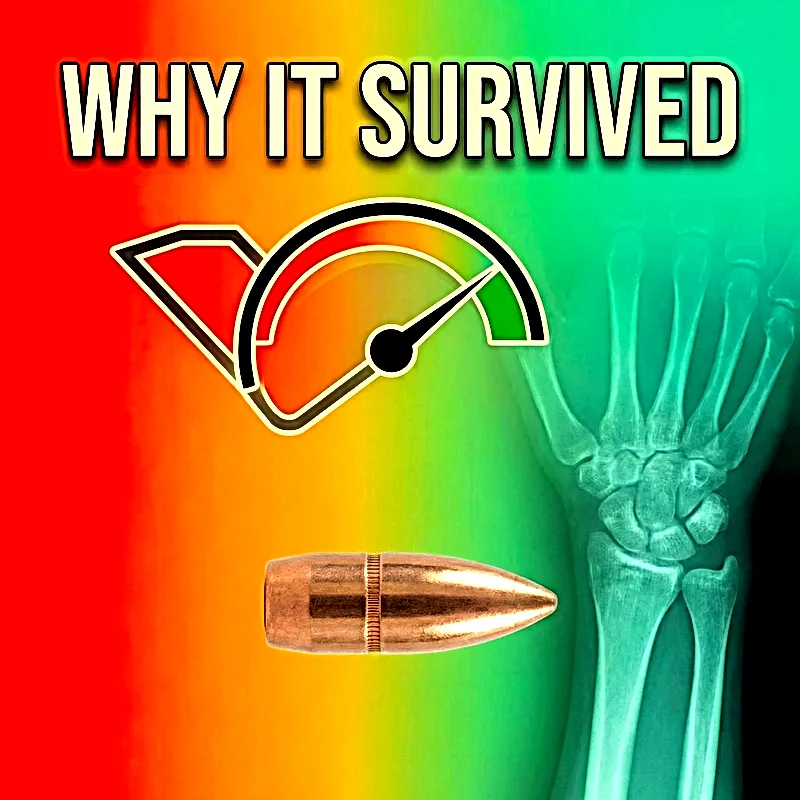
The structural integrity and terminal performance of Warren Commission Exhibit 399 (CE-399), colloquially known as the "Magic Bullet," represent a central point of debate in modern forensic ballistics and historical reconstruction. The Single Bullet Theory (SBT) posits that this specific 6.5x52mm Carcano projectile traversed the bodies of both President John F. Kennedy and Governor John Connally, sustaining only minimal deformation despite inflicting seven entry and exit wounds and fracturing two distinct bone structures. [1], [2] The primary scientific defense for this phenomenon is the "Diminishing Velocity Theory," advanced by ballistics expert Larry Sturdivan. [3] This theory suggests that the bullet's lack of catastrophic deformation is a predictable result of its specific velocity profile, material construction, and orientation during its transition through human tissue and bone. [3]
Case Snapshot
Exhibit
CE-399
Source Entries
19
Weight Lost
~2.2 grains
Theory
Diminishing Velocity
Evidence Distribution
Section Headings
8
Markdown Tables
6
Unique Citations
19
Inline References
65
Core Technical Anchors
| Variable | Value |
|---|---|
| Bullet Weight (unfired) | 160.8 grains |
| Bullet Weight (CE-399) | 158.6 grains |
| Mass Deficit | ~2.2 grains (≈140 mg) |
| Muzzle Velocity | ~2,165 ft/s |
| Estimated Impact (Connally Rib) | ~1,100 ft/s |
| Estimated Impact (Connally Wrist) | ~900 ft/s |
Baseline Ballistic Profile of the 6.5x52mm Carcano Cartridge
To understand the "breakability" of CE-399, one must first analyze the engineering and metallurgical properties of the 6.5x52mm Carcano ammunition produced by the Western Cartridge Company (WCC) for the Italian military. [2], [4] This cartridge, introduced in 1891, was one of the earliest smokeless powder rifle rounds, designed for high-velocity, small-bore infantry rifles. [4], [5], [6]
Projectile Design and Metallurgy
The CE-399 bullet is a 160-grain (approximately 10.4-gram) full metal jacket (FMJ) projectile characterized by a round-nose profile. [6], [7] This design is fundamentally different from modern law enforcement or hunting ammunition, which is engineered to expand or "mushroom" upon impact to maximize energy transfer. [3], [7], [8] The Carcano bullet was built to comply with the Hague Convention, prioritizing deep, straight-line penetration through the human body while maintaining structural integrity. [3]
| Physical Property | Value / Specification | Source |
|---|---|---|
| Caliber | 6.5x52mm Carcano | [7] |
| Bullet Weight | 158.6–161.5 Grains | [1], [7] |
| Bullet Type | Round-Nose Full Metal Jacket (FMJ) | [6], [7] |
| Bullet Diameter | 0.2675–0.268 Inches | [4], [5] |
| Jacket Material | Copper-nickel alloy (gilding metal) | [3], [7] |
| Core Material | Lead-antimony alloy | [2], [7] |
| Sectional Density | 0.329 (Very High) | [4] |
| Muzzle Velocity | ~2,165 ft/s | [4], [5] |
The sectional density of 0.329 is critical. A higher sectional density means the bullet resists deceleration more effectively, allowing it to penetrate deeper. This is the primary reason the 6.5mm Carcano round was capable of transiting two human bodies—it was simply not designed to stop quickly. [3], [4]
The Diminishing Velocity Theory: How CE-399 Survived
The core argument of Larry Sturdivan's Diminishing Velocity Theory is that CE-399 did not strike Governor Connally's bones at muzzle velocity, but at a significantly reduced velocity after losing kinetic energy through the soft tissue of President Kennedy's neck. [3]
Velocity Decay Through Soft Tissue
The bullet's journey began with a muzzle velocity of approximately 2,165 ft/s. [4] After traversing approximately 175 feet of air (accounting for the distance from the sixth-floor window to the limousine), its velocity was reduced to approximately 1,800–1,900 ft/s at the point of first impact with the President's upper back. [3], [19]
| Impact Phase | Estimated Velocity | Target Medium | Result | Source |
|---|---|---|---|---|
| Muzzle | ~2,165 ft/s | Air | N/A | [4] |
| Impact (JFK Back) | ~1,800–1,900 ft/s | Soft tissue (neck) | Clean transit; minimal deformation | [3], [19] |
| Exit (JFK Throat) | ~1,500 ft/s | Soft tissue | Tumble initiation (yaw begins) | [3] |
| Impact (Connally Back) | ~1,100–1,200 ft/s | Soft tissue + rib | 10 cm rib shatter; elliptical wound | [3], [11] |
| Exit (Connally Chest) | ~900 ft/s | Soft tissue | Continued tumble | [3] |
| Impact (Connally Wrist) | ~400–600 ft/s | Radius bone | Perforating fracture | [3], [11] |
| Final Rest (Connally Thigh) | ~200 ft/s | Soft tissue | Shallow puncture; fragment retained | [1], [3] |
According to Sturdivan, the critical "safety zone" for the bullet was between 900 and 1,300 ft/s. At these mid-range velocities, the bullet retained enough energy to fracture bone but had shed sufficient kinetic energy to avoid the explosive, structural deformation that occurs at higher impact speeds. [3]
Yawing and the Role of Bullet Orientation
A crucial component of the Diminishing Velocity Theory involves the concept of bullet yaw—the angular oscillation of the projectile as it travels through a medium. [3], [13]
When the 6.5mm Carcano bullet remains nose-forward, its cross-sectional area is minimal (approximately 35 square millimeters). [13], [16] However, as it yaws, the area increases to nearly 160 square millimeters. [13], [16] This increase in area has two paradoxical effects:
- Increased Energy Transfer: A tumbling bullet transfers kinetic energy to the target much more rapidly, creating a larger "temporary cavity" and causing more massive soft-tissue damage. This explains the massive wound in Governor Connally's chest and the extensive damage to his rib. [1], [13], [17], [18]
- Reduced Pressure on Jacket: By spreading the energy over a larger surface area, the localized pressure on any specific part of the copper jacket is reduced. A "side-slap" against bone at 1,100 ft/s is far less likely to cause a structural rupture than a nose-first impact at the same speed. [3], [12]
Cavitation and the "Head Snap"
The mechanics of cavitation are also used to explain the "backward head snap" seen in the Zapruder film at frame 313. [16], [19] Computational ballistic analysis using 3D nonlinear numerical simulations suggests that the fatal head shot (from a separate bullet, likely CE-567/569) caused an explosive transfer of energy, creating a temporary cavity within the brain. [16], [19] This instantaneous forward impulse was followed by a delayed rearward recoil and neuromuscular force—the "jet effect"—which moved the President's head toward the rear. [16], [19]
Unlike the relatively "pristine" CE-399, the fragments from the head shot (CE-567 and CE-569) showed "asymmetrical mushrooming" and jacket tearing, which is the expected result of a high-velocity (1,800+ ft/s) impact with the dense cortical bone of the skull. [19]
Critical Evaluation: Predictive Outcome or Forensic Anomaly?
To determine if CE-399 is a "predictable ballistic outcome," researchers must reconcile its condition with its documented workload. [1], [3]
- Mass Recovery: CE-399 was found on a stretcher at Parkland Hospital weighing 158.6 grains. Unfired bullets of this type average 160.8 grains. The missing 2.2 grains (approx. 140 milligrams) are strikingly close to the total weight of the lead fragments recovered from Governor Connally's wrist (approx. 2 grains). This weight-match is the strongest forensic indicator that CE-399 is indeed the bullet that struck the Governor's wrist. [1], [2]
- Longitudinal Twist: Forensic examination by NIST confirmed that CE-399 exhibits a subtle longitudinal twist and compression, consistent with a bullet that has been subjected to extreme stress without reaching its point of catastrophic failure. [9]
- The "Safety Zone" Validity: The Diminishing Velocity Theory relies on the bullet's impact with Connally's rib and wrist occurring between 1,000 and 1,300 ft/s. If the distance between the two men or the retardation in the President's neck had been different, the bullet would have either fragmented (if too fast) or failed to penetrate (if too slow). [1], [3]
| Theoretical Challenge | Ballistic Explanation | Potential Weakness | Source |
|---|---|---|---|
| Rib Destruction | Tumbling bullet distributed force. | Edgewood tests (CE-853) show deformity at side-impact. | [3], [11] |
| Wrist Fracture | Impact velocity < 1,100 ft/s. | CE-856 cadaver test resulted in shattering at low speeds. | [11] |
| Pristine Nose | Bullet struck side-on or base-first. | Elliptical entrance wound on JBC doesn't prove base-first. | [1], [3] |
| Lead Core Match | NAA linked antimony profiles. | Metallurgical inhomogeneity discredits 99.9% certainty. | [2] |
Conclusions on the Structural Integrity of CE-399
The forensic analysis of Warren Commission Exhibit 399 suggests that its nearly pristine condition is a highly specific, though physically possible, outcome within the parameters of the 6.5mm Carcano's performance envelope. [1], [3], [19] The "Diminishing Velocity Theory" successfully identifies the core mechanical reason for the bullet's survival: it shed sufficient kinetic energy through soft tissue to reach a velocity below its catastrophic deformation threshold before striking dense bone. [3]
Furthermore, the bullet's round-nose, full-metal-jacket construction and high sectional density made it uniquely suited for deep penetration without expansion. While the Edgewood Arsenal tests and NAA rebuttals highlight the extreme rarity and statistical uncertainty of such an event, modern 3D topography and computational fluid dynamics simulations have largely corroborated the physics required for the Single Bullet Theory to function as described. [1], [9], [19] Ultimately, whether CE-399 is viewed as a "magic bullet" or a "predictable outcome" depends on the acceptance of Larry Sturdivan's modeled velocity decay and the role of bullet yaw in protecting the projectile's structure during high-energy impacts. [3], [13]
Sources
- Single-bullet theory - Wikipedia, https://en.wikipedia.org/wiki/Single-bullet_theory
- Proper Assessment of the JFK Assassination Bullet - OSTI.GOV, https://www.osti.gov/servlets/purl/900118
- Breakability: CE-399 and the Diminishing Velocity Theory - History Matters, https://www.history-matters.com/essays/jfkmed/Breakability/Breakability.htm
- 6.5×52mm Carcano - Wikipedia, https://en.wikipedia.org/wiki/6.5%C3%9752mm_Carcano
- 6.5x52 Carcano Rifle Ammunition - Steinel Ammo, https://steinelammo.com/product-category/rifle-ammo/6-5x52-carcano/
- 6.5x52mm Carcano Ammo - Target Sports USA, https://www.targetsportsusa.com/65x52mm-carcano-ammo-c-90.aspx
- Hornady 6.5 Carcano Bullets 160 Grain Round Nose - MidwayUSA, https://www.midwayusa.com/product/1010595622?pid=974954&pr_rd_page=3
- Hornady Ammo 6.5x52 Carcano .267 160gr RNSP - DeGuns, https://www.deguns.com/hornady-hrn80486-ammo-6-5x52-carcano-267-160gr-rnsp-20b-10c
- How the JFK Assassination Bullets Were Digitally Preserved at NIST, https://www.nist.gov/blogs/taking-measure/how-jfk-assassination-bullets-were-digitally-preserved-nist
- HSCA Volume I: Testimony of Dr. Vincent P. Guinn - AARC, http://aarclibrary.org/publib/jfk/hsca/reportvols/vol1/pdf/HSCA_Vol1_0908_8_Guinn.pdf
- HSCA Volume I: Testimony of Dr. Cyril H. Wecht - History Matters, https://history-matters.com/archive/jfk/hsca/reportvols/vol1/pdf/HSCA_Vol1_0907_8_Wecht.pdf
- Wound Ballistics and Tissue Damage - CAMERA.org, https://www.camera.org/wp-content/uploads/2018/04/aaac137b8cad6ee1a3ee6944a5c21dfbcb90.pdf
- Conventional Warfare Ballistic, Blast and Burn Injuries, Chapter 4, https://medcoeckapwstorprd01.blob.core.usgovcloudapi.net/pfw-images/borden/conventional-warfare/Chap4Pages13-25.pdf
- Dr. Guinn HSCA Testimony - Internet Archive, https://ia600306.us.archive.org/35/items/JFKAssassinationNeutronActivationAnalysis/Dr.GuinnHscaTestimony.pdf
- Vincent Perrie Guinn - University of California In Memoriam, https://senate.universityofcalifornia.edu/_files/inmemoriam/html/VincentPerrieGuinn.htm
- Gunshot-wound dynamics model for John F. Kennedy assassination - PMC, https://pmc.ncbi.nlm.nih.gov/articles/PMC5934694/
- Physical Mechanisms of Soft Tissue Injury from Penetrating Ballistic Impact - DTIC, https://apps.dtic.mil/sti/tr/pdf/ADA570804.pdf
- Historical overview of wound ballistic research - ResearchGate, https://www.researchgate.net/publication/26238151_Historical_overview_of_wound_ballistic_research
- Computational ballistic analysis of the cranial shot to John F. Kennedy - ResearchGate, https://www.researchgate.net/publication/350482160_Computational_ballistic_analysis_of_the_cranial_shot_to_John_F_Kennedy