Valensole 1965: Maurice Masse, the Ground Traces, and What the French Records Actually Establish
Valensole 1965 Profile
Date
July 1, 1965
Witness
Maurice Masse
Location
Valensole, France
GEIPAN Category
D
Evidentiary Strength of Reported Elements
Physical Ground Trace Documented
5
Masse's Reported Paralysis
4
Soil became 'hard as cement'
3
Long-term lavender effect (10 years)
2
Soil 18.3% calcium anomaly
1
Analyst Note
Valensole is an officially archived unexplained French PAN case, but not an officially validated extraterrestrial encounter: GEIPAN lists it as D while simultaneously recording that no GEPAN-era in-depth investigation was published and that the D designation was applied "by default" because of the case's strangeness.
The July 1, 1965 Valensole case has a genuine official documentary record: the French Gendarmerie interviewed the witness, inspected and photographed the site, measured a physical ground trace, and produced several procès-verbaux that CNES/GEIPAN eventually released publicly.
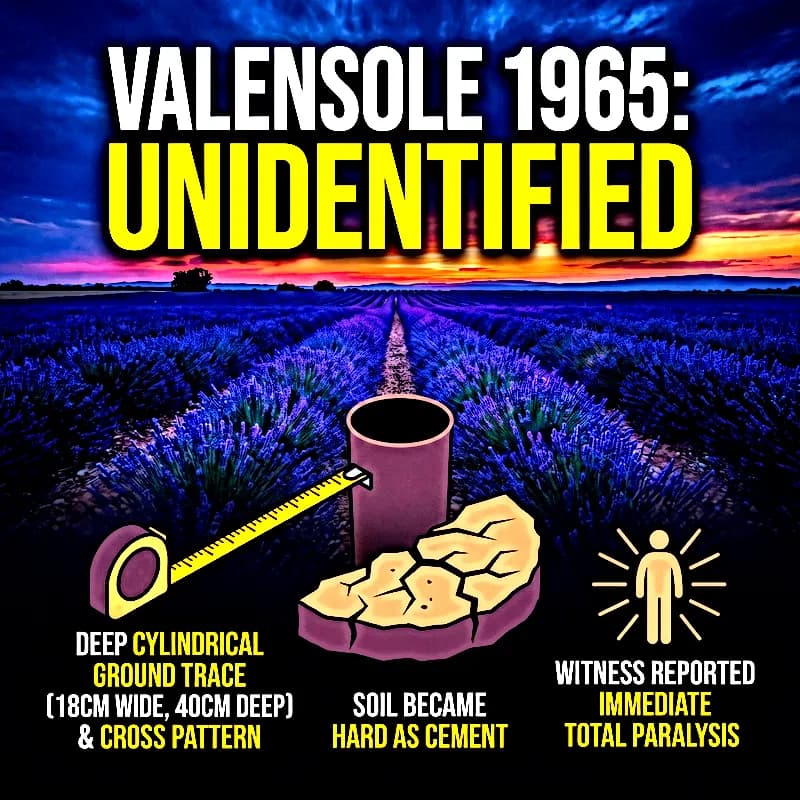
The strongest physical fact in that record is the Gendarmerie's direct observation that a freshly hoed lavender field contained a localized, more recent-looking compact trace consisting of a shallow depression about 1.20 m in diameter, a central cylindrical hole 18 cm in diameter and about 40 cm deep, and four shallow furrows roughly 8 cm wide and about 2 m long forming a cross.
Maurice Masse's statement that the initially wet ground had become "hard as cement" is authentically present in the 1965 police record, and investigators independently reported the localized soil was still compact. However, the official documents do not establish that the earth chemically transformed into a concrete-like material.
Claim vs. Official Record
| Claim | What the strongest available record actually supports |
|---|---|
| Deep central hole | Gendarmes directly measured a cylindrical hole 18 cm in diameter and about 40 cm deep. |
| 'Concrete-like' soil | Masse said wet soil became 'hard as cement' |
| gendarmes independently confirmed compaction. | - |
| 18.3% calcium | A later secondary/private claim attributed to Pierre Guérin, not in the released 1965 Gendarmerie PVs. |
| Lavender killed for ten years | COMETA says effects persisted for 'several years', while secondary accounts subsequently specify 1975. |
| Paralysis by a device | Masse formally reported complete voluntary immobility while a being pointed an object toward him |
| no device was recovered. | - |
The "hard as concrete" ground and the calcium problem
Nothing in PV no. 105's published measurement section supplies a quantitative hardness value or demonstrates that the soil had been chemically bound into a cementitious mass. Consequently, the defensible statement is "the site contained localized compacted soil that Masse described as having become hard like cement," rather than "scientists proved that the soil was converted into concrete."
The 18.3% calcium figure is found in later summaries, which attribute the interpretation to private investigator Pierre Guérin. GEIPAN's released official Valensole file contains no calcium result. Without the original analytical method, units, chain of custody and matched controls, the calcium number cannot establish either an inexplicable chemical transformation or a causal relationship to Masse's reported craft.
Lavender effects and the claim of ten-year biological sterility
The released contemporaneous PV passages document the field and trace in July and August 1965 but do not contain a longitudinal botanical experiment extending through 1975. The later independent COMETA report states that lavender beds dried up and the effect persisted for "several years." Secondary summaries subsequently sharpen the botanical story into the more specific statement that lavender at the landing spot did not grow again until 1975.
That 1975 endpoint is therefore much less securely documented than the 1965 physical trace itself, because it is absent from the contemporaneous government reports available through GEIPAN.
Credibility Strengths vs. Weaknesses
| Strengths | Weaknesses |
|---|---|
| Masse's reports were not merely reconstructed decades later | - |
| recorded within days or weeks. | The scene was not protected before extensive public foot traffic impaired its evidentiary integrity. |
| Investigators independently documented a real localized ground trace. | The most extraordinary components (7m distance, paralysis) were supplied more than six weeks later. |
Evidentiary Conclusion
The physical trace is the strongest part of the Valensole case because multiple Gendarmerie officers actually went to the location and recorded a localized feature that contrasted with the surrounding freshly hoed field. The trace's existence is therefore much better established than its cause.
The paralysis account is an authentic part of Masse's signed police testimony, but it is subjective and retrospective relative to the initial statement, and the documents supply no independent physiological evidence that a handheld device actually produced the effect.