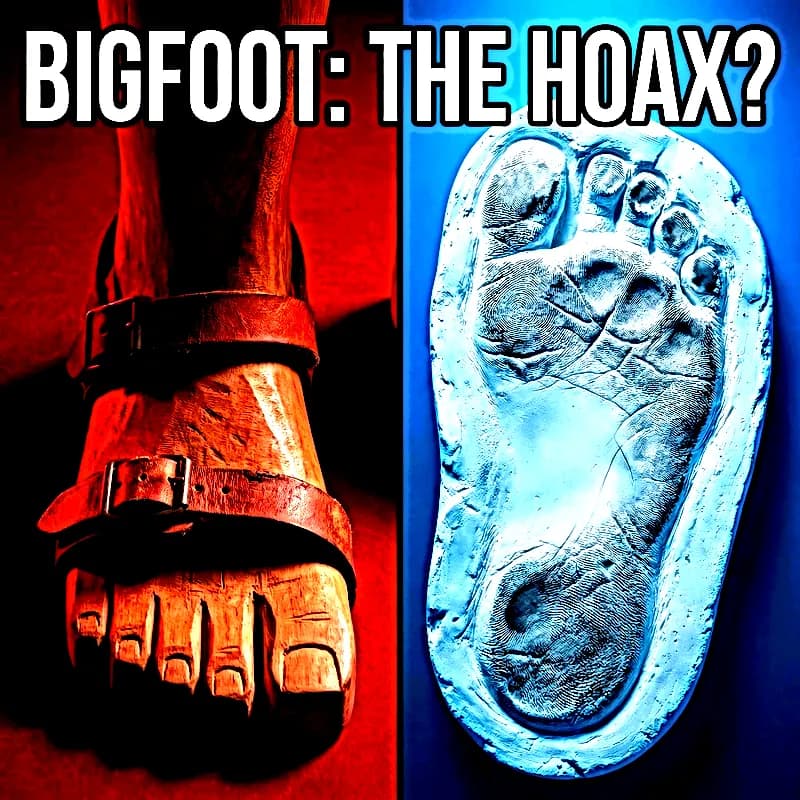
This forensic evaluation examines the legacy of Ray Wallace, a prolific trickster whose decades of systemic hoaxing fundamentally shaped the modern cultural identity of Bigfoot. While Wallace's use of wooden stompers and fabricated biological evidence successfully deceived the media and contaminated historical databases, the text highlights a critical distinction between these mechanical artifacts and more complex ichnological records. By contrasting crude wooden imitations with the biomechanical signatures identified by experts like Dr. Jeff Meldrum—such as the mid-tarsal break and dermal ridges—the source argues that human deception does not fully account for all documented evidence. Ultimately, the analysis serves to filter out fraudulent noise from the field of cryptozoology, allowing for a more rigorous scientific investigation into a persistent regional mystery.
Case Snapshot
Subject
Ray L. Wallace Hoaxes
Source Entries
40
Analysis Period
1958–2002
Key Figures
Wallace, Meldrum, Mullins
Core Issue
Ichnological Contamination
Evidence Distribution
Section Headings
14
Markdown Tables
3
Unique Citations
40
Inline References
95
Core Timeline Anchors
| Year | Milestone |
|---|---|
| 1930 | Rant Mullins carves first giant feet near Mt. St. Helens |
| 1957 | Mullins whittles stompers for Wallace |
| 1958 | Bluff Creek tracks discovered |
| 'Bigfoot' coined | - |
| 1967 | Wallace claims involvement in the Patterson-Gimlin film |
| 1990s | Jimmy Chilcutt analyzes dermal ridges on casts |
| 2002 | Wallace dies |
| family reveals hoaxing tools | - |
The 1958 Bluff Creek Incident and the Linguistic Genesis of Bigfoot
The history of cryptozoological inquiry in the Pacific Northwest is fundamentally bifurcated by the legacy of Raymond L. Wallace, a logging and road-construction contractor whose activities between 1958 and 2002 defined the popular conception of the Bigfoot phenomenon while simultaneously compromising the integrity of its physical evidence.[1], [2], [3] While indigenous traditions regarding large, hair-covered hominoids—variously termed the Sasquatch, Omah, or Hairy Man—predate European settlement by centuries, the modern linguistic and tabloid era of "Bigfoot" was inaugurated by a specific series of events at a Wallace construction site in Humboldt County, California.[3], [4], [5] The subsequent revelation of systemic hoaxing following Wallace's death in 2002 has necessitated a rigorous re-evaluation of the ichnological record, forcing a distinction between the crude mechanical artifacts of a prankster and the complex biomechanical signatures documented by researchers such as Dr. Jeff Meldrum.[6], [7], [8]
The contemporary Bigfoot era began on August 27, 1958, at a road construction project cleaving through the Six Rivers National Forest along Bluff Creek.[4], [8], [9] Jerry Crew, a bulldozer operator employed by Wallace Construction, discovered a series of massive, 16-inch humanoid footprints impressed into the soft mud surrounding his equipment.[5], [9], [10] The tracks, which appeared to originate from and return to the dense forest, suggested a bipedal creature of significant weight and an unnaturally large stride.[3], [5] Crew's discovery was accompanied by reports from other workers of unexplained occurrences, including the disappearance of 50-gallon oil drums, the tossing of 700-pound spare tires into steep gullies, and the dragging of 100-pound steel cables uphill.[5], [8]
When reporter Andrew Genzoli of the Humboldt Times published a front-page account of these findings on October 6, 1958, he utilized the moniker "Bigfoot" to describe the unknown culprit.[3], [4], [9] This term rapidly achieved national prominence, appearing on the NBC quiz show Truth or Consequences within weeks of the initial publication.[8] The immediate cultural impact was a fusion of modern industrial anxiety and primordial folklore, as the logging crews—many of Swedish descent—speculated on the nature of the "Big-footed Swede" or the "Omah" giants of Hoopa legend.[8]
| Date | Event | Key Personnel |
|---|---|---|
| August 27, 1958 | Discovery of 16-inch tracks around a bulldozer at Bluff Creek [5], [8] | Jerry Crew [4], [9] |
| August–Sept 1958 | Continued reports of tracks and moved equipment (oil drums, tires) [5], [8] | Wilbur "Shorty" Wallace [8], [11] |
| October 6, 1958 | Front-page story in the Humboldt Times coining the name "Bigfoot" [4], [9] | Andrew Genzoli [4], [12] |
| October 1958 | Plaster casts of the tracks are made and widely publicized [5], [9] | Jerry Crew, Ray Wallace [11], [13] |
| Late 1958 | Initial skeptical investigations by local authorities and journalists [14] | Humboldt County Sheriff [14] |
Mechanical Methodology: The Construction of the Wallace Hoax
The tools of the Wallace hoaxes were primarily carved from alder wood, a soft and easily worked timber native to the Pacific Northwest.[4], [11] These "stompers" were fashioned to be strapped to standard work boots using leather buckles or straps.[11], [15] The design of these artifacts was heavily influenced by Rant Mullins, a retired logger and associate of Wallace who claimed to have whittled giant feet as early as 1930 to frighten huckleberry pickers near Mount St. Helens.[16], [17], [18] Mullins reportedly whittled the first pair for Wallace in 1957, which were subsequently used to seed the Bluff Creek site.[11], [18]
The Logistics of Track Seeding
Generating a convincing trackway with wooden stompers required more than simple walking.[11], [19] To simulate the depth and compression that would naturally occur from a 600-to-800-pound creature, Wallace and his accomplices—including his brother Wilbur Wallace and nephew Mack McKinley—utilized mechanical assistance.[1], [19] A common method involved being towed slowly behind a pickup truck while wearing the stompers, allowing for deeper soil penetration and a stride length exceeding ten feet, which would be impossible for an unassisted human to maintain.[3], [11], [19] Despite these efforts, the footprints were often criticized by trackers as "static," meaning they lacked the dynamic morphological variations expected in a biological foot moving through varying substrates.[6], [20]
Diversified Fraudulent Evidence
Ray Wallace did not limit his activities to footprint production; he engaged in a multifaceted campaign to sustain the Bigfoot legend and monetize the resulting interest.[4], [6] This included:
- Bison-Derived Hair Samples: Wallace processed hair from bison kept on his Toledo, Washington animal farm to create "Sasquatch" hair for researchers to find.[1]
- Fabricated Biological Waste: The family left hair and feces samples in the woods to mislead contemporary Bigfoot hunters.[1]
- Prank Audio Recordings: Wallace helped produce a 1971 country album and made recordings of human-made "Bigfoot sounds" to baffle the public.[11], [15]
- Hoax Films: He created 16mm footage of "Bigfeet" eating elk, frogs, and cereal, often using family members in rudimentary gorilla suits.[4], [15]
| Artifact Category | Material / Source | Intended Impact |
|---|---|---|
| Footprint Stompers | Carved Alder or Pine wood [11], [15] | Creation of physical trackways [4], [11] |
| Hair Samples | Bison hair from Wallace's farm [1] | Contamination of biological databases [1] |
| Audio Media | Human vocalizations/Sound effects [15] | Promotion of acoustic evidence [11] |
| Film Media | 16mm camera / Gorilla suits [4], [11] | Visual "proof" for media and investors [4] |
The 2002 Posthumous Confession and Forensic Fallout
Ray Wallace died on November 26, 2002, in a Centralia, Washington nursing facility at the age of 84.[1], [4] Within weeks, his family—led by his son Michael Wallace and nephews Dale Lee Wallace and Todd McKinley—revealed a collection of wooden feet and other hoaxing tools found in Ray's basement.[4], [11] They asserted that the 1958 event was a calculated prank intended to deter equipment vandalism and amuse the crew, but that the story "took on a life of its own" after it hit the press.[4], [11], [15]
Media Misinterpretation and the "Death of Bigfoot"
The family's revelation triggered a global media frenzy, with major outlets such as the New York Times and the Seattle Times declaring that the Bigfoot mystery had been solved and effectively ended.[1], [4], [19] This narrative suggested that Wallace was the sole architect of the entire Bigfoot legend, a claim that researchers argue was a "posthumous hoax" perpetrated on the media.[6], [8] Skeptics and media commentators failed to recognize that the wooden feet produced by the family did not match the shapes or anatomical details of the famous 1958 Crew casts.[6], [19] Furthermore, sightings and reports of "wild men" in the region had existed for decades prior to Wallace's 1958 activities, including the 1924 Ape Canyon incident.[3], [18], [21]
Morphological Contamination of Cryptozoological Databases
The primary scientific casualty of the Wallace hoaxes was the integrity of trackway databases.[2], [22], [23] By seeding the Pacific Northwest with hundreds of fraudulent footprints over four decades, Wallace introduced "noise" into the data that has historically hindered the identification of biological patterns.[2], [23] This "Wallace Problem" is particularly acute for early researchers like John Green, who maintained a database of over 3,000 sightings and tracks.[24]
Ichnologists have identified specific characteristics common to Wallace's fraudulent tracks that distinguish them from potentially authentic biological evidence.
- Anatomical Uniformity: Every track in a Wallace trackway is identical, as they are produced by a static mold.[6], [25]
- Blocky Morphology: The toes are often rectangular or poorly defined, lacking the splay or independent movement characteristic of primate feet.[6], [26]
- Flat Plantar Surface: The tracks show a lack of an arch or the complex pressure distribution expected from a multi-jointed foot.[6], [20]
- Square Edges: Many wooden stompers leave sharp, unnatural edges in the soil that do not correspond to the yielding of soft tissue.[26]
The Anatomical Counter-Argument: Meldrum's Biological Model
Dr. Jeff Meldrum, a Professor of Anatomy and Anthropology at Idaho State University, has been the leading academic proponent for the existence of an unrecognized North American ape.[7], [27] Meldrum argues that Wallace's crude artifacts are incapable of replicating the complex biomechanical signatures found in a subset of the trackway record.[7], [8], [28] His research focuses on two primary morphological features: the mid-tarsal break and dermal ridges.[7], [28], [29]
The Mid-tarsal Break and Primate Locomotion
In modern humans, the foot is a rigid, arched structure that facilitates efficient bipedal walking through the "windlass mechanism" of the longitudinal arch.[28], [29] Great apes, however, possess a flexible joint at the midfoot—the mid-tarsal break—which allows the foot to bend during locomotion.[7], [29] Meldrum has documented numerous Bigfoot tracks that exhibit a "pressure ridge" in the midfoot, suggesting a flexible joint that bends during the push-off phase of the stride.[29], [30] This feature is biomechanically impossible to produce with a rigid wooden stomper.[7], [28], [31]
Dermal Ridges and Dermatoglyphics
A critical point of contention is the presence of dermal ridges—the equivalent of fingerprints for the feet—in certain plaster casts.[28], [32], [33] In the early 1990s, fingerprint expert Jimmy Chilcutt analyzed several casts, including the Onion Mountain cast, and concluded they contained primate-like friction skin patterns with a "flow" distinct from human morphology.[28], [30], [32] While skeptics such as Matt Crowley have demonstrated through experiment that "dessication ridges" (cracks formed as plaster dries) can mimic dermal ridges, Meldrum maintains that some specimens show a level of anatomical consistency that exceeds the possibilities of casting artifacts or wooden tools.[32]
| Feature | Wallace Stompers (Mechanical) | Meldrum Model (Biological) |
|---|---|---|
| Foot Flexibility | Rigid, flat, non-bending [6] | Mid-tarsal break (flexible midfoot) [7], [29] |
| Surface Detail | Smooth wood or tool marks [26] | Dermal ridges / friction skin [28], [32], [34] |
| Toe Anatomy | Fixed, uniform, blocky [6], [26] | Splayed, independent toe movement [28], [33] |
| Stride Dynamics | Static (identical prints) [6] | Dynamic (varying pressure/shape) [7], [28] |
| Pressure Distribution | Uniform depth [6], [25] | Heel-heavy or toe-off pressure patterns [7], [29] |
The Patterson-Gimlin Film (PGF) Controversy
Ray Wallace frequently claimed involvement in the 1967 Patterson-Gimlin film, which remains the most famous purported footage of a Sasquatch.[3], [13], [35] Wallace asserted that he told Roger Patterson where to film and that the figure in the footage was actually his wife, Elna Wallace, in a suit.[4], [15]
Forensic Rejection of Wallace's PGF Claims
Most academic and field researchers, including Meldrum, reject Wallace's claims regarding the PGF.[1], [6], [8] Evidence against Wallace's involvement includes:
- Anatomical Mismatch: The subject in the PGF exhibits muscle movement and proportions that are widely considered impossible for a human in a costume of that era.[7], [34], [36]
- Geographic Inconsistency: Wallace's descriptions of the Bluff Creek site were vague and inconsistent with the actual terrain where the film was captured.[1]
- Competing Hoax Claims: Numerous other individuals, such as Bob Heironimus and costume designer Philip Morris, have claimed credit for the PGF, creating a contradictory landscape of "confessions" that lack corroborating physical evidence.[12], [22], [36], [37]
Researchers like the BFRO argue that Wallace was a serial seeker of attention who retroactively claimed responsibility for high-profile evidence he had no part in creating.[6], [19]
The Sociological and Scientific Impact of the Hoaxes
The legacy of Ray Wallace has created a profound "epistemological arms race" between believers and skeptics.[2] For the scientific community, the hoaxes provided a reason to dismiss the subject entirely, labeling it as a "pseudoscience" driven by hubris and public mistrust.[3], [38] For cryptozoologists, Wallace became a necessary filter—a known entity whose "garbage" had to be identified and removed before serious study could begin.[6]
Impact on Scientific Credibility
The 2002 confession reinforced the public perception of Bigfoot researchers as gullible, making it nearly impossible to secure funding or institutional support for legitimate primatological research in the region.[2], [39] Dr. Meldrum has noted that these hoaxes "poisoned the well," pushing the field to the fringes of academia.[2] The media's willingness to accept the Wallace family's story without fact-checking is cited by researchers as a failure of journalistic integrity that matched the very hoaxes it sought to expose.[6], [19]
Conclusion: Synthesizing the Wallace Legacy
Ray L. Wallace did not invent the Sasquatch, but he was the primary architect of the Bigfoot as a cultural icon.[3], [4], [39] His activities between 1958 and 2002 established a baseline of fraudulent evidence that continues to contaminate the ichnological record.[2], [23] However, the mechanical limitations of his wooden stompers provide a forensic boundary.[6], [7] When contrasted with the complex biomechanical signatures of the mid-tarsal break and the microscopic detail of primate dermal ridges documented by scholars like Dr. Jeff Meldrum, the Wallace hoaxes do not explain the entirety of the phenomenon.[4], [7], [8], [29] Instead, they highlight a dual reality: a thriving culture of regional pranksters operating alongside a persistent biological mystery that continues to defy simple categorization.[2], [4], [25], [40] The "Wallace Problem" remains a permanent fixture of cryptozoology, a reminder that in the search for unknown species, the greatest obstacle is often the ingenuity of the human trickster.[2], [25], [39]
Sources
- Raymond L. Wallace - Wikipedia, https://en.wikipedia.org/wiki/Raymond_L._Wallace
- Bigfoot Hoaxes and Their Impact on Research: Unmasking the Myths - Hangar 1 Publishing, https://hangar1publishing.com/blogs/cryptids/bigfoot-hoaxes-and-their-impact-on-research
- What a Bigfoot Hoax Teaches Us About Public Mistrust of Science - SAPIENS, https://www.sapiens.org/biology/bigfoot-hoax-public-science/
- Lovable trickster created a monster with Bigfoot hoax - The Seattle Times, https://archive.seattletimes.com/archive/20021205/raywallaceobit05m/lovable-trickster-created-a-monster-with-bigfoot-hoax
- Bigfoot (Folklore) - Fictional Characters Wiki, https://characters.fandom.com/wiki/Bigfoot_(Folklore)
- BFRO's Quick FAQ on the 12/02 'Death of Bigfoot' Story, https://www.bfro.net/news/wallace_faq.asp
- Professor: Evidence points to Bigfoot's existence - Nisqually Valley News, https://www.yelmonline.com/stories/professor-evidence-points-to-bigfoots-existence,119286
- The Hoax That Led to the Word 'Bigfoot' - Mental Floss, https://www.mentalfloss.com/crime/bigfoot-word-origin-hoax
- Bigfoot - Wikipedia, https://en.wikipedia.org/wiki/Bigfoot
- Investigation Bigfoot - Resources for History Teachers, https://www.ichistory.com/uploads/1/0/2/9/10290322/investigation_bigfoot_free_member_2021.pdf
- The True Legend of Toledo's Bigfoot - Lewis County News, https://lewiscountytribune.com/the-true-legend-of-toledos-bigfoot.html
- Lowe-cation: A Visit to 'Bigfoot Country' - A&E, https://www.aetv.com/shows/the-lowe-files/exclusives/lowe-cation-bigfoot-country
- Tracking the Legend of Bigfoot - Arizona State Museum, https://statemuseum.arizona.edu/online-exhibit/curators-choice/tracking-legend-bigfoot
- Who Believes in Bigfoot? - Pacific Standard, https://psmag.com/social-justice/believes-bigfoot-animal-planet-70933/
- Bigfoot feat: Remarkable hoax looms large in Grant County family's history, https://bluemountaineagle.com/2002/12/24/bigfoot-feat-remarkable-hoax-looms-large-in-grant-county-familys-history/
- Bigfoot Hoax at Mount St. Helens - CBS Evening News, https://www.youtube.com/watch?v=P7swBxMl174
- Toledo Retiree Admits Bigfoot Hoax in 1982 - The Daily Chronicle, http://www.chronline.com/stories/toledo-retiree-admits-bigfoot-hoax-in-1982,212478
- Centralian claims Wallace is not Bigfoot creator - The Daily Chronicle, http://www.chronline.com/stories/centralian-claimswallace-is-notbigfoot-creator,256198
- Wallace Hoax Behind Bigfoot? - BFRO, https://www.bfro.net/news/wallace.asp
- Bigfoot Exposed: An Anthropologist Examines America's Enduring Legend - ISU, https://www.isu.edu/media/libraries/rhi/book-reviews/BF-Exposed.pdf
- A point I disagree with bigfoot skeptics on - r/Cryptozoology, https://www.reddit.com/r/Cryptozoology/comments/189ygc5/a_point_i_disagree_with_bigfoot_skeptics_on/
- Big Foot - Scribd, https://www.scribd.com/document/387887932/big-foot
- Big Foot / Sasquatch / Yeti, https://sunsetridge8.weebly.com/uploads/8/7/0/5/87051718/big_foot_yeti.pdf
- Tribute JOHN GREEN: A LIFETIME OF SASQUATCH RESEARCH - ISU, https://www.isu.edu/media/libraries/rhi/essays/Green_Tribute_revised.pdf
- The Most Famous Bigfoot Hoaxes (And Why We Still Believe) - Sasquatch Coffee, https://squatchcoffee.com/the-most-famous-bigfoot-hoaxes-and-why-we-still-believe/
- Wooden Bigfoot Feet - The Ullage Group, https://ullagegroup.com/2012/11/26/wooden-bigfoot-feet/
- Jeffrey Meldrum - Idaho State University, https://www.isu.edu/biology/people/faculty---professors/jeffrey-meldrum/
- Colorado News and Denver News - The Denver Post, https://extras.denverpost.com/news/news0114a.htm
- Midfoot Flexibility, Fossil Footprints, and Sasquatch Steps - ResearchGate, https://www.researchgate.net/publication/252899575_Midfoot_Flexibility_Fossil_Footprints_and_Sasquatch_Steps_New_Perspectives_on_the_Evolution_of_Bipedalism
- Analysis of the Bigfoot Phenomena - owyheejack.com, https://www.owyheejack.com/bigfoot/analysis-of-the-bigfoot-phenomena
- Bigfoot's best champion has passed on - The Waterthrush Blog, https://eatmorecookies.wordpress.com/2025/09/12/bigfoots-best-champion-has-passed-on/
- Bigfoot dermal ridges - compelling evidence or mundane explanation? - r/Cryptozoology, https://www.reddit.com/r/Cryptozoology/comments/1ci9of5/bigfoot_dermal_ridges_compelling_evidence_or/
- Jeff Meldrum's drawing of sasquatch foot mechanics - r/Cryptozoology, https://www.reddit.com/r/Cryptozoology/comments/1ez43l4/jeff_meldrums_drawing_of_how_a_sasquatchs_foot/
- Top 10 Reasons to Believe in Bigfoot - Toptenz.net, https://www.toptenz.net/top-10-reasons-to-believe-in-bigfoot.php
- Patterson–Gimlin film - Wikipedia, https://en.wikipedia.org/wiki/Patterson%E2%80%93Gimlin_film
- Apparently the Patterson-Gimlin film was debunked - r/Cryptozoology, https://www.reddit.com/r/Cryptozoology/comments/188eygt/apparently_the_pattersongimlin_film_was_debunked/
- Why do people say the Patterson-Gimlin Film is fake?! - r/Cryptozoology, https://www.reddit.com/r/Cryptozoology/comments/17ckpzr/why_do_people_say_the_pattersongimlin_film_is_fake/
- Anatomy of a Beast: Obsession and Myth on the Trail of Bigfoot - DOKUMEN.PUB, https://dokumen.pub/anatomy-of-a-beast-obsession-and-myth-on-the-trail-of-bigfoot-9780520943162-9780520269866.html
- The Death of Bigfoot - The Engines of Our Ingenuity, https://engines.egr.uh.edu/episode/1756
- Cryptid Research: #1 Bigfoot - DeviantArt, https://www.deviantart.com/captaincartoonist/art/Cryptid-Research-1-Bigfoot-1293569054