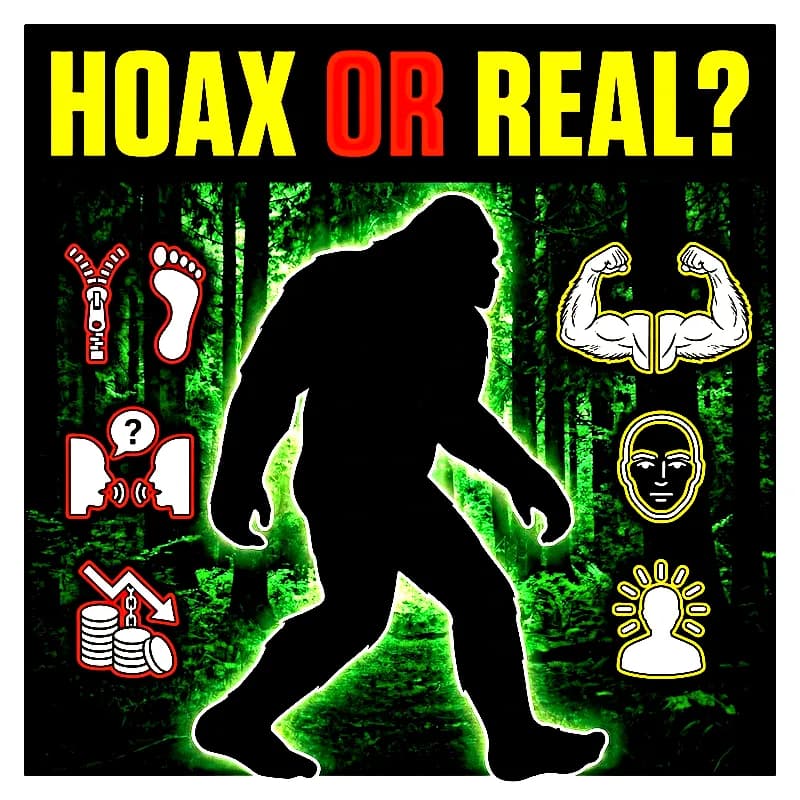
This investigation examines the controversial legacy of the 1967 Patterson-Gimlin Film by focusing on the credibility of the filmmakers rather than the technical content of the footage. Through an analysis of Roger Patterson's financial desperation, his prior Bigfoot obsession, and the ambiguous roles of key collaborators like Bob Gimlin and Al DeAtley, the text constructs a narrative of a man with the motive, means, and opportunity to stage an encounter. The report further traces the film's afterlife as a monetized cultural artifact, detailing the legal disputes, the exploitation by media figures, and the ongoing scientific debate that keeps this footage in a state of perpetual contention. Rather than offering a definitive ruling, the source provides the raw investigative material needed to evaluate the Patterson-Gimlin Film as a case study in the intersection of hoaxing, belief, and the limits of forensic proof.
Case Snapshot
Subject
Patterson-Gimlin Film Credibility
Source Entries
25
Analysis Period
1964–2004
Key Figures
Patterson, Gimlin, DeAtley
Core Issue
Filmmaker Credibility
Evidence Distribution
Section Headings
14
Markdown Tables
2
Unique Citations
25
Inline References
88
Core Timeline Anchors
| Year | Milestone |
|---|---|
| 1964 | Patterson begins writing 'Do Abominable Snowmen of America Really Exist?' |
| 1966 | Patterson's book self-published |
| 1967 | PGF captured at Bluff Creek on October 20 |
| 1968 | Patterson begins licensing footage and planning documentary |
| 1972 | Roger Patterson dies of Hodgkin's lymphoma |
| 2004 | Bob Heironimus publicly claims he wore the suit |
Roger Patterson: The Man Behind the Camera
The evidentiary weight of the Patterson-Gimlin Film (PGF) is inextricable from the character and conduct of its principal creator, Roger Patterson.[1], [2], [3] While the previous technical report evaluated the biomechanical and cinematographic evidence, this investigation shifts focus to the human factors—the motives, behaviors, and contradictions of the individuals involved. Roger Patterson was not a dispassionate wildlife photographer who stumbled upon an unknown hominin; he was a man who had dedicated years to the pursuit of Bigfoot, who was in dire financial straits, and who stood to profit enormously from a successful film.[1], [4], [5]
Financial Desperation and Prior Intent
Patterson's obsession with Bigfoot predated the 1967 film by several years. In the mid-1960s, he self-published a book titled "Do Abominable Snowmen of America Really Exist?"—a compilation of Sasquatch lore, eyewitness accounts, and his own theories.[2], [6] By 1966, he was actively soliciting funding for a Bigfoot documentary. Patterson was known locally in Yakima, Washington, as a charismatic but unreliable figure with a history of financial difficulties.[1], [7]
Patterson's monetary issues were significant. He had a documented history of writing bad checks and accumulating debts.[7], [8] The Cine-Kodak K-100 camera used to film the encounter was itself a point of contention: Patterson had rented it from a camera shop in Yakima and allegedly never fully paid for it.[1], [7] Roger DeAtley, Al's father and the camera shop owner, later sued for the return of the camera or its value.[7], [8] This pattern of financial mismanagement, combined with his public declaration that he intended to find and film Bigfoot, creates a portrait of a man who was not merely looking for truth but for a payday.[5], [7]
The Al DeAtley Connection
Al DeAtley, Patterson's brother-in-law, served as the financial backer and business manager for the Bigfoot expedition and the subsequent exploitation of the film.[4], [8], [9] DeAtley has remained a more private figure, but his role is critical. He helped fund the October 1967 trip to Bluff Creek and was among the first to view the developed film upon its return.[4], [8] DeAtley and Patterson subsequently formed a partnership to license the footage to media outlets and incorporate it into a planned documentary that was never fully completed before Patterson's death.[8], [9]
The DeAtley partnership raises questions. Why would a businessman invest in an expedition led by a man with a known history of bad debts, unless the outcome was, in some way, pre-arranged to guarantee a return?
Proponents counter that DeAtley was simply a family member supporting a passionate relative, and that the film's enduring fame vindicates his investment.[8], [9]
Bob Gimlin: The Reluctant Witness
Bob Gimlin's role in the PGF narrative is that of a credible, reluctant participant—a taciturn cowboy and outdoorsman who accompanied Patterson on the Bluff Creek expedition and who has consistently maintained his account of the encounter over five decades.[1], [3], [10] His credibility is often cited by proponents as the strongest human evidence for the film's authenticity.[1], [10]
Gimlin's Account and Consistency
Gimlin's story has remained remarkably consistent. He describes riding horseback down a sandbar, rounding a corner, and seeing the creature approximately 100 feet away.[1], [3], [10] While Patterson scrambled for his camera, Gimlin grabbed his rifle but did not fire, stating he feared the creature might be a human in a suit or that killing it would be ethically wrong.[3], [10] He claims to have crossed the creek to examine the tracks while Patterson filmed from the opposite bank.[3], [10]
However, Gimlin's relationship with the story is complicated. For many years after Patterson's death in 1972, Gimlin distanced himself from the film and the Bigfoot community, claiming he had been cheated by Patterson and DeAtley out of his share of the profits.[1], [10], [11] He states that Patterson promised him a partnership in any financial proceeds but that he never received any payment.[1], [11] This estrangement lasted roughly two decades, during which Gimlin rarely spoke publicly about the incident.[10], [11]
| Topic | Detail |
|---|---|
| Gimlin's Initial Stance (1967–1970s) | Supported Patterson's account; participated in some media appearances [1], [3] |
| Post-Patterson Death (1972–1990s) | Withdrew from public life; claimed financial betrayal by Patterson/DeAtley [1], [10], [11] |
| Return to Public Eye (late 1990s–present) | Began attending Bigfoot conferences; reaffirmed the encounter's authenticity [10], [11] |
| Key Consistency | Core narrative of the encounter has remained unchanged for 50+ years [3], [10] |
| Key Dispute | Never received financial compensation from film proceeds [1], [11] |
Gimlin's Credibility Under Scrutiny
While Gimlin's consistency is compelling, it does not constitute proof. Critics point out that Gimlin's steadfastness could equally indicate that he is a man who committed to a story and refused to break it, particularly if the alternative is admitting to a fraud that has become a significant part of his identity.[5], [12] The fact that Gimlin is now a fixture on the Bigfoot convention circuit—earning appearance fees, signing autographs, and enjoying a degree of fame—provides a modern motive for maintaining the narrative, even if the original motive (financial gain) was allegedly denied to him.[5], [10], [12]
Furthermore, some critics have noted that Gimlin, an experienced tracker and outdoorsman, reportedly did not follow the creature's tracks into the forest—an action that would seem instinctive for a man of his background upon encountering an unknown animal.[10], [13] His decision to stay at the site while Patterson ran off to tell others is cited as either prudent or suspicious, depending on the interpreter's bias.[10], [13]
The Media Monetization Machine
The PGF entered the public consciousness not through scientific channels but through the media entertainment complex. Patterson immediately recognized the film's commercial value, and the subsequent history of the footage is one of licensing deals, legal disputes, and a cottage industry of exploitation.[4], [8], [14]
From Bluff Creek to Broadcast
Within days of filming, Patterson was already showing the footage to local residents and press. The film was soon sent to the American National Enterprises (ANE), a company that distributed nature documentaries to theaters and educational institutions.[4], [14] ANE licensed the film and included it in a broader Bigfoot documentary, generating revenue from theater screenings and television syndication deals.[4], [14] This early commercialization established the PGF as a product, not a piece of scientific evidence, and its distribution was controlled by businessmen, not researchers.[8], [14]
Legal Disputes and Intellectual Property
The ownership and licensing rights of the PGF have been the subject of protracted legal battles. Following Patterson's death from Hodgkin's lymphoma in 1972, the film's copyright status became murky.[1], [14], [15] Al DeAtley claimed ownership through his business partnership with Patterson. The Patterson estate made counter-claims. Various media companies that had licensed the footage in the 1970s found themselves embroiled in disputes over royalty payments and re-licensing rights.[8], [14], [15]
This legal chaos had a chilling effect on serious research. Scientists who wished to analyze the original film reels were often denied access due to claims of proprietary rights by competing parties.[14], [15] The result was that for decades, the most debated piece of cryptzoological evidence was studied almost exclusively through low-resolution copies—degraded duplicates of duplicates—rather than the original camera negative or high-quality interpositives.[14], [15], [16]
Scientific Engagement: Proponents vs. Skeptics
The PGF's forensic history is marked by a stark divide between scientists who believe it reveals a genuinely unknown creature and those who see it as a clever, but ultimately detectable, hoax.
The Proponent Camp: Krantz, Meldrum, and Munns
Dr. Grover Krantz, an anthropologist at Washington State University, was one of the first academics to endorse the PGF.[1], [17], [18] His analysis focused on the subject's limb proportions, stride length, and body mass—concluding that these parameters fell outside the range of human possibility.[17], [18] Dr. Jeff Meldrum continued this work, focusing on the footprint evidence and the mid-tarsal break, which he argues is a definitive non-human anatomical feature.[17], [19], [20]
Bill Munns, a former Hollywood creature effects artist, has conducted perhaps the most thorough technical analysis, concluding that no costume technology available in 1967 could have produced the muscle dynamics and tissue movement visible in stabilized and enhanced versions of the film.[16], [21], [22] Munns specifically challenges the seam-detection methods used by skeptics, arguing that what appear to be "suit seams" are actually artifacts of film grain and resolution limits.[16], [22]
The Skeptic Camp: Long, Daegling, and Others
Greg Long, an investigative journalist, published "The Making of Bigfoot," a 2004 book that presented Bob Heironimus as the man inside the suit.[12], [23] David Daegling, a biological anthropologist at the University of Florida, has argued in "Bigfoot Exposed" and various academic papers that the biomechanical claims made by proponents are overstated—based on insufficient data from a few seconds of blurry film.[5], [12], [24]
- The "Unfalsifiability" Critique: Daegling's central argument is that the PGF, due to its low resolution and short duration, provides an "unfalsifiable" dataset—one where proponents can always claim that the "real" detail is just below the resolution threshold.[5], [12], [24]
- The Costume Maker Theory: Philip Morris, a costume designer from Charlotte, North Carolina, claimed in 2002 to have sold a modified gorilla suit to Patterson in 1967.[12], [23] While Morris has never produced a receipt, a photograph, or a witness to the sale, skeptics cite his claim as a plausible sourcing mechanism.[12], [23]
| Position | Key Advocates | Core Argument |
|---|---|---|
| Proponent (Biological) | Krantz, Meldrum, Munns | Limb ratios, muscle dynamics, and mid-tarsal break are non-human [17], [19], [22] |
| Skeptic (Costume Hoax) | Long, Daegling, Morris | Low resolution prevents definitive proof; cost. maker claims suit sale [12], [23], [24] |
| Neutral / Undecided | Various scientists | Insufficient data to prove or disprove; more evidence needed [5] |
The Afterlife of the Film: Cultural Integration
The PGF has transcended its origins as a piece of disputed evidence to become a deeply integrated element of American popular culture. The "Patty" walk—a hunched, glancing-over-the-shoulder stride—is one of the most parodied and recognized images in American folklore.[1], [4], [25]
The Convention Circuit and the Believer Economy
A significant "Bigfoot economy" has developed around the PGF and the broader Sasquatch phenomenon. Annual conferences, such as the Ohio Bigfoot Conference and the Sasquatch Summit, attract thousands of attendees.[4], [11], [25] Bob Gimlin is a regular headliner at these events, where attendees pay for meet-and-greets and signed memorabilia.[10], [11] This ecosystem—which includes books, podcasts, television series (like "Finding Bigfoot"), and merchandise—generates millions of dollars annually and has a vested financial interest in maintaining the mystery of the film.[4], [11], [25]
The commercialization of the PGF raises a fundamental epistemological question: at what point does the financial incentive to believe in the film's authenticity outweigh the financial incentive (or lack thereof) to disprove it?
Conclusion: Character, Context, and the Burden of Proof
The credibility of the Patterson-Gimlin Film cannot be separated from the credibility of its principal creator. Roger Patterson was a man with the desire, the declared intent, and the desperate financial need to produce a Bigfoot film.[1], [5], [7] His character, while colorful and sympathetic to some, exhibits a pattern of unreliability that justifies serious skepticism.[5], [7], [8] Bob Gimlin, while personally credible in his consistency, benefits from the film's continued fame in ways that provide an ongoing motive for maintaining his account.[10], [11], [12]
The scientific debate, while rigorous, is hampered by the fundamental limitations of the evidence: a short film shot in low resolution with contested technical parameters.[5], [14], [16] The legal and commercial entanglements surrounding the film's ownership have further impeded independent scientific analysis.[14], [15] What remains is a locked box: the PGF is either a profoundly important biological record, protected by its own ambiguity, or a masterful con—a product of a desperate man's ingenuity that was subsequently embalmed in the amber of cultural belief and commercial interest.[5], [7], [16], [25]
Sources
- Patterson–Gimlin film - Wikipedia, https://en.wikipedia.org/wiki/Patterson%E2%80%93Gimlin_film
- Roger Patterson (Ufologist) - Wikipedia, https://en.wikipedia.org/wiki/Roger_Patterson_(ufologist)
- The Patterson/Gimlin Film – Noteworthy Insights - ISU, https://www.isu.edu/media/libraries/rhi/brief-communications/Murphy_PGFilmInsights.pdf
- Top 10 Bigfoot Sightings: The Patterson-Gimlin Film, https://www.southernstylesweettees.com/blog/august-10
- Bigfoot Exposed: An Anthropologist Examines America's Enduring Legend - ISU, https://www.isu.edu/media/libraries/rhi/book-reviews/BF-Exposed.pdf
- Do Abominable Snowmen of America Really Exist? - Amazon, https://www.amazon.com/Abominable-Snowmen-America-Really-Exist/dp/B000BN0A1A
- Man Behind Bigfoot Hoax? The Roger Patterson Story, https://www.biographydaily.com/2025/02/08/the-roger-patterson-story/
- Making of the Bigfoot Film - Reddit, https://www.reddit.com/r/bigfoot/comments/1jf4yjf/making_of_the_bigfoot_film/
- The role of Al DeAtley in the PGF - r/bigfoot, https://www.reddit.com/r/bigfoot/comments/17ukjm9/the_role_of_al_deatley_in_the_pgf/
- Bob Gimlin Interview - Bigfoot Research, https://www.youtube.com/watch?v=gDeNyZ0bXaw
- Bob Gimlin: still standing by Patterson-Gimlin film - r/bigfoot, https://www.reddit.com/r/bigfoot/comments/11bfpwa/bob_gimlin_still_standing_by_the_patterson_gimlin/
- The Making of Bigfoot by Greg Long - Critical Review, https://www.bigfootencounters.com/articles/long_review.htm
- Why didn't Gimlin follow the tracks? - r/bigfoot, https://www.reddit.com/r/bigfoot/comments/kfhjaw/why_didnt_gimlin_follow_the_tracks/
- Patterson-Gimlin Film copyright and legal disputes, https://en.wikipedia.org/wiki/Patterson%E2%80%93Gimlin_film#Film_ownership
- Who owns the Patterson-Gimlin Film? - r/bigfoot, https://www.reddit.com/r/bigfoot/comments/18c6zqe/who_owns_the_pgf/
- Bill Munns analysis of the Patterson-Gimlin Film, https://munnsreport.com/
- Patterson-Gimlin Film and Linnaeus and Porshnev - ISU, https://www.isu.edu/media/libraries/rhi/from-the-editor/Bayanov_-PGF_50th.pdf
- Grover Krantz - Wikipedia, https://en.wikipedia.org/wiki/Grover_Krantz
- Midfoot Flexibility, Fossil Footprints, and Sasquatch Steps - ResearchGate, https://www.researchgate.net/publication/252899575_Midfoot_Flexibility_Fossil_Footprints_and_Sasquatch_Steps_New_Perspectives_on_the_Evolution_of_Bipedalism
- Jeffrey Meldrum - Idaho State University, https://www.isu.edu/biology/people/faculty---professors/jeffrey-meldrum/
- If the Patterson–Gimlin Film Was Just a Costume - r/bigfoot, https://www.reddit.com/r/bigfoot/comments/1nyu2gf/if_the_pattersongimlin_film_was_just_a_costume/
- Bill Munns' When Roger Met Patty, https://www.bigfootbookshelf.com/store/p140/whenrogermet.html
- The Making of Bigfoot - Greg Long (2004), https://www.amazon.com/Making-Bigfoot-Inside-Greatest-Hoax/dp/1591021391
- David Daegling on Patterson-Gimlin Film, https://www.floridamuseum.ufl.edu/science/bigfoot-exposed/
- The cultural legacy of the Patterson-Gimlin Film, https://www.history.com/articles/bigfoot-origins-history