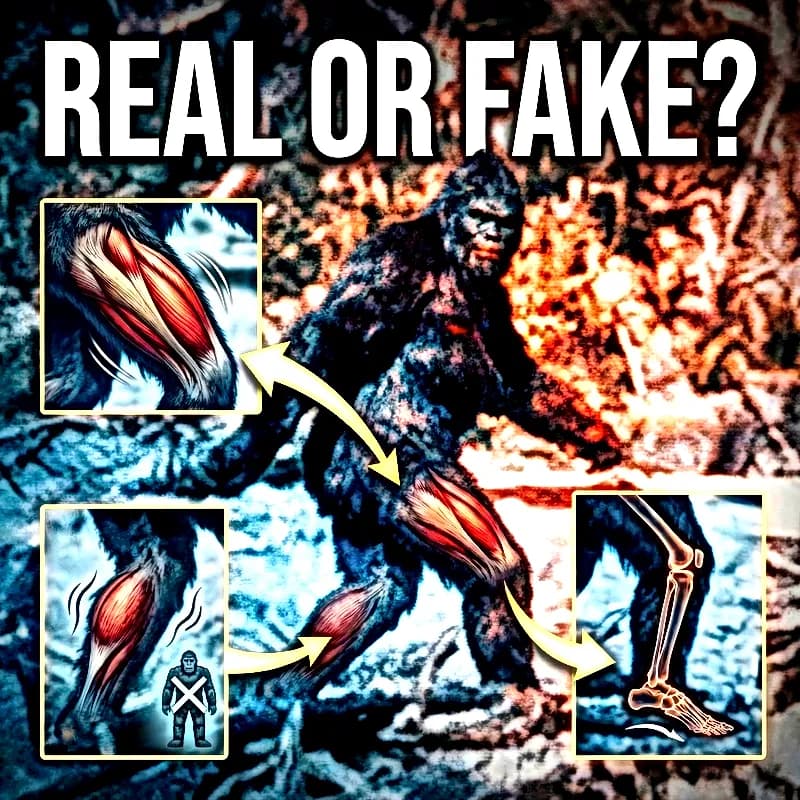
This technical report evaluates the 1967 Patterson-Gimlin film through the lenses of forensic cinematography and biomechanics to determine if the captured figure is a biological entity or a man in a costume. The analysis highlights specific anatomical anomalies, such as a "compliant gait" with constant knee flexion and non-human limb proportions, which suggest physical capabilities and weight loads that would be nearly impossible for a human actor to replicate. Furthermore, the text contrasts the visible muscle contractions and fluid tissue dynamics seen in the footage against the limited special effects technology of the late 1960s, arguing that such detail exceeded the era's makeup capabilities. Ultimately, the source frames the film as a persistent scientific mystery, weighing the biological consistency of the evidence against the suspicious background and financial motivations of the filmmakers.
Case Snapshot
Subject
Patterson-Gimlin Film (1967)
Source Entries
33
Key Figure
Roger Patterson
Core Tech
16mm Kodachrome
Analysis Focus
Biomechanical Gait
Evidence Distribution
Section Headings
18
Markdown Tables
4
Unique Citations
36
Inline References
110
Core Timeline Anchors
| Year | Milestone |
|---|---|
| 1962 | Spandex introduced commercially |
| 1967 | Patterson-Gimlin film shot at Bluff Creek on Oct 20 |
| 1968 | Planet of the Apes wins honorary Oscar for John Chambers' makeup |
| 1993 | Laser ignition subsystems developed for ordnance |
| 2004 | Bob Hieronimus comes forward claiming to be the man in the suit |
The Cinematographic Imaging Chain and Resolution Constraints
The 1967 Patterson-Gimlin film (PGF) serves as a unique artifact at the intersection of biological anthropology, forensic cinematography, and special effects history. Captured on October 20, 1967, along the sandbars of Bluff Creek in Northern California, the footage depicts a large, hair-covered, bipedal figure.[1], [2] For decades, the film has undergone intense scrutiny from both the scientific community and Hollywood professionals to determine if the subject, nicknamed "Patty," represents an unclassified primate or a sophisticated costume. This report provides an exhaustive analysis of the film's technical parameters, the biomechanics of the subject's locomotion, and a comparative study of 1960s special effects technology to establish the physical and biological limits of the evidence.
The PGF was recorded on 16 mm Kodachrome II daylight-balanced color reversal film stock using a Cine-Kodak K-100 camera.[3], [4] To evaluate the veracity of details such as muscle movement and skin rippling, one must first define the optical ceiling of the equipment used. The K-100 was a spring-wound camera capable of variable frame rates, which has significant implications for subsequent kinetic calculations.[1]
Optical System and Emulsion Performance
The camera was equipped with a 25 mm f/1.9 Kodak Cine Ektar lens.[3], [4] Kodachrome II film was renowned for its fine grain and high resolving power, theoretically capable of 63 to 100 line pairs per millimeter (lp/mm) in laboratory conditions.[3], [4] However, the real-world resolution in the Bluff Creek environment was limited by the taking lens, camera vibration from handheld operation, and subject motion. Analysis of the Cine Ektar lens reveals that at an aperture of f/1.9—likely used in the shaded woodland environment—the center resolution dropped to approximately 35–50 lp/mm.[3]
The vertical height of the subject on the original 16 mm emulsion provides a baseline for information density. In the "look-back" sequence (specifically Frame 352), the figure occupies roughly 16.7% of the vertical frame height.[3], [4] Given the standard 16 mm frame height of 7.49 mm, the physical image of the subject on the film is a mere 1.236 mm.[3], [4] Using a conservative effective resolution of 48 lp/mm, the theoretical resolution across the subject's height is approximately 59.3 line pairs.[3], [4] Applying the Nyquist-Shannon sampling theorem, which requires at least two samples per line pair for reconstruction, the figure is composed of approximately 180 to 280 vertical pixels of authentic structural information.[3], [4]
| Technical Parameter | Specification/Value | Source |
|---|---|---|
| Camera Model | Cine-Kodak K-100 (16 mm) | [3], [5] |
| Film Stock | Kodachrome II Reversal (ASA 25) | [3], [4] |
| Lens | 25 mm f/1.9 Kodak Cine Ektar | [3], [4] |
| Theoretical Subject Height | 1.236 mm (on emulsion) | [3], [4] |
| Estimated Vertical Resolution | 180–280 pixels | [3], [4] |
| Total Subject Information | 2.0–3.5 Megapixels (equivalent) | [3], [4] |
High-fidelity digitization of 4x5 inch interpositives—enlargements made directly from the original—is the current gold standard for extracting data.[3], [4] These interpositives preserve the spatial frequencies of the original while introducing only a 10-20% reduction in the modulation transfer function (MTF).
Consequently, claims of "muscle striations" or "fingerprints" must be tempered by the reality that such features approach the grain-limited resolution of the system.
The Frame Rate Determinant
The filming speed of the K-100 camera is the most critical variable in determining the subject's velocity and gait mechanics. The camera featured a dial with settings for 16, 24, 32, 48, and 64 frames per second (fps).[1] Roger Patterson initially claimed a setting of 16 fps, but later debate arose regarding the possibility of 24 fps.[1], [6] Biomechanical analysis of Patterson's own movement as he ran to steady the camera suggests the spring motor was likely running at approximately 18 fps.[1], [3]
This distinction is vital: if filmed at 24 fps, the subject's walk would be roughly 50% faster, making its stride more comparable to a human jog. However, the subject's torso remains remarkably stable, lacking the vertical oscillation (head-bob) characteristic of a human at that speed.[6] At 16 or 18 fps, the walk appears casual but covers ground at a rate that exceeds the average human walking speed of 3.1 mph, reaching approximately 3.85 mph.[6]
Biomechanical Evaluation of the Bluff Creek Subject
The subject in the PGF exhibits a locomotory style known as a "compliant gait," which stands in stark contrast to the standard human bipedal stride. In modern humans, walking is characterized by a "stiff-legged" pendulum model where the knee locks at full extension during the stance phase to minimize muscular energy expenditure.[7], [8]
Kinematics of the Compliant Gait
The PGF subject maintains a degree of knee flexion throughout the entire stride cycle, never reaching full extension.[6], [8] Measurements taken from stabilized versions of the film indicate a knee flexion of approximately 15 to 25 degrees during the stance phase.[8] This "bent-knee, bent-hip" gait requires massive quadriceps and gluteal strength to support the creature's estimated mass, which is calculated to be between 600 and 900 pounds based on the depth of the tracks left in the sand.[6], [9]
Another distinctive feature is the "shin-rise." During the swing phase, the trailing foot is lifted high, with the lower leg reaching an angle nearly 90 degrees relative to the vertical.[10], [11] This exaggerated motion, combined with a forward lean of approximately 5 degrees, suggests a mechanical strategy for moving through soft or uneven terrain while maintaining a low center of gravity.[6]
| Gait Metric | PGF Subject (Patty) | Human Average |
|---|---|---|
| Walking Speed (16 fps) | ~3.85 mph | 3.1 mph |
| Knee Flexion (Stance) | 15–25° | 0–5° |
| Forward Trunk Lean | ~5–10° | ~0–2° |
| Stride Duration | 0.8–1.1 seconds | 0.5–0.6 seconds |
| Foot Length | 14.5–15.5 inches | 10.5 inches |
The mid-tarsal break is perhaps the most debated biomechanical feature. Analysis of the footprints and the way the foot articulates in the film suggests the subject's foot is flexible at the mid-metatarsal region.[9], [12], [13] In humans, the longitudinal arch is a rigid structure designed for efficient push-off. A mid-tarsal break is a primitive primate trait that allows the heel to lift independently of the rest of the foot, which is consistent with the subject's "fluid, rolling" gait observed by researchers like Jeff Meldrum.[2], [13]
Anthropometrics and the Intermembral Index
The intermembral index (IMI) is a standard ratio used in physical anthropology to compare limb proportions across primate species. Humans typically possess an IMI of roughly 68 to 72, indicating legs that are significantly longer than arms.[6], [14] Extant great apes like gorillas and orangutans have IMI values of 100 or higher, as their arms are equal to or longer than their legs for locomotion and climbing.[6], [14]
Calculations derived from the clearest frames of the PGF suggest the subject has an IMI between 80 and 90.[14], [15] This proportion is functionally anomalous: it represents a creature with arms too long for a human but legs too long for an ape.[2], [14] If a human actor were in a suit, achieving these proportions would require arm extensions. However, extensions often result in stiff, "noodly" arm movements where the elbow and wrist do not articulate naturally with the actor's joints.[10], [16] In the PGF, the subject's arms swing with a natural pendular motion, and the hands exhibit independent finger movement, suggesting a biological arm of that specific length.[10], [16]
Morphological Surface Dynamics: Muscle and Adipose Analysis
A central pillar of the "it's a living animal" argument is the appearance of muscle mass movement and skin rippling underneath the fur. If the subject were a costume, the thick fabric or foam rubber backing would traditionally dampen the movement of the actor's underlying muscles.[11], [17], [18]
Muscle Movement in the Lower Limbs
In the lower body, several specific muscle groups have been identified during the locomotory cycle. During the push-off phase, the gastrocnemius (calf muscle) appears to bunch and flex visibly.[5], [10], [19] Even more striking is a bulge on the lateral side of the thigh, identified by some anatomists as consistent with a herniated muscle.[10], [19], [20] Such an anatomical defect—where muscle tissue protrudes through a tear in the fascia—is an extremely sophisticated detail for a 1960s hoaxer to include, especially since it serves no obvious narrative purpose and was only discovered decades later through digital enhancement.[10], [20]
The gluteal region also exhibits complex dynamics. While some skeptics describe a "diaper butt" appearance, frame-by-frame analysis shows the gluteus maximus muscles contracting independently as each leg cycles.[10], [16], [21] This suggests that the "skin" of the creature is thin and tightly adhered to the underlying musculature, a feat that would require the "fur" to be ventilated (sewn) into a thin, elastic membrane—a process that was both expensive and rare in 1967.[14], [17]
Pendulous Tissue and Breast Movement
The subject is clearly female, possessing prominent breasts covered in hair.[1], [5], [20] Skeptics have noted that most female primates do not have pendulous breasts except when lactating and that most species do not have hair-covered breasts.[21], [22] However, proponents point to the movement of this tissue. As the subject walks, the breasts are seen to sway and shift in a manner consistent with fatty, pendulous tissue affected by momentum and gravity.[5], [16], [20] Replicating this in 1967 would have required fluid-filled bladders or sophisticated weighted foam, which would likely have created unnatural bouncing or visible seams where they attached to the chest.[16], [20], [21]
| Feature | Observed Movement/Detail | Theoretical Costume Solution |
|---|---|---|
| Calf Muscle | Visible bunching and release during stride | Foam padding (typically static) |
| Thigh Bulge | Possible muscle herniation on lateral thigh | Anatomical anomaly (unlikely in 1967) |
| Breasts | Pendulous sway; no visible attachment seams | Weighted bladders or loose foam |
| Trapezius | Massive "hump" rising to the back of the skull | Built-up shoulder pads |
Hollywood Costume Capabilities in the Late 1960s
To determine if the PGF subject could be a hoax, its anatomical details must be compared to the state-of-the-art in creature suits of that era. The late 1960s represented a transition period in special effects, where traditional gorilla suits were being challenged by the new "prosthetic" approach pioneered by John Chambers.
The John Chambers / Planet of the Apes Comparison
John Chambers won an honorary Academy Award for Planet of the Apes (1968), which utilized multi-part foam latex appliances glued directly to the face to allow for emotional expression.[23], [24], [25] While Chambers' facial makeup was revolutionary, the body suits in the film remained relatively standard.[17], [23] They were largely "gorilla suits" consisting of fur attached to a fabric backing, which tended to sag at the joints and mask the actor's musculature.[14], [17]
Chambers himself, when asked about the PGF, denied any involvement and stated that while he was talented, he was "not that good" to have created the creature in the film.[1], [17], [26] He noted that to achieve the muscle movement seen in the PGF, one would need to develop a system of "artificial muscles" to fit under the skin—a technology that was not commercially available at the time.[1]
Janos Prohaska and the "Gorilla Man" Legacy
Janos Prohaska was the leading creature performer of the 1960s, creating and wearing suits for Star Trek (the Mugato and the Horta) and The Outer Limits.[27] Prohaska's suits were hand-crafted from rubber, jersey, leather, and yak hair.[28] While detailed, Prohaska's suits were anthropomorphic and designed for television sets; they lacked the non-human limb proportions and the complex biomechanical signatures found in the PGF.[17], [27], [29]
Earlier masters like Charlie Gemora had developed gorilla suits as early as the 1930s that utilized "diaper butt" pieces to allow for leg movement, but these suits were invariably bulky and failed to show the subtle "jiggle" of adipose tissue or the flexing of specific muscles beneath the fur.[11], [21], [30]
Material Science and Fabrication Constraints
The fabrication of a "Patty" suit in 1967 would have faced several material hurdles:
- Latex Technology: Natural foam latex was the primary medium, but it was prone to tearing and required thick walls to maintain its shape, which would hide muscle movement.[17], [25]
- Spandex and Stretch: Spandex was introduced in 1962, but the "four-way stretch" fur fabrics used in modern creature shops were not developed until the 1980s.[17]
- Hair Ventilation: To show muscle ripple through fur, hair must be "ventilated" (tied) into a thin, flesh-colored membrane. This is a painstaking process that, for a full-body suit, would have taken months and cost far more than the estimated $10,000 budget Roger Patterson reportedly lacked.[1], [17], [31]
Skeptical Analysis and Hoax Hypotheses
Despite the biomechanical and technical arguments for authenticity, the PGF is surrounded by a complex web of skeptical claims and historical red flags.
The Patterson Persona and Motivation
Roger Patterson was not a random witness; he was a dedicated Bigfoot seeker who had published a book on the subject and was actively trying to fund a documentary.[22], [31], [32] Critics point to the fact that Patterson had previously sketched a female Bigfoot with breasts that looked remarkably similar to "Patty" before ever filming the creature.[21], [22], [30] This suggests either a remarkable coincidence or that the film was a pre-meditated dramatization of his theories.[22], [30]
Furthermore, Patterson was reportedly in financial distress, with a history of bad checks and lawsuits.[30], [31] The camera used to film the encounter was a rented unit that he allegedly failed to pay for, and the timeline of the film's processing and shipment remains murky, with discrepancies regarding when the film was mailed and when it was seen by his brother-in-law, Al DeAtley.[6], [31]
The Bob Hieronimus Confession
In 2004, Bob Hieronimus came forward claiming he was the man in the suit.[17], [21], [32] He described the costume as a "horsehide" suit that was hot and smelled of dead animals.[32] However, proponents of the film point out that Hieronimus's description does not match the visual evidence: a horsehide suit would be stiff and heavy, precluding the fluid, compliant gait and the visible muscle flexion observed in the footage.[17], [32] Photogrammetric studies also suggest that Hieronimus, even with padding, does not have the correct height or limb ratios to match the subject in the film.[6]
Forensic Synthesis and Ichnological Correlation
The veracity of the PGF does not rest solely on the film itself but on the physical evidence found at the site. Following the encounter, Patterson and Gimlin cast several 14.5 to 15.5-inch footprints.[2], [6]
Weight Estimation and Subsurface Mechanics
Analysis of the depth of the impressions in the sand, compared to the tracks made by the men and their horses, led researchers like Dr. Grover Krantz to estimate the subject's weight at approximately 800 pounds.[1], [2], [9] For a human actor to create such tracks, they would need to carry an additional 600 pounds of weight. Biomechanically, carrying such a load would dramatically alter a human's gait, causing shorter steps and significant vertical oscillation—neither of which is seen in the PGF.[6], [9]
Dermal Ridges and Biological Consistency
Some of the footprint casts from the area allegedly exhibit "dermal ridges"—fine, fingerprint-like textures on the skin of the sole.[9], [30] While some skeptics argue these could be faked using textured rubber, the presence of these ridges in tracks found across different states and decades suggests a biological uniformity that would be difficult to coordinate as a long-term, multi-state hoax.[9], [30]
Conclusion: The Convergence of Probabilities
The Patterson-Gimlin film remains one of the most resilient pieces of photographic evidence in the field of hominology. When subjected to rigorous biomechanical analysis, the subject demonstrates a suite of traits—the compliant gait, the 80-90 intermembral index, the mid-tarsal break, and the localized muscle herniation—that are biologically consistent but functionally alien to human locomotion.[8], [9], [10], [14]
From a cinematographic perspective, the resolution of the 16 mm Kodachrome stock is sufficient to show that the "suit" (if it is one) possesses a level of skin-to-muscle adhesion and pendulous tissue dynamics that were not present in the highest-budget Hollywood productions of 1967.[1], [3], [17] While the character of Roger Patterson and the inconsistencies in his story provide ample reason for skepticism, they do not explain how he could have produced a costume and a performance that have resisted debunking by modern digital and forensic tools for nearly sixty years.[17], [18], [33] The film sits in an uncomfortable gray zone: either it is a genuine record of an unclassified primate, or it is the most technically advanced and biologically accurate hoax in the history of cinema—one that utilized anatomical principles and material behaviors that were not yet understood by the people who allegedly created it.
Sources
- Patterson–Gimlin film - Wikipedia, https://en.wikipedia.org/wiki/Patterson%E2%80%93Gimlin_film
- Top 10 Bigfoot Sightings: A Deep Dive into The Patterson-Gimlin Film, https://www.southernstylesweettees.com/blog/august-10
- Technical Resolution Analysis of the 1967 Patterson-Gimlin 16 mm Film - Reddit, https://www.reddit.com/r/bigfoot/comments/1rf5mo9/technical_resolution_analysis_of_the_1967/
- From the Camera Original to 4×5 Interpositives - Reddit, https://www.reddit.com/r/bigfoot/comments/1riq3i6/from_the_camera_original_to_45_interpositives_the/
- Notes on the Patterson-Gimlin Film - monsterminions, https://monsterminions.wordpress.com/2013/01/03/notes-on-the-patterson-gimlin-film/
- The Patterson/Gimlin Film – Some Noteworthy Insights - ISU, https://www.isu.edu/media/libraries/rhi/brief-communications/Murphy_PGFilmInsights.pdf
- Biomechanics of Human Motion and Its Clinical Applications - PMC, https://pmc.ncbi.nlm.nih.gov/articles/PMC12561807/
- Bigfoot's Screen Test - Center for Inquiry, https://cdn.centerforinquiry.org/wp-content/uploads/sites/29/1999/05/22164946/p20.pdf
- This PROVES That the Patterson-Gimlin Bigfoot Film is Real - YouTube, https://www.youtube.com/watch?v=xHAN3YZU-es
- 10 Pieces of Evidence Suggesting the Patterson–Gimlin Film Might Be Real - Reddit, https://www.reddit.com/r/bigfoot/comments/1nsrunw/10_pieces_of_evidence_suggesting_the/
- People keep saying impossible to make a realistic Bigfoot suit in 1967 - Reddit, https://www.reddit.com/r/bigfoot/comments/1oovk1u/people_keep_saying_that_it_was_impossible_to_make/
- A Wooster Geologist goes to a Bigfoot meeting, https://woostergeologists.scotblogs.wooster.edu/2015/08/29/a-wooster-geologist-goes-to-a-bigfoot-meeting/
- Close Encounter Club - Apple Podcasts, https://podcasts.apple.com/tr/podcast/close-encounter-club/id1775478035?l=tr
- The Patterson-Gimlin Film and Linnaeus and Porshnev - ISU, https://www.isu.edu/media/libraries/rhi/from-the-editor/Bayanov_-PGF_50th.pdf
- Know the Sasquatch/Bigfoot - DOKUMEN.PUB, https://dokumen.pub/know-the-sasquatch-bigfoot.html
- The Patterson film is sufficient evidence imo - r/bigfoot, https://www.reddit.com/r/bigfoot/comments/1k2d31r/the_patterson_film_is_by_itself_sufficient/
- If the Patterson–Gimlin Film Was Just a Costume - r/bigfoot, https://www.reddit.com/r/bigfoot/comments/1nyu2gf/if_the_pattersongimlin_film_was_just_a_costume/
- How the PG film could have been hoaxed - Reddit, https://www.reddit.com/r/bigfoot/comments/1d7bafp/i_asked_a_skeptic_of_bigfoot_to_explain_how_the/
- Precursor to his film - r/bigfoot, https://www.reddit.com/r/bigfoot/comments/168x695/always_had_a_problem_with_thistoo_many/
- Is there any actual evidence of Bigfoot? - r/Cryptozoology, https://www.reddit.com/r/Cryptozoology/comments/1d5jf4n/is_there_any_actual_evidence_of_bigfoot/
- Could the Patterson–Gimlin Film Actually Be Real? - r/Cryptozoology, https://www.reddit.com/r/Cryptozoology/comments/1nsrv2q/could_the_pattersongimlin_film_actually_be_real/
- Thoughts on Paterson gimlin film - r/Cryptozoology, https://www.reddit.com/r/Cryptozoology/comments/1krjnxg/thoughts_on_paterson_gimlin_film/
- Planet of the Apes Screen-used Mask - B Dry Goods, https://bdrygoods.com/products/planet-of-the-apes-john-chambers-20th-century-fox-screen-used-background-actor-ape-mask-1968
- Planet of the Apes Screen-used Mask - Schubertiade, https://www.schubertiademusic.com/products/21633-planet-of-the-apes-john-chambers-20th-century-fox-screen-used-background-actor-ape-mask-1968
- Beneath the Planet of the Apes Concept Art & Costume Tests, https://planetoftheapes.fandom.com/wiki/Beneath_the_Planet_of_the_Apes_Concept_Art_%26_Costume_Tests
- So where is HD evidence of Costumes? - r/bigfoot, https://www.reddit.com/r/bigfoot/comments/s39lb7/so_where_is_hd_evidence_of_costumes/
- The Actor Behind The Gorilla On Gilligan's Island - SlashFilm, https://www.slashfilm.com/1805479/gilligans-island-gorilla-actor-star-trek-janos-prohaska/
- The Great Prohaska - Tralfaz, https://tralfaz.blogspot.com/2019/07/the-great-prohaska.html
- Janos Prohaska gorilla impersonator - Reddit, https://www.reddit.com/r/VintageTV/comments/173ucfz/dont_monkey_around_wgorilla_impersonator_janos/
- Jeff Meldrum's drawing of sasquatch foot mechanics - r/Cryptozoology, https://www.reddit.com/r/Cryptozoology/comments/1ez43l4/jeff_meldrums_drawing_of_how_a_sasquatchs_foot/
- Talk:Patterson–Gimlin film - Wikipedia, https://en.wikipedia.org/wiki/en:Talk:Patterson-Gimlin_film
- Talk:Bigfoot/Archive 12 - Wikipedia, https://en.wikipedia.org/wiki/Talk%3ABigfoot%2FArchive_12
- I believe Patterson-Gimlin Bigfoot film is real - Reddit, https://www.reddit.com/r/bigfoot/comments/195dvgw/i_believe_pattersongimlin_bigfoot_film_is/