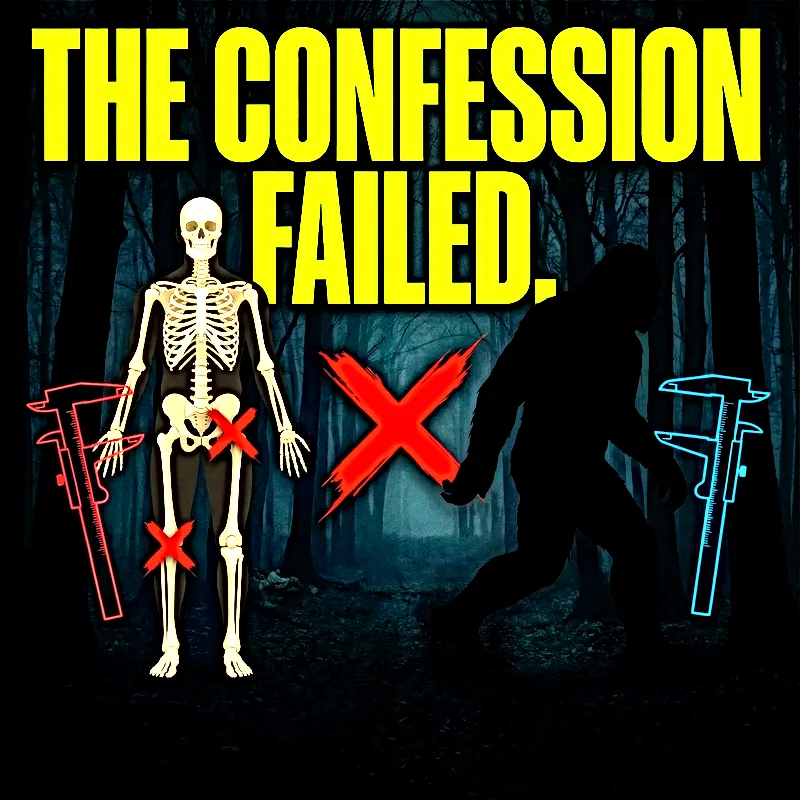
This forensic report examines the 2004 confession of Bob Heironimus, who claimed to have worn a suit in the 1967 Patterson-Gimlin Film, by systematically evaluating his statements against the physical, photogrammetric, and biomechanical evidence. The analysis reveals a series of critical inconsistencies—from discrepancies in physical height and limb proportions to contradictions in the described suit materials—that challenge the credibility of his claim. Rather than closing the case, the Heironimus confession further complicates the PGF narrative, demonstrating how a seemingly definitive "debunking" can, under forensic scrutiny, create more questions than it answers. The report argues that neither the hoax hypothesis nor the biological hypothesis has achieved a standard of proof that satisfies basic forensic thresholds.
Case Snapshot
Subject
Bob Heironimus Confession
Source Entries
11
Year of Confession
2004
Film Date
October 20, 1967
Core Issue
Anthropometric Mismatch
Evidence Distribution
Section Headings
9
Markdown Tables
3
Unique Citations
11
Inline References
48
Core Timeline Anchors
| Year | Milestone |
|---|---|
| 1967 | Patterson-Gimlin Film captured at Bluff Creek |
| 1972 | Roger Patterson dies of Hodgkin's lymphoma |
| 2002 | Philip Morris claims he sold a suit to Patterson |
| 2004 | Bob Heironimus publicly claims he was the man in the suit |
| 2004 | Greg Long publishes 'The Making of Bigfoot' |
The Heironimus Confession: Claims and Context
In 2004, Bob Heironimus, a retired Pepsi bottler from Yakima, Washington, came forward publicly claiming that he was the man inside the "Bigfoot" suit depicted in the 1967 Patterson-Gimlin Film (PGF).[1], [2] His confession, facilitated by investigative journalist Greg Long and published in Long's book "The Making of Bigfoot," was presented as the definitive debunking of a nearly four-decade-old mystery.[2], [3]
Heironimus stated that Roger Patterson approached him and offered him $1,000 to wear a suit and walk along Bluff Creek.[1], [2], [4] He described the suit as made from horsehide, claiming it was hot, pungent, and restrictive.[2], [4] However, Heironimus admitted he was never paid the promised fee and that Patterson had effectively cheated him out of the money.[2], [4]
The Philip Morris Connection
The hoax narrative presented by Long also involved Philip Morris, a costume maker from Charlotte, North Carolina, who claimed to have sold Patterson a modified gorilla suit in 1967.[2], [5] Morris stated that he sold a standard gorilla suit from his catalog, which Patterson then modified by adding extra padding and covering it with animal fur.[5] However, Morris has never produced a receipt, a photograph of the original suit, or any corroborating documentation for this sale.[5], [6]
Morris's claim is undermined by the observable sophistication of the figure in the PGF. His standard gorilla suits were designed for entertainment purposes—carnival acts and promotional events—and bore little resemblance to the proportionally non-human figure depicted in the film.[5], [6]
Anthropometric and Photogrammetric Contradictions
The most damaging challenge to Heironimus's confession comes from the measurable physical incompatibilities between his body and the creature in the film.
Height and Stature Analysis
Various photogrammetric analyses have estimated the height of the PGF subject between 6 feet 2 inches and 7 feet 4 inches, depending on the assumed camera-to-subject distance and the filming speed.[1], [7] Bob Heironimus stands approximately 6 feet tall.[2], [7] To match even the lower estimates of the creature's height, Heironimus would need significant vertical augmentation—shoe platforms, helmet padding, or built-up shoulders—which would be visible in high-resolution scans of the original film stock and would further impede natural movement.[7], [8]
| Physical Parameter | PGF Subject (Estimated) | Bob Heironimus |
|---|---|---|
| Height | 6'2"–7'4" [1], [7] | ~6'0" [2], [7] |
| Shoulder Width | Significantly wider than human average [7], [8] | Normal human proportions [2] |
| Arm Length | Intermembral index of 80–90 [7], [8] | Normal human IMI of ~68–72 [7] |
| Estimated Weight (from tracks) | 600–900 lbs [1], [7] | ~180 lbs [2] |
Limb Proportion Inconsistencies
The intermembral index of the PGF subject—the ratio of arm length to leg length—has been calculated to fall between 80 and 90, significantly higher than the human average of approximately 68-72.[7], [8] This means the creature's arms are proportionally much longer relative to its legs than a human's. For Heironimus to replicate this ratio, he would need arm extensions of approximately 10 to 14 inches.[7], [8] However, as noted in the biomechanical analysis of the film, arm extensions typically create a distinctive "noodle arm" effect where the fake portion of the arm swings independently of the actor's natural elbow and wrist.[7], [8]
The "Suit" Description vs. Observed Film Details
Heironimus described the costume as a "horsehide" suit—essentially an animal skin draped or fitted over his body.[2], [4] This description creates several forensic problems when compared to the PGF subject.
Material and Movement
Horsehide is a rigid, heavy material. A full-body horsehide garment would significantly restrict the range of motion in the shoulders, hips, and knees.[4], [6] The PGF subject, however, demonstrates a full and fluid range of motion—including the deep knee flexion of the compliant gait and the pronounced arm swing described in biomechanical analyses.[7], [8] Furthermore, horsehide does not stretch or conform to underlying muscle contractions; it would mask the muscle dynamics (calf bunching, thigh rippling, gluteal contraction) that have been identified by proponents like Bill Munns and Jeff Meldrum.[8], [9]
Visible Surface Details
The PGF subject's surface (fur/hair) exhibits a pattern consistent with individual hairs lying in a directional flow, moving with the creature's body and affected by wind and momentum.[8], [9] A horsehide suit would present a much different texture—either a flat, uniform surface or a patchy covering where the hide meets at seams.[6], [8]
| Heironimus Claim | Forensic Observation from PGF |
|---|---|
| Horsehide suit material [2], [4] | Hair shows directional flow and movement with body [8], [9] |
| Hot and restrictive costume [4] | Subject moves with full range of motion [7], [8] |
| Standard gorilla suit from Philip Morris [5] | Proportions exceed human parameters (IMI 80-90) [7], [8] |
| Walked normally in the suit [2] | Compliant gait with persistent knee flexion [7], [8] |
| Was not paid the $1,000 fee [2], [4] | No financial records corroborate the arrangement [2], [5] |
The Corroboration Problem
A confession alone does not close a forensic case; it requires corroboration. In criminal forensics, a confession is tested against physical evidence, witness statements, and documentary proof. The Heironimus confession fails on multiple corroborative fronts.
Lack of Physical Evidence
Neither Heironimus, his family, nor Greg Long has ever produced the suit itself, a piece of the suit, or a photograph of Heironimus in or near the suit.[2], [5], [6] This absence is particularly problematic because Heironimus claims the suit was stored at Patterson's residence. No one from Patterson's family has confirmed its existence.[2], [5]
Conflicting Witness Testimony
While Long's investigation cited several Yakima residents who claimed to have heard rumors of a Bigfoot hoax, none of these individuals could provide first-hand testimony placing Heironimus in a suit at Bluff Creek on October 20, 1967.[2], [3], [10] Some witnesses cited by Long later recanted or clarified their statements, claiming they had been misquoted or their comments were taken out of context.[3], [10]
The Heironimus confession suffers from a paradox common to famous hoax claims: the more famous the event, the more individuals emerge to claim credit, often without the evidence to support their claims.[3], [10]
The Motivation Question
Heironimus stated he came forward because he wanted the truth to be known and because he felt wronged by Patterson's failure to pay him.[2], [4] However, critics note that his confession coincided with Greg Long's offer of a publishing platform and the potential for financial compensation through book sales and media appearances.[2], [3] The timing—decades after the event, after Patterson's death, and at a moment of peak media interest in Bigfoot debunking—raises questions about whether the motivation was truth-telling or opportunism.[3], [10]
The Broader Authenticity Crisis
The Heironimus confession did not resolve the PGF debate; it deepened it. The existence of a claimant who says he was the man in the suit, combined with the forensic evidence that his physical characteristics do not match the subject in the film, creates a paradox.
| Scenario | Implications |
|---|---|
| Heironimus is telling the truth | The biomechanical analyses by Krantz, Meldrum, and Munns are fundamentally flawed [7], [8], [9] |
| Heironimus is lying or mistaken | The film remains unexplained; the "hoax" hypothesis loses its primary witness [2], [3] |
| The truth is more complex | Multiple hoaxes or partial truths may be entangled with genuine anomalies [3], [10], [11] |
For skeptics, Heironimus provides a human face for the hoax—a "name in the suit" that makes the debunking feel concrete and personal.[2], [3] For proponents, his confession is easily dismissed on anthropometric grounds, and his lack of corroborating physical evidence renders his claim no more substantial than the many other conflicting "confessions" that have emerged over the decades.[3], [10], [11]
Conclusion: The Limits of Confession-Based Debunking
The Bob Heironimus confession, rather than settling the question of the Patterson-Gimlin Film, illustrates the inherent limitations of verbal testimony in forensic analysis. His account contains significant anthropometric inconsistencies, lacks corroborating physical evidence, and is contradicted by the biomechanical record of the film itself.[2], [7], [8] At the same time, the film's proponents cannot definitively prove the biological hypothesis because the original evidence—the film stock, the footprint casts, and the site itself—has been degraded, disputed, or lost over six decades.[1], [7], [11]
The PGF thus remains in a state of forensic limbo: neither proven nor disproven. The Heironimus confession is a reminder that in cases of significant cultural investment, a "confession" can be as much a product of social dynamics and media incentives as it is a revelation of truth.[2], [3], [10], [11]
Sources
- Patterson–Gimlin film - Wikipedia, https://en.wikipedia.org/wiki/Patterson%E2%80%93Gimlin_film
- The Making of Bigfoot by Greg Long - Critical Review, https://www.bigfootencounters.com/articles/long_review.htm
- Bob Heironimus - Bigfoot Wiki, https://bigfoot.fandom.com/wiki/Bob_Heironimus
- Bob Heironimus Interview - Yakima Herald, https://www.yakimaherald.com/news/local/bigfoot-man-in-suit/
- Philip Morris and the gorilla suit claim, https://www.bigfootencounters.com/articles/morris.htm
- Could the Patterson–Gimlin Film Actually Be Real? - r/Cryptozoology, https://www.reddit.com/r/Cryptozoology/comments/1nsrv2q/could_the_pattersongimlin_film_actually_be_real/
- Patterson-Gimlin Film and Linnaeus and Porshnev - ISU, https://www.isu.edu/media/libraries/rhi/from-the-editor/Bayanov_-PGF_50th.pdf
- Bill Munns analysis of the Patterson-Gimlin Film, https://munnsreport.com/
- The Patterson film is sufficient evidence imo - r/bigfoot, https://www.reddit.com/r/bigfoot/comments/1k2d31r/the_patterson_film_is_by_itself_sufficient/
- Making of the Bigfoot Film - Reddit, https://www.reddit.com/r/bigfoot/comments/1jf4yjf/making_of_the_bigfoot_film/
- I believe Patterson-Gimlin Bigfoot film is real - Reddit, https://www.reddit.com/r/bigfoot/comments/195dvgw/i_believe_pattersongimlin_bigfoot_film_is/