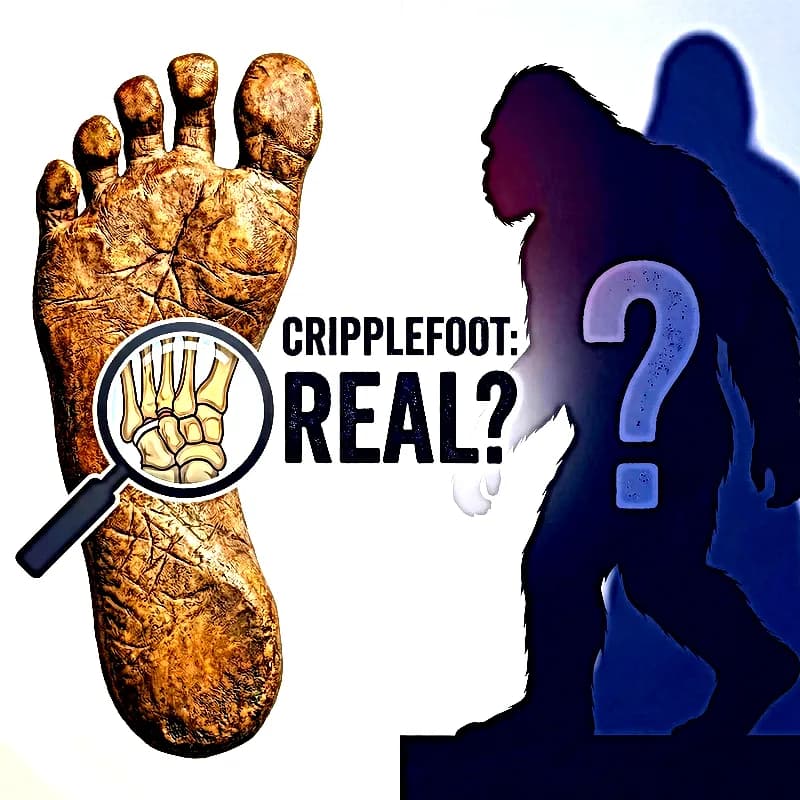
Forensic and Biomechanical Analysis of the 1970 Bossburg "Cripplefoot" Trackway: A Comprehensive Report on Hominological Evidence and Anthropological Skepticism
This report provides a forensic and historical examination of the 1970 Bossburg "Cripplefoot" trackway, a series of footprints that prompted a shift from amateur sightings to serious anthropological study. The text highlights the work of Dr. Grover Krantz, who argued that the tracks' unique biomechanical features, such as a flexible mid-foot and a specific skeletal deformity, were too complex for a layman to successfully fabricate. However, this scientific enthusiasm is balanced against a deep-seated skepticism rooted in the suspicious reputation of the local tracker, Ivan Marx, who was linked to several subsequent hoaxes. Ultimately, the source illustrates the ongoing tension between anatomical evidence and the reliability of its discoverers, leaving the incident as one of the most debated episodes in North American hominology.
Case Snapshot
Subject
1970 Bossburg Cripplefoot Trackway
Source Entries
19
Total Tracks Found
1,089
Print Length
17.5 inches
Key Scientist
Dr. Grover Krantz (WSU)
Primary Suspect Hoaxer
Ivan Marx
Evidence Distribution
Section Headings
10
Markdown Tables
4
Unique Citations
19
Inline References
87
Core Timeline Anchors
| Date | Milestone |
|---|---|
| Nov 24, 1969 | Joe Rhodes discovers tracks at Bossburg town dump |
| Nov 27, 1969 | René Dahinden arrives to investigate |
| Dec 13, 1969 | 1,089-print trackway found in snow |
| Jan 1970 | Joe Metlow's 'Bigfoot in a mine' hoax |
| Oct 1970 | Ivan Marx releases 'Cripplefoot' film |
| 1992 | Krantz publishes Big Footprints defending the evidence |
Introduction
The 1969–1970 Bossburg incident represents perhaps the most significant and analytically complex episode in the history of North American hominology. Centered in Stevens County, Washington, the discovery of a trackway consisting of over 1,000 individual footprints provided the primary catalyst for the transition of Bigfoot research from a pursuit dominated by amateur naturalists to one involving credentialed physical anthropologists.[1]What Bigfoot Teaches Us About Public Mistrust of Science https://www.sapiens.org/biology/bigfoot-hoax-public-science/ The core of this investigation involves the discovery of a massive, 17.5-inch-long footprint with a severe pathological deformity on the right foot, later identified by researchers as an uncorrected clubfoot or metatarsus adductus.[2]Sasquatch tracks are sighted in Bossburg in Stevens County on November 24, 1969 https://historylink.org/File/7938, [3]Cripplefoot Hobbled - Center for Inquiry https://cdn.centerforinquiry.org/wp-content/uploads/sites/29/2002/03/22164753/p35.pdf This case study examines the intersection of biomechanical analysis, the academic career of Dr. Grover Krantz, and the pervasive shadow of hoaxing associated with the local tracker Ivan Marx.
The Geography and Chronology of the Bossburg Incident
The events unfolded in and around Bossburg, Washington, a former mining town along the Columbia River that had largely become a ghost town by the mid-20th century.[2]Sasquatch tracks are sighted in Bossburg in Stevens County on November 24, 1969 https://historylink.org/File/7938 The region's history of lead and silver mining left behind a landscape of abandoned shafts and remote trails, providing a fertile environment for reports of large, unclassified primates.[2]Sasquatch tracks are sighted in Bossburg in Stevens County on November 24, 1969 https://historylink.org/File/7938 The immediate sequence of events leading to the "Cripplefoot" discovery began on November 24, 1969, when a local resident named Joe Rhodes encountered large, humanoid tracks while disposing of trash at a community dump.[2]Sasquatch tracks are sighted in Bossburg in Stevens County on November 24, 1969 https://historylink.org/File/7938
The tracks were immediately recognized as anomalous due to their size and the distinct asymmetry between the left and right feet.[4]Bossburg, Washington - Wikipedia https://en.wikipedia.org/wiki/Bossburg,_Washington On November 27, 1969, René Dahinden, a Swiss-Canadian investigator known for his rigorous and often confrontational approach to Bigfoot research, arrived in Bossburg to document the find.[4]Bossburg, Washington - Wikipedia https://en.wikipedia.org/wiki/Bossburg,_Washington Although the initial tracks at the dump had been largely trampled by curiosity seekers, Dahinden was able to photograph and cast the most viable remaining impressions.[4]Bossburg, Washington - Wikipedia https://en.wikipedia.org/wiki/Bossburg,_Washington He was eventually joined by Bob Titmus and Ivan Marx, the latter being a local tracker and cougar breeder with an established, albeit controversial, reputation in the field.[1]What Bigfoot Teaches Us About Public Mistrust of Science https://www.sapiens.org/biology/bigfoot-hoax-public-science/
The most significant find occurred on December 13, 1969, when Marx and Dahinden located a fresh trackway consisting of 1,089 prints in the snow.[4]Bossburg, Washington - Wikipedia https://en.wikipedia.org/wiki/Bossburg,_Washington These prints followed a complex path: they originated near the Columbia River, crossed a railroad and a main highway, navigated over a 43-inch-high wire fence, traversed a flatland area, and ascended halfway up a hill before returning to the river.[5]The Famous Bossburg Cripple Prints Revisited - Reddit https://www.reddit.com/r/bigfoot/comments/ugx0hs/the_famous_bossburg_cripple_prints_revisited/ The sheer length of the trackway and the variety of terrain it covered suggested a degree of persistence and locomotive capability that challenged the notion of a simple, static hoax.[6]Cripple Foot - Reddit https://www.reddit.com/r/bigfoot/comments/1kjk6gy/cripple_foot/
Morphological and Pathological Analysis of the Tracks
The "Cripplefoot" tracks presented an unprecedented level of anatomical detail that drew the attention of the wider scientific community, including primatologist John Napier and physical anthropologist Grover Krantz.[7]Grover Krantz - Wikipedia https://en.wikipedia.org/wiki/Grover_Krantz The left foot of the track-maker appeared as a "normal" example of the Sasquatch morphology previously reported in the Pacific Northwest.[2]Sasquatch tracks are sighted in Bossburg in Stevens County on November 24, 1969 https://historylink.org/File/7938 It measured 17.5 inches in length, with a width of 6.5 inches across the ball and 5.5 inches across the heel.[2]Sasquatch tracks are sighted in Bossburg in Stevens County on November 24, 1969 https://historylink.org/File/7938 The right foot, however, exhibited a profound deformity.[2]Sasquatch tracks are sighted in Bossburg in Stevens County on November 24, 1969 https://historylink.org/File/7938
Clinical Features of the Deformity
The right footprint was slightly shorter than the left and displayed several pathological markers:
- Metatarsus Adductus: The forefoot was turned sharply inward relative to the hindfoot, a condition identified by Dr. Jeff Meldrum as metatarsus adductus.[3]Cripplefoot Hobbled - Center for Inquiry https://cdn.centerforinquiry.org/wp-content/uploads/sites/29/2002/03/22164753/p35.pdf
- Lateral Protuberances: The outer (lateral) border of the foot featured two distinct lumps or bunions.[2]Sasquatch tracks are sighted in Bossburg in Stevens County on November 24, 1969 https://historylink.org/File/7938, [3]Cripplefoot Hobbled - Center for Inquiry https://cdn.centerforinquiry.org/wp-content/uploads/sites/29/2002/03/22164753/p35.pdf These were interpreted by Krantz as displaced anatomical joints resulting from the creature's massive weight pressing down on a malformed skeletal structure.[7]Grover Krantz - Wikipedia https://en.wikipedia.org/wiki/Grover_Krantz
- Digital Malformation: The third toe was either missing or severely twisted, and the fifth (little) toe protruded at a sharp, unnatural angle.[2]Sasquatch tracks are sighted in Bossburg in Stevens County on November 24, 1969 https://historylink.org/File/7938
- Differential Pressure Patterns: Observations of the trackway indicated that the deformed right foot left deeper impressions in the substrate than the healthy left foot.[5]The Famous Bossburg Cripple Prints Revisited - Reddit https://www.reddit.com/r/bigfoot/comments/ugx0hs/the_famous_bossburg_cripple_prints_revisited/ In forensic track analysis, this suggests a "limping" gait where the subject shifts weight or plants the foot with more force to compensate for instability.[6]Cripple Foot - Reddit https://www.reddit.com/r/bigfoot/comments/1kjk6gy/cripple_foot/
The Biomechanical Arguments of Dr. Grover Krantz
Dr. Grover Krantz, a professor of physical anthropology at Washington State University, became the foremost academic defender of the Bossburg tracks.[7]Grover Krantz - Wikipedia https://en.wikipedia.org/wiki/Grover_Krantz Krantz's approach was fundamentally different from the anecdotal evidence previously used in the field; he applied principles of skeletal reconstruction, lever mechanics, and primate evolution to the casts.[7]Grover Krantz - Wikipedia https://en.wikipedia.org/wiki/Grover_Krantz
The "Too Complex to Fake" Hypothesis
Krantz famously asserted that the Bossburg tracks were too anatomically sophisticated to have been fabricated by a layman.[3]Cripplefoot Hobbled - Center for Inquiry https://cdn.centerforinquiry.org/wp-content/uploads/sites/29/2002/03/22164753/p35.pdf He argued that for a person to fake the tracks, they would need to be an expert in anatomy, an original thinker, and possess a genius-level understanding of biomechanics.[9]Bigfoot Evidence: Are These Tracks Real? https://cdn.centerforinquiry.org/wp-content/uploads/sites/29/1994/09/22165114/p52.pdf He went as far as to claim that a hoaxer would have to "outclass" him in these areas, comparing such a hypothetical individual to Leonardo da Vinci.[9]Bigfoot Evidence: Are These Tracks Real? https://cdn.centerforinquiry.org/wp-content/uploads/sites/29/1994/09/22165114/p52.pdf
His biomechanical case rested on several key observations:
- The Midtarsal Break: Krantz noted that the Bossburg tracks showed evidence of a flexible joint in the mid-foot, a feature seen in great apes but lost in modern humans as we evolved rigid arches for endurance running.[10]Bigfoot vs. Bear Tracks: The Footprint Evidence - Southern Style Sweet Tees https://www.southernstylesweettees.com/blog/october-20 This "midtarsal break" allows the foot to adapt to uneven terrain, and Krantz argued that the pressure ridges found in the middle of the Bossburg prints were consistent with this primate anatomy rather than the flat, rigid profile of a wooden hoaxer's "stomper."[10]Bigfoot vs. Bear Tracks: The Footprint Evidence - Southern Style Sweet Tees https://www.southernstylesweettees.com/blog/october-20, [11]The Case for Bigfoot - Reddit https://www.reddit.com/r/wildlifebiology/comments/1m4ulru/the_case_for_bigfoot/
- Leverage and Weight Distribution: By analyzing the spacing of the tracks and the depth of the impressions, Krantz calculated that the creature stood approximately 8 feet tall and weighed between 700 and 800 pounds.[7]Grover Krantz - Wikipedia https://en.wikipedia.org/wiki/Grover_Krantz, [9]Bigfoot Evidence: Are These Tracks Real? https://cdn.centerforinquiry.org/wp-content/uploads/sites/29/1994/09/22165114/p52.pdf He argued that a human wearing stilts or weighted boots would not be able to maintain a consistent stride or mimic the dynamic "roll" of the foot from heel to toe seen in the Bossburg trackway.[7]Grover Krantz - Wikipedia https://en.wikipedia.org/wiki/Grover_Krantz, [10]Bigfoot vs. Bear Tracks: The Footprint Evidence - Southern Style Sweet Tees https://www.southernstylesweettees.com/blog/october-20
- Thenar Eminence Analysis: Krantz examined purported handprints associated with the Bossburg find (some found by Ivan Marx in 1970) and noted the absence of a thenar eminence—the fleshy mass at the base of the thumb.[7]Grover Krantz - Wikipedia https://en.wikipedia.org/wiki/Grover_Krantz, [12]Tracking the Legend of Bigfoot | Arizona State Museum https://statemuseum.arizona.edu/online-exhibit/curators-choice/tracking-legend-bigfoot He argued that a non-opposable thumb in a large primate would logically lead to the absence of this muscle, a detail so subtle he believed no hoaxer would think to include it.[7]Grover Krantz - Wikipedia https://en.wikipedia.org/wiki/Grover_Krantz
Dermal Ridge Controversy
A significant portion of Krantz's confidence stemmed from the presence of dermal ridges—microscopic skin patterns—on the plaster casts.[7]Grover Krantz - Wikipedia https://en.wikipedia.org/wiki/Grover_Krantz These patterns were scrutinized by various experts:
- A.G. de Wilde: A Dutch professor who concluded the prints came from a "living object able to spread its toes."[7]Grover Krantz - Wikipedia https://en.wikipedia.org/wiki/Grover_Krantz
- John Berry: A fingerprint expert and editor of Fingerprint Whorld, who informed Krantz that Scotland Yard had reviewed the ridge patterns and concluded they were "probably real."[7]Grover Krantz - Wikipedia https://en.wikipedia.org/wiki/Grover_Krantz
Krantz eventually integrated these findings into his broader theory that the Sasquatch was a surviving population of Gigantopithecus blacki, a giant extinct ape from Asia that had migrated to North America across the Bering Land Bridge.[7]Grover Krantz - Wikipedia https://en.wikipedia.org/wiki/Grover_Krantz He attempted to formally name the species using the Bossburg casts as holotypes, though this was rejected by the International Commission on Zoological Nomenclature because the name G. blacki was already in use and the casts did not constitute biological remains.[7]Grover Krantz - Wikipedia https://en.wikipedia.org/wiki/Grover_Krantz
Skepticism Surrounding Ivan Marx and the "Hoax" Paradigm
While Grover Krantz viewed the Bossburg tracks as a scientific "slam dunk," other researchers were deeply troubled by the involvement of Ivan Marx.[13]The Bossburg Tracks - Elite Sasquatch Evidence - Reddit https://www.reddit.com/r/Cryptozoology/comments/102zz3i/the_bossburg_tracks_elite_sasquatch_evidence/ Marx, a local tracker, was the person who alerted others to the dump tracks and was the co-discoverer of the 1,089 trackway.[1]What Bigfoot Teaches Us About Public Mistrust of Science https://www.sapiens.org/biology/bigfoot-hoax-public-science/, [4]Bossburg, Washington - Wikipedia https://en.wikipedia.org/wiki/Bossburg,_Washington
Suspicious Circumstances of Discovery
René Dahinden noted several "red flags" during the December 13 discovery.[4]Bossburg, Washington - Wikipedia https://en.wikipedia.org/wiki/Bossburg,_Washington While driving with Marx, the tracker suddenly pulled over, walked into the brush, and returned shortly after claiming to have found tracks.[4]Bossburg, Washington - Wikipedia https://en.wikipedia.org/wiki/Bossburg,_Washington Dahinden noticed an empty Jeep parked nearby, which was gone when they returned to the site, leading him to suspect that Marx may have had accomplices who were in the process of finishing the trackway.[4]Bossburg, Washington - Wikipedia https://en.wikipedia.org/wiki/Bossburg,_Washington Furthermore, observers noted that Bigfoot tracks only seemed to appear in Bossburg when Marx was in residence and ceased almost immediately after he left the area.[13]The Bossburg Tracks - Elite Sasquatch Evidence - Reddit https://www.reddit.com/r/Cryptozoology/comments/102zz3i/the_bossburg_tracks_elite_sasquatch_evidence/
Ivan Marx's Later Hoaxes
The credibility of the Bossburg tracks was further eroded by Marx's subsequent actions in the early 1970s. Marx produced several films that were almost universally rejected by the Bigfoot community as blatant frauds.[5]The Famous Bossburg Cripple Prints Revisited - Reddit https://www.reddit.com/r/bigfoot/comments/ugx0hs/the_famous_bossburg_cripple_prints_revisited/, [13]The Bossburg Tracks - Elite Sasquatch Evidence - Reddit https://www.reddit.com/r/Cryptozoology/comments/102zz3i/the_bossburg_tracks_elite_sasquatch_evidence/
One of the most damning pieces of evidence against Marx was the report that he had been seen purchasing large quantities of fur fabric in a neighboring town shortly before releasing his "Bigfoot" footage.[1]What Bigfoot Teaches Us About Public Mistrust of Science https://www.sapiens.org/biology/bigfoot-hoax-public-science/, [18]What is the backstory behind this photo? - Reddit https://www.reddit.com/r/Cryptozoology/comments/1eg7dt3/what_is_the_backstory_behind_this_photo_i_keep/ These incidents led many prominent researchers, including John Green and eventually René Dahinden, to conclude that while the tracks were impressive, they were almost certainly part of a larger deception orchestrated by Marx to capitalize on the lucrative rewards being offered for Bigfoot evidence at the time.[13]The Bossburg Tracks - Elite Sasquatch Evidence - Reddit https://www.reddit.com/r/Cryptozoology/comments/102zz3i/the_bossburg_tracks_elite_sasquatch_evidence/
Scientific Counter-Arguments: The "Imitative Hoax"
Anthropologist David J. Daegling, in his critique of the Bossburg incident, provided a scientific explanation for how a hoaxer could produce tracks that fooled experts like Krantz.[3]Cripplefoot Hobbled - Center for Inquiry https://cdn.centerforinquiry.org/wp-content/uploads/sites/29/2002/03/22164753/p35.pdf Daegling argued that Krantz's "Leonardo da Vinci" standard was a fallacy because it relied on the idea that the hoaxer had to invent the anatomy.[3]Cripplefoot Hobbled - Center for Inquiry https://cdn.centerforinquiry.org/wp-content/uploads/sites/29/2002/03/22164753/p35.pdf
Copying from Medical Literature
Daegling posited that a hoaxer did not need to be a genius; they simply needed to be a capable copyist.[3]Cripplefoot Hobbled - Center for Inquiry https://cdn.centerforinquiry.org/wp-content/uploads/sites/29/2002/03/22164753/p35.pdf In 1969, medical textbooks and public libraries were filled with photographs and radiographs of congenital foot deformities like metatarsus adductus and clubfoot.[3]Cripplefoot Hobbled - Center for Inquiry https://cdn.centerforinquiry.org/wp-content/uploads/sites/29/2002/03/22164753/p35.pdf, [13]The Bossburg Tracks - Elite Sasquatch Evidence - Reddit https://www.reddit.com/r/Cryptozoology/comments/102zz3i/the_bossburg_tracks_elite_sasquatch_evidence/ By enlarging a two-dimensional image of a human pathology and carving it into a wooden foot, a hoaxer could produce a track that displayed all the "subtle" anatomical features that Krantz found so convincing.[3]Cripplefoot Hobbled - Center for Inquiry https://cdn.centerforinquiry.org/wp-content/uploads/sites/29/2002/03/22164753/p35.pdf
The "Juvenile Proportion" Standard
Skeptics also pointed out that the supposedly "non-human" proportions of Bigfoot tracks—such as their extreme width—are actually a feature of infant and young juvenile human feet.[3]Cripplefoot Hobbled - Center for Inquiry https://cdn.centerforinquiry.org/wp-content/uploads/sites/29/2002/03/22164753/p35.pdf By selecting and enlarging an image of a child's foot deformity, a hoaxer would produce a Sasquatch track that matched the "theoretical ideal" of a heavy, bipedal primate without actually needing any formal training in physical anthropology.[3]Cripplefoot Hobbled - Center for Inquiry https://cdn.centerforinquiry.org/wp-content/uploads/sites/29/2002/03/22164753/p35.pdf
Problems with Skeletal Reconstruction
Daegling further challenged Krantz's skeletal reconstructions of the Cripplefoot.[3]Cripplefoot Hobbled - Center for Inquiry https://cdn.centerforinquiry.org/wp-content/uploads/sites/29/2002/03/22164753/p35.pdf He noted that Krantz's placement of the tibiotalar joint (the ankle) was purely an inference.[3]Cripplefoot Hobbled - Center for Inquiry https://cdn.centerforinquiry.org/wp-content/uploads/sites/29/2002/03/22164753/p35.pdf Since the ankle joint is well removed from the sole of the foot and does not make contact with the ground, its position in a footprint cannot be determined with the degree of certainty Krantz claimed.[3]Cripplefoot Hobbled - Center for Inquiry https://cdn.centerforinquiry.org/wp-content/uploads/sites/29/2002/03/22164753/p35.pdf The "bunions" that Krantz used as landmarks for skeletal joints could just as easily be explained as soft tissue pathologies or anomalies in the wooden "stomper" itself.[3]Cripplefoot Hobbled - Center for Inquiry https://cdn.centerforinquiry.org/wp-content/uploads/sites/29/2002/03/22164753/p35.pdf
The Collateral Hoaxes: Metlow and the Mine Shaft
The Bossburg incident was not limited to the tracks found by Rhodes and Marx. It also involved a series of secondary hoaxes that highlighted the chaotic and financially driven nature of the 1970 search.[1]What Bigfoot Teaches Us About Public Mistrust of Science https://www.sapiens.org/biology/bigfoot-hoax-public-science/
In January 1970, a prospector named Joe Metlow claimed he had a Bigfoot immobilized in an abandoned mine shaft and was taking "best offers" for the creature.[4]Bossburg, Washington - Wikipedia https://en.wikipedia.org/wiki/Bossburg,_Washington A bidding war ensued among researchers, with offers reportedly reaching $55,000.[4]Bossburg, Washington - Wikipedia https://en.wikipedia.org/wiki/Bossburg,_Washington However, interest evaporated when Metlow refused to allow a single viewing for a $1,000 fee.[4]Bossburg, Washington - Wikipedia https://en.wikipedia.org/wiki/Bossburg,_Washington
Metlow followed this by claiming he had a "Sasquatch foot in a freezer," starting another round of bids.[4]Bossburg, Washington - Wikipedia https://en.wikipedia.org/wiki/Bossburg,_Washington Like his mine shaft claim, this was met with evasion and changing stories, leading the investigators—who had by then dubbed themselves "Sasquatch squads"—to realize they had been the victims of a con man.[4]Bossburg, Washington - Wikipedia https://en.wikipedia.org/wiki/Bossburg,_Washington While these events were unrelated to the tracks themselves, they demonstrated the atmosphere of "hi-jinks" and greed that surrounded the Bossburg find, further complicating the task of legitimate scientific inquiry.[4]Bossburg, Washington - Wikipedia https://en.wikipedia.org/wiki/Bossburg,_Washington
Impact on the Professional Career of Grover Krantz
Grover Krantz's dedication to the Bossburg tracks was a defining element of his professional life and a source of significant academic hardship.[7]Grover Krantz - Wikipedia https://en.wikipedia.org/wiki/Grover_Krantz He was the only tenured physical anthropologist to devote his career to Bigfoot, a decision that led to severe criticism from his colleagues.[7]Grover Krantz - Wikipedia https://en.wikipedia.org/wiki/Grover_Krantz
Krantz's research into Sasquatch was viewed as "fringe science," which directly impacted his professional advancement:[7]Grover Krantz - Wikipedia https://en.wikipedia.org/wiki/Grover_Krantz
- Grant Rejection: He was routinely denied research grants for his hominological work.[7]Grover Krantz - Wikipedia https://en.wikipedia.org/wiki/Grover_Krantz
- Tenure Delays: His tenure at Washington State University was significantly delayed because of his public advocacy for the existence of the creature.[7]Grover Krantz - Wikipedia https://en.wikipedia.org/wiki/Grover_Krantz
- Academic Isolation: He was often described as the "lone professional" in a field dominated by amateurs, and while he attempted to bring scientific training to the search, he was frequently grouped with the very "monster hunters" he sought to differentiate himself from.[1]What Bigfoot Teaches Us About Public Mistrust of Science https://www.sapiens.org/biology/bigfoot-hoax-public-science/, [7]Grover Krantz - Wikipedia https://en.wikipedia.org/wiki/Grover_Krantz
Despite these setbacks, Krantz remained steadfast. In his 1992 book Big Footprints, he continued to maintain that the Bossburg Cripplefoot was authentic evidence.[9]Bigfoot Evidence: Are These Tracks Real? https://cdn.centerforinquiry.org/wp-content/uploads/sites/29/1994/09/22165114/p52.pdf, [12]Tracking the Legend of Bigfoot | Arizona State Museum https://statemuseum.arizona.edu/online-exhibit/curators-choice/tracking-legend-bigfoot He even actively hunted the creature, driving back roads at night in the hopes of obtaining a specimen to present as a physical holotype.[9]Bigfoot Evidence: Are These Tracks Real? https://cdn.centerforinquiry.org/wp-content/uploads/sites/29/1994/09/22165114/p52.pdf
Comparison of Evolutionary Theories
The Bossburg tracks forced researchers to articulate where Bigfoot might fit into the human evolutionary tree.
Legacy and Contemporary Perspectives
The 1970 Bossburg tracks continue to be a cornerstone of Bigfoot research more than 50 years after their discovery. For contemporary experts like Dr. Jeff Meldrum, the tracks remain one of the most credible pieces of evidence ever found, even surpassing the 1967 Patterson-Gimlin film in its anatomical complexity.[6]Cripple Foot - Reddit https://www.reddit.com/r/bigfoot/comments/1kjk6gy/cripple_foot/, [19]Patterson-Gimlin film - HorrorAddicts.net https://horroraddicts.wordpress.com/tag/patterson-gimlin-film/ Meldrum argues that the forensic standards applied to human tracks—if applied fairly to the Bossburg find—would demand further study rather than the outright dismissal that has characterized mainstream zoology.[6]Cripple Foot - Reddit https://www.reddit.com/r/bigfoot/comments/1kjk6gy/cripple_foot/, [11]The Case for Bigfoot - Reddit https://www.reddit.com/r/wildlifebiology/comments/1m4ulru/the_case_for_bigfoot/
However, the "Marx Shadow" remains a significant hurdle. Critics point out that since the tracks ceased appearing as soon as Marx left Bossburg, the coincidence is "too much to believe."[18]What is the backstory behind this photo? - Reddit https://www.reddit.com/r/Cryptozoology/comments/1eg7dt3/what_is_the_backstory_behind_this_photo_i_keep/ The legacy of Bossburg is thus a duality: it is a high point of biomechanical analysis and a low point of credibility, highlighting the "cocktail of science, ego, and arrogance" that often defines the hunt for anomalous primates.[1]What Bigfoot Teaches Us About Public Mistrust of Science https://www.sapiens.org/biology/bigfoot-hoax-public-science/
In final analysis, the Bossburg incident demonstrates the profound difficulty of verifying evidence when it is inextricably linked to individuals with a history of deception. While the tracks' anatomical detail—specifically the midtarsal break and the uncorrected metatarsus adductus—remains a powerful argument for a biological origin, the surrounding context of "Mickey Mouse" film canisters and "fur fabric" purchases ensures that Bossburg remains a subject of intense debate rather than a resolved scientific fact.[14]Triple Feature: The Legend of Bigfoot (1976)/Bigfoot (1970)/The Capture of Bigfoot (1979) https://www.midnightonly.com/2013/08/19/triple-feature-the-legend-of-bigfoot-1976bigfoot-1970the-capture-of-bigfoot-1979/ The tracks are a reminder that in the field of hominology, the distinction between a "discovery" and a "creation" is often found not in the print itself, but in the character and motivations of the tracker who found it.[1]What Bigfoot Teaches Us About Public Mistrust of Science https://www.sapiens.org/biology/bigfoot-hoax-public-science/
Sources
- What Bigfoot Teaches Us About Public Mistrust of Science, https://www.sapiens.org/biology/bigfoot-hoax-public-science/
- Sasquatch tracks are sighted in Bossburg in Stevens County on November 24, 1969, https://historylink.org/File/7938
- Cripplefoot Hobbled - Center for Inquiry, https://cdn.centerforinquiry.org/wp-content/uploads/sites/29/2002/03/22164753/p35.pdf
- Bossburg, Washington - Wikipedia, https://en.wikipedia.org/wiki/Bossburg,_Washington
- The Famous Bossburg Cripple Prints Revisited - Reddit, https://www.reddit.com/r/bigfoot/comments/ugx0hs/the_famous_bossburg_cripple_prints_revisited/
- Cripple Foot - Reddit, https://www.reddit.com/r/bigfoot/comments/1kjk6gy/cripple_foot/
- Grover Krantz - Wikipedia, https://en.wikipedia.org/wiki/Grover_Krantz
- 1969 Bossburg Bigfoot "Cripple Foot" cast C - BigfootCasts.com, https://bigfootcasts-com.myshopify.com/products/1969-bossburg-bigfoot-cripple-foot-cast-c
- Bigfoot Evidence: Are These Tracks Real?, https://cdn.centerforinquiry.org/wp-content/uploads/sites/29/1994/09/22165114/p52.pdf
- Bigfoot vs. Bear Tracks: The Footprint Evidence - Southern Style Sweet Tees, https://www.southernstylesweettees.com/blog/october-20
- The Case for Bigfoot - Reddit, https://www.reddit.com/r/wildlifebiology/comments/1m4ulru/the_case_for_bigfoot/
- Tracking the Legend of Bigfoot | Arizona State Museum, https://statemuseum.arizona.edu/online-exhibit/curators-choice/tracking-legend-bigfoot
- The Bossburg Tracks - Elite Sasquatch Evidence - Reddit, https://www.reddit.com/r/Cryptozoology/comments/102zz3i/the_bossburg_tracks_elite_sasquatch_evidence/
- Triple Feature: The Legend of Bigfoot (1976)/Bigfoot (1970)/The Capture of Bigfoot (1979), https://www.midnightonly.com/2013/08/19/triple-feature-the-legend-of-bigfoot-1976bigfoot-1970the-capture-of-bigfoot-1979/
- The Legend of Bigfoot - Wikipedia, https://en.wikipedia.org/wiki/The_Legend_of_Bigfoot
- BIGFOOT WEEK: The Legend of Bigfoot (1975) - B&S About Movies, https://bandsaboutmovies.com/2018/09/20/bigfoot-week-the-legend-of-bigfoot-1975/
- IN THE SHADOW of BIGFOOT 1977 vhs Ivan Marx - eBay, https://www.ebay.com/itm/275238217286
- What is the backstory behind this photo? - Reddit, https://www.reddit.com/r/Cryptozoology/comments/1eg7dt3/what_is_the_backstory_behind_this_photo_i_keep/
- Patterson-Gimlin film - HorrorAddicts.net, https://horroraddicts.wordpress.com/tag/patterson-gimlin-film/