The Evolutionary Cryptid: A Comprehensive Investigation into the Cryptozoological Career and Anthropological Methodologies of Dr. Grover Krantz
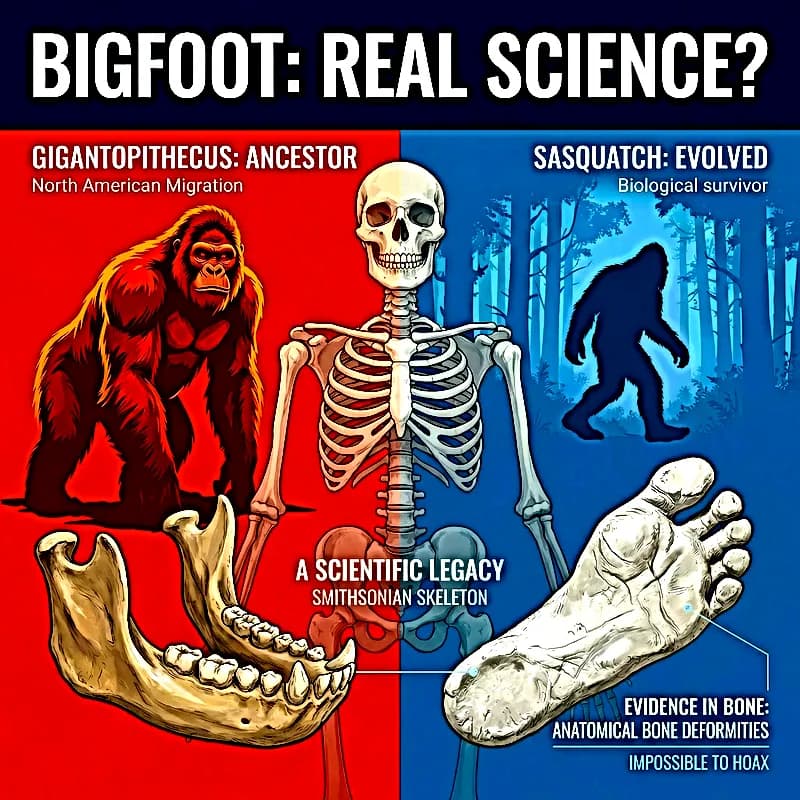
This academic biographical report chronicles the career of Dr. Grover Krantz, a distinguished physical anthropologist who risked his professional standing to apply scientific rigor to the study of Sasquatch. The text details how Krantz utilized biomechanical modeling and morphological analysis of footprints to hypothesize that Bigfoot was actually a surviving population of the extinct primate Gigantopithecus blacki. It further explores the institutional friction and peer ridicule he faced at Washington State University, alongside his controversial ethical argument that a lethal specimen was required for definitive proof. Ultimately, the source portrays Krantz as a professional maverick whose dedication to evidence-based inquiry led him to donate his own skeleton to the Smithsonian Institution, cementing a legacy that bridges traditional anthropology and the fringes of cryptozoology.
Case Snapshot
Subject
Dr. Grover Sanders Krantz (1931–2002)
Source Entries
17
Affiliation
Washington State University
Key Hypothesis
Sasquatch = surviving Gigantopithecus blacki
Publications
60+ articles, 10 books
Skeleton Location
Smithsonian National Museum of Natural History
Evidence Distribution
Section Headings
12
Markdown Tables
5
Unique Citations
17
Inline References
92
Core Timeline Anchors
| Date | Milestone |
|---|---|
| 1931 | Grover Krantz born in Salt Lake City, Utah |
| 1955 | B.S. from University of California, Berkeley |
| 1968 | Joins Washington State University faculty |
| 1970 | Analyzes Bossburg 'Cripplefoot' tracks — becomes Sasquatch proponent |
| 1985 | Presents taxonomic proposal to International Society of Cryptozoology |
| 1992 | Publishes Big Footprints |
| 1996 | Becomes pivotal figure in Kennewick Man case |
| 2002 | Dies of pancreatic cancer |
| donates body to Smithsonian | - |
Introduction
The career of Dr. Grover Sanders Krantz (1931–2002) represents a unique and often polarizing intersection between rigorous physical anthropology and the marginalized field of cryptozoology.[1]Grover Krantz - Wikipedia https://en.wikipedia.org/wiki/Grover_Krantz As a tenured professor at Washington State University (WSU), Krantz was one of the few credentialed scientists to stake his professional reputation on the existence of the Sasquatch, or Bigfoot.[1]Grover Krantz - Wikipedia https://en.wikipedia.org/wiki/Grover_Krantz His approach was not rooted in folklore but in the traditional tools of his trade: functional anatomy, biomechanical modeling, and the fossil record.[1]Grover Krantz - Wikipedia https://en.wikipedia.org/wiki/Grover_Krantz By treating the Sasquatch as a biological entity subject to the laws of evolution and physics, Krantz attempted to move the discourse from the realm of amateur sightings to the rigorous scrutiny of academic science.[2]Entering dubious realms: Grover Krantz, science, and Sasquatch - PubMed https://pubmed.ncbi.nlm.nih.gov/19831199/ This report investigates his pivotal morphological analyses, his taxonomic hypotheses connecting Sasquatch to the extinct primate Gigantopithecus blacki, the institutional friction he encountered at WSU, and his ethically complex stance on the necessity of a lethal specimen for scientific validation.[3]The Scientist Grover Krantz Risked It All...Chasing Bigfoot https://www.smithsonianmag.com/smithsonian-institution/scientist-grover-krantz-risked-it-all-chasing-bigfoot-180970676/
Academic Foundations and the Transition to Cryptozoology
Grover Krantz's path to becoming the first serious Bigfoot academic was paved with high-level training in physical anthropology and human evolution.[4]Grover Krantz Donated His Body to Science, On One Condition https://www.smithsonianmag.com/smithsonian-institution/grover-krantz-donated-his-body-to-science-on-one-condition-38726179/ Born on November 5, 1931, in Salt Lake City, Utah, to Carl Victor Emmanuel Krantz and Esther Maria Sanders, Krantz was raised in a devout Mormon household, though he did not remain active in the religion later in life.[1]Grover Krantz - Wikipedia https://en.wikipedia.org/wiki/Grover_Krantz His academic journey began at the University of Utah in 1949, interrupted by service in the Air National Guard as a desert survival instructor in New Mexico from 1951 to 1952.[1]Grover Krantz - Wikipedia https://en.wikipedia.org/wiki/Grover_Krantz He completed his Bachelor of Science in 1955 and a Master's degree in 1958 at the University of California, Berkeley, before earning his doctorate from the University of Minnesota in 1971 with a dissertation entitled The Origins of Man.[1]Grover Krantz - Wikipedia https://en.wikipedia.org/wiki/Grover_Krantz
Krantz's early career involved technical work at the Phoebe A. Hearst Museum of Anthropology in Berkeley, where he developed the osteological expertise that would define his later research.[1]Grover Krantz - Wikipedia https://en.wikipedia.org/wiki/Grover_Krantz His arrival at Washington State University in 1968 marked the beginning of a thirty-year tenure characterized by a divide between traditional scholarship and controversial pursuits.[5]Grover Krantz (1931–2002) and Clyde - Washington State Magazine https://magazine.wsu.edu/2009/10/30/grover-krantz-1931-2002-and-clyde/ Before his name became synonymous with Bigfoot, Krantz was a productive member of the anthropological community, authoring over 60 articles and 10 books on subjects ranging from human evolution to linguistic development.[1]Grover Krantz - Wikipedia https://en.wikipedia.org/wiki/Grover_Krantz
Academic Timeline
| Milestone | Year | Institution/Detail |
|---|---|---|
| Birth | 1931 | Salt Lake City, Utah [1]Grover Krantz - Wikipedia https://en.wikipedia.org/wiki/Grover_Krantz |
| B.S. Degree | 1955 | University of California, Berkeley [1]Grover Krantz - Wikipedia https://en.wikipedia.org/wiki/Grover_Krantz |
| M.S. Degree | 1958 | University of California, Berkeley [1]Grover Krantz - Wikipedia https://en.wikipedia.org/wiki/Grover_Krantz |
| PhD Degree | 1971 | University of Minnesota [1]Grover Krantz - Wikipedia https://en.wikipedia.org/wiki/Grover_Krantz |
| WSU Tenure Begins | 1968 | Washington State University [5]Grover Krantz (1931–2002) and Clyde - Washington State Magazine https://magazine.wsu.edu/2009/10/30/grover-krantz-1931-2002-and-clyde/ |
| Tenure Achievement | Late 1970s | Department of Anthropology [6]The Men Who Dream of Bigfoot https://www.outsideonline.com/outdoor-adventure/environment/men-who-dream-bigfoot/ |
| Death | 2002 | Port Angeles, Washington [1]Grover Krantz - Wikipedia https://en.wikipedia.org/wiki/Grover_Krantz |
The 1970 Bossburg Tracks: Morphological Analysis of "Cripplefoot"
The pivotal moment in Krantz's transformation from a skeptic to a proponent of Sasquatch existence occurred in late 1969 and early 1970 following the discovery of footprints near Bossburg, Washington.[1]Grover Krantz - Wikipedia https://en.wikipedia.org/wiki/Grover_Krantz While Krantz was initially dismissive of Bigfoot, assigning it only a 10 percent chance of being real after viewing the 1967 Patterson-Gimlin film, the Bossburg evidence provided physical clues that he believed were impossible to fake.[1]Grover Krantz - Wikipedia https://en.wikipedia.org/wiki/Grover_Krantz
Anatomical Detail and Pathology
The tracks, discovered in a former mining town, became known as the Cripplefoot prints due to a visible deformity in the right foot.[7]Grover Krantz: In Search of Bigfoot - Geek Frontiers https://geekfrontiers.com/grover-krantz-in-search-of-bigfoot/ Krantz analyzed plaster casts of these prints and observed what he identified as metatarsus adductus, a structural deformity involving the middle toes and strange bulges on the outer edge of the foot.[7]Grover Krantz: In Search of Bigfoot - Geek Frontiers https://geekfrontiers.com/grover-krantz-in-search-of-bigfoot/ He concluded that the right and left prints were distinctly different, with the right foot showing telltale signs of compensation for broken bones or a congenital pathology.[8]A student of Sasquatch, Prof. Grover Krantz, dies - Seattle PI https://www.seattlepi.com/news/article/a-student-of-sasquatch-prof-grover-krantz-dies-1080702.php
Krantz's reasoning was rooted in the difficulty of a hoaxer constructing such an elaborate anatomical detail.[8]A student of Sasquatch, Prof. Grover Krantz, dies - Seattle PI https://www.seattlepi.com/news/article/a-student-of-sasquatch-prof-grover-krantz-dies-1080702.php He argued that to fake the Cripplefoot tracks, a hoaxer would need to be an expert in primate anatomy on par with himself, possessing the ability to anticipate the specific structural modifications required for an 8-foot-tall, heavily built hominid to move bipedally with a deformity.[7]Grover Krantz: In Search of Bigfoot - Geek Frontiers https://geekfrontiers.com/grover-krantz-in-search-of-bigfoot/ He estimated the creature's height at approximately 2.44 meters (8 feet) and its weight at roughly 360 kilograms (800 pounds) based on the depth and spacing of the tracks.[1]Grover Krantz - Wikipedia https://en.wikipedia.org/wiki/Grover_Krantz
Biomechanical Modeling
Krantz developed complex mathematical equations to model the gait of a large, bipedal primate.[7]Grover Krantz: In Search of Bigfoot - Geek Frontiers https://geekfrontiers.com/grover-krantz-in-search-of-bigfoot/ He calculated the leverage required for the heel, ankle, and toe base to support a mass significantly beyond the human range.[1]Grover Krantz - Wikipedia https://en.wikipedia.org/wiki/Grover_Krantz His analysis of the Cripplefoot casts suggested that the proportions of the foot bones were nonhuman, with a wider heel and a more robust midfoot to manage the weight distribution.[9]Cripplefoot Hobbled - Center for Inquiry https://cdn.centerforinquiry.org/wp-content/uploads/sites/29/2002/03/22164753/p35.pdf
Comparative Foot Morphology
| Feature | Human Foot (Standard) | Cripplefoot Track (Bossburg) |
|---|---|---|
| Length | Variable (avg. 10–12 in) | Approximately 17 inches [7]Grover Krantz: In Search of Bigfoot - Geek Frontiers https://geekfrontiers.com/grover-krantz-in-search-of-bigfoot/ |
| Width | Proportional to human mass | Disproportionately wide [9]Cripplefoot Hobbled - Center for Inquiry https://cdn.centerforinquiry.org/wp-content/uploads/sites/29/2002/03/22164753/p35.pdf |
| Anatomy | Standard arch/toes | Metatarsus adductus (right foot) [9]Cripplefoot Hobbled - Center for Inquiry https://cdn.centerforinquiry.org/wp-content/uploads/sites/29/2002/03/22164753/p35.pdf |
| Weight Support | Max ~200–300 lbs | Optimized for ~800 lbs [1]Grover Krantz - Wikipedia https://en.wikipedia.org/wiki/Grover_Krantz |
| Heel Design | Bipedal human | "Disproportionately wide" heel [9]Cripplefoot Hobbled - Center for Inquiry https://cdn.centerforinquiry.org/wp-content/uploads/sites/29/2002/03/22164753/p35.pdf |
Critics of Krantz's analysis highlighted the possibility of an imitative hoax.[9]Cripplefoot Hobbled - Center for Inquiry https://cdn.centerforinquiry.org/wp-content/uploads/sites/29/2002/03/22164753/p35.pdf They argued that a hoaxer did not need to be an original anatomical genius; they only needed to copy and enlarge images of real human deformities from medical textbooks.[9]Cripplefoot Hobbled - Center for Inquiry https://cdn.centerforinquiry.org/wp-content/uploads/sites/29/2002/03/22164753/p35.pdf Some research suggested that the "disproportionately wide" nature of the prints matched the shape of infant and young juvenile feet, which a hoaxer might have used as a template for enlargement.[9]Cripplefoot Hobbled - Center for Inquiry https://cdn.centerforinquiry.org/wp-content/uploads/sites/29/2002/03/22164753/p35.pdf Furthermore, the presence of known hoaxer Ivan Marx in Bossburg at the time cast doubt on the reliability of the evidence, as the tracks appeared when he arrived and ceased when he left.[10]The Bossburg Tracks - Elite Sasquatch Evidence : r/Cryptozoology - Reddit https://www.reddit.com/r/Cryptozoology/comments/102zz3i/the_bossburg_tracks_elite_sasquatch_evidence/
Dermatoglyphics: The Dermal Ridge and Sweat Pore Debate
In the early 1980s, Krantz's research entered the realm of dermatoglyphics, the study of skin ridges on the hands and feet.[11]Alleged Pore Structure In Sasquatch (Bigfoot) Footprints - Center for Inquiry https://centerforinquiry.s3.amazonaws.com/wp-content/uploads/sites/29/1989/04/22165241/p54.pdf In 1982, footprints found in southeastern Washington by a Forest Service patrolman were cast in plaster, showing fine details that Krantz interpreted as dermal ridges and sweat pores.[11]Alleged Pore Structure In Sasquatch (Bigfoot) Footprints - Center for Inquiry https://centerforinquiry.s3.amazonaws.com/wp-content/uploads/sites/29/1989/04/22165241/p54.pdf
Evidence of Higher Primate Characteristics
Krantz argued that the ridges on the casts were spaced approximately 0.5 mm apart and featured bifurcations and terminations common to higher primates.[11]Alleged Pore Structure In Sasquatch (Bigfoot) Footprints - Center for Inquiry https://centerforinquiry.s3.amazonaws.com/wp-content/uploads/sites/29/1989/04/22165241/p54.pdf He also identified small indentations on the ridges, ranging from 0.1 mm to 0.2 mm in diameter, which he claimed were sweat pores.[11]Alleged Pore Structure In Sasquatch (Bigfoot) Footprints - Center for Inquiry https://centerforinquiry.s3.amazonaws.com/wp-content/uploads/sites/29/1989/04/22165241/p54.pdf To validate these findings, Krantz consulted fingerprint experts, including John Berry of Fingerprint Whorld, who reported that Scotland Yard had examined the prints and considered them "probably real."[1]Grover Krantz - Wikipedia https://en.wikipedia.org/wiki/Grover_Krantz
The Scientific Critique of Casting Artifacts
The scientific community responded with skepticism, specifically through an experimental study by Deborah J. Freeland and Walter F. Rowe.[11]Alleged Pore Structure In Sasquatch (Bigfoot) Footprints - Center for Inquiry https://centerforinquiry.s3.amazonaws.com/wp-content/uploads/sites/29/1989/04/22165241/p54.pdf They tested whether a coarse medium like loess (a porous silt) could actually duplicate primate dermatoglyphics.[11]Alleged Pore Structure In Sasquatch (Bigfoot) Footprints - Center for Inquiry https://centerforinquiry.s3.amazonaws.com/wp-content/uploads/sites/29/1989/04/22165241/p54.pdf Their findings suggested that the "pores" were likely artifacts of the casting process:[11]Alleged Pore Structure In Sasquatch (Bigfoot) Footprints - Center for Inquiry https://centerforinquiry.s3.amazonaws.com/wp-content/uploads/sites/29/1989/04/22165241/p54.pdf
- Bubble Formation: When plaster or dental stone is mixed, it entrains masses of air bubbles.[11]Alleged Pore Structure In Sasquatch (Bigfoot) Footprints - Center for Inquiry https://centerforinquiry.s3.amazonaws.com/wp-content/uploads/sites/29/1989/04/22165241/p54.pdf
- Geometric Analysis: Microscopic examination showed that the "pores" were spherical or hemispherical, a shape consistent with air bubbles, whereas biological pores would be conical.[11]Alleged Pore Structure In Sasquatch (Bigfoot) Footprints - Center for Inquiry https://centerforinquiry.s3.amazonaws.com/wp-content/uploads/sites/29/1989/04/22165241/p54.pdf
- Patterning: These bubbles tended to line up regularly on the ridges, mimicking the patterns Krantz observed.[11]Alleged Pore Structure In Sasquatch (Bigfoot) Footprints - Center for Inquiry https://centerforinquiry.s3.amazonaws.com/wp-content/uploads/sites/29/1989/04/22165241/p54.pdf
Despite this critique, Krantz remained convinced that the complexity of the ridge bifurcations and the overall anatomical "correctness" of the prints across different locations and times pointed toward a real biological maker rather than a recurring hoaxer.[1]Grover Krantz - Wikipedia https://en.wikipedia.org/wiki/Grover_Krantz
The Gigantopithecus blacki Hypothesis
Central to Krantz's cryptozoological legacy was his evolutionary hypothesis that Sasquatch was a surviving population of Gigantopithecus blacki.[1]Grover Krantz - Wikipedia https://en.wikipedia.org/wiki/Grover_Krantz This giant ape, first identified by Ralph von Koenigswald in 1935 from fossil teeth found in a Chinese apothecary, lived in eastern Asia until roughly 100,000 years ago.[1]Grover Krantz - Wikipedia https://en.wikipedia.org/wiki/Grover_Krantz
Migration and the Bering Land Bridge
Krantz theorized that Gigantopithecus migrated to North America across the Bering land bridge.[1]Grover Krantz - Wikipedia https://en.wikipedia.org/wiki/Grover_Krantz This bridge existed between 135,000 to 70,000 years ago, providing a window for the progenitor population to enter the continent before the land connection disappeared.[1]Grover Krantz - Wikipedia https://en.wikipedia.org/wiki/Grover_Krantz He argued that while the species faced extinction in its original Asian habitat due to climate change and human activity, isolated pockets survived in the remote, dense forests of the Pacific Northwest.[1]Grover Krantz - Wikipedia https://en.wikipedia.org/wiki/Grover_Krantz
Anatomical Reconstructions of Bipedalism
One of Krantz's most significant challenges was explaining how a traditionally quadrupedal ape could evolve into the bipedal Sasquatch.[12]Gigantopithecus - Wikipedia https://en.wikipedia.org/wiki/Gigantopithecus Krantz addressed this by reconstructing the Gigantopithecus skull based on Mandible III, a fossil found in Liucheng, China.[13]A Species Named from Footprints - Cryptozoological Reference Library https://cryptozoologicalreferencelibrary.wordpress.com/wp-content/uploads/2019/10/krantz-1986.pdf
He observed that the jaw rami diverged toward the rear to an extreme degree, implying that the neck must have been situated between the jawbones rather than behind them.[13]A Species Named from Footprints - Cryptozoological Reference Library https://cryptozoologicalreferencelibrary.wordpress.com/wp-content/uploads/2019/10/krantz-1986.pdf This vertical neck placement indicated an erect, bipedal posture.[13]A Species Named from Footprints - Cryptozoological Reference Library https://cryptozoologicalreferencelibrary.wordpress.com/wp-content/uploads/2019/10/krantz-1986.pdf Furthermore, he estimated that the creature's brain size would be approximately 600 cc, slightly larger than modern apes due to its massive body size, but lacking in cultural capacity or language.[13]A Species Named from Footprints - Cryptozoological Reference Library https://cryptozoologicalreferencelibrary.wordpress.com/wp-content/uploads/2019/10/krantz-1986.pdf
Comparative Morphology: Krantz Model vs. Modern Gorilla
Naming Challenges and Zoological Nomenclature
Krantz attempted to formally name Bigfoot by presenting a paper at the 1985 meeting of the International Society of Cryptozoology in England.[1]Grover Krantz - Wikipedia https://en.wikipedia.org/wiki/Grover_Krantz He proposed the binomen Gigantopithecus blacki, but the International Commission on Zoological Nomenclature rejected this because the taxon already existed for the fossil species.[1]Grover Krantz - Wikipedia https://en.wikipedia.org/wiki/Grover_Krantz He later suggested Gigantopithecus canadensis, arguing that plaster casts could serve as a holotype in the absence of a physical specimen—a position that was not permitted under standard zoological rules.[1]Grover Krantz - Wikipedia https://en.wikipedia.org/wiki/Grover_Krantz
Academic Backlash and Professional Isolation at WSU
Dr. Krantz's pursuit of Bigfoot was described as "professionally damaging," costing him research grants, promotions, and nearly preventing his tenure at Washington State University.[1]Grover Krantz - Wikipedia https://en.wikipedia.org/wiki/Grover_Krantz While he was a respected scholar in human evolution, his cryptozoological work led colleagues to view him as an institutional embarrassment.[3]The Scientist Grover Krantz Risked It All...Chasing Bigfoot https://www.smithsonianmag.com/smithsonian-institution/scientist-grover-krantz-risked-it-all-chasing-bigfoot-180970676/
Institutional Friction and Stagnation
Krantz was consistently denied tenure until the late 1970s due to a "nonbeliever" on the academic review board who discriminated against his research topic.[6]The Men Who Dream of Bigfoot https://www.outsideonline.com/outdoor-adventure/environment/men-who-dream-bigfoot/ Colleagues like Bill Lipe noted that while Krantz approached the subject as a scientist, his evidence "never got any better" over thirty years, leading the department to treat his obsession with a "butt of jokes" attitude.[8]A student of Sasquatch, Prof. Grover Krantz, dies - Seattle PI https://www.seattlepi.com/news/article/a-student-of-sasquatch-prof-grover-krantz-dies-1080702.php This isolation was exacerbated by his inability to publish Sasquatch-related articles in peer-reviewed journals, which preferred more established anthropological subjects.[1]Grover Krantz - Wikipedia https://en.wikipedia.org/wiki/Grover_Krantz
Social and Community Conflict
Beyond the university, Krantz faced backlash from the amateur Bigfoot community.[2]Entering dubious realms: Grover Krantz, science, and Sasquatch - PubMed https://pubmed.ncbi.nlm.nih.gov/19831199/ He warned about "backstabbing" within the field, where ego and personal rivalries often superseded scientific investigation.[6]The Men Who Dream of Bigfoot https://www.outsideonline.com/outdoor-adventure/environment/men-who-dream-bigfoot/ Rival researcher René Dahinden was particularly vocal in his disdain, labeling Krantz's book Big Footprints as "the worst book ever written" and accusing Krantz of unscientific practices.[14]Bigfoot Evidence: Are These Tracks Real? - Center for Inquiry https://cdn.centerforinquiry.org/wp-content/uploads/sites/29/1994/09/22165114/p52.pdf
Professional Consequences
| Form of Backlash | Impact on Career/Life |
|---|---|
| Tenure Denial | Delayed until late 1970s; career stagnation [6]The Men Who Dream of Bigfoot https://www.outsideonline.com/outdoor-adventure/environment/men-who-dream-bigfoot/ |
| Grant Rejection | Lack of funding for field research [1]Grover Krantz - Wikipedia https://en.wikipedia.org/wiki/Grover_Krantz |
| Public Ridicule | University switchboard flooded with calls mocking him [6]The Men Who Dream of Bigfoot https://www.outsideonline.com/outdoor-adventure/environment/men-who-dream-bigfoot/ |
| Peer Ridicule | "Butt of jokes" in anthropology circles [3]The Scientist Grover Krantz Risked It All...Chasing Bigfoot https://www.smithsonianmag.com/smithsonian-institution/scientist-grover-krantz-risked-it-all-chasing-bigfoot-180970676/ |
| Amateur Hostility | Threats and abuse from non-academic researchers [2]Entering dubious realms: Grover Krantz, science, and Sasquatch - PubMed https://pubmed.ncbi.nlm.nih.gov/19831199/ |
Despite the professional cost, Krantz remained unwavering. He served as the keynote speaker at international Sasquatch conferences and continued to mentor students like Gary Breschini and Donald Tyler, who remembered him as a brilliant mind who encouraged thinking "outside the box."[15]The Man, The Myth, and The Legend of Grover Krantz - Cal Alumni Association https://alumni.berkeley.edu/california-magazine/summer-2018-our-town/man-myth-and-legend-grover-krantz/
The Ethical Divide: The Controversy of Lethal Force
Krantz's most controversial stance was his insistence that a type specimen could only be secured via lethal force.[1]Grover Krantz - Wikipedia https://en.wikipedia.org/wiki/Grover_Krantz He argued that no amount of film or footprint evidence would convince the scientific community of Sasquatch's reality; only a body would suffice.[3]The Scientist Grover Krantz Risked It All...Chasing Bigfoot https://www.smithsonianmag.com/smithsonian-institution/scientist-grover-krantz-risked-it-all-chasing-bigfoot-180970676/
The "Unicorn" Logic of Conservation
Krantz famously wrote that "to pass laws against harming sasquatches presently makes little more sense than protecting unicorns."[15]The Man, The Myth, and The Legend of Grover Krantz - Cal Alumni Association https://alumni.berkeley.edu/california-magazine/summer-2018-our-town/man-myth-and-legend-grover-krantz/ He believed that the species could not be preserved until it was recognized by science, and therefore, killing one individual was a necessary sacrifice for the long-term protection of the species.[15]The Man, The Myth, and The Legend of Grover Krantz - Cal Alumni Association https://alumni.berkeley.edu/california-magazine/summer-2018-our-town/man-myth-and-legend-grover-krantz/ This position "divided the Bigfoot community right down the middle."[15]The Man, The Myth, and The Legend of Grover Krantz - Cal Alumni Association https://alumni.berkeley.edu/california-magazine/summer-2018-our-town/man-myth-and-legend-grover-krantz/
Field Pursuit and Spotlight Nights
Krantz lived his belief, spending many nights cruising the backroads of Washington alone with a spotlight and a shotgun.[15]The Man, The Myth, and The Legend of Grover Krantz - Cal Alumni Association https://alumni.berkeley.edu/california-magazine/summer-2018-our-town/man-myth-and-legend-grover-krantz/ He even attempted to build an ultralight helicopter in Sequim, Washington, to locate a decaying Bigfoot body via an infrared imager.[15]The Man, The Myth, and The Legend of Grover Krantz - Cal Alumni Association https://alumni.berkeley.edu/california-magazine/summer-2018-our-town/man-myth-and-legend-grover-krantz/ His colleague Jeff Meldrum eventually took the opposing view, deciding it was wrong to kill a specimen regardless of the circumstance, though he did not pass judgment on Krantz for his dedication to scientific proof.[15]The Man, The Myth, and The Legend of Grover Krantz - Cal Alumni Association https://alumni.berkeley.edu/california-magazine/summer-2018-our-town/man-myth-and-legend-grover-krantz/
Legitimate Scientific Contributions Beyond Sasquatch
While Bigfoot dominated his public persona, Krantz made significant contributions to the broader field of physical anthropology. He was the first to explain the biological function of the mastoid process and was a key figure in disproving that Ramapithecus was a human ancestor.[15]The Man, The Myth, and The Legend of Grover Krantz - Cal Alumni Association https://alumni.berkeley.edu/california-magazine/summer-2018-our-town/man-myth-and-legend-grover-krantz/
Kennewick Man and the Fossil Record
In 1996, Krantz became a pivotal figure in the Kennewick Man case, arguing for the study of an 8,400-year-old skeleton found on the banks of the Columbia River.[4]Grover Krantz Donated His Body to Science, On One Condition https://www.smithsonianmag.com/smithsonian-institution/grover-krantz-donated-his-body-to-science-on-one-condition-38726179/ He argued both in academia and court that the skeleton could not be racially or culturally associated with any existing American Indian group and that its preservation for scientific study was paramount.[1]Grover Krantz - Wikipedia https://en.wikipedia.org/wiki/Grover_Krantz This reinforced his reputation as a "maverick" willing to challenge cultural and academic norms.[16]Remembering Dr. Grover Krantz: WSU Anthropologist Who Believed in Bigfoot https://www.thegaetanogroup.com/%F0%9F%94%8D-remembering-dr-grover-krantz-wsu-anthropologist-who-believed-in-bigfoot/
Traditional Scholarly Work
| Subject/Achievement | Description |
|---|---|
| Climatic Races and Descent Groups | Racial variation and evolution [1]Grover Krantz - Wikipedia https://en.wikipedia.org/wiki/Grover_Krantz |
| The Process of Human Evolution | Core textbook on hominid history [1]Grover Krantz - Wikipedia https://en.wikipedia.org/wiki/Grover_Krantz |
| Geographical Development of European Languages | Linguistic and migration patterns [1]Grover Krantz - Wikipedia https://en.wikipedia.org/wiki/Grover_Krantz |
| Ramapithecus Analysis | Disproved human ancestry link [1]Grover Krantz - Wikipedia https://en.wikipedia.org/wiki/Grover_Krantz |
| Phonemic Speech Research | Analysis of Homo erectus speech [1]Grover Krantz - Wikipedia https://en.wikipedia.org/wiki/Grover_Krantz |
Post-Mortem Legacy at the Smithsonian
Krantz's dedication to science culminated in the donation of his body to the Smithsonian's National Museum of Natural History.[4]Grover Krantz Donated His Body to Science, On One Condition https://www.smithsonianmag.com/smithsonian-institution/grover-krantz-donated-his-body-to-science-on-one-condition-38726179/ He insisted that his skeleton be kept with his Irish wolfhounds, particularly Clyde.[4]Grover Krantz Donated His Body to Science, On One Condition https://www.smithsonianmag.com/smithsonian-institution/grover-krantz-donated-his-body-to-science-on-one-condition-38726179/ Since 2009, their articulated skeletons have been on display in the "Written in Bone" exhibit as a final lesson in forensic anatomy and body donation.[5]Grover Krantz (1931–2002) and Clyde - Washington State Magazine https://magazine.wsu.edu/2009/10/30/grover-krantz-1931-2002-and-clyde/
The Enduring Mystery of the Professional Maverick
Dr. Grover Krantz died on February 14, 2002, from pancreatic cancer.[1]Grover Krantz - Wikipedia https://en.wikipedia.org/wiki/Grover_Krantz His legacy remains a complex blend of brilliance and obsession. While he never produced the "body" that would have secured his place in the history books alongside the discoverers of the mountain gorilla or the giant panda, he succeeded in creating a framework for the scientific study of the unknown.[3]The Scientist Grover Krantz Risked It All...Chasing Bigfoot https://www.smithsonianmag.com/smithsonian-institution/scientist-grover-krantz-risked-it-all-chasing-bigfoot-180970676/ He remains the "foremost proponent" of the Gigantopithecus theory and the modern era's first academically affiliated anthropologist to risk his career for the pursuit of a mythic creature.[17]Remembering Dr. Grover Krantz - BFRO https://www.bfro.net/news/krantz.asp
Whether he was "too smart for his own good" or simply a scientist who followed the evidence where it led, his skeleton at the Smithsonian stands as a final monument to a life spent in pursuit of knowledge, no matter how controversial.[8]A student of Sasquatch, Prof. Grover Krantz, dies - Seattle PI https://www.seattlepi.com/news/article/a-student-of-sasquatch-prof-grover-krantz-dies-1080702.php
Sources
- Grover Krantz - Wikipedia, https://en.wikipedia.org/wiki/Grover_Krantz
- Entering dubious realms: Grover Krantz, science, and Sasquatch - PubMed, https://pubmed.ncbi.nlm.nih.gov/19831199/
- The Scientist Grover Krantz Risked It All...Chasing Bigfoot, https://www.smithsonianmag.com/smithsonian-institution/scientist-grover-krantz-risked-it-all-chasing-bigfoot-180970676/
- Grover Krantz Donated His Body to Science, On One Condition, https://www.smithsonianmag.com/smithsonian-institution/grover-krantz-donated-his-body-to-science-on-one-condition-38726179/
- Grover Krantz (1931–2002) and Clyde - Washington State Magazine, https://magazine.wsu.edu/2009/10/30/grover-krantz-1931-2002-and-clyde/
- The Men Who Dream of Bigfoot, https://www.outsideonline.com/outdoor-adventure/environment/men-who-dream-bigfoot/
- Grover Krantz: In Search of Bigfoot - Geek Frontiers, https://geekfrontiers.com/grover-krantz-in-search-of-bigfoot/
- A student of Sasquatch, Prof. Grover Krantz, dies - Seattle PI, https://www.seattlepi.com/news/article/a-student-of-sasquatch-prof-grover-krantz-dies-1080702.php
- Cripplefoot Hobbled - Center for Inquiry, https://cdn.centerforinquiry.org/wp-content/uploads/sites/29/2002/03/22164753/p35.pdf
- The Bossburg Tracks - Elite Sasquatch Evidence : r/Cryptozoology - Reddit, https://www.reddit.com/r/Cryptozoology/comments/102zz3i/the_bossburg_tracks_elite_sasquatch_evidence/
- Alleged Pore Structure In Sasquatch (Bigfoot) Footprints - Center for Inquiry, https://centerforinquiry.s3.amazonaws.com/wp-content/uploads/sites/29/1989/04/22165241/p54.pdf
- Gigantopithecus - Wikipedia, https://en.wikipedia.org/wiki/Gigantopithecus
- A Species Named from Footprints - Cryptozoological Reference Library, https://cryptozoologicalreferencelibrary.wordpress.com/wp-content/uploads/2019/10/krantz-1986.pdf
- Bigfoot Evidence: Are These Tracks Real? - Center for Inquiry, https://cdn.centerforinquiry.org/wp-content/uploads/sites/29/1994/09/22165114/p52.pdf
- The Man, The Myth, and The Legend of Grover Krantz - Cal Alumni Association, https://alumni.berkeley.edu/california-magazine/summer-2018-our-town/man-myth-and-legend-grover-krantz/
- Remembering Dr. Grover Krantz: WSU Anthropologist Who Believed in Bigfoot, https://www.thegaetanogroup.com/%F0%9F%94%8D-remembering-dr-grover-krantz-wsu-anthropologist-who-believed-in-bigfoot/
- Remembering Dr. Grover Krantz - BFRO, https://www.bfro.net/news/krantz.asp