The geographic and cultural landscape of Miller County, Arkansas, underwent a profound transformation in the early 1970s, transitioning from a quiet, agrarian region characterized by the dense timberlands and swampy riparian corridors of the Sulphur River to a focal point of international cryptozoological interest [1]. This shift was catalyzed by a series of reports in May 1971 concerning a creature that would eventually be designated as the Fouke Monster [1]. The small town of Fouke, situated a few miles southeast of Texarkana, became the epicenter of a phenomenon that blended traditional folklore with modern media sensationalism [1]. While historical accounts of "wild men" or hairy humanoids in the Arkansas backcountry date back as far as the 1850s, the events of 1971 represented a unique intersection of eyewitness testimony, physical evidence, and a localized law enforcement crisis that demanded an unprecedented civic response [2]. The narrative of the Fouke Monster is not merely a chronicle of a cryptid sighting but a study in how a rural community negotiates the sudden intrusion of the unknown and the subsequent commercialization of its own local legends [3].
Creature & Cinema Metrics
Estimated Height
7.0 - 8.0 feet
Dactylology
3 Toes
Fraudulent Report Fine
$59
Boggy Creek Budget
$160,000
Tourism Reach
U.S. States Visited
50
Countries Visited
29
Boggy Creek Sequels
2
Ford Family Siege Data
| Key Siege Variable | Detail and Physical Data |
|---|---|
| Date of Primary Incident | May 1 - May 2, 1971 |
| Witnesses Involved | Bobby Ford, Elizabeth Ford, Don Ford |
| Hospital Facility | St. Michael Hospital, Texarkana |
| Reported Injuries | Scratches/deep claw marks on back, mild shock |
| Structural Damage | Screen window damage, kicked-in back door, siding damage |
| Initial Sighting Duration | Approximately several days of lurking prior to attack |
The Genesis of the 1971 Hysteria: The Ford Family Siege
The most significant event in the modern history of the Fouke Monster occurred on the night of May 1 and the early morning of May 2, 1971, at the rural home of Bobby and Elizabeth Ford [4]. The Fords, a young couple who had occupied the residence for less than a week, reported a harrowing encounter with a creature that appeared to be actively attempting to enter their home [5]. The incident began while Elizabeth Ford was resting on a couch in the living room; she observed a large, hairy arm with claws reaching through a screen window [1]. Startled by the sight and the accompanying red eyes of the intruder, she began to scream, which alerted her husband, Bobby Ford, and his brother, Don Ford, who had been returning from a hunting trip [6]. The creature was initially chased away, but the respite was temporary [5].
Following the initial encounter, the Fords contacted the local constable, who provided them with a more powerful flashlight and additional ammunition [5]. However, the creature returned shortly after midnight [5]. In the second phase of the encounter, the creature reportedly kicked in the back door of the house [5]. Bobby Ford, attempting to confront the intruder, stepped out onto the back porch where he was physically attacked [1]. He described a hairy arm coming over his shoulder and being thrown to the ground [1]. Ford managed to break free and fled with such intensity that he reportedly ran through the front door without opening it, barreling right through the wood [1]. He was subsequently driven to St. Michael Hospital in Texarkana, Texas, where he was treated for scratches across his back and mild shock [6]. The trauma of the "siege" was so profound that the Ford family vacated the property and moved into a trailer that very afternoon [5].
The descriptions provided by the Fords and subsequent witnesses in 1971 established a consistent physical profile for the Fouke Monster [4]. It was generally described as a bipedal hominid standing approximately seven feet tall with a chest measurement of roughly three feet across [1]. The creature's weight was estimated to be between 250 and 300 pounds, though some later reports from the 1980s would inflate this figure to as much as 800 pounds [4]. A defining characteristic mentioned in almost every account was the creature's eyes, which were described as large, glowing, and red, often compared in size to silver dollars or half-dollars [7]. Furthermore, the creature was noted for its incredible speed, utilizing a galloping gait and swinging its arms in a manner reminiscent of an ape or monkey [4].
Physicality of the Cryptid: Forensic Realities and Eyewitness Divergence
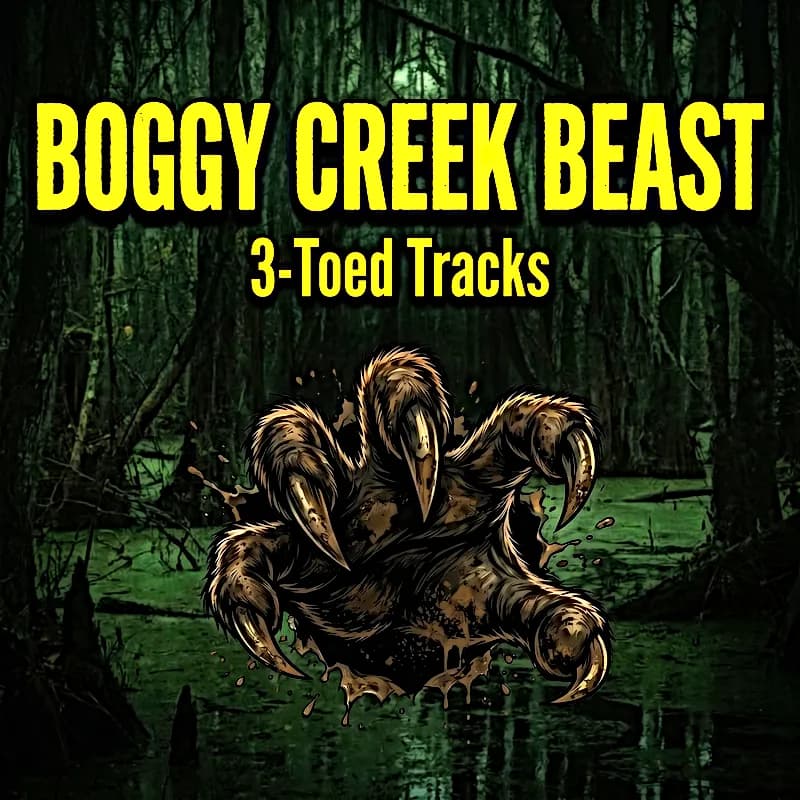
In the wake of the Ford incident, law enforcement officers and local investigators conducted searches of the property, uncovering several pieces of physical evidence that supported the family's claims of an intrusion [1]. These findings included deep claw scratches on the front porch and damage to the home's exterior, specifically the siding and a window [4]. Perhaps the most controversial evidence was the discovery of three-toed footprints near the house [1]. These tracks were estimated to be roughly 13.5 inches long and 4.5 inches wide [5]. The presence of only three toes was a significant anomaly that challenged standard biological classifications, as primates and known hominids possess five toes [4].
The investigation into the tracks extended beyond the Ford property [4]. In mid-June 1971, a farmer named Scott Keith discovered similar three-toed footprints in his soybean field near Boggy Creek [4]. These prints stretched for approximately 150 yards and indicated a creature with a stride of 57 inches [8]. Game warden Carl Galyon scrutinized these tracks but was unable to verify their authenticity definitively [4]. The environmental impact also included broken tree limbs in the nearby woods, suggesting that a large, heavy animal had moved through the brush with considerable force [5].
| Biological/Physical Feature | Observed/Reported Characteristic |
|---|---|
| Height | 7.0 to 8.0 feet [9] |
| Weight | 250 to 300 lbs (initial); 800 lbs (later) [4] |
| Eye Color | Luminescent Red [7] |
| Odor | Skunk/Wet Dog mixture [7] |
| Dactylology | Three toes per foot [1] |
| Footprint Dimensions | 13.5 in × 4.5 in [5] |
The scientific community's response was characterized by profound skepticism, most notably represented by Frank Schambach, an archaeologist at Southern State College (now Southern Arkansas University) [4]. In June 1971, Schambach was invited to investigate the three-toed footprints found in a stand of trees [2]. After a thorough review, Schambach stated he was 99 percent certain the tracks were a hoax [2]. His conclusion was based on several biological and ecological factors [4]. First, he pointed out that no known primates possess three toes; such a morphology is more consistent with certain avian species or deliberate human artifice [4]. Second, he noted that the Fouke Monster was reported to be nocturnal, whereas all known apes are strictly diurnal [4]. Finally, he argued that the region lacked any historical evidence of indigenous primate activity that could support the existence of a remnant species [4]. Despite this scientific dismissal, the sightings continued, and the "three-toed" characteristic became a permanent fixture of the Fouke Monster's lore [4].
Administrative and Law Enforcement Management: The Leslie Greer Era
The surge of sightings in 1971 created a logistical and public safety nightmare for Miller County officials [7]. The news of the Ford attack, disseminated by the Texarkana Gazette and wire services like the Associated Press and United Press International, drew thousands of tourists, amateur monster hunters, and journalists to the area [1]. Miller County Sheriff Leslie Greer found himself managing a "monster frenzy" that threatened to escalate into violence [7]. To prevent accidental shootings or injuries among the influx of armed enthusiasts, Greer implemented a temporary "no guns" policy and threatened to arrest anyone trespassing on private property [4]. Local farmers were particularly vocal about the damage caused to their crops and fences by trespassers searching for the creature [2].
The sheriff's department also had to contend with fraudulent reports [4]. On June 28, 1971, three men—L.H. Harvin, Floyd Thomas, and Robert B. Williams—were each fined $59 for filing a fraudulent monster report [2]. Sheriff Greer became suspicious of their claims when he observed blood under their fingernails, suggesting they had manually created the "claw marks" they were reporting as evidence of an attack [2]. This legal action, totaling $177 in fines, served as a deterrent and marked a turning point where law enforcement began to take a harder stance against the hysteria [2]. By 1986, Greer would publicly state his belief that many of the reported tracks were man-made hoaxes, though he acknowledged that many of the original witnesses were "respectable and responsible folks" [4].
| Law Enforcement Metric | Data Point and Result |
|---|---|
| Sheriff in Office (1971) | Leslie Greer [7] |
| Fraudulent Report Fine | $59.00 per individual [2] |
| Indicted Hoaxers | Harvin, Thomas, and Williams [2] |
| Safety Mandates | Temporary "No Guns" policy [4] |
| Bounty Presence | $1,090 from KAAY Radio [10] |
| Search Success Rate | 0% (No blood or tissue recovered) [1] |
The transition of the Fouke Monster from a local rumor to a national icon was largely driven by the reporting of Jim Powell of the Texarkana Gazette and Dave Hall, the news director of radio station KTFS [1]. Powell's articles were the first to use the name "Fouke Monster," a title that was quickly adopted by national wire services [1]. This media saturation caught the attention of Charles B. Pierce, an advertising man from Texarkana who recognized the cinematic potential of the story [8].
The Cinematic Metamorphosis: Charles B. Pierce and the Docudrama Revolution
In 1972, Charles B. Pierce directed and produced The Legend of Boggy Creek, a docudrama horror film that would become a landmark in independent cinema [11]. Pierce secured initial funding of approximately $100,000 to $160,000 from a local trucking company owner, L.W. Ledwell, and utilized local high school students and residents as his cast and crew [12]. The film was shot using 35mm cameras and employed a "pseudo-documentary" style that blended voice-over narration with re-enactments of real encounters [8].
The Legend of Boggy Creek was notable for its use of actual Fouke residents to portray themselves or their neighbors in re-enactments [13]. Over 60 locals participated, providing a level of verisimilitude and authenticity that traditional Hollywood productions lacked [8]. Pierce focused on atmosphere, utilizing long lenses and shallow depth of field to keep the creature shaggy and mysterious, often appearing only as a faceless shadow loping through the trees [13]. This choice was partly born of a limited budget, which necessitated a customized gorilla suit augmented with black-haired wigs to create the creature's silhouette [8].
| Cinematic Feature | Description and Technical Data |
|---|---|
| Primary Genre | Docudrama / Pseudo-documentary [11] |
| Film Budget | $160,000 (approximate) [11] |
| Box Office Gross | $20,000,000 to $25,000,000 [11] |
| Director | Charles B. Pierce [11] |
| Primary Narrator | Vern Stierman [13] |
| Key Local Cast | Smokey Crabtree, Willie E. Smith [8] |
| Distribution Strategy | "Four-walling" (renting theaters directly) [14] |
The film’s incredible ROI is one of the highest in cinematic history [11]. Despite its "shoestring" budget, the film became the 11th highest-grossing film of 1972 [4]. This financial success was facilitated by "four-walling," a practice where the distributor rents a theater and keeps all the box office receipts, which Pierce used effectively during the initial release [14]. Pierce eventually sold a 50 percent interest in the film to Howco International for $1.29 million, and later struck a deal with American International Pictures for worldwide distribution [12].
Economic Metamorphosis: The Monster Mart and Crypto-Tourism
The success of the film and the lingering notoriety of the 1971 sightings provided a unique economic opportunity for the town of Fouke, though the community's reaction was initially mixed [15]. Mayor J. D. Larey noted in 1973 that the town had not immediately capitalized on the phenomenon, lamenting the lack of souvenir shops in the early years [2]. However, the Monster Mart eventually emerged as a hub for monster-related tourism [16]. Established in the early 1980s by Denny and Brenda Roberts, the Monster Mart evolved from a simple restaurant into a combination convenience store, museum, and gift shop [17].
The economic footprint of crypto-tourism in Fouke is significant [18]. The Monster Mart has hosted visitors from all 50 U.S. states and at least 29 countries [17]. The store sells monster-themed apparel, "swamp water" souvenirs, and local food items, with sales of Boggy Creek memorabilia tripling in 2021 alone [17]. For the residents of Fouke, the monster has transitioned from a source of genuine fear to a core part of the town's identity and a primary driver of its service economy [18].
| Tourism Variable | Impact and Statistical Data |
|---|---|
| Economic Sector | Cryptozoology Tourism [18] |
| Global Reach | 50 States, 29 Countries [17] |
| Store Branding | Large murals, life-size monster statues [17] |
| Specific Souvenirs | "Swamp Water," 40+ t-shirt styles, pickled goods [17] |
| Recent Growth | 20% increase in food sales; 300% increase in merch (2021) [17] |
| New Ownership | Shane Fondren (recent acquisition) [16] |
The Monster Mart serves as an unofficial headquarters for the legend, housing newspaper clippings, plaster casts of footprints, and other memorabilia [18]. Longtime Mayor Terry Purvis recently endorsed this development, stating that the cryptid's fame is "great for tourism" [15]. This symbiotic relationship between a local mystery and economic growth has transformed Fouke into a mandatory stop for enthusiasts of the unknown [18].
Cultural Legacy and Found Footage Influence
The Fouke Monster's most enduring contribution to popular culture lies in the cinematic DNA of The Legend of Boggy Creek [4]. The film's found footage precursors and its innovative use of re-enactments paved the way for future horror classics [19]. Daniel Myrick, co-director of The Blair Witch Project (1999), explicitly cited Pierce's film as a primary influence on his work [11]. The "bare-bones" production values and the blurred lines between reality and fiction in Boggy Creek created an air of authenticity that many modern filmmakers seek to replicate [20].
Furthermore, the film articulates a specific type of folk horror that emphasizes the psychological impact of isolation and the "lonely monster" trope [21]. The narrator of the film speculates that the creature is the last of its kind, driven to aggression by the encroachment of civilization and the absence of its own species [13]. This environmental and psychological depth elevated the Fouke Monster beyond a mere "monster of the week" and into a figure of tragic regional mythology [8].
| Cultural Influence Variable | Detail and Cinematic Legacy |
|---|---|
| Seminal Genre Influence | Found Footage horror [11] |
| Direct Descendant Film | The Blair Witch Project [11] |
| Thematic Core | Psychological folk horror, isolation, man vs. nature [22] |
| Restoration Date | 4K remaster released in 2019 [19] |
| Sequel Production | Return to Boggy Creek (1977), Boggy Creek II (1984) [11] |
Synthesis of 1971 Sightings and Historical Context
While the peak of the Fouke Monster sightings occurred between 1971 and 1974, reports have surfaced sporadically in the decades since [4]. In 1991, the creature was allegedly seen jumping from a bridge, and sightings were reported over 40 times in 1997 alone [9]. Despite the absence of definitive scientific proof, the cultural infrastructure—including the Monster Mart, the Perot Theatre's 2019 restoration screening, and the "Fouke Monster Festival"—ensures that the legend remains vibrant in the 21st century [15].
The Fouke Monster serves as a pivotal case study in the intersection of rural folklore, forensic investigation, and mass media exploitation [23]. The siege on the Ford home remains one of the most vivid and well-documented episodes in American cryptozoology, providing a detailed physical and behavioral profile of a creature that defied conventional biological explanation [23]. While the scientific community, led by figures such as Frank Schambach, dismissed the physical evidence as elaborate hoaxes, the sociological impact on Miller County was undeniable [2]. From the emergency measures taken by Sheriff Leslie Greer to the global commercial success of Charles B. Pierce's docudrama, the phenomenon transformed a local fear into an international attraction [1]. Today, the legend persists not merely as a question of biological fact, but as a robust cultural legacy that continues to define the identity and economy of Fouke, Arkansas [18]. The three-toed tracks may remain a point of skepticism for primatologists, but they have left an indelible mark on the landscape of American legend and the history of independent horror cinema [4].
Conclusion: Final Evaluative Summary
The investigation into the 1971 encounters reveals a multi-layered phenomenon where local trauma was rapidly subsumed into a larger media narrative [7]. The Ford siege represents a rare instance where a purported cryptid encounter resulted in documented hospital treatment for physical injuries, providing a layer of material reality often absent in such tales [6]. The law enforcement response, characterized by the use of $59 fines for hoaxing and the imposition of a "no guns" policy, highlights the real-world consequences of cryptozoological hysteria on civil order [2]. Finally, the cinematic legacy of The Legend of Boggy Creek ensures that the Fouke Monster will remain a fixture of American folk horror, bridging the gap between the rural oral traditions of the 19th century and the digital folklore of the 21st [11].
Sources
- Fouke Monster - Encyclopedia of Arkansas, Link
- The Fouke Monster, Link
- Legend of the Fouke Monster in Arkansas, Link
- Fouke Monster - Wikipedia, Link
- Arkansas Backstories: Fouke Monster - AY Magazine, Link
- Fouke Monster | It's Something Wiki, Link
- The Strange Tale of the Fouke Monster : r/UnresolvedMysteries - Reddit, Link
- THE LEGEND OF BOGGY CREEK: A 50th Anniversary Appreciation ..., Link
- Boggy Creek Monster in Fouke | Atlas Obscura, Link
- Bigfoot , missing link, bear or hoax? What exactly plague a small town nearly 50+ years ago in Arkansas? - Reddit, Link
- The Legend of Boggy Creek - Wikipedia, Link
- Charles B. Pierce - Wikipedia, Link
- The Legend of Boggy Creek (1972) | REVIEW ALL MONSTERS - WordPress.com, Link
- August 2015 - Classic Film and TV Café, Link
- 50 years later: The legend and mystery of the Fouke Monster - thv11.com, Link
- Monster Mart, Indoor Point of Interest in Fouke - ZuzuForKids, Link
- A Monster Store | NACS Magazine, Link
- Discover the Best Cryptozoology Tourism Locations for Adventurous Travelers, Link
- 02/17/20 - Cool Ass Cinema, Link
- I Was Seven When I First Heard Him Scream… (Part 1) - Miracle Movies, Link
- The Blair Witch Project - Wikipedia, Link
- Blair Witch Project (Film) - Overview | StudyGuides.com, Link
- Fouke Monster: Aggressive Arkansas Hominid - Beasts of Legend, Link