Municipal Governance and Cryptozoology: A Comprehensive Analysis of the 1991-1992 Whatcom County Sasquatch Protection Resolution
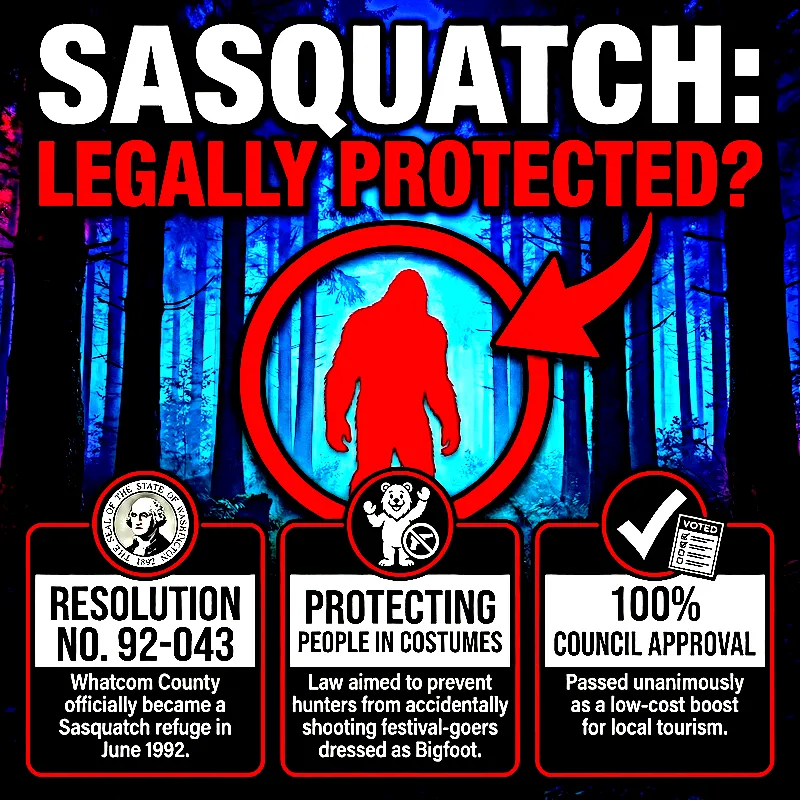
This comprehensive analysis explores the 1992 legislative decision to establish Whatcom County as a Sasquatch protection and refuge area through Resolution No. 92-043. Driven by the Mt. Baker Foothills Chamber of Commerce, the initiative was primarily a tourism strategy designed to support local festivals and provide a "low-stakes" political victory during a time of economic transition and heated environmental debate. Beyond marketing, the text highlights how the resolution served as a public safety measure to protect people in costumes from hunters and acted as a symbolic nod to the regional cultural heritage and indigenous folklore of the Pacific Northwest. Ultimately, the author frames this unanimous council vote as a sophisticated act of municipal governance that balanced economic pragmatism with the preservation of local legend without requiring significant taxpayer resources.
Case Snapshot
Subject
Whatcom County Res. 92-043
Source Entries
16
Key Advocate
Al Magnussen (Mt. Baker Chamber)
Vote
Unanimous (7-0)
Council Chair
Margaret A. Laidlaw
County Exec
Shirley Van Zanten
Evidence Distribution
Section Headings
10
Markdown Tables
4
Unique Citations
16
Inline References
62
Core Timeline Anchors
| Date | Milestone |
|---|---|
| 1969 | Skamania County passes Ordinance No. 6901 (felony for killing Sasquatch) |
| June 11, 1991 | Al Magnussen addresses Whatcom Council to ban Bigfoot hunting |
| July 2, 1991 | Council approves Natural Heritage Plan (Res. 91-044) |
| June 9, 1992 | Resolution 92-043 adopted unanimously |
| 2003 | Bigfoot at Baker Fest fades from annual calendar |
| 2022 | Grays Harbor County passes similar resolution |
Introduction
The intersection of local legislative action and North American folklore reached a definitive zenith in the early 1990s within the jurisdictional boundaries of Whatcom County, Washington. While often relegated to the peripheries of regional trivia, the formal declaration of the county as a Sasquatch protection and refuge area via Resolution No. 92-043 represents a sophisticated synthesis of rural economic repositioning, public safety management, and the symbolic appropriation of cultural heritage. This report provides an exhaustive investigation into the events of June 1991 through June 1992, identifying the specific political actors, the socio-economic motivations, and the broader legislative context that facilitated the unanimous passage of one of the most distinctive municipal resolutions in the history of the Pacific Northwest.
The Socio-Economic Landscape of Whatcom County (1991–1992)
To understand the emergence of Sasquatch-specific legislation in 1991, it is necessary to examine the prevailing economic climate of Whatcom County during this period. The early 1990s were marked by a profound transition in the rural economy of the Pacific Northwest, characterized by the decline of the traditional timber industry and a burgeoning interest in environmental preservation and tourism-driven revitalization.
Whatcom County, encompassing approximately 2,500 square miles and stretching from the Salish Sea to the crest of the North Cascades, was grappling with significant land-use conflicts.[1]Bigfoot Is Legally Protected in These 2 Washington State Counties https://keyw.com/bigfoot-is-legally-protected-in-these-2-washington-state-counties/, [2]Sasquatch and the Law: The Implications of Bigfoot Preservation Laws in Washington State - UMass Boston ScholarWorks https://scholarworks.umb.edu/cgi/viewcontent.cgi?article=1079&context=ghc The rural communities of the Mt. Baker foothills, such as Maple Falls, Glacier, and Deming, were particularly vulnerable to the economic shifts resulting from federal and state environmental regulations, including the "spotted owl" controversy which restricted logging in old-growth forests.[2]Sasquatch and the Law: The Implications of Bigfoot Preservation Laws in Washington State - UMass Boston ScholarWorks https://scholarworks.umb.edu/cgi/viewcontent.cgi?article=1079&context=ghc, [3]Special Council June 1 1992 - Whatcom County https://documents.whatcomcounty.us/WebLink/DocView.aspx?id=3348845&dbid=0&repo=WC It was within this climate of economic uncertainty that local business leaders began seeking innovative, if unconventional, methods to stimulate the regional economy and define the county's unique "Natural Heritage."[2]Sasquatch and the Law: The Implications of Bigfoot Preservation Laws in Washington State - UMass Boston ScholarWorks https://scholarworks.umb.edu/cgi/viewcontent.cgi?article=1079&context=ghc, [4]Natural Heritage Plan | Whatcom County, WA - Official Website https://www.whatcomcounty.us/2379/Natural-Heritage-Plan
The 1991 Natural Heritage Plan
In 1991, the Whatcom County Council was already actively engaged in formalizing the county's commitment to conservation. At the encouragement of local citizens, the Council requested that the County Executive form a citizen group to explore strategies for the preservation of the region's natural legacy.[4]Natural Heritage Plan | Whatcom County, WA - Official Website https://www.whatcomcounty.us/2379/Natural-Heritage-Plan This resulted in the formation of the Whatcom County Natural Heritage Task Force. On July 2, 1991, the Council approved Resolution No. 91-044, titled "A Resolution in the Matter of Endorsing The Natural Heritage Plan and Goals of Whatcom County."[4]Natural Heritage Plan | Whatcom County, WA - Official Website https://www.whatcomcounty.us/2379/Natural-Heritage-Plan This plan, subtitled "Preserving a Way of Life," provided the intellectual and political framework for subsequent conservation efforts, including the symbolic protection of legendary creatures.[4]Natural Heritage Plan | Whatcom County, WA - Official Website https://www.whatcomcounty.us/2379/Natural-Heritage-Plan
Legislative Catalyst: The Presentation of Al Magnussen
The formal process of Sasquatch protection began not as a top-down initiative from the Council, but as a specific grassroots request from the business community. On June 11, 1991, Al Magnussen, serving as the Vice President of the Mt. Baker Foothills Chamber of Commerce, appeared before the Whatcom County Council during an open session.[2]Sasquatch and the Law: The Implications of Bigfoot Preservation Laws in Washington State - UMass Boston ScholarWorks https://scholarworks.umb.edu/cgi/viewcontent.cgi?article=1079&context=ghc, [5]County Council June 11 1991 - Whatcom County https://documents.whatcomcounty.us/WebLink/DocView.aspx?id=3349019&dbid=0&repo=WC
Magnussen's appearance was strategically timed to align with the creation of the inaugural Mount Baker Foothills Bigfoot Festival (also referred to as "Bigfoot at Baker Fest") in Maple Falls.[2]Sasquatch and the Law: The Implications of Bigfoot Preservation Laws in Washington State - UMass Boston ScholarWorks https://scholarworks.umb.edu/cgi/viewcontent.cgi?article=1079&context=ghc His presentation to the Council was designed to provide a legal and symbolic anchor for this new tourism initiative. According to the official minutes of the June 11, 1991 meeting, Magnussen's primary request was for the Council to "ban Big Foot hunting."[5]County Council June 11 1991 - Whatcom County https://documents.whatcomcounty.us/WebLink/DocView.aspx?id=3349019&dbid=0&repo=WC
The Argument for Public Safety
A critical, yet often overlooked, component of Magnussen's advocacy was the concern for human safety. He explicitly informed the Council that the Chamber feared for the safety of individuals who might dress as Sasquatch during the upcoming festival.[5]County Council June 11 1991 - Whatcom County https://documents.whatcomcounty.us/WebLink/DocView.aspx?id=3349019&dbid=0&repo=WC The logic was pragmatic: in a region where hunting is a common recreational activity, an influx of "Bigfoot hunters" or "scientific investigators" armed with lethal weapons could lead to a tragic case of mistaken identity.[2]Sasquatch and the Law: The Implications of Bigfoot Preservation Laws in Washington State - UMass Boston ScholarWorks https://scholarworks.umb.edu/cgi/viewcontent.cgi?article=1079&context=ghc, [5]County Council June 11 1991 - Whatcom County https://documents.whatcomcounty.us/WebLink/DocView.aspx?id=3349019&dbid=0&repo=WC By declaring the county a refuge, the Council would effectively discourage the discharge of firearms in pursuit of the creature, thereby protecting both the "legend" and the human participants in the festival.[2]Sasquatch and the Law: The Implications of Bigfoot Preservation Laws in Washington State - UMass Boston ScholarWorks https://scholarworks.umb.edu/cgi/viewcontent.cgi?article=1079&context=ghc, [7]Sasquatch in BC Law - Courthouse Libraries BC https://www.courthouselibrary.ca/how-we-can-help/our-legal-knowledge-base/sasquatch-bc-law
To support his request, Magnussen provided the Council with a petition from local citizens and a copy of a resolution from another county—likely Skamania County, which had enacted similar legislation in 1969—to serve as a legislative model.[2]Sasquatch and the Law: The Implications of Bigfoot Preservation Laws in Washington State - UMass Boston ScholarWorks https://scholarworks.umb.edu/cgi/viewcontent.cgi?article=1079&context=ghc, [5]County Council June 11 1991 - Whatcom County https://documents.whatcomcounty.us/WebLink/DocView.aspx?id=3349019&dbid=0&repo=WC, [8]Today's theme is Bigfoot - SteveCarroll.net https://www.stevecarroll.net/weird-but-true/todays-theme-bigfoot/
The 1992 Council and the Passage of Resolution 92-043
While the initial request was made in June 1991, the administrative machinery of the county required nearly a year to formalize the resolution. On June 9, 1992, the Whatcom County Council officially adopted Resolution No. 92-043, titled "Resolution declaring Whatcom County a Sasquatch Protection and Refuge area."[9]res1992-043 - Whatcom County http://documents.whatcomcounty.us/WebLink8/0/doc/3276411/Page1.aspx
The resolution was assigned administrative number AB1992-247 and was passed unanimously by the seven-member council.[6]What's the Deal With: Whatcom County's Sasquatch protection and refuge area? https://www.cascadiadaily.com/2025/may/18/whats-the-deal-with-whatcom-countys-sasquatch-protection-and-refuge-area/, [9]res1992-043 - Whatcom County http://documents.whatcomcounty.us/WebLink8/0/doc/3276411/Page1.aspx This unanimity suggests that the resolution was viewed as a "low-stakes" political win that satisfied the rural business community without alienating urban constituents or requiring significant budget expenditures.[2]Sasquatch and the Law: The Implications of Bigfoot Preservation Laws in Washington State - UMass Boston ScholarWorks https://scholarworks.umb.edu/cgi/viewcontent.cgi?article=1079&context=ghc, [6]What's the Deal With: Whatcom County's Sasquatch protection and refuge area? https://www.cascadiadaily.com/2025/may/18/whats-the-deal-with-whatcom-countys-sasquatch-protection-and-refuge-area/
The 1992 Whatcom County Council Roster
The executive leadership during this transition period was provided by Shirley Van Zanten, who served as the Whatcom County Executive from 1988 through 1992.[10]Historical County Council Photos: 1979 - 1999 https://www.whatcomcounty.us/3127/Historical-Council-Photos, [11]Previous Whatcom County Commissioners and Councilmembers https://www.whatcomcounty.us/4366/Previous-Commissioners-and-Councilmember Van Zanten was instrumental in the creation of the Natural Heritage Task Force, which provided the cultural context for the Sasquatch resolution.[4]Natural Heritage Plan | Whatcom County, WA - Official Website https://www.whatcomcounty.us/2379/Natural-Heritage-Plan
Analysis of Resolution No. 92-043 Text
The text of Resolution 92-043 was carefully crafted to balance the acknowledgement of Sasquatch as a legendary figure with the formal language of environmental protection. The resolution states:
"WHEREAS, legend, purported recent finding and spoor suggest that Bigfoot may exist; and WHEREAS, if such a creature exists, it is inadequately...source said status."[2]Sasquatch and the Law: The Implications of Bigfoot Preservation Laws in Washington State - UMass Boston ScholarWorks https://scholarworks.umb.edu/cgi/viewcontent.cgi?article=1079&context=ghc, [6]What's the Deal With: Whatcom County's Sasquatch protection and refuge area? https://www.cascadiadaily.com/2025/may/18/whats-the-deal-with-whatcom-countys-sasquatch-protection-and-refuge-area/
Legal Interpretation and Scope
The resolution is notable for what it does not do. Unlike the Skamania County Ordinance No. 6901 (passed in 1969 and amended in 1984), which established specific criminal penalties for killing a Sasquatch—including fines up to $10,000 and jail time—the Whatcom resolution is non-binding and non-punitive.[1]Bigfoot Is Legally Protected in These 2 Washington State Counties https://keyw.com/bigfoot-is-legally-protected-in-these-2-washington-state-counties/, [2]Sasquatch and the Law: The Implications of Bigfoot Preservation Laws in Washington State - UMass Boston ScholarWorks https://scholarworks.umb.edu/cgi/viewcontent.cgi?article=1079&context=ghc, [8]Today's theme is Bigfoot - SteveCarroll.net https://www.stevecarroll.net/weird-but-true/todays-theme-bigfoot/ It functions as a policy statement rather than a criminal statute.[2]Sasquatch and the Law: The Implications of Bigfoot Preservation Laws in Washington State - UMass Boston ScholarWorks https://scholarworks.umb.edu/cgi/viewcontent.cgi?article=1079&context=ghc
The decision to frame the action as a "resolution" rather than an "ordinance" was a strategic choice. A resolution allows the Council to express a formal opinion or policy without the complex legal hurdles and enforcement requirements of an ordinance.[2]Sasquatch and the Law: The Implications of Bigfoot Preservation Laws in Washington State - UMass Boston ScholarWorks https://scholarworks.umb.edu/cgi/viewcontent.cgi?article=1079&context=ghc, [6]What's the Deal With: Whatcom County's Sasquatch protection and refuge area? https://www.cascadiadaily.com/2025/may/18/whats-the-deal-with-whatcom-countys-sasquatch-protection-and-refuge-area/ This approach satisfied the Chamber of Commerce's desire for a "protection area" while avoiding the jurisdictional absurdity of charging an individual with the murder of an unproven species.[2]Sasquatch and the Law: The Implications of Bigfoot Preservation Laws in Washington State - UMass Boston ScholarWorks https://scholarworks.umb.edu/cgi/viewcontent.cgi?article=1079&context=ghc, [7]Sasquatch in BC Law - Courthouse Libraries BC https://www.courthouselibrary.ca/how-we-can-help/our-legal-knowledge-base/sasquatch-bc-law
Political Motivations: Tourism vs. Conservation vs. Heritage
The investigation into the 1991–1992 proceedings reveals that the resolution was driven by a triad of motivations, with tourism strategy being the primary catalyst.
The Tourism Strategy
The Mt. Baker Foothills Chamber of Commerce viewed the Sasquatch as a "unique selling proposition" for the North Cascades.[2]Sasquatch and the Law: The Implications of Bigfoot Preservation Laws in Washington State - UMass Boston ScholarWorks https://scholarworks.umb.edu/cgi/viewcontent.cgi?article=1079&context=ghc The 1991 "Bigfoot at Baker Fest" featured thematic events, petroglyph-inspired merchandise, and guided hikes designed to attract urban visitors from Bellingham, Seattle, and Vancouver, B.C..[2]Sasquatch and the Law: The Implications of Bigfoot Preservation Laws in Washington State - UMass Boston ScholarWorks https://scholarworks.umb.edu/cgi/viewcontent.cgi?article=1079&context=ghc, [13]BIGFOOT SLIPPERS W/ SOUND vintage novelty sasquatch yeti cryptid 1989 80s RARE https://www.ebay.com/itm/205487804209 The passage of the resolution provided the festival with "official" status, allowing organizers to market the county as the only "sanctuary" for the creature in the northern part of the state.[2]Sasquatch and the Law: The Implications of Bigfoot Preservation Laws in Washington State - UMass Boston ScholarWorks https://scholarworks.umb.edu/cgi/viewcontent.cgi?article=1079&context=ghc
Cultural Heritage and Native American Influence
The resolution also served as a recognition of the region's cultural heritage. The Lummi Nation, whose ancestral lands include Whatcom County, has a long history of Sasquatch sightings and oral traditions.[6]What's the Deal With: Whatcom County's Sasquatch protection and refuge area? https://www.cascadiadaily.com/2025/may/18/whats-the-deal-with-whatcom-countys-sasquatch-protection-and-refuge-area/ In the 1970s, the Lummi reservation reported over 100 sightings, several of which were made by tribal police officers.[6]What's the Deal With: Whatcom County's Sasquatch protection and refuge area? https://www.cascadiadaily.com/2025/may/18/whats-the-deal-with-whatcom-countys-sasquatch-protection-and-refuge-area/, [14]Whatcom County, Washington -- Reports & Articles - BFRO https://www.bfro.net/GDB/show_county_reports.asp?state=wa&county=Whatcom By acknowledging the "legend" in the resolution's preamble, the Council was indirectly validating a component of local indigenous and pioneer folklore that had been part of the region's identity for generations.[1]Bigfoot Is Legally Protected in These 2 Washington State Counties https://keyw.com/bigfoot-is-legally-protected-in-these-2-washington-state-counties/, [6]What's the Deal With: Whatcom County's Sasquatch protection and refuge area? https://www.cascadiadaily.com/2025/may/18/whats-the-deal-with-whatcom-countys-sasquatch-protection-and-refuge-area/, [13]BIGFOOT SLIPPERS W/ SOUND vintage novelty sasquatch yeti cryptid 1989 80s RARE https://www.ebay.com/itm/205487804209
Genuine Conservation Framing
While the scientific existence of Sasquatch remained unproven, the resolution was framed within the language of genuine conservation. By using terms like "inadequately protected" and "endangered," the Council aligned the Sasquatch resolution with the broader environmentalist zeitgeist of the early 1990s.[2]Sasquatch and the Law: The Implications of Bigfoot Preservation Laws in Washington State - UMass Boston ScholarWorks https://scholarworks.umb.edu/cgi/viewcontent.cgi?article=1079&context=ghc, [15]What Washington County Made it Illegal to Hunt Bigfoot? - 610 KONA https://610kona.com/what-washington-county-made-it-illegal-to-hunt-bigfoot/ This framing allowed the Council to appear proactive on conservation issues without imposing the restrictive land-use regulations that typically accompanied the protection of recognized endangered species like the spotted owl.[2]Sasquatch and the Law: The Implications of Bigfoot Preservation Laws in Washington State - UMass Boston ScholarWorks https://scholarworks.umb.edu/cgi/viewcontent.cgi?article=1079&context=ghc, [3]Special Council June 1 1992 - Whatcom County https://documents.whatcomcounty.us/WebLink/DocView.aspx?id=3348845&dbid=0&repo=WC
Recorded Pushback and Taxpayer Resource Allocation
The historical record indicates that the Sasquatch resolution encountered very little formal pushback from the public, largely because it was perceived as a "cost-free" gesture.
Taxpayer Resource Allocation: A Comparative Analysis
There is no evidence in the county records that any specific taxpayer funds were allocated for the enforcement of Resolution 92-043.[2]Sasquatch and the Law: The Implications of Bigfoot Preservation Laws in Washington State - UMass Boston ScholarWorks https://scholarworks.umb.edu/cgi/viewcontent.cgi?article=1079&context=ghc, [6]What's the Deal With: Whatcom County's Sasquatch protection and refuge area? https://www.cascadiadaily.com/2025/may/18/whats-the-deal-with-whatcom-countys-sasquatch-protection-and-refuge-area/ Because it was a resolution and not an ordinance, there was no need for:
- Specialized law enforcement patrols.
- Administrative oversight for Sasquatch-related claims.
- Scientific research funding.
The Sasquatch resolution essentially served as a "political relief valve," providing the Council with a unanimous, popular environmental action during a time when their other environmental policies were causing deep divisions within the community.[2]Sasquatch and the Law: The Implications of Bigfoot Preservation Laws in Washington State - UMass Boston ScholarWorks https://scholarworks.umb.edu/cgi/viewcontent.cgi?article=1079&context=ghc, [3]Special Council June 1 1992 - Whatcom County https://documents.whatcomcounty.us/WebLink/DocView.aspx?id=3348845&dbid=0&repo=WC
Comparison with Regional Crypto-Legislation
Whatcom County's action in 1992 must be viewed as part of a larger regional trend in the Pacific Northwest where municipal governments have granted legal or symbolic status to cryptids.
Skamania County (1969 and 1984)
The pioneer in this field was Skamania County, located in the southern part of Washington. In April 1969, the Skamania Board of Commissioners passed Ordinance No. 6901.[2]Sasquatch and the Law: The Implications of Bigfoot Preservation Laws in Washington State - UMass Boston ScholarWorks https://scholarworks.umb.edu/cgi/viewcontent.cgi?article=1079&context=ghc, [8]Today's theme is Bigfoot - SteveCarroll.net https://www.stevecarroll.net/weird-but-true/todays-theme-bigfoot/ This law was enacted in response to a surge in sightings and an influx of armed hunters.[2]Sasquatch and the Law: The Implications of Bigfoot Preservation Laws in Washington State - UMass Boston ScholarWorks https://scholarworks.umb.edu/cgi/viewcontent.cgi?article=1079&context=ghc
The Skamania law was significantly more severe than Whatcom's resolution:
- Original 1969 Version: Deemed the slaying of a Sasquatch a felony, punishable by up to 5 years in prison and a $10,000 fine.[2]Sasquatch and the Law: The Implications of Bigfoot Preservation Laws in Washington State - UMass Boston ScholarWorks https://scholarworks.umb.edu/cgi/viewcontent.cgi?article=1079&context=ghc, [8]Today's theme is Bigfoot - SteveCarroll.net https://www.stevecarroll.net/weird-but-true/todays-theme-bigfoot/
- 1984 Amended Version: Reduced the crime to a misdemeanor (following concerns about jurisdictional authority over felonies) but officially declared the creature an "endangered species" and created a "Sasquatch Refuge" covering the entire county.[2]Sasquatch and the Law: The Implications of Bigfoot Preservation Laws in Washington State - UMass Boston ScholarWorks https://scholarworks.umb.edu/cgi/viewcontent.cgi?article=1079&context=ghc, [7]Sasquatch in BC Law - Courthouse Libraries BC https://www.courthouselibrary.ca/how-we-can-help/our-legal-knowledge-base/sasquatch-bc-law, [8]Today's theme is Bigfoot - SteveCarroll.net https://www.stevecarroll.net/weird-but-true/todays-theme-bigfoot/
Other Washington Jurisdictions
Following Whatcom County's 1992 resolution, several other Washington jurisdictions have taken similar steps:
- State Level (2017): State Senator Ann Rivers sponsored SB 5816 to recognize Sasquatch as the official state cryptid. While the bill did not pass, it demonstrated the continued political utility of the legend.[15]What Washington County Made it Illegal to Hunt Bigfoot? - 610 KONA https://610kona.com/what-washington-county-made-it-illegal-to-hunt-bigfoot/
- Grays Harbor County (2022): Adopted a resolution declaring a Sasquatch protection and refuge area, modeled directly after the Whatcom and Skamania examples.[6]What's the Deal With: Whatcom County's Sasquatch protection and refuge area? https://www.cascadiadaily.com/2025/may/18/whats-the-deal-with-whatcom-countys-sasquatch-protection-and-refuge-area/
- Mason County (2024): Passed a similar resolution following a lobbying campaign by a fifth-grade class, focusing on the educational and civic engagement aspects of the legend.[16]Fifth graders three-peat on Sasquatch protections - The Daily World https://www.thedailyworld.com/2024/05/07/fifth-graders-three-peat-on-sasquatch-protections/
The Role of Media and Pop Culture in 1991
The political willingness to pass the resolution was undoubtedly influenced by the cultural zeitgeist of the early 1990s. The film Harry and the Hendersons (1987), which was set in the Seattle area and the North Cascades, had successfully "rehabilitated" the image of Sasquatch from a terrifying monster to a gentle, misunderstood giant in need of protection.[2]Sasquatch and the Law: The Implications of Bigfoot Preservation Laws in Washington State - UMass Boston ScholarWorks https://scholarworks.umb.edu/cgi/viewcontent.cgi?article=1079&context=ghc
The subsequent television spin-off of Harry and the Hendersons aired from 1991 to 1993, coinciding exactly with the period of the Whatcom resolution's proposal and passage.[2]Sasquatch and the Law: The Implications of Bigfoot Preservation Laws in Washington State - UMass Boston ScholarWorks https://scholarworks.umb.edu/cgi/viewcontent.cgi?article=1079&context=ghc This cultural shift made the idea of a "protection and refuge area" socially palatable and even popular among the general public, further reducing the risk of political pushback for the Council.[2]Sasquatch and the Law: The Implications of Bigfoot Preservation Laws in Washington State - UMass Boston ScholarWorks https://scholarworks.umb.edu/cgi/viewcontent.cgi?article=1079&context=ghc
Conclusion: The Lasting Legacy of Resolution 92-043
Investigation into the June 1991–June 1992 Whatcom County Sasquatch Protection Resolution reveals a multifaceted legislative event. While the resolution was requested by Al Magnussen as a tourism strategy to support the Mount Baker Foothills Bigfoot Festival, its unanimous passage by the Whatcom County Council was facilitated by a broader convergence of political and social factors.
The resolution successfully:
- Ensured Public Safety: By formally requesting that citizens recognize the county as a refuge, it provided a symbolic deterrent against the reckless discharge of firearms by hunters in pursuit of the cryptid, thereby protecting hikers and festival participants.[2]Sasquatch and the Law: The Implications of Bigfoot Preservation Laws in Washington State - UMass Boston ScholarWorks https://scholarworks.umb.edu/cgi/viewcontent.cgi?article=1079&context=ghc, [5]County Council June 11 1991 - Whatcom County https://documents.whatcomcounty.us/WebLink/DocView.aspx?id=3349019&dbid=0&repo=WC
- Validated Cultural Heritage: It acknowledged the deep-seated oral traditions of the Lummi Nation and other regional inhabitants, integrating these legends into the county's "Natural Heritage."[4]Natural Heritage Plan | Whatcom County, WA - Official Website https://www.whatcomcounty.us/2379/Natural-Heritage-Plan, [6]What's the Deal With: Whatcom County's Sasquatch protection and refuge area? https://www.cascadiadaily.com/2025/may/18/whats-the-deal-with-whatcom-countys-sasquatch-protection-and-refuge-area/, [14]Whatcom County, Washington -- Reports & Articles - BFRO https://www.bfro.net/GDB/show_county_reports.asp?state=wa&county=Whatcom
- Provided Economic Revitalization: It offered the rural communities of the Mt. Baker foothills a unique identity and a sustainable tourism platform during a period of industrial decline.[2]Sasquatch and the Law: The Implications of Bigfoot Preservation Laws in Washington State - UMass Boston ScholarWorks https://scholarworks.umb.edu/cgi/viewcontent.cgi?article=1079&context=ghc, [6]What's the Deal With: Whatcom County's Sasquatch protection and refuge area? https://www.cascadiadaily.com/2025/may/18/whats-the-deal-with-whatcom-countys-sasquatch-protection-and-refuge-area/
- Achieved Political Consensus: In a time of heated debate over the Critical Areas Ordinance and property rights, the Sasquatch resolution served as a rare point of unanimous agreement, providing a "low-cost" environmental victory for the Council.[3]Special Council June 1 1992 - Whatcom County https://documents.whatcomcounty.us/WebLink/DocView.aspx?id=3348845&dbid=0&repo=WC, [6]What's the Deal With: Whatcom County's Sasquatch protection and refuge area? https://www.cascadiadaily.com/2025/may/18/whats-the-deal-with-whatcom-countys-sasquatch-protection-and-refuge-area/
To date, Resolution No. 92-043 remains on the books in Whatcom County. While the "Bigfoot at Baker Fest" eventually faded from the annual calendar around 2003, the legal status of the county as a sanctuary for the unseen remains a testament to the unique intersection of folklore, law, and economic pragmatism in the Pacific Northwest.[1]Bigfoot Is Legally Protected in These 2 Washington State Counties https://keyw.com/bigfoot-is-legally-protected-in-these-2-washington-state-counties/, [2]Sasquatch and the Law: The Implications of Bigfoot Preservation Laws in Washington State - UMass Boston ScholarWorks https://scholarworks.umb.edu/cgi/viewcontent.cgi?article=1079&context=ghc, [8]Today's theme is Bigfoot - SteveCarroll.net https://www.stevecarroll.net/weird-but-true/todays-theme-bigfoot/ Whatcom County continues to stand alongside Skamania, Grays Harbor, and Mason counties as a legally designated refuge for a creature that, should it exist, would find its only formal protection in the resolutions of local governments.[1]Bigfoot Is Legally Protected in These 2 Washington State Counties https://keyw.com/bigfoot-is-legally-protected-in-these-2-washington-state-counties/, [2]Sasquatch and the Law: The Implications of Bigfoot Preservation Laws in Washington State - UMass Boston ScholarWorks https://scholarworks.umb.edu/cgi/viewcontent.cgi?article=1079&context=ghc, [6]What's the Deal With: Whatcom County's Sasquatch protection and refuge area? https://www.cascadiadaily.com/2025/may/18/whats-the-deal-with-whatcom-countys-sasquatch-protection-and-refuge-area/
Sources
- Bigfoot Is Legally Protected in These 2 Washington State Counties, https://keyw.com/bigfoot-is-legally-protected-in-these-2-washington-state-counties/
- Sasquatch and the Law: The Implications of Bigfoot Preservation Laws in Washington State - UMass Boston ScholarWorks, https://scholarworks.umb.edu/cgi/viewcontent.cgi?article=1079&context=ghc
- Special Council June 1 1992 - Whatcom County, https://documents.whatcomcounty.us/WebLink/DocView.aspx?id=3348845&dbid=0&repo=WC
- Natural Heritage Plan | Whatcom County, WA - Official Website, https://www.whatcomcounty.us/2379/Natural-Heritage-Plan
- County Council June 11 1991 - Whatcom County, https://documents.whatcomcounty.us/WebLink/DocView.aspx?id=3349019&dbid=0&repo=WC
- What's the Deal With: Whatcom County's Sasquatch protection and refuge area?, https://www.cascadiadaily.com/2025/may/18/whats-the-deal-with-whatcom-countys-sasquatch-protection-and-refuge-area/
- Sasquatch in BC Law - Courthouse Libraries BC, https://www.courthouselibrary.ca/how-we-can-help/our-legal-knowledge-base/sasquatch-bc-law
- Today's theme is Bigfoot - SteveCarroll.net, https://www.stevecarroll.net/weird-but-true/todays-theme-bigfoot/
- res1992-043 - Whatcom County, http://documents.whatcomcounty.us/WebLink8/0/doc/3276411/Page1.aspx
- Historical County Council Photos: 1979 - 1999, https://www.whatcomcounty.us/3127/Historical-Council-Photos
- Previous Whatcom County Commissioners and Councilmembers, https://www.whatcomcounty.us/4366/Previous-Commissioners-and-Councilmember
- Historical County Council Photos | Whatcom County, WA - Official Website, https://www.whatcomcounty.us/3126/34167/Historical-Council-Photos
- BIGFOOT SLIPPERS W/ SOUND vintage novelty sasquatch yeti cryptid 1989 80s RARE, https://www.ebay.com/itm/205487804209
- Whatcom County, Washington -- Reports & Articles - BFRO, https://www.bfro.net/GDB/show_county_reports.asp?state=wa&county=Whatcom
- What Washington County Made it Illegal to Hunt Bigfoot? - 610 KONA, https://610kona.com/what-washington-county-made-it-illegal-to-hunt-bigfoot/
- Fifth graders three-peat on Sasquatch protections - The Daily World, https://www.thedailyworld.com/2024/05/07/fifth-graders-three-peat-on-sasquatch-protections/