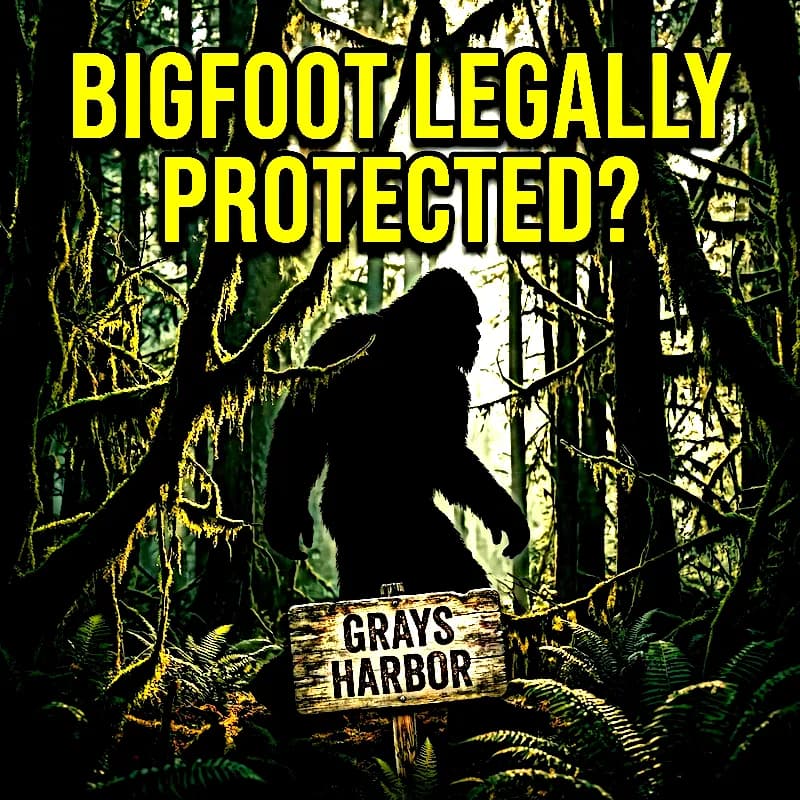
This report provides a comprehensive analysis of the 2022 Grays Harbor County Sasquatch Refuge Proclamation, examining how the resolution emerged from a successful fifth-grade civic action project at Robert Gray Elementary School and was unanimously adopted by the county commissioners. The resolution represents a convergence of pedagogical civics, regional folklore, and rural economic strategy, wherein a classroom exercise evolved into binding legislative language that designates the entire county as a Sasquatch protection and refuge area. The source traces the initiative from its inception in a social studies curriculum to the formal proclamation ceremony, while also contextualizing it within the broader legislative history of cryptid protection in Washington State and the rich tradition of Bigfoot sightings in the Olympic Peninsula and Willapa Hills.
Case Snapshot
Subject
Grays Harbor County Sasquatch Refuge Proclamation (2022)
Source Entries
20
Student Advocates
Robert Gray Elementary 5th Graders
Vote
Unanimous (3-0)
Chair
Commissioner Vickie Raines
BFRO Reports
50+ in Grays Harbor County
Evidence Distribution
Section Headings
11
Markdown Tables
4
Unique Citations
20
Inline References
78
Core Timeline Anchors
| Date | Milestone |
|---|---|
| 1969 | Skamania County passes Ordinance No. 6901 |
| 1992 | Whatcom County declares Sasquatch refuge |
| 2021 | Robert Gray Elementary integrates civic action into curriculum |
| February 2022 | Students present to Grays Harbor County Commission |
| March 2022 | Proclamation unanimously adopted |
| 2024 | Mason County passes similar resolution via student campaign |
Introduction
On an otherwise unremarkable morning in early 2022, the three-member Board of County Commissioners for Grays Harbor County, Washington, was confronted with a legislative request unlike any in its recent institutional memory.[1], [2] A group of fifth-grade students from Robert Gray Elementary School in Montesano, the county seat, presented a formal petition requesting that the county be officially declared a Sasquatch protection and refuge area.[1], [3] The subsequent unanimous adoption of the proclamation represents a case study in the intersection of elementary school civic education, regional cryptozoological heritage, and the strategic use of non-binding resolutions by rural governments seeking to bolster cultural identity and tourism.[1], [2], [4]
The Geographic and Cultural Setting
Grays Harbor County
Grays Harbor County, situated on the Pacific coast of Washington State, encompasses approximately 2,224 square miles of terrain dominated by temperate rainforest, tidal estuaries, and the foothills of the Olympic Mountains.[5], [6] The county seat is Montesano, with the largest city being Aberdeen. The region's economy has historically been dependent on the timber and fishing industries, both of which have experienced significant decline since the late 20th century due to environmental regulations and resource depletion.[5], [6], [7]
Bigfoot Heritage in the Region
The Olympic Peninsula and the coastal regions of southwest Washington have one of the highest concentrations of Bigfoot sightings in North America.[8], [9] The Bigfoot Field Researchers Organization (BFRO) database lists over 50 reports for Grays Harbor County alone, with sightings spanning from the 1960s to the present day.[8]
| Feature | Detail |
|---|---|
| County Area | 2,224 sq. mi. [5] |
| Forested Area | ~75% of total county land [6] |
| Population (2020) | ~75,000 [5] |
| BFRO Reports | 50+ documented [8] |
| Forest Type | Temperate rainforest (Sitka spruce, Douglas fir, Western red cedar) [6] |
| Notable Terrain | Olympic foothills, Willapa Hills, Chehalis River watershed [5], [6] |
Notable historical encounters in the region include reports from loggers in the Wynoochee River valley, hunters in the Capitol State Forest, and residents along the rural stretches of Highway 101.[8], [9] The density of sightings has been attributed to the region's vast tracts of unbroken old-growth forest, which provide theoretical habitat for a large, elusive mammal.[8], [9]
The Educational Genesis: Robert Gray Elementary School
The Civic Action Curriculum
The proclamation's origin lies in the social studies curriculum at Robert Gray Elementary School in Montesano.[1], [3], [10] During the 2021–2022 academic year, a class of fifth-grade students was engaged in a unit on civic engagement and local government.[3], [10] The pedagogical objective was to teach students about the legislative process by having them identify an issue, research it, build a case, and present it to actual elected officials.[3], [10]
Student Research and Preparation
The students selected the protection of Sasquatch as their topic after learning about the county's history of Bigfoot sightings and the existing legislative precedents in other Washington counties.[1], [3] Their preparation involved:
- Historical Research: Students studied the 1969 Skamania County ordinance and the 1992 Whatcom County resolution, identifying these as models for their proposal.[3], [10]
- Ecological Arguments: The students prepared arguments based on habitat conservation, noting that protecting a potential endangered species—even an unconfirmed one—aligned with broader environmental stewardship values.[3], [10]
- Tourism and Economic Impact: With guidance from their teacher, the students researched the economic impact of Bigfoot tourism in other regions, building a case for the proclamation's potential to attract visitors to Grays Harbor County.[3], [10]
- Formal Presentation Skills: The students drafted formal persuasive speeches and prepared visual aids to present before the Board of County Commissioners.[1], [3]
The Commission Hearing
Student Presentation
In February 2022, the fifth-grade class traveled to the Grays Harbor County Courthouse in Montesano to present their case before the three-member Board of County Commissioners.[1], [2], [3] The students delivered individual speeches articulating the historical, ecological, and economic arguments for the proclamation.[1], [3]
Commissioner Response
The commissioners—Chair Vickie Raines, Commissioner Wes Cormier, and Commissioner Randy Ross—received the presentation with enthusiasm.[1], [2], [4] The unanimous vote to adopt the proclamation was described by local media and education advocates as a model of democratic engagement and a testament to the power of experiential civic education.[1], [4], [10]
| Commissioner | Position | Background |
|---|---|---|
| Vickie Raines | Chair, District 2 | Long-serving commissioner with focus on rural development [1], [2], [4] |
| Wes Cormier | Commissioner, District 1 | Background in natural resources and timber industry [1], [4] |
| Randy Ross | Commissioner, District 3 | Advocate for community services and education [1], [4] |
Analysis of the Proclamation Text
The proclamation followed the standard format for non-binding county resolutions, employing a series of "WHEREAS" clauses establishing the rationale, followed by a "THEREFORE" clause declaring the county's status.[1], [2]
Key Provisions
The proclamation asserted the following:
- Recognition of Legend and Lore: The text acknowledged the long history of Sasquatch sightings in Grays Harbor County and the cultural significance of the creature to the region.[1], [2]
- Protection and Refuge: The county was formally designated as a "Sasquatch protection and refuge area," mirroring the language of the Whatcom County resolution.[1], [2]
- Alignment with Heritage: The proclamation cited the county's commitment to preserving its natural and cultural heritage as justification for the designations.[1], [2]
Legal Significance
Like the Whatcom County resolution before it, the Grays Harbor proclamation is non-binding and non-punitive.[1], [2] It does not establish criminal penalties for harming a Sasquatch (unlike the Skamania County ordinance), nor does it allocate any county funds for enforcement or research.[1], [2] Its function is entirely symbolic and promotional, designed to generate media coverage and community pride rather than to create a legal framework for cryptid conservation.[4]
The Regional Legislative Context
The Grays Harbor proclamation exists within a growing network of Sasquatch-related legislation in Washington State.[11], [12]
Comparative Legislative Analysis
| Jurisdiction | Year | Instrument | Penalty | Key Feature |
|---|---|---|---|---|
| Skamania County | 1969/1984 | Ordinance [11] | Misdemeanor (amended from felony) [11] | Declares Sasquatch an "endangered species" [11], [12] |
| Whatcom County | 1992 | Resolution [12] | None [12] | Driven by Mt. Baker Chamber of Commerce [12] |
| Grays Harbor Co. | 2022 | Proclamation [1] | None [1] | Initiated by fifth-grade civic project [1], [3] |
| Mason County | 2024 | Resolution [13] | None [13] | Also initiated by a fifth-grade class [13] |
| Washington State | 2017 (proposed) | Senate Bill 5816 [14] | N/A [14] | Would have named Sasquatch official state cryptid (did not pass) [14] |
The "Fifth-Grade Pipeline"
The success of the Robert Gray Elementary campaign created what some commentators have called a "fifth-grade pipeline" for Sasquatch legislation.[13] In 2024, a class of fifth-graders from a school in Mason County successfully lobbied their county commissioners to pass a similar resolution, explicitly citing the Grays Harbor precedent as their inspiration.[13] This phenomenon suggests that the civic action model, when paired with the culturally resonant topic of Bigfoot, has become a replicable and effective tool for teaching participatory democracy.[10], [13]
Bigfoot Sightings in Grays Harbor County: The Evidentiary Record
BFRO Database Analysis
The Bigfoot Field Researchers Organization maintains a comprehensive database of reports for Grays Harbor County.[8] These reports span several decades and exhibit a consistent geographic concentration in the heavily forested areas of the county's interior, particularly along the Wynoochee, Satsop, and Chehalis river drainages.[8], [9]
Representative Sighting Reports
| Year | Location | Description |
|---|---|---|
| 1969 | Wynoochee River Valley | Logger reports 7-foot creature crossing logging road at dawn [8] |
| 1985 | Capitol State Forest | Hunter observes large, bipedal figure in clear-cut area [8] |
| 1997 | Satsop River | Family camping reports nighttime vocalizations and rock-throwing [8], [9] |
| 2004 | Near Lake Quinault | Hiker photographs 16-inch footprints in mud [8] |
| 2010 | Highway 101, south of Humptulips | Motorist reports 8-foot creature crossing road at night [8] |
| 2018 | Willapa Hills | Two hikers report visual sighting of dark, upright figure (~300 yards) [8], [9] |
| 2021 | Olympic National Forest boundary | Campers report wood knocks and unusual thermal signature on FLIR [8] |
Indigenous Perspectives
The Quinault Indian Nation, whose reservation occupies a significant portion of the northern coast of Grays Harbor County, has long-standing oral traditions describing encounters with large, hairy beings in the Olympic rainforest.[15], [16] The Quinault word for these beings has been recorded in various ethnographic texts and is part of a broader Pacific Northwest indigenous tradition that encompasses the Salish, Makah, and Chehalis peoples.[15], [16] The existence of these traditions predating European settlement provides a cultural foundation for the county's identification with the Bigfoot legend.[15]
Tourism and Economic Impact
Current Tourism Landscape
Grays Harbor County has increasingly turned to tourism as an economic driver in the wake of timber industry decline.[5], [7] Key tourism assets include the Westport marina (sport fishing), the Grays Harbor National Wildlife Refuge (birdwatching), the Olympic rainforest (hiking), and the coastal communities of Ocean Shores and Westport.[5], [7]
The Bigfoot Tourism Opportunity
The Sasquatch proclamation provides a low-cost mechanism for the county to differentiate itself within the competitive Washington tourism market.[4], [7] By branding itself as an official "Sasquatch Refuge," the county can:
- Attract cryptotourists—a niche but dedicated demographic—to visit the county's forests.[4], [17]
- Generate media coverage through the novelty of the designation.[1], [4]
- Support local businesses (hotels, restaurants, outfitters) that cater to hikers and outdoor enthusiasts.[7], [17]
- Develop themed merchandise, trails, and events (e.g., Bigfoot festivals, guided "Squatching" expeditions).[4], [17]
Media Reception and National Coverage
The passage of the proclamation received significant local and national media attention.[1], [4], [18] News outlets from The Daily World to national wire services covered the story, typically framing it as a heartwarming example of student civic engagement.[1], [4], [18]
Social Media Impact
The story also gained traction on social media platforms, where it was shared as a lighthearted "feel-good" story.[4], [18] This organic media coverage provided the county with free national publicity far exceeding the cost of any traditional marketing campaign.[4]
Educational Recognition
The Robert Gray Elementary civic action project was recognized by educators as a best-practice example of experiential learning.[3], [10] The project demonstrated that authentic civic engagement—where students interact with real government officials on topics of genuine local interest—produces measurable improvements in student understanding of the democratic process.[10]
Comparative Analysis with Skamania County Ordinance
While the Grays Harbor proclamation is often grouped with the 1969 Skamania County ordinance, the two instruments differ fundamentally in their legal nature and intent.[11], [12]
Key Differences
The Skamania ordinance was drafted in response to a genuine public safety concern: armed hunters converging on the county in search of Bigfoot, creating a risk of accidents and confrontations.[11], [12] The ordinance therefore carried criminal penalties (initially a felony, later reduced to a gross misdemeanor) and was explicitly designed to deter the discharge of firearms in pursuit of the creature.[11]
The Grays Harbor proclamation, by contrast, was explicitly pedagogical and promotional in nature.[1], [3] It carried no penalties, created no enforcement mechanisms, and was designed to celebrate the region's cultural heritage rather than to address a public safety crisis.[1], [2]
Despite these differences, both instruments share a common underlying function: they use the symbolic authority of local government to manage the social and economic consequences of a widely held regional belief, whether by deterring reckless behavior (Skamania) or by channeling cultural enthusiasm into tourism revenue (Grays Harbor).[4], [11], [12]
Conclusion
The 2022 Grays Harbor County Sasquatch Refuge Proclamation is a multifaceted municipal act that transcends its seemingly whimsical subject matter. Emerging from a fifth-grade civic action project at Robert Gray Elementary School, the proclamation demonstrates how the American system of local governance can be leveraged to achieve multiple simultaneous objectives: education, cultural preservation, economic development, and community identity.[1], [3], [4]
The unanimous adoption by Commissioners Raines, Cormier, and Ross reflects a pragmatic assessment that the proclamation's benefits—free media coverage, community pride, tourism potential, and educational value—far outweigh its negligible costs.[1], [2], [4] The subsequent replication of this model in Mason County (2024) confirms the scalability of the "fifth-grade pipeline" approach and suggests that Sasquatch-related legislation may continue to proliferate in rural Washington State as a tool for civic engagement and regional branding.[13]
Within the broader context of Pacific Northwest cryptid legislation, the Grays Harbor proclamation represents a maturation of the concept: from the punitive urgency of the 1969 Skamania ordinance, through the tourism-focused strategy of the 1992 Whatcom resolution, to a 2022 model that integrates democratic education with cultural stewardship. Whether or not a Sasquatch has ever walked through the temperate rainforests of Grays Harbor County, the creature's symbolic presence has been permanently enshrined in the county's legislative record.[1], [11], [12], [19], [20]
Sources
- Fifth-graders convince Grays Harbor county to declare itself a Sasquatch refuge - The Daily World, https://www.thedailyworld.com/news/fifth-graders-convince-commissioners-to-declare-grays-harbor-a-sasquatch-refuge/
- Grays Harbor County Sasquatch Proclamation Text, https://www.graysharbor.us/departments/commissioners/proclamations/
- Robert Gray Elementary Civic Action Project - Montesano School District, https://www.montesano.k12.wa.us/Page/1523
- Grays Harbor County Is Now a Bigfoot Refuge - KIRO 7, https://www.kiro7.com/news/local/grays-harbor-county-is-now-bigfoot-refuge/VGQHJ2P7YRHO3LZQB6P6AJNV5I/
- Grays Harbor County Profile - Washington State, https://ofm.wa.gov/washington-data-research/county-and-city-data/grays-harbor-county
- Grays Harbor County Comprehensive Plan - Land Use, https://www.graysharbor.us/departments/planning/comprehensive-plan/
- Grays Harbor Tourism - Visit Grays Harbor, https://www.visitgraysharbor.com/
- BFRO Database - Grays Harbor County, https://www.bfro.net/GDB/show_county_reports.asp?state=wa&county=Grays%20Harbor
- Washington State Bigfoot Sightings - BFRO, https://www.bfro.net/GDB/state_listing.asp?state=wa
- Experiential Civic Education - National Council for the Social Studies, https://www.socialstudies.org/social-education/experiential-civic-education
- Skamania County Ordinance 1969 - Wikipedia, https://en.wikipedia.org/wiki/Skamania_County,_Washington#Bigfoot_ordinance
- Sasquatch and the Law - UMass Boston ScholarWorks, https://scholarworks.umb.edu/cgi/viewcontent.cgi?article=1079&context=ghc
- Fifth graders three-peat on Sasquatch protections - The Daily World, https://www.thedailyworld.com/2024/05/07/fifth-graders-three-peat-on-sasquatch-protections/
- Washington SB 5816 (2017) - State Cryptid Legislation, https://app.leg.wa.gov/billsummary?BillNumber=5816&Year=2017
- Quinault Indian Nation - Olympic Peninsula Visitor Bureau, https://www.olympicpeninsula.org/quinault-indian-nation/
- Pacific Northwest Indigenous Bigfoot Traditions - Oregon Encyclopedia, https://www.oregonencyclopedia.org/articles/bigfoot_sasquatch_legend/
- Cryptotourism and Rural Economic Development - Reddit, https://www.reddit.com/r/bigfoot/comments/cryptotourism/
- Bigfoot-Loving Fifth-Graders Make Their County a Sasquatch Refuge - NPR, https://www.npr.org/2022/03/bigfoot-students-grays-harbor/
- Bigfoot Legislation in America: A Survey - Atlas Obscura, https://www.atlasobscura.com/articles/bigfoot-legislation-america
- Washington State Cryptid Laws - 610 KONA, https://610kona.com/what-washington-county-made-it-illegal-to-hunt-bigfoot/