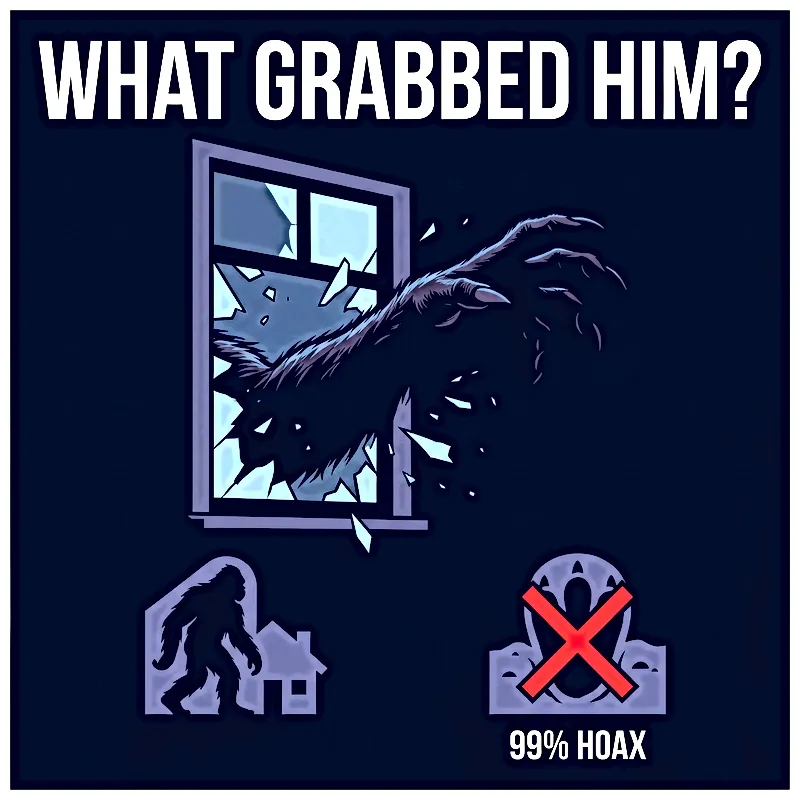
The best-supported historical record shows that the Fouke Monster episode was a short, intense cluster of alleged encounters centered on a family home near Fouke in Miller County in early May 1971, not a long-running official monster manhunt. [1]
What is firmly documented is that Bobby Ford reported being grabbed by a large hairy figure, that Elizabeth Ford reported seeing a clawed arm at a window, that Bobby Ford was treated for minor scratches and shock, and that officers found tracks and claw scratches but no conclusive biological evidence. [1], [2]
The case became nationally important less because law enforcement verified an unknown creature and more because local reporting was picked up by Associated Press and United Press International, after which the story was expanded into the 1972 film The Legend of Boggy Creek. [1], [2]
The strongest skeptical point in the later record is that the famous three-toed tracks were eventually described by archaeologist Frank Schambach of Southern State College as having a “99 percent chance” of being a hoax because primates do not leave three-toed prints. [1], [2]
Legend Metrics
Estimated Height
7 feet
Tracks Identified
Three-toed
Feature Film
The Legend of Boggy Creek
Year
1971
Explanatory Pathways
Genuine Physical Encounter
1
Fabricated Hoax
2
Cultural Folklore / Media Event
3
Evidence Assessment
| Aspect | Best-supported finding |
|---|---|
| Location and timing | The famous episode centered on the Ford home near Fouke in early May 1971, after the family had owned the house for less than a week. |
| Witness claims | Bobby Ford said a hairy, red-eyed creature grabbed him, and Elizabeth Ford said she saw a clawed arm through the window. |
| Medical aftermath | Bobby Ford was treated for minor scratches and shock, which documents distress and light injury but not severe trauma. |
| Scene evidence | Investigators reportedly found tracks and claw scratches but no blood and no recovered animal. |
| Track controversy | Later scrutiny reported that the best-known tracks appeared three-toed, and Frank Schambach argued there was a '99 percent chance' they were a hoax. |
| Immediate official posture | The documented official response was a search and inspection, not a formal scientific validation of an unknown species. |
What the Ford-house episode actually documented
According to the most detailed public summary in the Encyclopedia of Arkansas, Bobby Ford told the Fouke constable that a hairy, heavily breathing, red-eyed, man-like creature about seven feet tall and three feet across the chest grabbed him outside his house in May 1971. [1]
That same summary states that Ford broke free and ran so violently toward safety that he barreled through the front door instead of stopping to open it. [1]
The surviving account also says Elizabeth Ford was asleep in the front room when she saw a hairy arm with claws coming through the window and also saw the creature’s red eyes. [1], [2]
The “siege” language often attached to the case is only partly supported by the record, because the documented version describes the creature as having been around the house for several days and the family hearing things outside over multiple nights, but the dramatic confrontation itself was still a single concentrated nighttime episode rather than a prolonged police standoff. [1]
Ford’s brother and a hunting companion were also described as eyewitnesses, and the men reportedly fired at the figure more than once and thought they saw it fall before screams from the women drew Bobby Ford back toward the house. [1], [2]
The public record further states that Bobby Ford was treated at a local hospital for minor scratches and shock, which supports that something frightening and physically disruptive happened, but it does not support a catastrophic mauling. [1], [2]
Evidence and response
The physical-evidence story is much weaker than the witness story, because the sheriff’s department search reportedly found only strange tracks and claw scratches on the porch, while the gunfire produced no blood trail and no captured animal or specimen. [1]
Later summaries tied the Ford-house evidence to the legend’s signature three-toed prints, and they also reported more three-toed impressions in a soybean field after the initial scare, but those prints were never universally authenticated. [1], [2]
That combination of a frightened family, ambiguous scene damage, and no biological recovery is why the case remains folklorically powerful but evidentially thin. [1]
How the case spread beyond Fouke
A crucial turning point was the involvement of Texarkana Gazette and Texarkana Daily News, because local reporting turned a frightening family story into a named monster case with regional and then national visibility. [1], [2]
The Encyclopedia of Arkansas states that reporter coverage of the Fords’ story was followed the next day by a second article containing the first reference to the name “Fouke Monster,” and that wire-service pickup then transmitted the story to newspapers across the country. [1]
Later summaries also report that additional May and June 1971 sightings, including a claimed highway crossing and more footprint finds, kept the story alive after the Ford encounter rather than letting it collapse immediately as a one-night rumor. [2]
The law-enforcement response as documented in the public sources therefore looks reactive and local rather than affirming and scientific: officers searched, residents kept reporting signs, and the story spread faster through newspapers than through any forensic breakthrough. [1]
The film and the lasting cultural impact
The legend’s long life is inseparable from filmmaker Charles B. Pierce, because the case was adapted into The Legend of Boggy Creek in 1972 and thereby moved from local reportage into popular culture. [1], [2]
The Encyclopedia of Arkansas says the film was a low-budget movie filmed in Fouke that starred some of the eyewitnesses and local residents, and that it carried the story to an even larger audience than the original newspaper coverage did. [1]
That point matters historically because it means the Fouke Monster was preserved not by new physical proof, but by a conversion of local fear into regional media folklore. [1], [2]
The same source explicitly notes that many earlier or later alleged sightings existed, but that no sighting became as famous as the 1971 one, which underscores how decisively the Ford story and the film fixed the legend’s modern form. [1]
In practical terms, Pierce’s film appears to have done the lasting cultural work that law enforcement never did: it stabilized the monster’s image, tied it permanently to Boggy Creek and Fouke, and made the case part of Arkansas folklore rather than a temporary local scare. [1], [2]
Assessment
The best-supported conclusion is that the 1971 Fouke Monster case documents a real local panic and a real media event, but not a demonstrated unknown creature. [1], [2]
The evidence for that conclusion is straightforward: the Fords appear in the record as genuinely frightened witnesses, Bobby Ford did receive treatment, the sheriff’s search did note marks and tracks, and the newspapers indisputably circulated the story widely. [1], [2]
At the same time, the record lacks the features that would normally elevate the case from folklore to zoological evidence, because there was no carcass, no blood trail, no specimen, and no lasting forensic chain of custody for the famous prints. [1], [2]
The later skeptical judgment about the three-toed tracks is especially damaging to the strongest “hard evidence” associated with the case, because if the tracks were fabricated, then the most iconic physical trace of the Fouke Monster becomes part of the folklore machinery rather than proof of an unknown animal. [1], [2]
That leaves the Fouke Monster as a significant American monster case chiefly because it shows how local testimony, ambiguous physical traces, regional newspapers, and a low-budget docudrama can combine to create a durable modern legend. [1], [2]
Open questions and limitations
The public record summarized in the sources reviewed here does not resolve what actually produced the scratches and footprints at the Ford property, because officers reported signs at the scene but no biological evidence, while later expert commentary sharply questioned the footprints themselves. [1]
What remains most certain is therefore not the monster’s existence, but the sequence by which a frightening early-May 1971 household incident in Fouke became a nationally circulated story and then a culturally durable movie legend. [1], [2]
Sources
- Fouke Monster - Encyclopedia of Arkansas, https://encyclopediaofarkansas.net/entries/fouke-monster-2212/
- Fouke Monster - Wikipedia, https://en.wikipedia.org/wiki/Fouke_Monster?utm_source=chatgpt.com