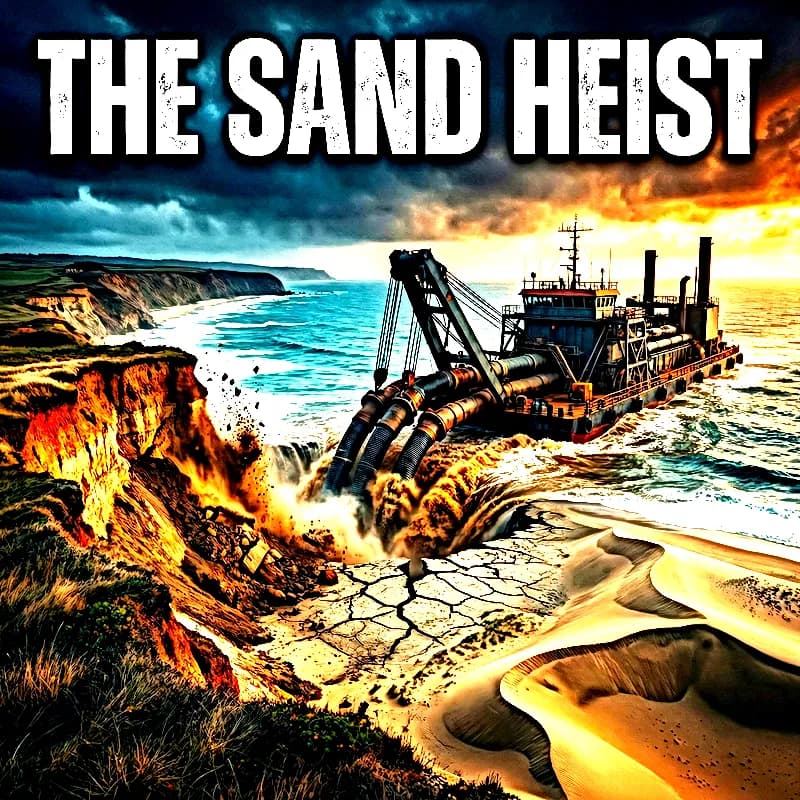
The industrial extraction of sand in the United States has transitioned from a localized construction-support activity into a high-stakes "grey market" defined by a collision of antiquated property rights, explosive energy demand, and accelerating coastal instability. This dossier examines the systemic exploitation of "grandfathered" legal status and regulatory gaps by multinational corporations to secure massive volumes of sand, often at the direct expense of public trust resources, ecological integrity, and community health.
Dossier Snapshot
Year Span
1906-2046
Word Count
3,235
Source Entries
39
Citation Calls
138
Report Signal Profile
Section Headings
17
Table Lines
24
Unique Citations
39
Source Entries
39
Verification Metrics
| Metric | Value |
|---|---|
| Section Headings | 17 |
| Table Lines | 24 |
| Year Span | 1906-2046 |
| Citation Coverage | 39/39 |
Executive Summary: The Geopolitics of Sedimentary Capital
The industrial extraction of sand in the United States has transitioned from a localized construction-support activity into a high-stakes "grey market" defined by a collision of antiquated property rights, explosive energy demand, and accelerating coastal instability. This dossier examines the systemic exploitation of "grandfathered" legal status and regulatory gaps by multinational corporations to secure massive volumes of sand, often at the direct expense of public trust resources, ecological integrity, and community health.
At the core of this investigation is a fundamental paradox: while sand is geologically ubiquitous, the specific grades required for high-strength infrastructure, coastal defense, and hydraulic fracturing are finite and increasingly rare. This scarcity has birthed a specialized extraction economy where legal maneuvering is as critical to corporate success as the mechanical process of dredging or blasting. In California, the CEMEX (https://www.cemex.com) [1], [2] Lapis Sand Plant utilized a "vested rights" claim to bypass decades of modern environmental oversight, becoming the last coastal sand mine in the continental United States. In the Midwest, the "Northern White" silica sand rush transformed the geomorphology of the Driftless Area, as corporations like U.S. Silica (https://www.ussilica.com) [3], [4] moved faster than local regulators to strip-mine ancient bluffs. Meanwhile, on the Atlantic and Gulf Coasts, a recursive and expensive "beach nourishment" cycle has sparked "sand wars" between jurisdictions over dwindling offshore deposits, forcing the U.S. Army Corps of Engineers (https://www.usace.army.mil) [5], [6] to navigate a landscape of litigation and ecological degradation.
The California Front: The Lapis Sand Mine and the Marina Controversy
The case of the Lapis Sand Mine in Marina, California, represents a singular instance of industrial-scale commercial mining on a public beach, facilitated by a complex historical legal loophole. Operated by the multinational building materials giant CEMEX (https://www.cemex.com) [1], [2], the facility functioned as a primary driver of coastal recession in the southern Monterey Bay for over a century, operating under the radar of the state's most stringent coastal protection laws.
The Mechanism: Suction Dredging and the Littoral Sink
The Lapis Mine's operation was uniquely positioned to exploit the "Sand Sharing System," a natural geological process where sediment is constantly exchanged between dunes, beaches, and nearshore sandbars.[7], [8] The physical mechanism of extraction relied on a suction dredge situated within an artificial lagoon located on the landward side of the beach berm. However, the operational reality was far more integrated into the active surf zone than its terrestrial footprint suggested.
During periods of high tides and significant wave energy, seawater and sand would overtop the beach berm, pouring directly into the dredging pond. This "wash-over" effect allowed CEMEX (https://www.cemex.com) [1], [7] to capture sand that had been naturally transported into the site by the Pacific Ocean. Once trapped in the lagoon, the sand was vacuumed out by the suction dredge, processed, and sold commercially as high-grade construction and industrial sand, including a variety marketed as "Lapis Lustre".[2]
This mechanism effectively turned the mine into a "permanent annual sink" within the local sediment budget. Scientists from the Naval Postgraduate School (https://nps.edu) [6], [9] and the U.S. Geological Survey (https://www.usgs.gov) [10], [11] established that by removing sand from the lagoon, the mine prevented that sediment from ever returning to the beach or the nearby dune systems. This created a localized deficit in the "Sand Sharing System," forcing the ocean to satisfy its energy balance by eroding the adjacent coastline at accelerated rates.
The "Grandfather" Loophole: The Vested Rights Defense
The primary reason CEMEX (https://www.cemex.com) [2], [12] was able to operate a commercial mine on a public beach for decades after the passage of the California Coastal Act (https://www.coastal.ca.gov) [1] lies in the legal concept of "vested rights." When the California Coastal Act was enacted in 1976—following the voter-approved Coastal Zone Conservation Act of 1972—it established a mandatory permitting process for all new developments within the coastal zone. However, Section 30608 of the Act provided an exemption for operations that could prove they had obtained a "vested right" to their activity prior to the law's inception.
The Lapis Sand Plant began its operations in 1906.[1], [10] For decades, CEMEX (https://www.cemex.com) [2], [13] and its predecessors argued that their right to mine sand was "grandfathered" in, as the industrial use of the land predated any modern environmental regulations. This defense allowed the company to bypass the requirement for a Coastal Development Permit, which would have subjected the mine to rigorous environmental impact reports and public scrutiny regarding its effect on coastal erosion.
The legal "grey market" thrived in this ambiguity. While the California Coastal Commission (https://www.coastal.ca.gov) [1], [14] and the City of Marina (https://www.cityofmarina.org) [2], [12] grew increasingly concerned about the mine's impact, the company's claim to a vested right acted as a formidable legal shield, deterring enforcement actions that would likely lead to protracted and expensive litigation against a global corporation with nearly unlimited legal resources. It was not until the State Lands Commission (https://www.slc.ca.gov) [1], [14] intervened in 2017, asserting that the mining of sand from state-owned sovereign lands without a lease constituted "expropriation" and a "public nuisance," that the legal deadlock began to break.
Scientific Quantification: Linking Dredging to Erosion
The causal link between the Lapis Mine's dredging and the rapid erosion of the southern Monterey Bay shoreline is documented in extensive studies from the Naval Postgraduate School (https://nps.edu) [6], [9] and the USGS (https://www.usgs.gov).[7], [10] Researchers utilized stereo-photogrammetry, LIDAR, and GPS surveys to track the recession of the dune edge over a century.
The data revealed that the southern Monterey Bay coastline suffered from the highest erosion rates in the state of California.[1], [7] While sea-level rise and El Niño cycles contribute to episodic erosion, the baseline rates near the mine were found to be anomalously high and directly correlated with mining volumes.
| Metric | Historical Mining Era (1940–1984) | Modern Erosion Observations (1970–2002) |
|---|---|---|
| Yearly Average Mined Sand | 128,000 m3/yr [10] | 153,000 - 205,000 m3/yr [7] |
| Marina State Beach Erosion Rate | 1.4 - 2.0 ft/yr [7] | 3.1 - 5.2 ft/yr [7] |
| Southern Bay Average Erosion | 0.5 m/yr [10] | 1.5 m/yr [10] |
| 1997-98 El Niño Dune Volume Loss | N/A | 1,820,000 m3 [10] |
Studies by Edward Thornton (https://nps.edu) [6], [7] emphasized that sand mining at the Lapis site was the only significant "sink" for beach-sized sand in the central sub-cell's sediment budget. His 2016 report concluded that the removal of sand by CEMEX (https://www.cemex.com) [2], [7] created a substantial deficit that forced the surrounding beaches to starve, leading to the dramatic inland retreat of dunes and the destruction of coastal property. The "Sand Sharing System" could not replenish the shoreline because the primary "sharing" mechanism—the movement of sand along the beach—was being intercepted by the dredging lagoon.
The 2017 Settlement: A Business Decision vs. Legal Culpability
The resolution of the CEMEX (https://www.cemex.com) [1], [13] case was reached through a historic four-party settlement agreement in July 2017. The parties included the California Coastal Commission (https://www.coastal.ca.gov) [1], the California State Lands Commission (https://www.slc.ca.gov) [14], the City of Marina (https://www.cityofmarina.org) [12], and CEMEX (https://www.cemex.com).[12]
The agreement was strategically designed to avoid an admission of guilt. In the text of the Consent Settlement Agreement and Cease and Desist Order No. CCC-17-CD-02 (https://www.coastal.ca.gov) [13], it is explicitly stated that "CEMEX has disputed and continues to dispute the Commission's allegations... and asserts that it conducts the Lapis sand plant operations lawfully." The document further notes that the agreement represents a resolution of a "disputed matter to avoid the cost and uncertainty of proceedings".[13] Thus, the closure was framed purely as a business decision to settle unpermitted development claims and potential public nuisance litigation.
Key terms of the 2017 settlement included:
- Cessation of Mining: CEMEX (https://www.cemex.com) [1], [12] was required to stop all sand extraction from the site by December 31, 2020.
- Interim Extraction Caps: During the three-year phase-out, extraction was capped at 240,000 tons per year (down from an estimated 300,000 tons).[12], [14]
- Reclamation and Restoration: The company was given an additional three years (until 2023-2024) to remove the dredge, reclaim the site, and transition its workforce.[1]
- Deed Restriction and Conservation: A permanent deed restriction was placed on the 400-acre property to protect it for conservation and public access. The site is intended for sale to an approved non-profit or government agency at a reduced price.[1], [12]
The Midwest Gold Rush: Northern White Silica Sand
While the California coast fought to stop the removal of sand, the Midwestern states of Wisconsin and Minnesota were being reshaped by a massive surge in demand for a different type of sediment. The "Northern White" silica sand found in the Upper Mississippi River Valley became the critical fuel for the American shale revolution, leading to a decade-long "gold rush" characterized by the physical removal of entire hills and bluffs.
The Target: Technical Specifications of "Northern White"
The petroleum industry's demand for sand is driven by the physics of hydraulic fracturing. In a fracking operation, millions of gallons of water and chemicals are pumped into shale rock to create fractures. These fractures must be propped open by a "proppant" to allow oil and gas to escape. While various materials can be used, "Northern White" silica sand—sourced primarily from the St. Peter, Jordan, and Wonewoc formations (https://www.usgs.gov) [15], [16]—is the gold standard for proppants. The technical requirements for frac sand are codified by the American Petroleum Institute (API) (https://www.api.org).[3], [16] Unlike common construction sand, Northern White sand is valued for several specific geomechanical properties:
- Sphericity and Roundness: The sand grains must be nearly perfect spheres. This ensures that when the grains are packed into a fracture, they create large, uniform pathways (permeability) for hydrocarbons to flow. Angular sand would pack too tightly, blocking the flow.[17], [18]
- High Purity: The sand must be over 99% monocrystalline quartz (silica). This purity ensures the grains are chemically inert and incredibly strong.[3], [17]
- Crush Resistance: The sand must withstand the immense pressure of the earth—often between 6,000 and 14,000 pounds per square inch (PSI)—without shattering. If the sand crushes into "fines," it will clog the well.[18], [19] | Feature | Construction Sand | Northern White Frac Sand | | --- | --- | --- | | Mineralogy | Mixed (quartz, feldspar, mica) | >99% Quartz (SiO2) [17] | | Grain Shape | Angular to sub-rounded | High Sphericity/Roundness [3] | | Crush Strength | Low | 6K - 14K PSI [18] | | Typical Formations | Glacial / Riverine | St. Peter / Wonewoc / Jordan [15] | | Market Price (c. 2012) | ~$10 - $15 / ton | $60 - $80 / ton [20] |
The "Wild West" Period and Landscape Erasure (2010–2015)
The period between 2010 and 2015 is often described as the "Wild West" of silica sand mining in the Midwest. The demand for frac sand exploded almost overnight; in 2009, the U.S. produced 12.1 million tons of frac sand, a figure that doubled by 2010.[16], [20] Wisconsin, positioned atop the world's most accessible deposits of Northern White sand, saw the number of active or proposed mines skyrocket from fewer than five to over 100 within a few years.[20], [21] During this period, regulatory oversight lagged significantly behind corporate extraction. Local townships and counties were often overwhelmed by permit applications for industrial mines ranging from 50 to 1,000 acres in size.[20], [22] In many instances, mining companies like Wisconsin Industrial Sand Co. (https://www.ussilica.com) [22] or Taylor Frac (https://www.mammothenergy.com) [19] began operations or expansions before comprehensive zoning laws were in place to address the unique impacts of industrial silica mining. The most visible impact of this rush was the removal of the region's iconic bluffs. The "Driftless Area" of Wisconsin and Minnesota is characterized by a unique landscape of hills and coulees that were never smoothed by the last ice age.[21], [23] However, because the valuable Northern White sand is contained within these ancient hills, the mining process involves stripping the vegetation, removing the topsoil, and using explosives to pulverize the sandstone bluffs.[24] Researchers and residents alike have documented the "erasure" of the landscape. Thomas W. Pearson (https://www.upress.umn.edu) [25] and organizations like the FracTracker Alliance (https://www.fractracker.org) [23] have highlighted how these mines are "putting the land blank," turning green ridges into open-pit mines and towering stockpiles of white silica. In Buffalo County, Wisconsin (https://www.buffalocounty.wi.gov) [26], [27], the scale of these operations led to intense community conflict, as the "boom-bust" nature of the industry threatened the region's traditional tourism and dairy economies.
Public Health: The Silica Dust Controversy
The industrial extraction and processing of silica sand generate Respirable Crystalline Silica (RCS)—fine dust particles smaller than 4 microns (PM4) that are invisible to the naked eye.[22], [28] For workers, the hazards of RCS are well-known, including silicosis (an incurable scarring of the lungs), lung cancer, and increased susceptibility to tuberculosis.[28], [29] However, the "grey market" controversy in the Midwest surrounds the exposure of residents living near mine sites and along truck routes. Concerns grew during the 2010-2015 boom that fugitive dust—sand that escapes from mines, processing plants, and uncovered trucks—was contaminating the ambient air of rural communities.[22], [30] While the EPA (https://www.epa.gov) [29], [31] regulates general particulate matter (PM2.5 and PM10), there were no federal or state ambient air quality standards specifically for crystalline silica during the initial rush. In 2011, Wisconsin citizens petitioned the DNR (https://dnr.wisconsin.gov) [22] to adopt an air quality standard of 3 micrograms of silica per cubic meter of air, similar to California's. The DNR denied the petition, despite its own studies acknowledging the carcinogenic risks of the dust.[22]
| Health Concern | Source of Exposure | Long-Term Impact |
|---|---|---|
| Silicosis | Inhalation of PM4 silica particles | Permanent lung scarring / respiratory failure [22] |
| Lung Cancer | Chronic exposure to RCS | Carcinogenic cell mutation [28] |
| Fugitive Dust | Trucks, rail cars, stockpiles | Community-wide respiratory irritation [30] |
| Noise & Vibration | Blasting and 24/7 truck traffic | Sleep disruption / mental health stress [22] |
The Beach Nourishment Economy: A Recursive Resource War
On the East Coast and in Florida, the sand economy is defined by "beach nourishment"—the artificial placement of sand on shorelines to mitigate erosion caused by rising sea levels and storm surges. This has created a massive, recursive economy where sand is "borrowed" from one location to protect another, sparking jurisdictional "sand wars" and causing long-term ecological damage.
The Cycle: Costs and Frequency of Nourishment
Beach nourishment is not a permanent solution; it is a temporary engineering fix that must be repeated every few years as the ocean naturally pulls the artificial sand back into the sea. In Miami-Dade County, Florida (https://www.miamidade.gov) [5], [32], and along the Jersey Shore (https://dep.nj.gov) [33], [34], these projects have become a multi-billion-dollar recurring expense. The frequency and cost of these projects are staggering. Miami Beach, for instance, has undergone dozens of nourishment cycles over the last several decades.[6] A typical project can cost upwards of $40 million for just a few miles of shoreline.[5], [32] In New Jersey, the state maintains a Shore Protection Fund that provides $25 million annually, though the total cost of rebuilding the state's barrier islands since the 1980s has exceeded $1.2 billion.[33], [34]
| Region | Project Cost (Approx.) | Frequency | Total Historical Spend |
|---|---|---|---|
| Miami Beach (USACE) | $40.4M (2022-23 cycle) | Every 3-10 years | N/A (Billions over decades) [5] |
| New Jersey (NJDEP) | $25M (Annual Base) | Post-storm / Recurring | $1.2B (since 1980s) [34] |
| Florida (Statewide) | $64.88M (FY 24-25 request) | Varies by county | $1.5B (since 1998) [35] |
The "Borrow Sites": Mining Offshore Shoals
As inshore sand resources are exhausted, the U.S. Army Corps of Engineers (https://www.usace.army.mil) [5], [6] and state agencies have turned to "borrow sites"—offshore sand banks and linear shoals located in state and federal waters. These underwater features, such as Manasquan Ridge in New Jersey or various shoals off the Florida coast, are mined using massive hopper dredges.[6] The "borrowing" of sand is a controversial practice because these shoals are not just piles of sediment; they are "prime fishing grounds" and complex ecosystems. The top layer of the ocean floor contains thousands of organisms—sea worms, shrimp, and shellfish—that form the base of the marine food chain.[6] Suction dredging removes this entire habitat, creating underwater "dead zones." The Jersey Coast Anglers Association (https://www.jcaa.org) [6] has been a vocal critic of these projects, arguing that the destruction of offshore ridges like Manasquan Ridge permanently damages flounder fisheries. Anglers and commercial fishermen maintain that while the sand provides temporary protection for beachfront real estate, the long-term cost is the degradation of the marine environment and the livelihoods that depend on it.[6]
The "Sand Wars": Inter-County and International Conflict
The scarcity of beach-compatible sand has led to a phenomenon known as "Sand Wars"—legal and political battles between counties and states over sand rights. In Florida, Miami-Dade and Broward Counties have effectively run out of available offshore sand that is not nestled among protected coral reefs.[36], [37] This desperation led to a proposal by the USACE (https://www.usace.army.mil) [6], [38] to dredge sand from the Treasure Coast (St. Lucie, Martin, and Indian River Counties) to replenish Miami Beach. The response from the northern counties was one of fierce protectionism. Residents and officials in St. Lucie County (https://www.stlucieco.gov) [6], [39] argued that their sand was "held in trust" for their own future nourishment needs and should not be exported to solve Miami's erosion crisis. This inter-county conflict reflects a broader trend: as the resource becomes scarcer, sand is being treated not as a public good, but as a strategic asset to be hoarded. The "Sand Wars" have even reached an international scale. The 2016 Water Resources Development Act (https://www.congress.gov) [36], [37] authorized the Army Corps to study the feasibility of importing sand from foreign countries, specifically the Bahamas. However, this has been blocked by:
- The Foreign Sand Ban: Congress has historically banned the use of federal funds for beach projects that use foreign sand, a policy heavily supported by the U.S. dredging industry (https://dredgecentral.com).[36], [37]
- The Jones Act: Requires that all cargo (including sand) transported between U.S. ports be carried on U.S.-flagged vessels, making the transport of Bahamian sand prohibitively expensive.[37]
- International Resistance: Bahamian environmental groups, such as Save the Bays (https://www.savethebays.bs) [36], have vowed to stop any attempt to remove Bahamian sand, viewing it as an extraction of their sovereign natural wealth to benefit American tourism.
Conclusion: The Structural Impunity of Sand Extraction
The "grey market" for sand in the United States is not a result of a lack of law, but rather a sophisticated exploitation of legal hierarchies. Corporations like CEMEX (https://www.cemex.com) [1], [2] utilized the "vested rights" doctrine to prioritize 19th-century property claims over 21st-century environmental reality, while frac sand miners in the Midwest used "regulatory lag" to strip-mine the landscape during the 2010-2015 boom. On the coasts, the recursive beach nourishment economy creates a cycle of dependency where the "public trust" is constantly sacrificed to protect private coastal investments. The evidence from Monterey Bay, the Midwest, and the Florida coast suggests that the current model of sand extraction is geologically and legally unsustainable. As sea levels continue to rise and the demand for high-purity silica remains high, the "Sand Wars" are likely to intensify. Without a comprehensive national framework that treats sand as a finite, strategic resource rather than an extractable commodity, the costs—both economic and environmental—will continue to be borne by the public, while the profits remain with the corporations that master the art of the loophole.
Sources
- Coastal Commission Letterhead - CA.gov, https://documents.coastal.ca.gov/assets/press-releases/cemex/CEMEX_FINAL_VOTE.pdf
- Coastal Commission approves agreement to close last beach sand ..., https://coastalcare.org/2017/07/coastal-commission-approves-agreement-to-close-last-beach-sand-mining-operation-in-mainland-u-s/
- U.S. Silica White, https://www.ussilica.com/products/us-silica-whiter
- US Silica White® Hydraulic Fracturing Sand, https://www.ussilica.com/sites/default/files/data-sheets/USS2001_US-Silica-Technical-Data-Sheet_US-Silica-White-Version-2.pdf
- Miami Beach Renourishment 2022-2023, https://www.saj.usace.army.mil/Missions/Civil-Works/Shore-Protection/Dade-County/Miami-Beach-Renourishment-2022-2023/
- Sand wars: raiding the sea to rebuild the beach - Soundings Online, https://soundingsonline.com/features/sand-wars-raiding-the-sea-to-rebuild-the-beach/
- An Evaluation of the Ongoing Impacts of Sand Mining at the CEMEX ..., https://psds.wcu.edu/wp-content/uploads/2014/03/2017.05.25-Final-Expert-Report.pdf
- An Evaluation of the Ongoing Impacts of Sand Mining at the CEMEX Lapis Sand Plant in Marina, California on the Southern Monterey Bay Shoreline; By Robert S. Young, PhD - Coastal Care, https://coastalcare.org/2017/05/an-evaluation-of-the-ongoing-impacts-of-sand-mining-at-the-cemex-lapis-sand-plant-in-marina-california-on-the-southern-monterey-bay-shoreline-by-robert-s-young-phd/
- The southern Monterey Bay littoral cell: A preliminary sediment budget study, https://pubs.usgs.gov/ds/2006/182/source_metadata/Dorman_MS_1968/Dorman_MS_1968.html
- Sand mining impacts on long-term dune erosion in southern Monterey Bay, https://pubs.usgs.gov/publication/70184421
- USGS surveys the southern Monterey Bay coast to study changing beaches, https://www.usgs.gov/news/usgs-surveys-southern-monterey-bay-coast-study-changing-beaches
- consider approval of a settlement agreement between the california state lands commission and, https://slcprdwordpressstorage.blob.core.windows.net/wordpressdata/Meeting_Summaries/2017_Documents/08-17-17/Items_and_Exhibits/81.pdf
- Appendix A CCC-17-CD-02 (CEMEX) JULY 13, 2017 - CA.gov, https://documents.coastal.ca.gov/reports/2017/7/th22/th22-7-2017-appendix.pdf
- State Lands Commission approves closure of last coastal sand mine in the continental U.S., https://www.slc.ca.gov/press-release/state-lands-commission-approves-closure-of-last-coastal-sand-mine-in-the-continental-u-s/
- Frac sand in the United States: a geological and industry overview, https://pubs.usgs.gov/publication/ofr20151107
- January 11 PRELIMINARY: WORKING DRAFT Report on Industrial Silica Sand - Minnesota Environmental Quality Board, https://www.eqb.state.mn.us/sites/eqb/files/documents/13.%20Silica%20Sand%20report%20working%20draft%20JANUARY%2011.pdf
- What Is Frac Sand and How Is It Used in Hydraulic Fracturing? - Sunita Hydrocolloids Inc., https://sunitausa.com/blog/frac-sand-in-hydraulic-fracturing/
- Frac Sand: Demand, Regulations and Innovations - SCS Engineers, https://www.scsengineers.com/frac-sand-demand-regulations-and-innovations/
- Natural Sand Proppant | Mammoth Energy, https://www.mammothenergy.com/oilfield-services/natural-sand-proppant/
- Sand surge, https://www.minneapolisfed.org/~/media/files/pubs/fedgaz/12-07/sand_surge_fedgazette_july_2012.pdf
- Sand Rush: Fracking Boom Spurs Rush on Wisconsin Silica | National Geographic, https://www.nationalgeographic.com/science/article/130703-wisconsin-fracking-sand-rush
- Non-Metallic Mining — Wisconsin Environmental Health Network, https://www.wehnonline.org/nonmetallic-mining
- Looking Closely at Fracking in Rural Wisconsin - Sapiens.org, https://www.sapiens.org/culture/fracking-rural-wisconsin/
- The Midwestern Sand Mines Feeding the Fracking Industry | Discover Magazine, https://www.discovermagazine.com/the-midwestern-sand-mines-feeding-the-fracking-industry-12113
- When the Hills Are Gone: Frac Sand Mining and the Struggle for Community Thomas W. Pearson ebook power reader edition | PDF | Project Gutenberg - Scribd, https://www.scribd.com/document/961787568/When-the-Hills-Are-Gone-Frac-Sand-Mining-and-the-Struggle-for-Community-Thomas-W-Pearson-ebook-power-reader-edition
- frac-sand-Final-Report-version-1-4.pdf, https://buffalo.extension.wisc.edu/files/2011/12/frac-sand-Final-Report-version-1-4.pdf
- THE ECONOMICS OF SAND MINING AND BUFFALO COUNTY - Executive Summary, https://buffalo.extension.wisc.edu/files/2011/12/Frac-Sand-Executive-Summary-Final.pdf
- Air Quality: Respirable Crystalline Silica from Sand Mining | Wisconsin Department of Health Services, https://www.dhs.wisconsin.gov/air/rcs.htm
- Air Quality and Industrial Sand (Frac Sand) Mining - Center for Agricultural and Shale Law, https://aglaw.psu.edu/wp-content/uploads/2020/05/Frac-Sand-Air-Quality.pdf
- Frac Sand Health and Environmental Impacts - Earthworks, https://earthworks.org/issues/frac-sand-health-and-environmental-impacts/
- PM25 Airborne Particulates Near Frac Sand Operations - Winona County, https://www.winonacounty.gov/DocumentCenter/View/103/Airborne-Particulates-Near-Frack-Sand-Operations-PDF
- Miami Beach - Rising Above, https://www.mbrisingabove.com/climate-mitigation/natural-resources/beaches/
- Federal funding freeze stalls New Jersey beach replenishment projects - WHYY, https://whyy.org/articles/federal-funding-freeze-stalls-new-jersey-beach-replenishment-projects/
- Division of Science and Research | Beach Replenishment - NJDEP, https://dep.nj.gov/dsr/environmental-trends/beach-replenishment/
- Beach Management Funding Assistance Program Fixed Capital Outlay Government Funding Request Fiscal Year 2024-25 Office of Resil - Florida Department of Environmental Protection, https://floridadep.gov/sites/default/files/FY%202024-2025%20LGFR_1.pdf
- US warned: "Hands off our beaches!" | The Tribune, https://www.tribune242.com/news/2017/jan/04/us-warned-hands-our-beaches/
- Bahamian Sand Considered for Replenishing Eroded Florida Beaches, https://businessviewcaribbean.com/bahamian-sand-considered-for-replenishing-eroded-florida-beaches/
- City Commission Meeting - IIS Windows Server - City of Miami Beach, https://docmgmt.miamibeachfl.gov/WebLink/edoc/204662/After%20Action%2020150615.pdf?dbid=0&repo=CityClerk
- VB32963_ISSUE20_051916_OPT - Flip eBook Pages 1-50 | AnyFlip, https://anyflip.com/mmja/rltv/basic