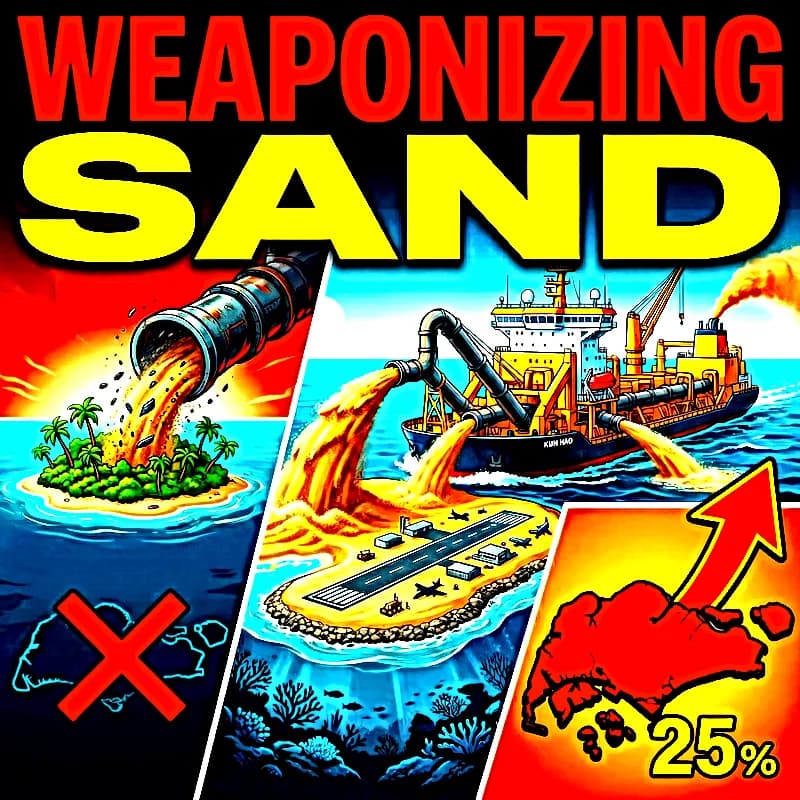
The contemporary strategic environment in Southeast Asia and the South China Sea is undergoing a fundamental transformation, driven not only by naval maneuvering and diplomatic posturing but by the literal reconstruction of the earth's surface. Sand, traditionally viewed as a low-value bulk commodity, has emerged as a primary instrument of statecraft and a critical weapon in the pursuit of territorial expansion and military dominance. This dossier examines the systemic manipulation of geography through aggressive sand mining and land reclamation, analyzing how states in the region use sediment to delete existing sovereign territory, create new landmasses, and redraw the legal and military map of Asia.
Dossier Snapshot
Year Span
1923-2075
Word Count
3,149
Source Entries
85
Citation Calls
204
Report Signal Profile
Section Headings
20
Table Lines
28
Unique Citations
85
Source Entries
85
Verification Metrics
| Metric | Value |
|---|---|
| Section Headings | 20 |
| Table Lines | 28 |
| Year Span | 1923-2075 |
| Citation Coverage | 85/85 |
The Vanishing Islands of Indonesia: The Erosion of Sovereignty
For an archipelagic state like Indonesia, the physical permanence of its outermost islands is a prerequisite for the maintenance of its maritime boundaries. Under the United Nations Convention on the Law of the Sea (UNCLOS), the maritime zones of a nation—including its 12-nautical-mile territorial sea and its 200-nautical-mile Exclusive Economic Zone (EEZ)—are measured from baselines that often rely on these small, peripheral landmasses.[1] The systematic extraction of sand from the Riau Islands and other strategic archipelagos has resulted in the literal deletion of Indonesian geography, creating a crisis of sovereignty that reverberates throughout the region.
The Riau Archipelago: Ground Zero for Geographical Deletion
The Riau Islands province, which shares a maritime border with Singapore to the northeast and Malaysia to the east, has been the primary source of the sand used to fuel the rapid expansion of the Singaporean landmass.[2] Between 1979 and the mid-2000s, a massive, often unregulated dredging industry targeted the small sand islands of this region.[3] By 2007, the Indonesian government issued a stark report confirming that 26 islands had officially disappeared from the map.[3], [4] These islands did not sink due to sea-level rise alone; they were dredged out of existence to meet the construction and reclamation needs of foreign markets.[5]
The following table identifies specific Indonesian islands that have either vanished or suffered catastrophic damage as a direct or indirect result of sand extraction activities:
| Island Name | Archipelago/Location | Status and Condition | Documented Cause/Mechanism |
|---|---|---|---|
| Nipah Island (Pulau Nipa) | Riau Islands | Nearly submerged (2003); only palm trees remained.[5] | Intensive dredging of ~300 million cubic meters of sand.[6], [7] |
| Beting Aceh | Riau Islands | Critically eroded; white sandy beaches vanished by 2022.[3] | Sand mining by PT Logo Mas (LMU) between Beting Aceh and Babi Island.[3] |
| Babi Island | Riau Islands | Severely damaged coastline and habitat.[3] | Proximity to intensive dredging operations by PT Logo Mas.[3] |
| Propos Island | Riau Islands (Karimun) | Barren and mining-scarred; interior turned into water-filled pits.[8], [9] | Bauxite and sand mining permits issued in 2010.[8], [9] |
| Kas Island | Riau Islands | Heavily exploited landmass.[9] | Mining Business Licenses (IUP) for mineral/sand extraction.[9] |
| Betet Island | South Sumatra | Submerged (1m below sea level).[10], [11] | Synergistic effect of rising sea levels and environmental degradation.[10], [12] |
| Gundul Island | South Sumatra | Submerged (3m below sea level).[10], [12] | Climate change and unsustainable land-use patterns.[10], [11] |
| Pari Island | Thousand Islands | Sandbars and fishing grounds deleted.[13] | Clandestine sand sucking by 98-foot dredging vessels.[13] |
| Gee Island | North Maluku | "Monument of destruction".[14] | Intensive excavation for mineral and coal mining.[14] |
| Pakal Island | North Maluku | "Monument of destruction".[14] | Systematic excavation of the island's body by mining firms.[14] |
| Bunyu Island | North Kalimantan | Severely eroded and demolished.[14] | Coal mining and oil extraction moving within 100m of settlements.[14] |
| Bangka Island | North Sulawesi | Coastal areas destroyed.[14] | Iron ore mining facilities by PT Mikgro Metal Perdana.[14] |
The phenomenon of the "vanishing islands" is a second-order consequence of a global market failure. Sand is often treated as a common resource, leading to a "tragedy of the commons" where immediate economic gains for dredging companies and state-level developers override the long-term territorial and ecological security of the source nation.[15], [16] The removal of sand alters wave patterns and underwater currents, which in turn accelerates the erosion of remaining landmasses, creating a domino effect that can threaten thousands of low-lying islands across the Indonesian archipelago.[13], [17]
Legal Implications: The Redrawing of Maritime Borders
The disappearance of Nipah Island (Pulau Nipa) represents the most significant geopolitical crisis in this context. Nipah is one of 12 "leading islands" of Indonesia, located only 10 kilometers from Singapore and overlooking some of the world's most critical shipping lanes.[18] In early 2000, Nipah was dredged to the brink of extinction, an act that carried the potential to erase the Indonesian baseline and push the country's maritime border southward.[18], [19]
Under the principles of UNCLOS, if an island that serves as a basepoint disappears, the nation's territorial sea and EEZ boundaries may be invalidated or forced to shift, resulting in a direct loss of maritime territory.[7], [18], [19] Indonesia's response was a massive, high-stakes reclamation and restoration project. During the administration of President Megawati Soekarnoputri in 2004, the government began the physical reconstruction of Nipah to prevent it from sinking, an effort marked by the planting of cemara sea (sea pine) and the installation of a traffic monitoring base for anchoring vessels.[6], [18]
The legal resolution of this border friction culminated in the 2009 Maritime Delimitation Treaty between Indonesia and Singapore.[20], [21] This treaty was a milestone in "border diplomacy," as it saw Singapore formally renounce its reclaimed shorelines as the basis for determining the western segment of the maritime border.[6], [21] Instead, the two nations agreed to use the original 1973 basepoints, including Nipah Island and Sultan Shoal, ensuring that Singapore's land expansion did not translate into a legal advancement of its territorial sea at Indonesia's expense.[6], [21], [22] However, the continued vulnerability of these basepoints to environmental change and illegal mining remains a "subsequent event" that could call the stability of the boundary into question in the future.[20]
Documentary Record of Sand Export Bans
Indonesia, Vietnam, and Cambodia have all instituted significant prohibitions on the export of sand to Singapore, often citing environmental destruction and the protection of national sovereignty as the primary motivations.
Indonesia's Multi-Tiered Prohibition
- February 2003 (Sea Sand Ban): President Megawati Soekarnoputri issued Presidential Decree No. 33 of 2002 and later Minister of Industry and Trade Decree No. 117/MPP/Kep/2/2003, which implemented a temporary halt on sea sand exports to prevent the sinking of islands in the Riau archipelago.[23], [24], [25]
- January 2007 (Land Sand Ban): The Ministry of Trade issued Regulation No. 02/M-DAG/PER/1/2007, which prohibited the export of land sand (used for concrete), soil, and topsoil.[26], [27] This ban was prompted by the discovery that sand miners were all but demolishing islands lying between Indonesia and Singapore.[22], [28]
- May 2023 (Partial Reopening): Government Regulation No. 26 of 2023 was introduced by President Joko Widodo to allow the utilization of "sedimentation results," including sea sand, for export after domestic needs were met.[19], [29]
- June 2025 (Supreme Court Intervention): The Indonesian Supreme Court struck down key provisions of the 2023 regulation, ruling that the commercial exploitation of sea sand violated higher legislation (Article 56 of Law No. 32/2014) and neglected the government's duty to protect marine ecosystems.[30], [31]
Vietnam's Regulatory Framework
- October 2008 (Instruction No. 29): Prime Ministerial Instruction No. 29 established a temporary ban on the export of sand and gravel from rivers and seas.[32], [33]
- 2009 (Comprehensive Ban): Vietnam officially prohibited sand exports to Singapore, although a loophole allowed companies involved in river dredging projects to sell sand to recoup expenses.[34], [35]
- November 2017 (Silica Sand Ban): The Minister of Finance issued Official Letter No. 7406/TCHQ-GSQL to specifically ban the export of white silica sand.[36]
Cambodia's Legislative Response
- May 2009 (River Sand Ban): Prime Minister Hun Sen announced a ban on river sand exports, though Global Witness investigations found that sea sand exports remained merely "limited" and continued under various licenses.[37], [38]
- November 2016 (Temporary Halt): All sand exports to Singapore were suspended following the exposure of massive data discrepancies between the two nations.[39], [40]
- July 2017 (Permanent Ban): The Ministry of Mines and Energy permanently banned the export of sand for construction and "sand mud" from Koh Kong province, effectively ending the large-scale trade with Singapore.[40], [41], [42]
Singapore's Expansion: The Geopolitics of Infilling
Singapore's status as a global financial and logistics hub is intrinsically tied to its ability to manufacture land. Since 1965, the city-state has engaged in an existential struggle for space, using land reclamation to overcome its natural geographic limitations.[43], [44] This growth, while economically transformative, has made Singapore the world's largest importer of sand, drawing material from throughout the region to expand its territorial domain.[16], [38], [45]
Quantitative Land Area Growth
Over the past two centuries, Singapore's land area has expanded by approximately 25%, increasing from a baseline of 582 square kilometers in the 1960s to over 735 square kilometers today.[44], [46], [47] The post-independence era has seen the most dramatic acceleration of this process, with nearly 14,000 hectares (140 square kilometers) added through reclamation.[44]
| Historical Period | Land Area (sq km) | Major Reclamation Milestones |
|---|---|---|
| 1819 (Founding) | 578.0 [44] | Mangrove swamps and mosquito-infested jungle.[44] |
| 1822 (Colonial) | ~578.3 | Boat Quay project; leveling of hills to fill wetlands.[44] |
| 1960 | 581.5 [45] | Pre-independence baseline for the modern era.[47] |
| 2003 | 692.8 [48] | High-intensity import period from Indonesia (~53M metric tons/year).[25], [49] |
| 2007 | 700.3 [48] | Indonesia enacts comprehensive ban on land sand.[22] |
| 2015 | 719.1 [48] | Completion of Changi East and Jurong Island mergers.[44] |
| 2024 | 735.6 [48] | Commencement of Tuas Terminal and northwestern polders.[50] |
| 2030 (Projected) | 766.0 [45] | Targeted area required to support a 6.9M population.[44] |
| The 2013 Land Use Plan stipulated a requirement for an additional 5,600 hectares of land by 2030.[44] This ongoing expansion serves multiple strategic objectives: the construction of the Tuas Terminal (planned to be the world's largest container terminal), the expansion of Changi Airport, and the creation of deep-water military training grounds.[45], [50], [51] |
The Strategic Sand Reserve and Resource Management
The vulnerability of Singapore's construction industry to geopolitical leverage was starkly revealed during the 2007 "Sand Crisis," when Indonesia's ban caused prices to spike from US3tonearlyUS200 per tonne on the black market.[22], [52] To mitigate such risks, Singapore maintains a "Strategic Sand Reserve"—a national stockpile that functions as an economic buffer, similar to a strategic oil reserve.[53]
- Primary Location: The stockpile is located in an isolated area of eastern Singapore, adjacent to the Bedok Reservoir.[51], [53]
- Security Profile: The site is a restricted zone, surrounded by high-security fencing and patrol houses.[51], [53]
- Operational Role: During the 2007 supply crunch, the Building and Construction Authority (BCA) released sand from this reserve to the market to stabilize costs for public infrastructure projects.[22], [45]
- Stockpile Management: Additional "floating" stockpiles are managed at the Tuas View Extension, where hopper barges and dredgers transport material to support large-scale marine construction.[54] As the cost of imported sand rises and the environmental and political toll on neighboring countries increases, Singapore is transitioning toward more sustainable land-building methods. The adoption of the "empoldering" method at Pulau Tekong has reduced sand requirements by nearly 50%, utilizing a system of dikes and pumps to reclaim land below sea level rather than filling it to the surface.[50], [55], [56] This technological pivot is a strategic response to the diminishing availability of regional sediment.
China's Great Wall of Sand: The Terraforming of the South China Sea
While Singapore uses sand for survival and Indonesia seeks to protect it as territory, China has weaponized sand to project power and enforce revisionist maritime claims in the South China Sea. Through a rapid campaign of terraforming known as the "Great Wall of Sand," Beijing has converted remote, submerged reefs in the Spratly Islands into fortified military outposts.[57], [58], [59]
Terraforming Operations at Subi and Mischief Reefs
Since late 2013, China has reclaimed more than 3,200 acres (approx. 13 square kilometers) across seven features in the Spratlys: Subi, Mischief, Fiery Cross, Cuarteron, Gaven, Johnson, and Hughes Reefs.[57], [60], [61]
Subi Reef (Zamora Reef)
Subi Reef, located only 26 kilometers from the Philippines' Pag-asa Island, was originally a low-tide elevation (LTE)—a feature submerged at high tide.[62], [63] Through dredging, China created approximately 976 to 980 acres of reclaimed land.[61], [62]
- Infrastructure: Includes a 3,000-meter runway, massive hangars capable of housing combat aircraft, and advanced radar domes.[61], [63]
- Signals Intelligence: Features "elephant cage" high-frequency antenna arrays for broad-spectrum monitoring of the region.[63], [64]
Mischief Reef (Panganiban Reef)
Mischief Reef is the largest of China's artificial islands, totaling approximately 1,379 acres (5.58 million square meters).[61], [63] It is also the most legally contested, as the 2016 Permanent Court of Arbitration (PCA) ruled it to be an LTE located within the Philippines' EEZ and continental shelf.[65], [66], [67]
- Fortification: China has built an airfield, hardened shelters for surface-to-air missiles (SAM), and deep-water harbor facilities.[63], [68]
- Electronic Warfare: Features advanced EW pads and circular direction-finding antenna arrays installed in 2023.[63]
Dredging Technology: The Mechanics of Creation
The unprecedented speed of China's terraforming was driven by a domestic fleet of "magic island-making" ships. China tripled its dredging capacity between 2000 and 2015, developing some of the most powerful cutter suction dredgers (CSD) in the world.[69]
| Vessel Name | Length/Specs | Dredging Capacity | Operational Profile |
|---|---|---|---|
| Tian Jing Hao | 127.5m long; 6,017 gross tonnes.[57], [70] | 4,500 cubic meters per hour.[57], [70] | Credited as the primary "island maker" for Fiery Cross and Gaven Reefs; designed by VOSTA LMG (Germany).[57], [70], [71] |
| Tian Kun Hao | 140.0m long; 28.0m wide.[69], [72] | 6,000 to 7,500 cubic meters per hour.[72], [73] | Features an integrated intelligent control system for unmanned dredging; can blast through rock with 60 MPa hardness and discharge material up to 15km away.[69], [73], [74] |
| These vessels function as massive industrial processors, grinding the coral reef structures and seabed material into a slurry that is then pumped into the lagoon or designated reclamation area.[57], [69], [75] The environmental impact is catastrophic: the process destroyed over 13 square kilometers of living coral reefs and generated vast sediment plumes that buried surrounding ecosystems under millions of tons of gravel.[57], [66], [76] |
Military Strategy: The Fait Accompli
China's strategy in the South China Sea is a classic example of "salami slicing"—incrementally changing the physical reality of the region through terraforming until it reaches a fait accompli that cannot be reversed without high-intensity conflict.[77], [78], [79] By turning submerged features into "sand islands," China seeks to establish a permanent military presence that serves three primary goals:
- Anti-Access/Area-Denial (A2/AD): The islands house SAM batteries (HQ-9) and anti-ship cruise missiles (YJ-12B, YJ-62), creating a protective envelope over the sea lanes.[63], [68]
- Surveillance and Intelligence: The extensive radar and communications arrays (ISR radomes) provide overlapping coverage, allowing China to monitor all ship and aircraft movements in the South China Sea.[63], [68]
- Forward Operational Bases: The islands provide harbors and runways that extend the operational range of the People's Liberation Army Navy (PLAN) and the China Coast Guard (CCG), allowing them to harass the vessels of other claimant states far from the Chinese mainland.[77], [78], [80]
The Legal Frontier: UNCLOS and the Status of Artificial Islands
The critical legal question in this geopolitical struggle is whether the transformation of a submerged reef into a "sand island" generates any maritime entitlements. The 2016 PCA ruling in The Philippines v. China provided a definitive answer, which China has continued to reject as "null and void".[65], [81], [82]
The Distinction Between Islands, Rocks, and LTEs
Under UNCLOS Article 121, the status of a maritime feature—and the territory it generates—is determined by its natural condition, prior to human modification.[65], [82], [83]
- Islands: Naturally formed areas of land that stay above water at high tide and can sustain human habitation or economic life. They generate a 12-nm territorial sea and a 200-nm EEZ.[65], [84]
- Rocks: Features that stay above water at high tide but cannot sustain habitation. They generate a 12-nm territorial sea but no EEZ.[65]
- Low-Tide Elevations (LTEs): Land features submerged at high tide. They generate no maritime territory and cannot be legally appropriated through occupation.[65], [82], [84]
- Artificial Islands: Under Article 60, artificial islands do not possess the status of islands. They have no territorial sea of their own, and their presence does not affect the delimitation of the territorial sea or EEZ.[65], [66], [67] The Tribunal ruled that Mischief Reef and Subi Reef are naturally LTEs.[65], [82] Therefore, despite China's massive terraforming and the stationing of military personnel, these features remain legally submerged seabed.[81], [85] China's construction of artificial islands on Mischief Reef was found to be an unlawful violation of the Philippines' sovereign rights within its EEZ.[65], [82]
Geopolitical Synthesis and Conclusion
The weaponization of sand in Asia represents a paradigm shift in how states interact with geography. Territory is no longer a static endowment of nature; it is a resource to be extracted, traded, and engineered to serve national ambitions. In the case of Indonesia, the depletion of its archipelagic basepoints has necessitated a defensive restoration of geography to protect its maritime borders from legal erosion.[6], [18] For Singapore, sand has been the physical currency of its survival, a bulk commodity that has enabled it to grow by 25% while creating an existential dependency on the environmental and political stability of its neighbors.[16], [43], [44] For China, the terraforming of the South China Sea is a strategic attempt to redraw the map through brute physical persistence, using dredging technology to manufacture "sovereignty" where none exists under international law.[58], [78], [82] The "Great Wall of Sand" and the "Vanishing Islands" are two sides of the same geopolitical coin. As sand becomes increasingly scarce and the environmental toll of its extraction more profound, the competition for this granular resource will likely remain a central flashpoint in Asian security. The stability of regional borders now depends as much on the control of sediment as it does on the movements of navies and the ink of treaties. The era of anthropogenic geography has arrived, and in this new cartographic order, sand is the ultimate arbiter of power.
Sources
- THE REPUBLIC OF INDONESIA AND THE REPUBLIC OF SINGAPORE RELATING TO THE DELIMINATION OF THE TERRITORIAL SEAS OF THE TWO COUNTRIE, https://faolex.fao.org/docs/pdf/ins107176.pdf
- Riau Islands - Wikipedia, https://en.wikipedia.org/wiki/Riau_Islands
- 'Nowhere to fish, nowhere to farm' - Beneath the Sands, https://www.beneaththesands.earth/nowhere-to-fish-nowhere-to-farm
- Minister says 24 Indonesian islands disappeared: report - Terra Daily, https://www.terradaily.com/reports/Minister_says_24_Indonesian_islands_disappeared_report_999.html
- Seen and Not Seen: Tracing Sand Agency in ... - Galen Pardee, https://drawingagency.org/Seen-and-Not-Seen
- RI, Singapore sign maritime boundary agreement - Wed, March 11, 2009 - The Jakarta Post, https://www.thejakartapost.com/news/2009/03/11/ri-singapore-sign-maritime-boundary-agreement.html
- (PDF) THE IMPACT OF SINGAPORE COASTAL RECLAMATION ..., https://www.researchgate.net/publication/368085269_THE_IMPACT_OF_SINGAPORE_COASTAL_RECLAMATION_AGAINST_MARITIME_BOUNDARIES_AND_TERRITORIAL_SOVEREIGNTY_OF_INDONESIA-SINGAPORE
- Mining-Scarred Island in Indonesia's Riau Islands Goes Viral Again - Tempo.co English, https://en.tempo.co/read/2075969/mining-scarred-island-in-indonesias-riau-islands-goes-viral-again
- Mining-scarred island in Indonesia's Riau Islands goes viral again - APSN, https://www.asia-pacific-solidarity.net/news/2025-12-24/mining-scarred-island-indonesias-riau-islands-goes-viral-again.html
- Two islands vanish, four more may sink soon, says Walhi - The Jakarta Post, https://www.thejakartapost.com/news/2020/01/16/two-islands-vanish-four-more-may-sink-soon-says-walhi.html
- Two Indonesian islands vanish, more may sink | The Straits Times, https://www.straitstimes.com/asia/se-asia/two-indonesian-islands-vanish-more-may-sink
- Two islands vanish, four more may soon sink, Walhi blames environmental problems - Indonesia | ReliefWeb, https://reliefweb.int/report/indonesia/two-islands-vanish-four-more-may-soon-sink-walhi-blames-environmental-problems
- They removed the sand from an entire island overnight, and the disappearance exposed a billion-dollar market that is making territories vanish from the map - Click Oil and Gas, https://en.clickpetroleoegas.com.br/They-removed-the-sand-from-an-entire-island-during-the-early-morning-hours--and-the-disappearance-exposed-a-billion-dollar-market./
- Small Islands of Indonesia, The Land of Mines - Jaringan Advokasi Tambang, https://jatam.org/wp-content/uploads/2021/05/Small-island-book.pdf
- Creating a sustainable sand industry requires greater regulation – here's why, https://www.worldfinance.com/featured/creating-a-sustainable-sand-industry-requires-greater-regulation-heres-why
- Myanmar: Sand mining for reclamation of coastal areas is both, a geopolitical and conservation issue for the Southeast Asian region - ICSF, https://icsf.net/newss/myanmar-sand-mining-for-reclamation-of-coastal-areas-is-both-a-geopolitical-and-conservation-issue-for-the-southeast-asian-region/
- The last time it was legal, exports of sea sand destroyed dozens of Indonesian islands. Now, the ban is being lifted - Yahoo News Australia, https://au.news.yahoo.com/last-time-legal-exports-sea-192318934.html
- Oath on Nipah Island - Directorate of Partnerships and International Affairs, https://dia.upi.edu/oath-on-nipah-island/
- The Impact Of Indonesia's Sea Sand Export Policy To Singapore On ..., https://ifrelresearch.org/index.php/jrp-widyakarya/article/download/4299/4507
- Shifting Shores, Keeping Lines? Revisiting the Indonesia–Singapore Delimitation Treaty in Light of Subsequent Changes - Brill, https://brill.com/view/journals/mpyo/aop/article-10.1163-18757413-bja10035/article-10.1163-18757413-bja10035.pdf
- Indonesia–Singapore border - Wikipedia, https://en.wikipedia.org/wiki/Indonesia%E2%80%93Singapore_border
- Indonesia bans land sand exports to Singapore - NLB, https://www.nlb.gov.sg/main/article-detail?cmsuuid=5c6485bb-c357-48be-9d12-bf7c1d422d0e
- Indonesian sea sand mining: History and potential ramifications of lifting the decades-old export ban - The American Ceramic Society, https://ceramics.org/ceramic-tech-today/indonesian-sea-sand-mining/
- Min. Industry 117/MPP/Kep/2/2003 Temporary Termination on Export of Sea Sand (Pasir Laut), https://www.flevin.com/id/lgso/translations/JICA%20Mirror/english/304.No.117_MPP_2003.ada-E.html
- Indonesia's risky gamble with sea sand exports | News - Eco-Business, https://www.eco-business.com/news/indonesias-risky-gamble-with-sea-sand-exports/
- Indonesia Bans Sand Exports to Singapore - Mines and Communities, https://www.minesandcommunities.org/article.php?a=1837
- PROHIBITION OF EXPORT OF SAND, SOIL, AND TOP SOIL (INCLUDING HUMUS), https://faolex.fao.org/docs/pdf/ins71697.pdf
- Land reclamation in Singapore - Wikipedia, https://en.wikipedia.org/wiki/Land_reclamation_in_Singapore
- Indonesia's risky gamble with sea sand exports | Dialogue Earth, https://dialogue.earth/en/nature/indonesias-risky-gamble-with-sea-sand-exports/
- Indonesia's Supreme Court Cancels Regulation Allowing Sea Sand Export, https://en.tempo.co/read/2021451/indonesias-supreme-court-cancels-regulation-allowing-sea-sand-export
- Indonesia moves to revise sea sand export policy after court ruling - Mongabay, https://news.mongabay.com/2025/07/indonesia-sea-sand-dredging-exports-marine-fisheries/
- Surge in Vietnam sand exported to Singapore, https://wildshores.blogspot.com/2009/08/surge-in-vietnam-sand-exported-to.html
- Southeast Asia's Vanishing Sand Bans are Destroying the Region ..., https://www.resilience.org/stories/2018-06-21/southeast-asias-vanishing-sand-bans-are-destroying-the-region/
- Sand exported unethically from Vietnam ends up in Singapore - Mothership.SG, https://mothership.sg/2017/04/sand-exported-unethically-from-vietnam-end-up-in-singapore/
- Shifting sands: illegal VN sales to Singapore - Open Development Mekong, https://opendevelopmentmekong.net/news/shifting-sands-illegal-vn-sales-to-singapore/
- Vietnam: Introduced Export Ban on White Silica Sand - Global Trade Alert, https://globaltradealert.org/intervention/80797-vietnam-introduced-export-ban-on-white-silica-sand
- Shifting Sands final may 8 inc cover.indd, https://yale-threesixty.files.svdcdn.com/production/digest/shifting_sand_final.pdf
- Singapore is dredging our home away: hands off our sand! - Rainforest Rescue, https://www.rainforest-rescue.org/petitions/1010/singapore-is-dredging-our-home-away-hands-off-our-sand
- S'pore's alleged use of too much Cambodian sand to reclaim land highlighted again in recent documentary - Mothership.SG - News from Singapore, Asia and around the world, https://mothership.sg/2019/04/land-reclamation-cambodia-sand-singapore/
- Cambodia Bans Exports of Two Types of Sand From Koh Kong - Radio Free Asia, https://www.rfa.org/english/news/cambodia/sand-07112017155042.html
- Ban on Cambodian Sand Exports to Singapore | NorthStandard | Marine Insurance, https://north-standard.com/insights-and-resources/resources/archive/news/ban-on-cambodian-sand-exports-to-singapore
- In Cambodia, Activists Risk Prison to Expose Ecological Scars of Sand Mining - Undark Magazine, https://undark.org/2017/10/25/sand-mining-dredging-cambodia/
- Singapore's Lost Coast: Land Reclamation, National Development and the Erasure of Human and Ecological Communities, 1822-Present | Environment and History - Liverpool University Press, http://www.liverpooluniversitypress.co.uk/doi/10.3197/096734019X15631846928710
- Land From Sand: Singapore's Reclamation Story - BiblioAsia, https://biblioasia.nlb.gov.sg/vol-13/issue-1/apr-jun-2017/land-from-sand/
- Sand | SG101, https://www.sg101.gov.sg/environment/case-studies/sand/
- Green + Growth: Singapore from Above - ArcGIS StoryMaps, https://storymaps.arcgis.com/stories/34ac438da27d45c1b536ff702f6e04d8
- Geography of Singapore - Wikipedia, https://en.wikipedia.org/wiki/Geography_of_Singapore
- Land Area (As At June), Annual | SINGSTAT | data.gov.sg, https://data.gov.sg/datasets/d_d5472d7368d6547892138f779872bbff/view
- Opposition grows to Indonesia's resumption of sea sand exports - Mongabay, https://news.mongabay.com/2023/07/indonesia-sea-sand-export-dredging-reclamation-singapore-islands-marine-fisheries/
- Singapore completes first polder project, reclaims 800ha of land at Pulau Tekong - CNA, https://www.channelnewsasia.com/singapore/polder-pulau-tekong-first-land-reclamation-military-training-hdb-pub-5332341
- April 2017 - Bharatkalyan97, http://bharatkalyan97.blogspot.com/2017/04/
- Sand smuggling in Southeast Asia - Wikipedia, https://en.wikipedia.org/wiki/Sand_smuggling_in_Southeast_Asia
- The Mountainous and Surreal Sand Reserves of Singapore, https://www.untappedcities.com/the-mountainous-and-surreal-sand-reserves-of-singapore/
- Transport of sand material to stockpile at Tuas View Extension - GAC, https://www.gac.com/hot-port-news/transport-of-sand-material-to-stockpile-at-tuas-view-extension
- Dutch polder concept as new land reclamation method at Pulau Tekong - Deltares, https://www.deltares.nl/en/expertise/projects/singapore-adopts-dutch-polder-concept-as-new-land-reclamation-method-at-pulau-tekong
- Tekong Polder | PUB, Singapore's National Water Agency, https://www.pub.gov.sg/Resources/News-Room/PressReleases/2025/09/Tekong-Polder
- Great Wall of Sand | Military Wiki | Fandom, https://military-history.fandom.com/wiki/Great_Wall_of_Sand
- Strategy and law in the South China Sea disputes workshop report - UNSW Sydney, https://www.unsw.edu.au/content/dam/pdfs/unsw-canberra/research/research-excellence/2023-01-south-china-sea-workshop-report.pdf
- The Rise of a Great Wall of Sand in the South China Sea - Lund University Publications, https://lup.lub.lu.se/student-papers/record/9143733/file/9143736.pdf
- China's New Spratly Island Defenses - Asia Maritime Transparency Initiative, https://amti.csis.org/chinas-new-spratly-island-defenses/
- China Tracker | Asia Maritime Transparency Initiative, https://amti.csis.org/island-tracker/china/
- Subi Reef | Asia Maritime Transparency Initiative - CSIS, https://amti.csis.org/subi-reef/
- China's Spratly ISR and EW Upgrades | Asia Maritime Transparency ..., https://amti.csis.org/chinas-spratly-isr-and-ew-upgrades/
- A Constructive Year for Chinese Base Building | Asia Maritime Transparency Initiative, https://amti.csis.org/constructive-year-chinese-building/
- South China Sea Arbitration Ruling: What Happened and What's Next?, https://www.uscc.gov/sites/default/files/Research/Issue%20Brief_South%20China%20Sea%20Arbitration%20Ruling%20What%20Happened%20and%20What's%20Next071216.pdf
- Document: South China Sea Tribunal Decision - USNI News, https://news.usni.org/2016/07/12/document-overview-south-china-sea-tribunal-decision
- Draft 23 December 2016 Artificial Islands in the South China Sea: The Legal Regime and Implications of the Award J. Ashley Roac - NUS Centre for International Law, https://cil.nus.edu.sg/wp-content/uploads/2017/01/Session-4-on-Installations-Artificial-Islands-and-Structures-J-Ashley-Roach-Paper.pdf
- Chinese Power Projection Capabilities in the South China Sea | Asia Maritime Transparency Initiative, https://amti.csis.org/chinese-power-projection/
- China will again triple dredging and will have over 50 fortified islands by 2030 in South China Sea, https://imoa.ph/china-will-triple-dredging-will-50-fortified-islands-2030-south-china-sea/
- Tian Jing Hao | Dredgepoint, https://dredgepoint.org/equipment/tian-jing-hao
- Competing without Fighting, https://csis-website-prod.s3.amazonaws.com/s3fs-public/2023-08/230802_Jones_CompetingwithoutFighting.pdf?VersionId=Zb5B2Le0lf0kk7.QH7E0meA9phGqQEZf
- MV Tian Kun Hao - Wikipedia, https://en.wikipedia.org/wiki/MV_Tian_Kun_Hao
- Asia's largest dredging vessel returns after completing sea trial - Xinhua | English.news.cn, http://www.xinhuanet.com/english/2019-01/09/c_137731266.htm
- Chinese dredger contributes to high-quality construction of Belt and Road - DredgeWire, https://dredgewire.com/chinese-dredger-contributes-to-high-quality-construction-of-belt-and-road/
- China reclaiming land in 5 reefs? - Philstar.com, https://www.philstar.com/headlines/2014/06/13/1334238/china-reclaiming-land-5-reefs
- The South China Sea Arbitration, Independent Expert Report - Coral Reef Environment, 26 Apr 2016 - Jus Mundi, https://jusmundi.com/en/document/other/en-the-south-china-sea-arbitration-the-republic-of-philippines-v-the-peoples-republic-of-china-independent-expert-report-coral-reef-environment-tuesday-26th-april-2016
- A step-change to Beijing's "lawfare" in the South China Sea | Lowy Institute, https://www.lowyinstitute.org/the-interpreter/step-change-beijing-s-lawfare-south-china-sea
- Institute for National Defense and Security Research-Defense Security Brief, https://indsr.org.tw/en/respublicationcon?uid=15&resid=3001&pid=5368
- The Import of Hybrid Activities in the South China Sea - Air University, https://www.airuniversity.af.edu/JIPA/Display/Article/3532882/the-import-of-hybrid-activities-in-the-south-china-sea/
- Think Small to Win Big in the South China Sea | Proceedings - U.S. Naval Institute, https://www.usni.org/magazines/proceedings/2022/july/think-small-win-big-south-china-sea
- The Legal Victory of the Philippines against China - Global Challenges, https://globalchallenges.ch/issue/1/legal-victory-for-the-philippines-against-china-a-case-study/
- The South China Sea Arbitration Award - U.S. Naval War College ..., https://digital-commons.usnwc.edu/cgi/viewcontent.cgi?article=2946&context=ils
- RIAA XXXIII: The South China Sea Arbitration between the Republic of the Philippines and the People's Republic of China, Award - OFFICE OF LEGAL AFFAIRS |, https://legal.un.org/riaa/cases/vol_XXXIII/153-617.pdf
- The Legal Regime of Islands after the South China Sea Award—Orphaned or Influential? An Essay in Honor of Ted L. McDorman, https://www.tandfonline.com/doi/full/10.1080/00908320.2024.2413612
- CHINA'S CLAIMS DASHED IN SOUTH CHINA SEA ARBITRATION - 6 St James Hall Chambers, https://sixthfloor.squarespace.com/s/Stephens-T_LSJ-August-2016-Final-copy.pdf