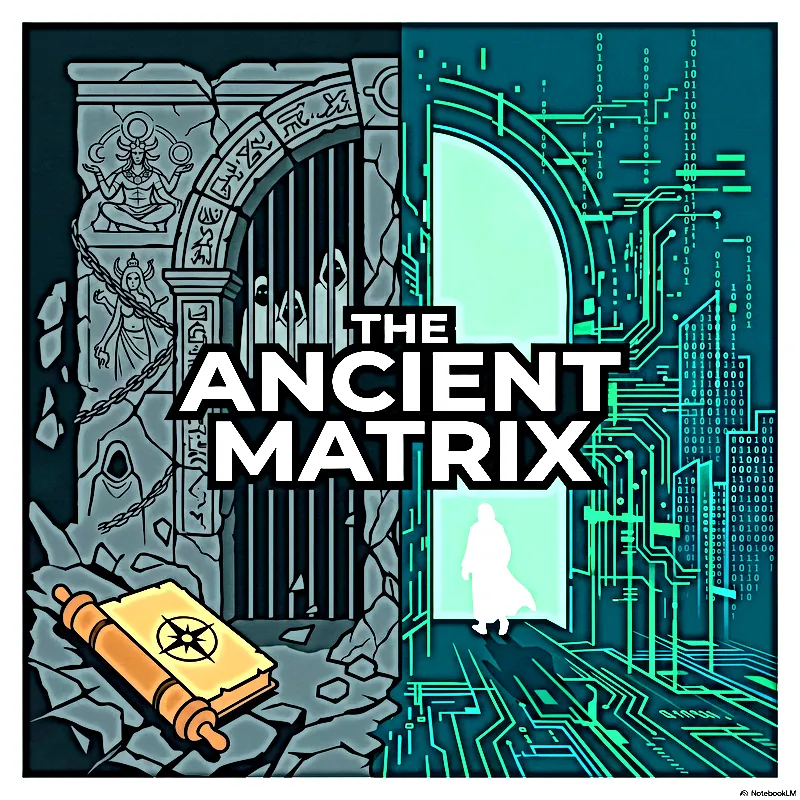
Gnosticism as the Ancient Simulation Hypothesis
Concept Snapshot
Origin
2nd-3rd Centuries AD
Key Traditions
Sethian & Valentinian
Metaphor
Cosmic Prison
Modern Analogue
Simulation Hypothesis
Evidentiary Focus
Sethian Prison Cosmology
4
Valentinian Error & Forgetfulness
4
Structural Parallels
3
Cyber-Mythology (Matrix)
4
Mapping the Myth
| Dimension | Ancient Evidence::Modern Analogue |
|---|---|
| Derived World | Lower creator (Demiurge)::Simulated world (Bostrom) |
| Trapped Consciousness | Archons jail divine spark::Substrate-independent minds |
| Saving Knowledge | Gnosis / Awakening::The Red Pill |
| Exit Narrative | Ascent beyond Pleroma::Unplugging from Matrix |
This text explores the profound conceptual links between ancient Gnostic traditions and the modern simulation hypothesis, suggesting that historical myths serve as a narrative blueprint for today's digital philosophies. By examining Sethian and Valentinian cosmologies, the author illustrates how early ideas of a counterfeit world and a lesser creator mirror contemporary arguments that our reality might be an artificial construct. While acknowledging that these ancient thinkers did not literally anticipate computer science, the source highlights a shared "jailbreak myth" where salvation is achieved through a revelatory awakening to one's true origins beyond the system. Ultimately, the text positions the "red pill" symbolism of The Matrix as a modern revival of this gnosis, framing the struggle to recognize a fabricated existence as a timeless human preoccupation.
Framing the Claim
Gnosticism is a modern scholarly umbrella term rather than a single, universally agreed name for one ancient religion, and both reference works and academic summaries now stress that the category itself is contested. [1]Source entry missing for citation [1] https://doi.org/10.1017/CHOL9780521764407.013
Even so, many of the sources commonly grouped under that label share a recognizable mythic architecture: the visible world is made by a lower creator rather than the highest God, and salvation comes through a revelatory awakening to one's origin beyond the world. [1]Source entry missing for citation [1] https://doi.org/10.1017/CHOL9780521764407.013 https://iep.utm.edu/gnostic/
Nick Bostrom's 2003 simulation argument claimed that at least one of three propositions must be true: civilizations almost never become posthuman, posthuman civilizations almost never run many ancestor simulations, or we are almost certainly living in a computer simulation. https://doi.org/10.1111/1467-9213.00309 [15]Source entry missing for citation [15]
A recent article in Sophia states explicitly that Bostrom's hypothesis has "striking parallels" with the cosmogonies of Gnosticism, Mormonism, and Neoplatonism. [7]Source entry missing for citation [7]
The most defensible thesis, therefore, is not that ancient Gnostics anticipated computer science in a literal sense, but that Sethian and Valentinian cosmologies are powerful historical precursors to the later "counterfeit world plus awakening knowledge" pattern that now appears in simulation discourse, cyber-mythology, and red-pill storytelling. [7]Source entry missing for citation [7] https://jetpress.org/volume14/krueger.pdf [17]Source entry missing for citation [17]
Sethian Prison Cosmology
The text most often treated as the classic Sethian source is Apocryphon of John, which a Cambridge overview calls an early example of "classic Sethian Gnosticism," while Britannica calls it an especially important Gnostic myth. https://doi.org/10.1017/CHOL9780521764407.013 [2]Source entry missing for citation [2]
According to Britannica, the text presents itself as a secret revelation from Jesus to John and explains the relation between the divine realm, the material cosmos, and humanity. [2]Source entry missing for citation [2]
In that myth, the maker of the visible realm is not the highest God but a lesser ruler named Ialdabaoth/Yaldabaoth, whom Britannica describes as a dark caricature of the creator God of Genesis and as distinct from the true, transcendent deity. [2]Source entry missing for citation [2]
The same reference work defines the archons as world-governing powers made with the material world by the Demiurge and says that their recurring image is that of jailers imprisoning the divine spark in captive human souls. [3]Source entry missing for citation [3]
A translation of Hypostasis of the Archons preserved at the Nag Hammadi archive likewise characterizes the chief ruler as blind, ignorant, and arrogant, and records his exclusive claim to divinity. [9]Source entry missing for citation [9]
The most simulation-like moment in the Sethian material is the revealer's awakening speech in Apocryphon of John: the text says the revealer enters "the prison of the body" and commands the sleeper to rise from "deep sleep." [10]Source entry missing for citation [10]
Taken together, those elements generate a full ancient jailbreak myth: a derivative world, hostile or ignorant system-administrators, consciousness trapped inside embodied ignorance, and a wake-up call that comes from outside the enclosing system. [2]Source entry missing for citation [2] [3]Source entry missing for citation [3] [10]Source entry missing for citation [10]
Valentinian Revision of the Prison Myth
The Valentinian traditions associated with Valentinus were among the most famous of the movements later classed as Gnostic, and Britannica notes that their materials appear both in heresiological reports and among the Nag Hammadi works. [4]Source entry missing for citation [4]
Modern scholarship on Valentinianism is cautious about imposing one fixed system on every text, and an introduction to Valentinian Christianity: Texts and Translations argues that Valentinian writings are better understood through "family resemblance" than through a single doctrinal essence. [12]Source entry missing for citation [12]
That same scholarly introduction still identifies a common Wisdom/Sophia myth in which a heavenly mistake helps produce an inferior creator who then makes the material world. [12]Source entry missing for citation [12]
The major difference from Sethianism is that the Valentinian Demiurge is lower and limited without being straightforwardly demonic, and Britannica says plainly that the Demiurge in Valentinianism is "not a malevolent figure, as is Ialdabaoth in the Apocryphon of John." [2]Source entry missing for citation [2]
A Claremont encyclopedia entry on Tripartite Tractate says its second part explains the human condition by teaching that Adam's soul is composite: the spiritual element comes from the Logos, the psychic element from the Demiurge, and the hylic or material element from lower powers. [13]Source entry missing for citation [13]
That anthropology matters because the Valentinian problem is not just captivity but mixture and misrecognition. [13]Source entry missing for citation [13] [2]Source entry missing for citation [2]
The key Valentinian work for the red-pill analogy is Gospel of Truth, which the same modern source places confidently in the Valentinian corpus and describes not as a narrative gospel but as a homily. [12]Source entry missing for citation [12]
Cambridge's preview of the text says that "Error's own forgetfulness" is central to the work, while another Cambridge study says that knowledge abolishes terror and forgetfulness and enables reintegration into the Father. [14]Source entry missing for citation [14] https://www.cambridge.org/core/books/nag-hammadi-codices-and-their-ancient-readers/textual-fluidity-and-multiple-versions-in-monastic-textual-practice/672312FB2CCCA8612E655243EC20886C
A Nag Hammadi translation snippet from the same text adds that the aeons "rest themselves" in the Father once they know him. [11]Source entry missing for citation [11]
For that reason, the Valentinian tradition is a softer precursor to simulation language than the Sethian one: its dominant metaphor is not only prison but also error, forgetfulness, and the recovery of one's true interpretive frame. [14]Source entry missing for citation [14] https://www.cambridge.org/core/books/nag-hammadi-codices-and-their-ancient-readers/textual-fluidity-and-multiple-versions-in-monastic-textual-practice/672312FB2CCCA8612E655243EC20886C [2]Source entry missing for citation [2]
Why the Simulation Analogy Persuades
The analogy becomes clearest when the ancient materials are compared not word-for-word but structurally. [7]Source entry missing for citation [7] [17]Source entry missing for citation [17] https://jetpress.org/volume14/krueger.pdf
| Dimension | Ancient evidence | Modern analogue |
|---|---|---|
| Derived world | Sethian sources assign the cosmos to a lesser ruler, and Valentinian sources also distinguish a lower creator from the highest God. [2]Source entry missing for citation [2] [12]Source entry missing for citation [12] | The simulation argument likewise imagines experienced reality as produced by beings outside the world we experience. https://doi.org/10.1111/1467-9213.00309 [15]Source entry missing for citation [15] |
| Trapped consciousness | The archons are portrayed as jailers of the divine spark, and Valentinian anthropology treats humans as mixtures of spiritual, psychic, and material elements. [3]Source entry missing for citation [3] [13]Source entry missing for citation [13] | Bostrom's argument presupposes that conscious experience could in principle be instantiated on nonbiological computational substrates and therefore embedded within an artificial world. [15]Source entry missing for citation [15] |
| Saving knowledge | Gnosis is awakening to hidden origin, and the Gospel of Truth opposes saving knowledge to terror, deficiency, and forgetfulness. [1]Source entry missing for citation [1] https://www.cambridge.org/core/books/nag-hammadi-codices-and-their-ancient-readers/textual-fluidity-and-multiple-versions-in-monastic-textual-practice/672312FB2CCCA8612E655243EC20886C [11]Source entry missing for citation [11] | The red pill in modern culture symbolizes the choice to abandon comfortable illusion for painful truth. https://www.britannica.com/topic/red-pill-and-blue-pill [18]Source entry missing for citation [18] |
| Exit narrative | Britannica summarizes the myth by saying divine sparks from the pleroma are trapped in humans and return through gnosis, while the Apocryphon's revealer awakens those trapped in the body. [5]Source entry missing for citation [5] [10]Source entry missing for citation [10] | Unplugging from a simulated environment or recognizing that one lives inside one functions as a secularized version of ascent beyond the enclosing system. https://www.britannica.com/topic/red-pill-and-blue-pill [19]Source entry missing for citation [19] [21]Source entry missing for citation [21] |
Structural Parallels
The strongest resemblance is between Sethian myth and what later culture would call a simulation prison: a world generated by a lower-order maker, governed by deceptive agents, and maintained through the ignorance of its captives. [2]Source entry missing for citation [2] [3]Source entry missing for citation [3] [10]Source entry missing for citation [10] https://doi.org/10.1111/1467-9213.00309
The strongest Valentinian resemblance is epistemic rather than carceral: the human problem is lived forgetfulness, and salvation is the recovery of hidden provenance and meaning. [14]Source entry missing for citation [14] https://www.cambridge.org/core/books/nag-hammadi-codices-and-their-ancient-readers/textual-fluidity-and-multiple-versions-in-monastic-textual-practice/672312FB2CCCA8612E655243EC20886C [11]Source entry missing for citation [11]
That is why the phrase "take the red pill" maps so well onto gnosis: in both cases, the decisive event is not merely learning another fact but discovering that the world, the self, and the source of authority have all been fundamentally misdescribed. [1]Source entry missing for citation [1] https://www.britannica.com/topic/red-pill-and-blue-pill [18]Source entry missing for citation [18] [21]Source entry missing for citation [21]
Structural Limits
The analogy still has real limits because ancient Gnostic texts do not describe the universe as software, computation, or code, and Bostrom's hypothesis depends instead on computation, posthuman engineering, and substrate-independence. [15]Source entry missing for citation [15]
David J. Chalmers also argues that the Matrix Hypothesis is a metaphysical claim about the underlying nature of reality, not a straightforward skeptical proof that the world is unreal. [16]Source entry missing for citation [16] [19]Source entry missing for citation [19]
A critical theological reading by Enrico Beltramini goes further and argues that the simulation hypothesis is not classic Gnosticism at all but a modern nihilism that lacks the old transcendental exit. [17]Source entry missing for citation [17]
So the phrase "ancient simulation hypothesis" is best taken as an illuminating historical analogy rather than as a claim that Sethians or Valentinians literally taught digital metaphysics. [7]Source entry missing for citation [7] [17]Source entry missing for citation [17]
Cyber-Mythology and The Matrix
The modern symbol complex of red pill, wake up, and unplugging comes most directly from The Matrix, and Britannica defines the red and blue pills as symbols of choosing painful reality over blissful ignorance. https://www.britannica.com/topic/red-pill-and-blue-pill
In the film's screenplay, Morpheus tells Neo that the world has been "pulled over" his eyes and that he lives inside "a prison for your mind." [18]Source entry missing for citation [18]
The franchise's link to philosophy was made explicit very early, because David J. Chalmers notes that his essay "The Matrix as Metaphysics" was written for the official Matrix website's philosophy section, and in that essay he defines a matrix as an artificially designed computer simulation of a world. [19]Source entry missing for citation [19]
Scholarly reception moved in the same direction: the issue index for the Journal of Religion and Film lists Frances Flannery-Dailey and Rachel L. Wagner's article "Wake up! Gnosticism and Buddhism in The Matrix," and the article abstract says that the film draws on multiple religious traditions to build its worldview. [20]Source entry missing for citation [20] https://doi.org/10.32873/uno.dc.jrf.05.02.04
A later philosophical essay by Marcus William Hunt says that one way to read the trilogy is as a cyber-version of the Gnostic epic, and he argues that the command "Wake up, Neo" realizes the old Gnostic Call to awaken from sleep inside a false world. [21]Source entry missing for citation [21]
More broadly, sociologist Stef Aupers describes the convergence of digital technology and spirituality as "cybergnosis," a relocation of the sacred to the digital realm, while Oliver Krueger argues that posthuman dreams of virtual immortality are a continuation or revivification of ancient Gnostic philosophy. [22]Source entry missing for citation [22] https://jetpress.org/volume14/krueger.pdf
The best-supported conclusion is therefore that The Matrix did not need to preach ancient Gnosticism literally in order to reactivate its narrative grammar: a false world, hidden rulers, sleeping selves, dangerous revelation, and liberating reidentification. [21]Source entry missing for citation [21] https://jetpress.org/volume14/krueger.pdf [22]Source entry missing for citation [22]
Verdict
If one asks which ancient tradition most closely resembles a simulation prison, the answer is Sethian theology, because its myths foreground a counterfeit cosmos, deceptive rulers, and a wake-up summons issued to consciousness trapped in the body. [2]Source entry missing for citation [2] [3]Source entry missing for citation [3] [10]Source entry missing for citation [10]
If one asks which ancient tradition most closely resembles a cognitive red-pill awakening, the answer is Valentinian Christianity, because its dominant language is not only imprisonment but also error, forgetfulness, deficiency, and rest gained through knowledge of the Father. [14]Source entry missing for citation [14] https://www.cambridge.org/core/books/nag-hammadi-codices-and-their-ancient-readers/textual-fluidity-and-multiple-versions-in-monastic-textual-practice/672312FB2CCCA8612E655243EC20886C [11]Source entry missing for citation [11] [2]Source entry missing for citation [2]
Bostrom's modern hypothesis belongs to analytic metaphysics and computational speculation rather than to ancient salvation theology, and Chalmers explicitly argues that a simulated world can still be real even if its underlying structure is surprising. https://doi.org/10.1111/1467-9213.00309 [15]Source entry missing for citation [15] [16]Source entry missing for citation [16]
So the most accurate final formulation is this: Gnosticism was not an ancient theory of computer code, but it was an ancient myth of counterfeit reality and awakening consciousness, and that is why it functions so well as the deepest historical precursor to modern simulation talk, cybergnosis, and the red-pill imagination of The Matrix. [7]Source entry missing for citation [7] https://jetpress.org/volume14/krueger.pdf [22]Source entry missing for citation [22] [21]Source entry missing for citation [21] [17]Source entry missing for citation [17]
Sources
- [1]
- [2]
- [3]
- [4]
- [5]
- [6]
- [7]
- [8]
- [9]
- [10]
- [11]
- [12]
- [13]
- [14]
- [15]
- [16]
- [17]
- [18]
- [19]
- [20]
- [21]
- [22]