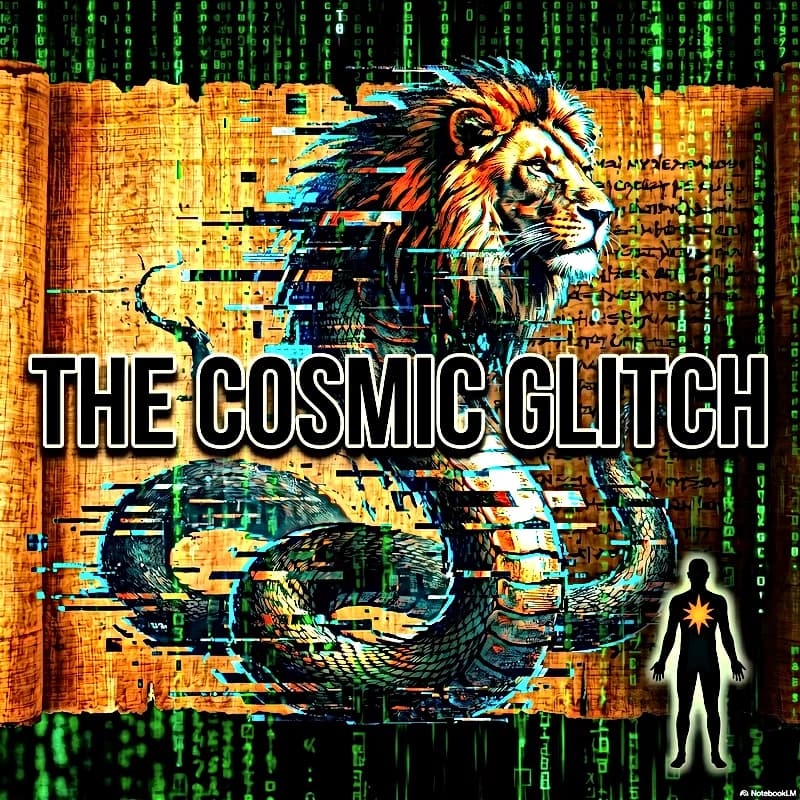
Sophia's Error as the Cosmic Glitch
Concept Snapshot
Key Figure
Sophia (Wisdom)
Trigger
Unauthorized Emanation
Outcome
Yaldabaoth & The Archons
Metaphor
System Glitch / Backdoor Patch
Thematic Balance
Primary Sources (Nag Hammadi)
5
Sethian Pattern
4
Valentinian Pattern
3
Modern Interpretative Framework
3
Mythic Prototypes
| Ancient Idiom | Textual Basis::Modern Metaphor |
|---|---|
| Unauthorized Generation | Sophia acts without approval::Unauthorized Process |
| Malformed Output | Yaldabaoth as lion-faced serpent::Corrupted Output |
| Ignorance | Yaldabaoth's exclusive claim::Missing Origin Data |
| Hidden Insight | Luminous Epinoia in Adam::Backdoor Recovery Channel |
Sources and frame
The Nag Hammadi codices were discovered near Nag Hammadi in Upper Egypt in 1945, and scholars describe them as fourth-century papyrus codices preserving a large body of Coptic translations of earlier works. [2, 7]
The collection contains over fifty texts, and the Apocryphon of John survives in three Nag Hammadi copies plus a fourth copy in the Berlin Codex, which is one reason scholars treat it as a major witness to Sethian mythmaking. [3]
The category Gnosticism is itself disputed in scholarship, and major reference works explicitly warn that it is a troubled or problematic classification inherited from ancient heresiology rather than a simple self-description used uniformly by the texts themselves. [1]
| Source cluster | Why it matters for this prompt |
|---|---|
| Apocryphon of John | This text gives the clearest surviving account of Sophia's independent generation, the rise of Yaldabaoth, the formation of a dim and deficient lower cosmos, and the hiding of luminous insight within Adam as a remedy for Sophia's deficiency. [4] |
| Hypostasis of the Archons | This text repeats the motif that Sophia creates alone without her partner and adds a dramatic anthropology in which incorruptible Spirit migrates through Adam, Eve, the serpent, and Norea against the archons. [5] |
| On the Origin of the World | This text parallels Hypostasis, treats Sophia and Zoē as salvific agents, and is summarized by scholars as ending with the destruction of the archons' creation rather than its permanent stabilization. [6] |
| Irenaeus, Against Heresies | Irenaeus preserves an important Valentinian version in which Sophia's passion yields Achamoth, the visible world emerges from her disturbances, and the Demiurge is ignorant and imagines himself sole creator. [10, 12] |
| Modern scholarship | Modern scholarship is useful here not to replace the ancient texts, but to distinguish Sethian from Valentinian patterns and to keep the “glitch” metaphor from flattening real differences among traditions. [8, 1, 11] |
Sophia's unauthorized emanation and the birth of the anomaly
In the Apocryphon of John, Sophia is said to generate by herself, without the approval of the Spirit and without the participation of her consort, which makes her action an act of unsanctioned production inside the myth's own logic. [4]
The product of that act is described as imperfect, unlike Sophia's own appearance, and so malformed that it takes the form of a lion-faced serpent whom she hides away in a cloud and names Yaldabaoth. [4]
The same text says that Yaldabaoth seizes a great power from his mother, withdraws from her, and generates subordinate rulers and heavens of his own. [4]
The lower realm that results is not pure darkness and not pure light, but a dim mixture produced by the mingling of both, and Yaldabaoth's arrogance culminates in the claim that he alone is God because he does not know the source of the power he stole. [4]
The Hypostasis of the Archons repeats the same structural premise by saying that Sophia, called Pistis, wished to create something by herself without her consort, after which a veil, shadow, and matter define the split between upper incorruptibility and lower corruption. [5, 13]
In the Valentinian account preserved by Irenaeus, Sophia's passion is presented differently, but the result is still an ontological disturbance in which her shapeless or unfixed derivative stands outside the Pleroma and visible reality emerges from the disturbances or passions associated with that crisis. [10]
| Stage in the myth | Primary textual witness | Relevance to the “glitch” metaphor |
|---|---|---|
| Unauthorized generation | Sophia acts without Spirit-approved cooperation and without her consort in the Apocryphon of John. [4] | As an interpretive inference, this resembles a process launched outside authorized order or permission. [4, 5] |
| Malformed output | The offspring is explicitly described as imperfect and unlike its mother, and then takes on a monstrous serpent-lion form. [4] | As an interpretive inference, this is the closest ancient equivalent to corrupted output rather than intended emanation. [4] |
| Runaway subsystem | Yaldabaoth takes power from Sophia, departs, and generates his own authorities and heavens. [4] | As an interpretive inference, the myth now behaves like an error that has become self-propagating. [4] |
| False self-certification | Yaldabaoth declares himself sole God while remaining ignorant of his source. [4] | As an interpretive inference, this fits the idea of a defective controller mistaking local scope for total sovereignty. [4, 12] |
The flawed cosmos as a corrupted construct
The ancient texts do not call the material world a simulation, but as an interpretive inference they do describe it as a derivative, dimmed, and counterfeit order constructed by an inferior ruler rather than by the highest God. [4, 8]
The Apocryphon of John says the reworked human body is formed from earth, water, fire, matter-derived spirit, darkness, desire, and a false spirit, and it calls that body a tomb and a bond of forgetfulness. [4]
The same text recodes Eden itself as a trap by portraying the rulers' paradise as deceptive, bitter, corrupt, and oriented toward death rather than toward genuine life. [4]
In Irenaeus's report of Valentinian doctrine, the visible world is generated out of Sophia-Achamoth's disturbances, and the Demiurge imagines that he creates by himself while remaining ignorant of the heavens, the earth, humanity, and even his own mother. [10, 12]
That combination of inferior authorship, ignorance, false self-certainty, composite materiality, and forgetfulness is why the user's “corrupted code” metaphor has real traction, even though the ancient idiom is metaphysical and mythic rather than computational. [4, 12]
| Ancient idiom | What the text says | Closest modern metaphor |
|---|---|---|
| Ignorance | Yaldabaoth boasts of exclusive divinity because he does not know the source of his own power. [4] | Faulty system state caused by missing origin data. [4] |
| Deficiency | Sophia later recognizes a deficiency resulting from her act, and hidden luminous insight is placed in Adam as a remedy for that deficiency. [4] | Error condition followed by corrective routine. [4] |
| False spirit | The rulers produce a deceptive spirit that misleads souls and deepens forgetfulness. [4] | Malicious payload or poisoned process. [4] |
| Forgetfulness | The mortal body is described as a prison-like form that binds the human being into oblivion of origin. [4] | Memory corruption or amnesia built into the environment. [4] |
Humanity as the hidden recovery channel
The Apocryphon of John says that Sophia seeks to recover the maternal power trapped in the chief archon, petitions the merciful Father, and then the five lights tell Yaldabaoth to breathe his spirit into Adam. [4]
When Yaldabaoth obeys, the text says that the power of his mother leaves him and passes into the natural body of Adam, which immediately becomes luminous and strong. [4]
The rulers then become jealous because Adam's intelligence surpasses theirs and the chief archon's, which shows that the implanted divine element destabilizes the hierarchy that built the lower world. [4]
The same passage adds that a luminous Epinoia or Life is hidden in Adam specifically so that the rulers cannot detect it and so that it may function as a remedy for the mother's deficiency. [4]
Later in the text, Sophia is described as descending in innocence to repair her own deficiency, and she is identified with Life, the mother of the living, through whom humans taste perfect knowledge. [4]
Modern scholars often summarize this anthropological theme with the language of a divine spark in humanity, and Cambridge reference works describe the broader pattern as the fall of a divine spark into humans and the conviction that the deepest human core derives from the divine world. [1]
The Apocryphon of John itself states that those on whom the Spirit of life descends are saved and perfected, whereas those dominated by the false spirit are led astray and imprisoned in ignorance until they regain knowledge. [4]
As an interpretive inference, this is the strongest basis for calling the divine element in humanity a backdoor patch, because the rulers unknowingly transfer the very power that will undermine their control and awaken their captives from inside the system they built. [4]
| Repair mechanic in the myth | Textual basis | Interpretive value |
|---|---|---|
| Power extraction from the archon | Yaldabaoth is tricked into breathing out the power derived from his mother and thereby animating Adam. [4] | The inferior ruler unknowingly seeds the agent of his own defeat. [4] |
| Hidden luminous insight | Luminous Epinoia is concealed in Adam so the archons do not know her and so she can remedy Sophia's deficiency. [4] | This most closely resembles a concealed recovery layer or hidden override path. [4] |
| Awakening through knowledge | Sophia/Life and the revealer bring knowledge that awakens humans from forgetfulness. [4] | The patch is not merely ontological presence; it requires activation through revelation. [4] |
| Split outcome | Souls strengthened by the Spirit of life are saved, while souls ruled by the false spirit remain in error until freed by knowledge. [4] | The remedy exists in the world, but its effect is not automatic or universal in the same way for every soul. [4] |
Sethian and Valentinian models compared
The user's specific framing aligns most strongly with Sethian materials such as the Apocryphon of John and the Hypostasis of the Archons, because those texts directly trace the lower world's disorders to Sophia's solitary act and to the ignorance of the rulers produced from it. [4, 5]
The Valentinian evidence preserved by Irenaeus is related but not identical, because the narrative moves through Sophia's passion, the emergence of Achamoth, and a Demiurge formed from animal substance who is ignorant and self-deceived, yet is not always described with the same stark hostility found in Sethian materials. [12, 10, 11]
Scholars also note that texts commonly grouped as Gnostic do not all demonize the creator in the same way, and Britannica explicitly warns that what these myths share is often the presence of inferior creators rather than one uniform evaluation of the creator or of matter. [11]
| Question | Sethian pattern | Valentinian pattern |
|---|---|---|
| What triggers the crisis? | Sophia generates alone, without approved cooperation, and the result is Yaldabaoth and the archons. [4, 5] | Sophia's passion and failed attempt produce a disturbance outside the Pleroma. [10] |
| What is the Demiurge like? | He is a thief of maternal power, architect of a dim lower order, and openly ignorant. [4] | He is an ignorant maker who imagines himself sole creator. [12] |
| How is humanity linked? | Through maternal power and hidden luminous Epinoia that awakens and repairs. [4] | Through a spiritual element deposited in humanity without the Demiurge's knowledge. [12] |
| How does the story end? | Moves toward awakening, salvation of the spiritual, and destruction of the rulers. [13, 6] | Emphasizes restoration, proper ordering, and different destinies of spiritual, psychic, and material elements. [12] |
How well the glitch and backdoor metaphors hold
As a historically careful interpretation, calling Sophia's act the original system glitch works best for the Sethian materials, because those texts explicitly present an unsanctioned generation that produces a malformed ruler, a dim lower cosmos, counterfeit embodiment, and a regime of ignorance and forgetfulness. [4, 5]
As a historically careful interpretation, calling the divine element in humanity a backdoor patch also fits surprisingly well, because the archon unknowingly transfers Sophia-derived power into Adam, the rulers cannot detect the hidden luminous insight in humanity, and salvation comes through awakening that hidden relation to the upper realm. [4, 1]
The metaphor becomes less exact if it suggests that humanity autonomously crashes the world-order by its own unaided effort, because the primary sources normally add a revealer, higher lights, heavenly intervention, judgment, or eschatological destruction rather than a purely self-executing human hack. [4, 13, 6]
The On the Origin of the World and Hypostasis of the Archons materials do support an eventual end of the archontic order, because scholarly summaries of those texts describe the destruction of the archons or the destruction of their creation as part of the final state. [13, 6]
Even so, the most text-faithful conclusion is that the ancient myth imagines exposure, awakening, exodus, and judgment more clearly than it imagines the material world as a literal software simulation. [4, 11]
Sources
- https://www.cambridge.org/core/books/cambridge-companion-to-christian-heresy/gnosticism/50F270B25A600F4AF57131C2673B3305
- https://www.cambridge.org/core/books/nag-hammadi-codices-and-their-ancient-readers/introduction/333084781B98EFDB225C0C6EC60D1F84
- https://www.britannica.com/topic/gnosticism/Apocryphon-of-John
- https://pm.whdl.org/sites/default/files/resource/7387091/The%20Apocryphon%20of%20John%20-%20Frederik%20Wisse%20-%20The%20Nag%20Hammadi%20Library.pdf?language=en
- https://www.gnosis.org/naghamm/hypostas.html
- https://ccdl.claremont.edu/digital/api/collection/cce/id/1489/download
- https://www.gnosis.org/naghamm/nhl.html
- https://resolve.cambridge.org/core/services/aop-cambridge-core/content/view/EA2BBE9BEB03A5E426D13462B6FA6EA2/9781139095457c10_p174-196_CBO.pdf/gnosticism.pdf
- https://www.gnosis.org/naghamm/origin.html
- https://www.newadvent.org/fathers/0103102.htm
- https://www.britannica.com/topic/gnosticism/Diversity-of-gnostic-myths
- https://www.newadvent.org/fathers/0103105.htm
- https://ccdl.claremont.edu/digital/api/collection/cce/id/1001/download