Lunar Orbital Mechanics and Placement Precision
Key Lunar Parameters
Average Distance
384,400 km
Orbital Tilt
5°
Visible Surface
59% (via libration)
Recession Rate
3.8 cm/yr
Support for Lunar Hypotheses
Natural Tidal Locking
5
Giant Impact Formation Models
4
Anthropic Stabilization Role
3
Engineered Placement
1
Analyst Note
Current astronomy does not offer a single accepted numeric probability for the Moon's exact present configuration. Instead, standard tidal theory evaluates mechanisms and parameter ranges, concluding that tidal locking itself is a common natural outcome for large satellites, while engineered placement remains outside the evidence-based literature.
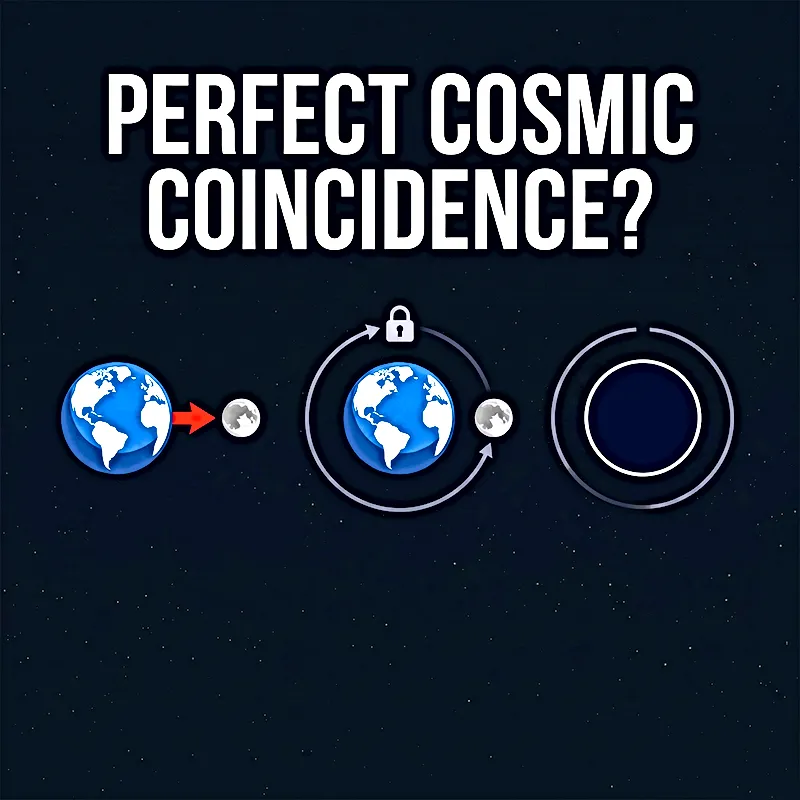
The Moon is in a long-lived 1:1 spin-orbit resonance with Earth, meaning it rotates once on its axis in the same time that it revolves around Earth, so the same hemisphere faces Earth on average.
That configuration is not a mathematically perfect concealment of the far side in the strict everyday sense, because the Moon's elliptical orbit and orbital tilt produce libration, allowing observers on Earth to see about 59% of the lunar surface over time rather than exactly 50%.
Within accepted models, tidal locking itself is not extraordinary. NASA states that all the solar system's large moons are tidally locked with their planets and that larger moons synchronize early, within hundreds of thousands of orbits. Barnes likewise notes that bodies on circular orbits tidally evolve toward synchronous rotation, whereas eccentric orbits can produce libration or super-synchronous states.
What appears more unusual than tidal locking per se is that Earth has a fractionally large Moon. Recent modeling argues that rocky planets smaller than about 1.6 Earth radii are the best candidates for forming fractionally large impact-generated moons, and the Earth-Moon system is explicitly treated as an important example of that class.
The near-match between the apparent sizes of the Sun and Moon that allows total solar eclipses is treated in mainstream astronomy as a natural and temporary coincidence, not as evidence of engineering. NASA explicitly describes total eclipses as the result of a "cosmic coincidence," notes that annular eclipses already occur because the apparent sizes vary, and explains that total solar eclipses will eventually disappear because the Moon is receding from Earth by about 3.8–4 cm per year.
The Moon's Present Configuration
| Quantity or feature | Accepted description::Why it matters |
|---|---|
| Spin state | The Moon rotates at the same rate it orbits Earth, a special case of synchronous rotation.::This is why one hemisphere faces Earth on average. |
| Average Earth-Moon distance | About 384,400 km.::Sets tides, apparent size, and long-term tidal evolution. |
| Orbital shape | The orbit is elliptical, not perfectly circular.::Causes changing orbital speed and changing apparent size. |
| Orbital inclination | About 5° to the ecliptic.::Explains why eclipses are seasonal rather than monthly. |
| Visible fraction over time | Earth-based observers can see about 59% of the Moon over time because of libration.::Shows that 'far side permanently hidden' is only approximately true. |
| Current recession | The Moon is receding by about 3.8–4 cm/yr.::Proves the present geometry is evolving and not fixed. |
How likely synchronous rotation is in accepted mechanics
In standard tidal theory, a close secondary body raises tidal bulges, dissipates energy internally, and evolves toward a state in which the torque no longer changes the spin rate strongly. Barnes summarizes the general rule succinctly: tidally locked bodies on circular orbits evolve toward synchronous rotation, whereas eccentric cases can librate or settle into super-synchronous states.
NASA's current Moon explainer emphasizes the same point in more Solar-System-specific language: the Moon's early, hotter, less rigid body was strongly distorted by Earth's gravity, the misaligned tidal bulge dissipated energy as heat, the spin slowed, and the system reached the state where one rotation matched one orbit. NASA also states that this process is common, not rare, among large moons.
So the best evidence-based answer to the user's "mathematical likelihood" question is conditional rather than absolute. Conditional on a sufficiently massive moon forming close enough to its primary and surviving for long enough, the likelihood of ending in or near synchronous rotation is high under accepted tidal evolution theory.
The Moon's role in Earth's obliquity and tides
The strongest classical result on obliquity stabilization is the 1993 Laskar study, which found that Earth's obliquity without the Moon could vary between about 0° and 85° under chaotic evolution. That result is still the landmark argument for the claim that the Moon stabilizes Earth's axial tilt.
Later work made the picture more nuanced. Lissauer, Barnes, and Chambers reported that although a moonless Earth's obliquity varies more than the real Earth's, it typically stays within a constrained range over long intervals, and they concluded that a large moon does not seem to be needed to stabilize an Earth-like planet's obliquity on timescales relevant to advanced life. Li and Batygin pushed that nuance further by arguing that even in the Moon's absence, chaotic obliquity diffusion would be slow enough that it would not preclude long-term habitability.
For tides, the evidence is stronger on mechanism than on biological necessity. NOAA states that the Moon is the major influence on Earth's tides and that solar tides are about half as large as lunar tides. Biologically, the best-supported claim is not "tides were necessary," but "tides can matter a great deal."
A careful habitability summary, therefore, is that the Moon gives Earth stronger and more structured tides and likely a more stable obliquity history, both of which may have favored some long-term biospheric developments, but the present evidence base does not justify saying the Moon was uniquely required for complex life.
Eclipse symmetry and the question of fine tuning
NASA's eclipse geometry page states that a total solar eclipse happens because the Sun is about 400 times bigger than the Moon but also about 400 times farther away, making the two appear almost exactly the same size in Earth's sky. NASA explicitly calls this a "cosmic coincidence."
That coincidence is also imperfect. NASA explains that the Moon and Sun do not keep identical apparent sizes, because both the Moon's orbit around Earth and Earth's orbit around the Sun are slightly elliptical. When the Moon is near apogee, it can appear too small to cover the Sun completely, producing an annular eclipse rather than a total eclipse.
The symmetry is also temporary on geological timescales. NASA's current explanation says the Moon is receding by about 3.8 cm per year, and that total solar eclipses will disappear in more than 600 million years once the Moon is far enough away that it can no longer fully cover the Sun. That temporal finiteness matters for probability arguments. A phenomenon that exists only during one section of Earth's history is not well described as a timeless "perfect placement"; it is better described as a consequence of evolving orbital geometry.
Accepted Models vs Engineered Claims
| Question | Supported by accepted literature::Not established by accepted literature |
|---|---|
| Why is the Moon tidally locked? | Tidal dissipation and spin-orbit evolution naturally drive close satellites toward synchronous states.::A need for external engineering to create 1:1 locking. |
| Why does the Moon stay at its present distance? | It does not stay fixed |
| it is receding today because of tidal interaction with Earth. | Any evidence that the present distance is a static, intentionally preserved setting. |
| Why are eclipses so close to 'perfect'? | Apparent-size matching follows from current size-distance ratios and changing elliptical orbits |
| it is a transient coincidence. | Any observational signature showing total-eclipse geometry was engineered. |
| Why is the Moon relatively large? | Impact formation models can produce fractionally large moons under constrained conditions |
| Earth may lie in a favorable mass-radius regime. | A demonstrated non-natural cause for the Moon's mass ratio or composition. |
| Did the Moon help habitability? | Likely yes, by affecting tides and obliquity stability.::That it was unequivocally necessary for complex life. |
Open questions and limitations
A single rigorous statistical probability for "getting a Moon exactly like ours" is still unavailable because the lunar outcome depends on uncertain initial conditions and on several coupled stages of evolution rather than one draw from a simple distribution.
The eclipse-related "fine-tuning" discussion has a real scientific component only at the level of geometry, tidal modulation, and possible anthropic selection effects. It does not currently extend to a validated scientific case for deliberate placement or engineering.