Precision Dynamics of the Earth-Moon System: Orbital Mechanics, Astrobiological Stabilization, and Evolutionary Hypotheses
Lunar Orbital Baseline
Mean Radius
1738.1 km
Orbital Distance
384,400 km
Orbital Period
27.32 days
Mass Ratio to Earth
1.23×10^-2
Drivers of Lunar Evolution
Tidal Friction / Gravitational Torque
5
Giant Impact Synthesis
4
Cassini State Precession
3
Engineered Static Placement
1
Analyst Note
While the Moon's large mass ratio and stabilizing role for Earth's axial tilt are unique and important, they are fully consistent with natural planetary accretion physics and tidal evolution. Claims of engineered, static design ignore the continuous 3.8 cm/year orbital recession and the resulting temporal nature of lunar phenomena.
Tidal locking is a stable dynamical endpoint in the rotational evolution of a satellite orbiting a primary body, wherein the satellite's axial rotation period matches its orbital revolution period, forcing the satellite to permanently present the same hemisphere to its primary. This synchronization is driven by the gravitational gradient exerted by the primary body, which deforms the satellite into an elongated, prolate spheroid.
Because Earth's rotation is faster than the Moon's orbital period, tidal friction drags Earth's tidal bulge ahead of the Earth-Moon axis. This bulge continuously exerts a forward gravitational pull on the Moon, transferring angular momentum from Earth's rotation to the Moon's orbit. As a consequence, Earth's day is gradually lengthening, and the Moon is receding outward at a measured rate of roughly 3.8 cm per year. This exchange will continue until the system reaches a complete, mutually synchronized state, at which point Earth's day and the lunar month will equalize at 46.9 Earth days.
Planetary Satellite Comparison
| Satellite (Host) | Mass Ratio::Orbital Period::Tug-of-War Value (Primary vs Sun) |
|---|---|
| Moon (Earth) | 1.23×10^-2::27.32 days::0.46 (Sun wins) |
| Phobos (Mars) | 1.67×10^-8::7.66 hours::1.05 (at Mars orbit) |
| Deimos (Mars) | 2.26×10^-9::30.31 hours::>1.0 (Mars wins) |
| Io (Jupiter) | 4.70×10^-5::1.77 days::>1.0 (Jupiter wins) |
| Titan (Saturn) | 2.37×10^-4::15.94 days::>1.0 (Saturn wins) |
| Charon (Pluto) | 1.22×10^-1::6.39 days::>1.0 (Pluto wins) |
This comparison reveals that the Earth-Moon system is dynamically unique. In Asimov's "tug-of-war" metric, which calculates the ratio of the gravitational pull exerted on a satellite by its primary planet versus the Sun, the Moon scores a 0.46. This means the Sun's gravitational pull on the Moon exceeds Earth's gravitational pull on the Moon—making Earth's Moon unique among all major satellites where the primary planet overwhelmingly dominates.
Astrobiological Significance: Obliquity Stabilization
The presence of a massive satellite has long been considered a key factor in planetary habitability, primarily due to its capacity to stabilize a planet's axial tilt (obliquity). In 1993, Jacques Laskar demonstrated that Earth's current obliquity is stabilized at 23.3° by the Moon's gravitational torque, oscillating within a narrow range of ±1.3°. Without this lunar torque, Laskar argued that Earth's chaotic obliquity zone would expand to span nearly 0° to 85°. Under these moonless conditions, Earth's axis would wander chaotically, triggering severe, climate-disrupting swings.
However, Jack Lissauer's 2011 multi-body integrations leveraged high-performance computing to discover that without the Moon, Earth's prograde rotational axis would actually remain relatively stable, wobbling by only about 10° more than its current tilt, regulated by secular gravitational resonances with giant neighboring planets like Jupiter. This implies that a large moon is not a strict necessity for long-term climate stability, expanding the potential parameter space for habitable exoplanets.
Evolution of Planetary Spin and Obliquity
| Scenario | Rotational Speed::Resulting Obliquity Behavior |
|---|---|
| Present Earth (with Moon) | 1.0 v0::Stable precession |
| minor variations of ±1.3° around 23.3° mean. | - |
| Moonless Earth (Present Spin) | 1.0 v0::Chaotic obliquity variations spanning nearly 0° to 85° over millions of years. |
| Moonless Earth (2.5 Ga Spin) | 1.22 v0::Large chaotic zone expanding from 0° to 80° |
| axial tilt can exceed 50° rapidly. | - |
| Moonless Earth (Primordial) | 1.6 v0::If obliquity starts at 0°, variations are ~10° |
| if tilt ≥4°, chaos exceeds 30°. | - |
Prebiotic Evolution and Tides
Following the Moon-forming collision, the young Moon orbited 10 to 15 times closer to Earth than it does today. This continuous mechanical kneading generated substantial tidal heating, powering a deep magma ocean and driving global volcanic activity that degassed a thick, volatile-rich atmosphere.
Furthermore, the Moon-driven tides may have actively facilitated abiogenesis. At approximately 3.9 Ga, Earth's rapid rotation and the Moon's close proximity produced high-amplitude, rapid coastal tides with a periodicity of 2 to 6 hours. This fast tidal cycling acted as a prebiotic engine driving the replication of DNA-like polymers through a mechanism analogous to the laboratory Polymerase Chain Reaction (PCR). During the low-tide drying phase, evaporative concentration promoted non-enzymatic polymerization, while the high-tide flooding phase caused the double-stranded duplexes to spring apart, freeing both single strands to serve as templates in the next drying cycle.
Accepted Scientific Models of Origin and Evolution
The leading scientific explanation for the origin of the Earth-Moon system is the Giant Impact Hypothesis, which posits that a Mars-sized co-orbital protoplanet named Theia collided with the proto-Earth approximately 4.5 billion years ago. The high-energy collision melted much of Earth's mantle and flung rock and metal debris into a circumplanetary disk that coalesced to form the Moon.
To reconcile this hypothesis with the near-identical oxygen and titanium isotope ratios shared by Earth and Moon rocks, planetary scientists introduced the Synestia Model. This model proposes that the collision completely vaporized both bodies, merging them into a rapidly rotating, donut-shaped cloud of hot rock vapor called a synestia. The turbulent vapor mixed thoroughly, homogenizing the isotopic signatures before the outer regions cooled and accreted to form the Moon.
Engineered Placement Hypotheses
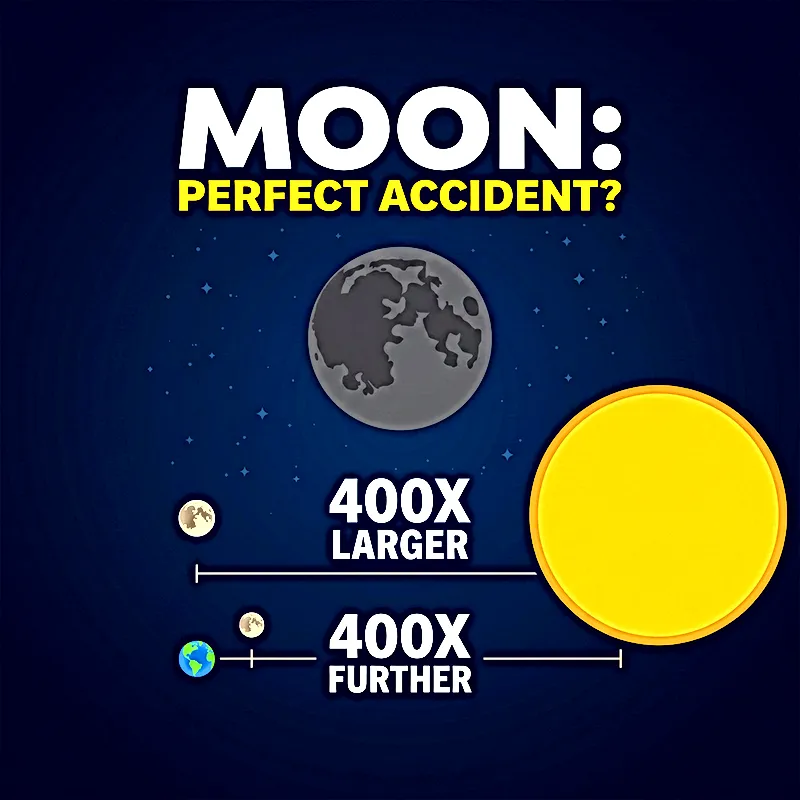
In contrast to accepted natural models, several alternative hypotheses propose that the Moon is not a natural celestial body, pointing to mathematical "coincidences" in the Earth-Moon-Sun system. Proponents claim the Moon was engineered based on integer-based relationships, noting that the Sun is approximately 400 times larger than the Moon and approximately 400 times further away. Both bodies consequently sweep out an identical angular size of approximately 0.5° in Earth's sky, enabling perfect total solar eclipses.
These claims are closely related to the "Hollow Moon" and "Spaceship Moon" hypotheses first advanced by Soviet scientists in 1970, who cited Apollo 12 experiments where the deliberate crash of the Lunar Module Ascent Stage caused the Moon to "ring like a bell" for nearly an hour.
Modern geophysics thoroughly refutes these assertions. Extensive lunar seismic data demonstrates that the Moon is a solid, differentiated body. The "ringing like a bell" phenomenon is fully explained by the Moon's dry, highly fractured geological structure, which scatters and reverberates seismic waves continuously because it lacks water to dampen them.
Transient Geometry
A rigorous scientific analysis of the Earth-Moon system indicates that its notable geometric properties are the result of dynamic processes rather than deliberate engineering. The "perfect" 400x solar eclipse symmetry is a transient phase in a continuously evolving system. Because the Moon is steadily receding at 3.8 cm per year, its apparent size in the sky is shrinking. In approximately 600 million years, the Moon's perigee distance will have grown by roughly 23,000 km, making total solar eclipses impossible and leaving only annular eclipses. Treating a temporary stage of a dynamic system as a permanent, static design feature ignores the broader timeline of orbital mechanics.