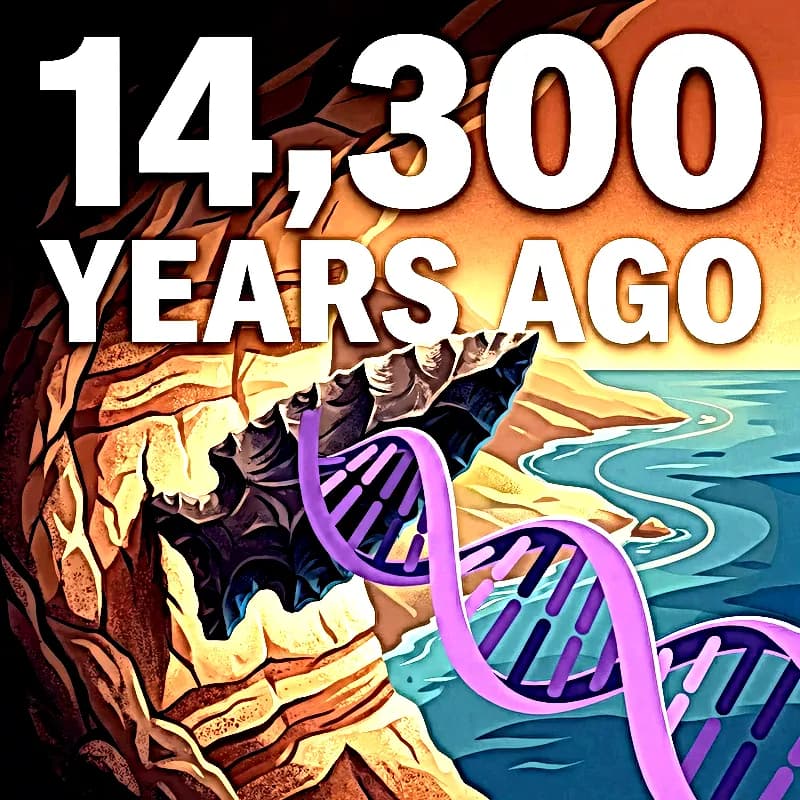
Archaeological Case File: The Paisley Five Mile Point Caves and the Deconstruction of the Clovis-First Paradigm
The archaeological consensus regarding the initial peopling of the Americas has, for nearly a century, been anchored to the "Clovis First" model. This paradigm posits that a single group of big-game hunters migrated from Siberia across the Bering Land Bridge into Alaska, subsequently moving southward through an ice-free corridor between the Laurentide and Cordilleran ice sheets approximately 13,000 to 13,500 years ago. However, forensic investigations conducted at the Paisley Five Mile Point Caves (Paisley Caves) in south-central Oregon have yielded empirical evidence that not only predates this timeline but also suggests a technologically and genetically divergent founding population. This report serves as a formal investigation into the Paisley Caves site, documenting the biological, lithic, and stratigraphic evidence that disrupts established chronological frameworks and exploring the implications of a maritime-based coastal migration.
Dossier Snapshot
Year Span
1838-2077
Word Count
3,286
Source Entries
45
Citation Calls
105
Report Signal Profile
Section Headings
19
Table Lines
19
Unique Citations
45
Source Entries
45
Verification Metrics
| Metric | Value |
|---|---|
| Document ID | drr_paisley_caves |
| Section Headings | 19 |
| Table Lines | 19 |
| Year Span | 1838-2077 |
| Citation Coverage | 45/45 |
Biological Forensics: The Chronological Disruption of Human Coprolites
The most significant evidentiary challenge to the Clovis paradigm at Paisley Caves is the recovery of human coprolites—fossilized excrement—directly dated to approximately 14,300 calibrated years before present (cal BP). These remains represent the oldest directly dated human biological material in the Western Hemisphere, providing a definitive anchor for human presence in North America at least a millennium before the appearance of Clovis technology [1]Clovis age Western Stemmed projectile points and human coprolites at the Paisley Caves - PubMed https://pubmed.ncbi.nlm.nih.gov/22798611/. Under the supervision of Dennis Jenkins from the University of Oregon's Museum of Natural and Cultural History, excavations targeting the deep silt and basalt-debris layers of Cave 5 and Cave 2 identified these specimens in well-stratified context [2]Paisley Caves study uncovers a new scoop on ancient poop - University of Oregon https://news.uoregon.edu/content/paisley-caves-study-uncovers-new-scoop-ancient-poop.
Mitochondrial DNA Analysis and Haplogroup Identification
Initial analysis of the coprolites was conducted by geneticist Eske Willerslev at the University of Copenhagen. Through the extraction and sequencing of mitochondrial DNA (mtDNA), the researchers identified founding Native American haplogroups A2 and B2 [3]DNA from pre-Clovis human coprolites in Oregon, North America - PubMed https://pubmed.ncbi.nlm.nih.gov/18388261/. These haplogroups are characteristic of contemporary indigenous populations in the Americas and trace their ancestral origins back to Siberian and East Asian populations, reinforcing the genetic link between Paleolithic Asians and the first Americans [3]DNA from pre-Clovis human coprolites in Oregon, North America - PubMed https://pubmed.ncbi.nlm.nih.gov/18388261/[4]INITIAL HUMAN COLONIZATION OF THE AMERICAS, REDUX | Radiocarbon https://www.cambridge.org/core/journals/radiocarbon/article/initial-human-colonization-of-the-americas-redux/F4094CA23F4F87D0021CFBF63152597D.
| Specimen ID | Lab Date (14C yr BP) | Calibrated Age (cal BP) | Identified Haplogroup | Analytical Laboratory |
|---|---|---|---|---|
| PC-2002-1 | 12,300 ± 60 | ~14,300 | A2 | Copenhagen / DNA Lab |
| PC-2002-2 | 12,290 ± 60 | ~14,290 | B2 | Copenhagen / DNA Lab |
| PC-1294 | 11,315 ± 25 | ~13,200 | A2 | Independent Blind Test |
| Bulrush Shaft | 12,273 ± 56 | ~14,200 | N/A (Cultural) | AMS Lab |
Data synthesized from: [3]DNA from pre-Clovis human coprolites in Oregon, North America - PubMed https://pubmed.ncbi.nlm.nih.gov/18388261/[1]Clovis age Western Stemmed projectile points and human coprolites at the Paisley Caves - PubMed https://pubmed.ncbi.nlm.nih.gov/22798611/[5]The Paisley Caves complex - when did people first reach North America? - Don's Maps https://donsmaps.com/coproliteevidence.html.
The dating of these samples was achieved using high-precision accelerator mass spectrometry (AMS) on terrestrial plants and macrofossils extracted directly from the coprolite matrix [6]Paisley Caves yield 13,000-year old Western Stemmed points, more https://pages.uoregon.edu/digital/uonews-archive/archive/news-release/2012/7/paisley-caves-yield-13000-year-old-western-stemmed-points-more-human-dna.html. This methodology was designed to bypass potential carbon-reservoir effects associated with aquatic resources. The dates of 14,290 to 14,400 cal BP are critical because they occur during the Bølling-Allerød warming period, prior to the onset of the Younger Dryas, a timeframe when the ice-free corridor was not yet ecologically viable for human migration [7]Did Pre-Clovis People Inhabit the Paisley Caves (And Why Does It https://digitalcommons.wayne.edu/cgi/viewcontent.cgi?article=1046&context=humbiol_preprints[8]Kelp Highway Hypothesis - ThoughtCo https://www.thoughtco.com/kelp-highway-hypothesis-171475.
Verification through Fecal Lipid Biomarkers
The validity of the coprolite DNA was challenged by several researchers who hypothesized that modern human DNA or DNA from later occupations could have leached downward through the cave's porous sediments, contaminating older, non-human specimens [7]Did Pre-Clovis People Inhabit the Paisley Caves (And Why Does It https://digitalcommons.wayne.edu/cgi/viewcontent.cgi?article=1046&context=humbiol_preprints[2]Paisley Caves study uncovers a new scoop on ancient poop - University of Oregon https://news.uoregon.edu/content/paisley-caves-study-uncovers-new-scoop-ancient-poop. To resolve this ambiguity, a forensic study led by Lisa-Marie Shillito and John Blong utilized fecal lipid biomarkers—chemically stable, hydrophobic molecules such as bile acids and sterols (e.g., 5β-stigmastanol and 5β-coprostanol) [9]Pre-Clovis occupation of the Americas identified by human fecal https://pmc.ncbi.nlm.nih.gov/articles/PMC7363456/.
Lipids are significantly less mobile than DNA in sedimentary environments. The analysis confirmed that of the specimens previously identified as human via DNA, three pre-Clovis samples were unequivocally human in origin based on their lipid profiles [9]Pre-Clovis occupation of the Americas identified by human fecal https://pmc.ncbi.nlm.nih.gov/articles/PMC7363456/. This "unambiguous" biomarker evidence supports the integrity of the stratigraphic record and confirms that the DNA was not a product of leaching from younger strata [9]Pre-Clovis occupation of the Americas identified by human fecal https://pmc.ncbi.nlm.nih.gov/articles/PMC7363456/[2]Paisley Caves study uncovers a new scoop on ancient poop - University of Oregon https://news.uoregon.edu/content/paisley-caves-study-uncovers-new-scoop-ancient-poop. The presence of these individuals at Paisley Caves nearly 1,000 miles from the contemporary coastline suggests a well-established interior presence derived from an even earlier coastal arrival.
Technological Correlation: Western Stemmed Tradition vs. Clovis
The lithic industry at Paisley Caves provides a separate but corroborating line of evidence for the disruption of the Clovis-First model. The site has produced a significant assemblage of projectile points and stone tools that belong to the Western Stemmed Tradition (WST), yet it is notably devoid of the fluted points that define the Clovis culture [10]Oregon's Paisley Caves as old as Clovis sites - but not Clovis - Newsroom https://news.oregonstate.edu/news/oregons-paisley-caves-old-clovis-sites-not-clovis.
Morphological Divergence and Parallel Development
Western Stemmed points differ fundamentally from Clovis points in their manufacturing process and hafting technology. Clovis points are characterized by a central "flute" or longitudinal groove removed from the base, designed to secure the point to a split shaft [11]Clovis people weren't alone - Science Illustrated https://scienceillustrated.com.au/blog/science/clovis-people-werent-alone/. In contrast, WST points feature a constricted, stem-like base and were manufactured from smaller flakes using different reduction sequences [11]Clovis people weren't alone - Science Illustrated https://scienceillustrated.com.au/blog/science/clovis-people-werent-alone/[10]Oregon's Paisley Caves as old as Clovis sites - but not Clovis - Newsroom https://news.oregonstate.edu/news/oregons-paisley-caves-old-clovis-sites-not-clovis.
| Technology Feature | Clovis Tradition | Western Stemmed Tradition (WST) |
|---|---|---|
| Base Design | Concave, bifacially fluted | Constricted, non-fluted stem |
| Flaking Method | Large bifacial thinning (overshot) | Percussion and pressure on smaller flakes |
| Tool Life | High reduction of large bifaces | Frequent resharpening, used as knives |
| Earliest Age (cal BP) | ~13,100 | ~13,200 - 14,000 |
| Geographic Range | Continental, South/East focus | Intermountain West, Pacific Coast |
Data synthesized from: [11]Clovis people weren't alone - Science Illustrated https://scienceillustrated.com.au/blog/science/clovis-people-werent-alone/[10]Oregon's Paisley Caves as old as Clovis sites - but not Clovis - Newsroom https://news.oregonstate.edu/news/oregons-paisley-caves-old-clovis-sites-not-clovis[12]Articles – Page 134 – Popular Archeology https://popular-archaeology.com/article/page/134/?rcp_action%2525255C%2525255Cu003dlos%252Ctpasswo%252Crd&rcp_action=lostpassword.
The radiocarbon dates associated with WST points at Paisley Caves indicate they were contemporaneous with, or possibly preceded, Clovis technology [6]Paisley Caves yield 13,000-year old Western Stemmed points, more https://pages.uoregon.edu/digital/uonews-archive/archive/news-release/2012/7/paisley-caves-yield-13000-year-old-western-stemmed-points-more-human-dna.html[13](PDF) Clovis Age Western Stemmed Projectile Points and Human Coprolites at the Paisley Caves - ResearchGate https://www.researchgate.net/publication/229153787_Clovis_Age_Western_Stemmed_Projectile_Points_and_Human_Coprolites_at_the_Paisley_Caves. This suggests that the peopling of the Americas involved multiple technologically divergent groups. Loren Davis and Dennis Jenkins posit that WST technology did not evolve from Clovis; rather, they represent separate lineages co-existing on the continent for hundreds of years without significant cultural blending [6]Paisley Caves yield 13,000-year old Western Stemmed points, more https://pages.uoregon.edu/digital/uonews-archive/archive/news-release/2012/7/paisley-caves-yield-13000-year-old-western-stemmed-points-more-human-dna.html[10]Oregon's Paisley Caves as old as Clovis sites - but not Clovis - Newsroom https://news.oregonstate.edu/news/oregons-paisley-caves-old-clovis-sites-not-clovis.
The Solutrean Hypothesis Critique
A specific alternative theory, the Solutrean Hypothesis proposed by Dennis Stanford and Bruce Bradley, suggests that Clovis technology was derived from the Solutrean culture of Ice Age Europe [14]"When Is An Hypothesis Not An Hypothesis? When it's the Solutrean Hypothesis." by Michael Z. Williamson - Baen Books https://www.baen.com/solutrean_hypothesis[15]The Solutrean Hypothesis. Did Ice Age Europeans Discover America? - Institut für Anglistik/Amerikanistik - Universität Rostock https://www.iaa.uni-rostock.de/forschung/laufende-forschungsprojekte/american-antiquities-prof-mackenthun/project/stories/solutrean-h. This hypothesis is based on shared aesthetic traits, particularly the use of "overshot flaking" (outrepassé) to thin bifaces [16]Solutrean hypothesis - Wikipedia https://en.wikipedia.org/wiki/Solutrean_hypothesis. However, forensic evidence from Paisley Caves and other genomic studies significantly undermines this link:
- Genetic Refutation: The Anzick-1 genome (a Clovis-era infant) shows a clear Siberian-East Asian ancestry with no evidence of trans-Atlantic gene flow from European populations [17]Rejecting the Solutrean hypothesis: the first peoples in the Americas were not from Europe https://www.theguardian.com/science/2018/feb/21/rejecting-the-solutrean-hypothesis-the-first-peoples-in-the-americas-were-not-from-europe[18]Problematic science journalism: Native American ancestry and the Solutrean hypothesis https://violentmetaphors.com/2014/03/10/problematic-science-journalism-native-american-ancestry-and-the-solutrean-hypothesis/.
- Chronological Gap: A temporal gap of approximately 5,000 to 7,000 years exists between the end of the Solutrean culture in Europe and the emergence of Clovis in North America [17]Rejecting the Solutrean hypothesis: the first peoples in the Americas were not from Europe https://www.theguardian.com/science/2018/feb/21/rejecting-the-solutrean-hypothesis-the-first-peoples-in-the-americas-were-not-from-europe.
- Independent Invention: Archaeologists argue that overshot flaking is a functional outcome of bifacial thinning that can be developed independently, as evidenced by its appearance in disparate cultures in South Africa and the Americas [14]"When Is An Hypothesis Not An Hypothesis? When it's the Solutrean Hypothesis." by Michael Z. Williamson - Baen Books https://www.baen.com/solutrean_hypothesis[19]Pre-Clovis sites and their implications for human occupation before the Last Glacial Maximum | Request PDF - ResearchGate https://www.researchgate.net/publication/247220772_Pre-Clovis_sites_and_their_implications_for_human_occupation_before_the_Last_Glacial_Ma. The WST points at Paisley Caves demonstrate a stronger morphological affinity with Late Upper Paleolithic (LUP) assemblages in Northeast Asia, supporting the theory that these early Americans arrived via the Pacific Rim rather than the Atlantic [11]Clovis people weren't alone - Science Illustrated https://scienceillustrated.com.au/blog/science/clovis-people-werent-alone/[20]Characterizing the American Upper Paleolithic - PMC - PubMed Central - NIH https://pmc.ncbi.nlm.nih.gov/articles/PMC12542946/.
The Kelp Highway and Maritime Dispersal
The presence of humans in the interior of Oregon at 14,300 cal BP, a time when the inland ice-free corridor was impassable, serves as primary evidence for the "Kelp Highway" or Coastal Migration Hypothesis [21]The first Americans were seafarers, not hikers, paper says - University of Oregon https://news.uoregon.edu/content/first-americans-were-seafarers-not-hikers-paper-says[8]Kelp Highway Hypothesis - ThoughtCo https://www.thoughtco.com/kelp-highway-hypothesis-171475.
Marine Ecology and Migration Facilitation
The Kelp Highway Hypothesis, articulated by Jon Erlandson, proposes that maritime-adapted peoples from Northeast Asia followed the Pacific coastline, utilizing the highly productive kelp forest ecosystems as a source of sustenance [21]The first Americans were seafarers, not hikers, paper says - University of Oregon https://news.uoregon.edu/content/first-americans-were-seafarers-not-hikers-paper-says[22]The kelp highway hypothesis: Marine ecology, the coastal migration theory, and the peopling of the Americas - USGS Publications Warehouse https://pubs.usgs.gov/publication/70029934. These forests, stretching from Japan to Baja California, provided an abundance of shellfish, fish, marine mammals, and waterfowl that would have allowed for rapid movement southward without the need for significant terrestrial adaptation [23]The Kelp Highway Hypothesis: Marine Ecology, the Coastal Migration Theory, and the Peopling of the Americas - Elakha Alliance https://www.elakhaalliance.org/wp-content/uploads/2020/10/Erlandsonetal.KelpHighwayinJICA.pdf[22]The kelp highway hypothesis: Marine ecology, the coastal migration theory, and the peopling of the Americas - USGS Publications Warehouse https://pubs.usgs.gov/publication/70029934. This model is supported by the fact that many of the oldest archaeological sites in the Americas, such as Monte Verde in Chile (14,500 cal BP) and Paisley Caves in Oregon (14,300 cal BP), are located near or have access to coastal routes [8]Kelp Highway Hypothesis - ThoughtCo https://www.thoughtco.com/kelp-highway-hypothesis-171475[24]Coastal migration (Americas) Facts for Kids https://kids.kiddle.co/Coastal_migration_(Americas. The use of seaworthy boats by Paleolithic populations is inferred from the early colonization of Australia (50,000 years ago) and the presence of human remains on the Channel Islands of California by 13,000 cal BP [8]Kelp Highway Hypothesis - ThoughtCo https://www.thoughtco.com/kelp-highway-hypothesis-171475[23]The Kelp Highway Hypothesis: Marine Ecology, the Coastal Migration Theory, and the Peopling of the Americas - Elakha Alliance https://www.elakhaalliance.org/wp-content/uploads/2020/10/Erlandsonetal.KelpHighwayinJICA.pdf.
From the Coast to the Inland Basin
The forensic mystery of how seafaring peoples reached the Paisley Caves involves the complex hydrology of the late Pleistocene. At the time of habitation, the caves were located near the shores of pluvial Lake Chewaucan, an expansive inland sea [25]Late glacial through Early Holocene environments inferred using pollen from coprolites and sediments recovered from Paisley Caves, Oregon | Quaternary Research - Cambridge University Press & Assessment https://www.cambridge.org/core/journals/quaternary-researc. It is hypothesized that early migrants moved inland along major river corridors, such as the Columbia River system, which provided a natural conduit from the Pacific coast into the Great Basin [8]Kelp Highway Hypothesis - ThoughtCo https://www.thoughtco.com/kelp-highway-hypothesis-171475[26]Social Dimensions of Obsidian in the Portland Basin, Columbia River - Willamette Cultural Resources https://willamettecra.com/wp-content/uploads/posters/Ellis_and_Skinner_2012_SAA_Poster.pdf. This transition from a purely marine diet to a foraged lacustrine diet (including beetles, fish, and bison, as found in coprolite analysis) suggests a versatile and adaptive population [27]Paisley Caves | The Oregon Encyclopedia https://www.oregonencyclopedia.org/articles/paisley_caves/pdf/[28]Paisley Caves - Wikipedia https://en.wikipedia.org/wiki/Paisley_Caves.
Stratigraphic Anomalies: The Younger Dryas and the "Cultural Hiatus"
The Younger Dryas period (approx. 12,900 to 11,600 cal BP) was a time of abrupt climatic reversal to near-glacial conditions, often associated with the extinction of North American megafauna and the collapse of the Clovis culture [29]Younger Dryas "black mats" and the Rancholabrean termination in North America - PMC https://pmc.ncbi.nlm.nih.gov/articles/PMC2373324/[30]Accumulation of impact markers in desert wetlands and implication for the Younger Dryas impact hypothesis - ResearchGate https://www.researchgate.net/publication/224824913_Accumulation_of_impact_markers_in_desert_wetlands_and_implication_for_the_Younger_Dryas_. Forensic investigation of the Paisley Caves stratigraphy provides insight into how these early occupants responded to this cataclysm.
Investigation of the "Black Mat" and Impact Markers
In many archaeological sites across North America, the Younger Dryas boundary (YDB) is marked by a "black mat"—a dark, organic-rich sediment layer containing high concentrations of impact markers such as magnetic spherules, nanodiamonds, and iridium [29]Younger Dryas "black mats" and the Rancholabrean termination in North America - PMC https://pmc.ncbi.nlm.nih.gov/articles/PMC2373324/[31]CLOVIS COMET REVISITED - Texas A&M College of Liberal Arts https://liberalarts.tamu.edu/wp-content/uploads/sites/14/2019/08/vol_26num3.pdf. Some researchers attribute this to an extraterrestrial impact or airburst over the North American ice sheet [32]Clovis ComEt rEvisitEd - Texas A&M College of Liberal Arts https://liberalarts.tamu.edu/wp-content/uploads/sites/14/2019/08/vol_26num4.pdf[30]Accumulation of impact markers in desert wetlands and implication for the Younger Dryas impact hypothesis - ResearchGate https://www.researchgate.net/publication/224824913_Accumulation_of_impact_markers_in_desert_wetlands_and_implication_for_the_Younger_Dryas_. At Paisley Caves, a classic black mat is conspicuously absent [7]Did Pre-Clovis People Inhabit the Paisley Caves (And Why Does It https://digitalcommons.wayne.edu/cgi/viewcontent.cgi?article=1046&context=humbiol_preprints[33](PDF) Younger Dryas Archaeology and Human Experience at the https://www.researchgate.net/publication/304010612_Younger_Dryas_Archaeology_and_Human_Experience_at_the_Paisley_Caves_in_the_Northern_Great_Basin. Instead, the transition is recorded as a "compact silt lens" or a "botanical lens" rich in organic material [7]Did Pre-Clovis People Inhabit the Paisley Caves (And Why Does It https://digitalcommons.wayne.edu/cgi/viewcontent.cgi?article=1046&context=humbiol_preprints[33](PDF) Younger Dryas Archaeology and Human Experience at the https://www.researchgate.net/publication/304010612_Younger_Dryas_Archaeology_and_Human_Experience_at_the_Paisley_Caves_in_the_Northern_Great_Basin. While the silt lens indicates a brief pooling of water—perhaps reflecting the fluctuating levels of pluvial Lake Chewaucan—it does not provide evidence of a catastrophic regional impact [7]Did Pre-Clovis People Inhabit the Paisley Caves (And Why Does It https://digitalcommons.wayne.edu/cgi/viewcontent.cgi?article=1046&context=humbiol_preprints.
Continuity vs. Hiatus
A "cultural hiatus" or gap in habitation has been debated regarding the Paisley Caves. Stratigraphic analysis shows a dramatic increase in radiocarbon dates below the 10,200 14 C yr BP zone, suggesting a period of limited occupation or an abrupt discontinuity in sediment deposition [7]Did Pre-Clovis People Inhabit the Paisley Caves (And Why Does It https://digitalcommons.wayne.edu/cgi/viewcontent.cgi?article=1046&context=humbiol_preprints. However, WST occupation appears to resume or persist throughout the Holocene, indicating that the occupants of the Northern Great Basin may have been more resilient to the Younger Dryas cooling than the terrestrial Clovis populations [34]Distribution and Dating of Cultural and Paleontological Remains at the Paisley Five Mil me Point Caves in the Northern Great Basin - ResearchGate https://www.researchgate.net/publication/286211704_Distribution_and_Dating_of_Cultural_and_Paleontological_Remains[28]Paisley Caves - Wikipedia https://en.wikipedia.org/wiki/Paisley_Caves.
High Weirdness: Regional Legends and Osteological Anomalies
The Paisley Caves are situated in a region rich in Native American folklore, most notably the legends of the Northern Paiute regarding the Si-Te-Cah [35]Si-Te-Cah - Wikipedia https://en.wikipedia.org/wiki/Si-Te-Cah. This investigation examines the intersection of these legends with the physical evidence found at nearby Lovelock Cave and the Summer Lake basin.
The Red-Haired Giants of Lovelock (Si-Te-Cah)
Paiute oral history, particularly as recorded by Sarah Winnemucca Hopkins, tells of the Si-Te-Cah—a tribe of red-haired, cannibalistic giants who lived on tule rafts on Lake Humboldt to escape harassment [35]Si-Te-Cah - Wikipedia https://en.wikipedia.org/wiki/Si-Te-Cah[36]Giants: Red-headed Cannibals — The Si-Te-Cah - MalloryKelly https://mallory-kelly.com/2018/04/03/giants-red-headed-cannibals-the-si-te-cah/. The legend culminates in the Paiutes trapping the giants in Lovelock Cave and setting it on fire, an event allegedly supported by the discovery of mummified remains and charred artifacts in the early 20th century [37]Legends of Si-Te-Cah Giants in Nevada Folklore - Kevin Pierce https://authorkevinpierce.com/exploring-the-origins-of-si-te-cah-giants-in-nevada-folklore/[38]The Giants of Lovelock Cave: Myth or Prehistoric Reality? - Discovery UK https://www.discoveryuk.com/mysteries/the-giants-of-lovelock-cave-myth-or-prehistoric-reality/. Forensic osteology of the Lovelock remains provides a more grounded interpretation:
- Stature: While miners reported "giant" skeletons, subsequent analysis by archaeologists such as Loud and Harrington found that the remains were within the normal range for modern humans, though one male was measured at 6'6" [35]Si-Te-Cah - Wikipedia https://en.wikipedia.org/wiki/Si-Te-Cah[38]The Giants of Lovelock Cave: Myth or Prehistoric Reality? - Discovery UK https://www.discoveryuk.com/mysteries/the-giants-of-lovelock-cave-myth-or-prehistoric-reality/.
- Hair Color: The red hair found on many mummies is a known taphonomic phenomenon. In dry, alkaline environments, the dark pigment in human hair (eumelanin) degrades over centuries, leaving behind a rusty or orange hue [39]Si-Te-Cah - Myth and Folklore Wiki - Fandom https://mythus.fandom.com/wiki/Si-Te-Cah[38]The Giants of Lovelock Cave: Myth or Prehistoric Reality? - Discovery UK https://www.discoveryuk.com/mysteries/the-giants-of-lovelock-cave-myth-or-prehistoric-reality/.
- Tule Artifacts: The Si-Te-Cah were known as "tule eaters," and indeed, Lovelock Cave yielded sophisticated tule duck decoys and 15-inch sandals, reflecting a specialized maritime adaptation to the Great Basin lakes [36]Giants: Red-headed Cannibals — The Si-Te-Cah - MalloryKelly https://mallory-kelly.com/2018/04/03/giants-red-headed-cannibals-the-si-te-cah/[38]The Giants of Lovelock Cave: Myth or Prehistoric Reality? - Discovery UK https://www.discoveryuk.com/mysteries/the-giants-of-lovelock-cave-myth-or-prehistoric-reality/. While there are no anecdotal reports of oversized remains specifically at Paisley Caves, the presence of taller-than-average individuals (such as the 6'6" man at Lovelock) among a generally smaller population may have birthed the "giant" lore [35]Si-Te-Cah - Wikipedia https://en.wikipedia.org/wiki/Si-Te-Cah. This highlights the possibility that the pre-Clovis occupants represented a physically distinct group from the later Numic-speaking populations like the Paiute [35]Si-Te-Cah - Wikipedia https://en.wikipedia.org/wiki/Si-Te-Cah.
Paleo-Economic Networks: Trade and Mobility Checks
The forensic plausibility of these early people being seafaring or highly mobile is reinforced by the analysis of non-local materials found in the deep strata of Paisley Caves and the surrounding Northern Great Basin.
Obsidian Sourcing and Long-Distance Exchange
Obsidian artifacts found at Paisley Caves have been subjected to X-ray Fluorescence (XRF) analysis to identify their geologic source [40]Obsidian and Stone Sourcing – Keys to Prehistoric Trade Networks - Bruker https://www.bruker.com/en/applications/academia-materials-science/art-conservation-archaeology/archaeology-and-archaeometry/obsidian-and-stone-sourcing-keys-to-prehistoric-trade-networks[40]Obsidian and Stone Sourcing – Keys to Prehistoric Trade Networks - Bruker https://www.bruker.com/en/applications/academia-materials-science/art-conservation-archaeology/archaeology-and-archaeometry/obsidian-and-stone-sourcing-keys-to-prehistoric-trade-networks. Because each volcanic flow has a unique trace-element signature (Rb, Sr, Zr), researchers can determine that the Paisley occupants were obtaining obsidian from quarries located hundreds of kilometers away [40]Obsidian and Stone Sourcing – Keys to Prehistoric Trade Networks - Bruker https://www.bruker.com/en/applications/academia-materials-science/art-conservation-archaeology/archaeology-and-archaeometry/obsidian-and-stone-sourcing-keys-to-prehistoric-trade-networks[41]Untitled https://scholarsbank.uoregon.edu/server/api/core/bitstreams/1b9c50e4-7543-4350-9ddb-b7fdc627259e/content. Specific identified sources include:
- Coso Area: Located in Inyo County, California [42]Obsidian source characterization and human exchange systems on California's Channel Islands - ResearchGate https://www.researchgate.net/publication/235726375_Obsidian_source_characterization_and_human_exchange_systems_on_California's_Channel_Islands.
- Casa Diablo: Central California [42]Obsidian source characterization and human exchange systems on California's Channel Islands - ResearchGate https://www.researchgate.net/publication/235726375_Obsidian_source_characterization_and_human_exchange_systems_on_California's_Channel_Islands.
- High Cascades: Oregon-based sources [26]Social Dimensions of Obsidian in the Portland Basin, Columbia River - Willamette Cultural Resources https://willamettecra.com/wp-content/uploads/posters/Ellis_and_Skinner_2012_SAA_Poster.pdf. This mobility demonstrates that these early people were not isolated foragers but were part of an expansive network of exchange or seasonal migration that spanned the Pacific Northwest and the Great Basin [42]Obsidian source characterization and human exchange systems on California's Channel Islands - ResearchGate https://www.researchgate.net/publication/235726375_Obsidian_source_characterization_and_human_exchange_systems_on_California's_Channel_Islands[26]Social Dimensions of Obsidian in the Portland Basin, Columbia River - Willamette Cultural Resources https://willamettecra.com/wp-content/uploads/posters/Ellis_and_Skinner_2012_SAA_Poster.pdf.
Marine Shells and Perishable Artifacts
The recovery of Olivella marine shell beads at interior sites, some dating back to the early Holocene and terminal Pleistocene, further proves contact with the Pacific coast [43](PDF) The Age and Origin of Olivella Beads from Oregon's LSP-1 Rockshelter: the Oldest Marine Shell Beads in the Northern Great Basin - ResearchGate https://www.researchgate.net/publication/305419479_The_Age_and_Origin_of_Olivella_Beads_from_Oregon's_LSP-1_Roc. While no copper artifacts have been documented in the pre-Clovis layers (confirming the site's "lithic" stage), the textile technology found in the caves is remarkably advanced [44]The Paisley Caves: A Paleoethnobotanical Approach to Textiles Studies in the Northern Great Basin, Oregon - Scholars' Bank https://scholarsbank.uoregon.edu/items/14fb2c0a-9de4-4251-b90b-182c23dfc06e.
Synthesis and Conclusion
The forensic investigation of the Paisley Five Mile Point Caves conclusively identifies a pre-Clovis human presence in North America dating to at least 14,300 cal BP [3]DNA from pre-Clovis human coprolites in Oregon, North America - PubMed https://pubmed.ncbi.nlm.nih.gov/18388261/[9]Pre-Clovis occupation of the Americas identified by human fecal https://pmc.ncbi.nlm.nih.gov/articles/PMC7363456/. This finding, corroborated by the presence of Western Stemmed Tradition points and the absence of Clovis markers, necessitates the abandonment of the "Clovis First" paradigm as a monolithic explanation for the peopling of the continent [6]Paisley Caves yield 13,000-year old Western Stemmed points, more https://pages.uoregon.edu/digital/uonews-archive/archive/news-release/2012/7/paisley-caves-yield-13000-year-old-western-stemmed-points-more-human-dna.html[10]Oregon's Paisley Caves as old as Clovis sites - but not Clovis - Newsroom https://news.oregonstate.edu/news/oregons-paisley-caves-old-clovis-sites-not-clovis. The biological evidence from haplogroups A2 and B2 confirms a Siberian-East Asian ancestry, but the chronological positioning of these individuals suggests a maritime dispersal route—the Kelp Highway—that bypassed the interior ice sheets [21]The first Americans were seafarers, not hikers, paper says - University of Oregon https://news.uoregon.edu/content/first-americans-were-seafarers-not-hikers-paper-says[8]Kelp Highway Hypothesis - ThoughtCo https://www.thoughtco.com/kelp-highway-hypothesis-171475. The lack of a "black mat" or catastrophic impact layer at the site suggests that these groups were resilient to the environmental volatility of the Younger Dryas [7]Did Pre-Clovis People Inhabit the Paisley Caves (And Why Does It https://digitalcommons.wayne.edu/cgi/viewcontent.cgi?article=1046&context=humbiol_preprints[33](PDF) Younger Dryas Archaeology and Human Experience at the https://www.researchgate.net/publication/304010612_Younger_Dryas_Archaeology_and_Human_Experience_at_the_Paisley_Caves_in_the_Northern_Great_Basin. Furthermore, the regional legends of tall, red-haired inhabitants (Si-Te-Cah), while mythologized, may reflect a real historical encounter with a technologically and physically distinct founding population [35]Si-Te-Cah - Wikipedia https://en.wikipedia.org/wiki/Si-Te-Cah[38]The Giants of Lovelock Cave: Myth or Prehistoric Reality? - Discovery UK https://www.discoveryuk.com/mysteries/the-giants-of-lovelock-cave-myth-or-prehistoric-reality/. The Paisley Caves remain a "timeline anomaly" only within the context of a crumbling 20th-century framework. When viewed through the lens of coastal migration and parallel technological development, they reveal a dynamic, mobile, and sophisticated ancient society that had successfully colonized the American West thousands of years before the "Clovis" hunters set foot in the interior corridor. Future research into the submerged coastlines of the Pacific Rim will likely provide the final evidence required to map the exact maritime routes of these first seafaring Americans.
Sources
- Clovis age Western Stemmed projectile points and human coprolites at the Paisley Caves - PubMed, https://pubmed.ncbi.nlm.nih.gov/22798611/
- Paisley Caves study uncovers a new scoop on ancient poop - University of Oregon, https://news.uoregon.edu/content/paisley-caves-study-uncovers-new-scoop-ancient-poop
- DNA from pre-Clovis human coprolites in Oregon, North America - PubMed, https://pubmed.ncbi.nlm.nih.gov/18388261/
- INITIAL HUMAN COLONIZATION OF THE AMERICAS, REDUX | Radiocarbon, https://www.cambridge.org/core/journals/radiocarbon/article/initial-human-colonization-of-the-americas-redux/F4094CA23F4F87D0021CFBF63152597D
- The Paisley Caves complex - when did people first reach North America? - Don's Maps, https://donsmaps.com/coproliteevidence.html
- Paisley Caves yield 13,000-year old Western Stemmed points, more ..., https://pages.uoregon.edu/digital/uonews-archive/archive/news-release/2012/7/paisley-caves-yield-13000-year-old-western-stemmed-points-more-human-dna.html
- Did Pre-Clovis People Inhabit the Paisley Caves (And Why Does It ..., https://digitalcommons.wayne.edu/cgi/viewcontent.cgi?article=1046&context=humbiol_preprints
- Kelp Highway Hypothesis - ThoughtCo, https://www.thoughtco.com/kelp-highway-hypothesis-171475
- Pre-Clovis occupation of the Americas identified by human fecal ..., https://pmc.ncbi.nlm.nih.gov/articles/PMC7363456/
- Oregon's Paisley Caves as old as Clovis sites - but not Clovis - Newsroom, https://news.oregonstate.edu/news/oregons-paisley-caves-old-clovis-sites-not-clovis
- Clovis people weren't alone - Science Illustrated, https://scienceillustrated.com.au/blog/science/clovis-people-werent-alone/
- Articles – Page 134 – Popular Archeology, https://popular-archaeology.com/article/page/134/?rcp_action%2525255C%2525255Cu003dlos%252Ctpasswo%252Crd&rcp_action=lostpassword
- (PDF) Clovis Age Western Stemmed Projectile Points and Human Coprolites at the Paisley Caves - ResearchGate, https://www.researchgate.net/publication/229153787_Clovis_Age_Western_Stemmed_Projectile_Points_and_Human_Coprolites_at_the_Paisley_Caves
- "When Is An Hypothesis Not An Hypothesis? When it's the Solutrean Hypothesis." by Michael Z. Williamson - Baen Books, https://www.baen.com/solutrean_hypothesis
- The Solutrean Hypothesis. Did Ice Age Europeans Discover America? - Institut für Anglistik/Amerikanistik - Universität Rostock, https://www.iaa.uni-rostock.de/forschung/laufende-forschungsprojekte/american-antiquities-prof-mackenthun/project/stories/solutrean-hypothesis/
- Solutrean hypothesis - Wikipedia, https://en.wikipedia.org/wiki/Solutrean_hypothesis
- Rejecting the Solutrean hypothesis: the first peoples in the Americas were not from Europe, https://www.theguardian.com/science/2018/feb/21/rejecting-the-solutrean-hypothesis-the-first-peoples-in-the-americas-were-not-from-europe
- Problematic science journalism: Native American ancestry and the Solutrean hypothesis, https://violentmetaphors.com/2014/03/10/problematic-science-journalism-native-american-ancestry-and-the-solutrean-hypothesis/
- Pre-Clovis sites and their implications for human occupation before the Last Glacial Maximum | Request PDF - ResearchGate, https://www.researchgate.net/publication/247220772_Pre-Clovis_sites_and_their_implications_for_human_occupation_before_the_Last_Glacial_Maximum
- Characterizing the American Upper Paleolithic - PMC - PubMed Central - NIH, https://pmc.ncbi.nlm.nih.gov/articles/PMC12542946/
- The first Americans were seafarers, not hikers, paper says - University of Oregon, https://news.uoregon.edu/content/first-americans-were-seafarers-not-hikers-paper-says
- The kelp highway hypothesis: Marine ecology, the coastal migration theory, and the peopling of the Americas - USGS Publications Warehouse, https://pubs.usgs.gov/publication/70029934
- The Kelp Highway Hypothesis: Marine Ecology, the Coastal Migration Theory, and the Peopling of the Americas - Elakha Alliance, https://www.elakhaalliance.org/wp-content/uploads/2020/10/Erlandsonetal.KelpHighwayinJICA.pdf
- Coastal migration (Americas) Facts for Kids, https://kids.kiddle.co/Coastal_migration_(Americas)
- Late glacial through Early Holocene environments inferred using pollen from coprolites and sediments recovered from Paisley Caves, Oregon | Quaternary Research - Cambridge University Press & Assessment, https://www.cambridge.org/core/journals/quaternary-research/article/late-glacial-through-early-holocene-environments-inferred-using-pollen-from-coprolites-and-sediments-recovered-from-paisley-caves-oregon/B22CC4637DA61BB2E7DB5FEEA7DEB09B
- Social Dimensions of Obsidian in the Portland Basin, Columbia River - Willamette Cultural Resources, https://willamettecra.com/wp-content/uploads/posters/Ellis_and_Skinner_2012_SAA_Poster.pdf
- Paisley Caves | The Oregon Encyclopedia, https://www.oregonencyclopedia.org/articles/paisley_caves/pdf/
- Paisley Caves - Wikipedia, https://en.wikipedia.org/wiki/Paisley_Caves
- Younger Dryas "black mats" and the Rancholabrean termination in North America - PMC, https://pmc.ncbi.nlm.nih.gov/articles/PMC2373324/
- Accumulation of impact markers in desert wetlands and implication for the Younger Dryas impact hypothesis - ResearchGate, https://www.researchgate.net/publication/224824913_Accumulation_of_impact_markers_in_desert_wetlands_and_implication_for_the_Younger_Dryas_impact_hypothesis
- CLOVIS COMET REVISITED - Texas A&M College of Liberal Arts, https://liberalarts.tamu.edu/wp-content/uploads/sites/14/2019/08/vol_26num3.pdf
- Clovis ComEt rEvisitEd - Texas A&M College of Liberal Arts, https://liberalarts.tamu.edu/wp-content/uploads/sites/14/2019/08/vol_26num4.pdf
- (PDF) Younger Dryas Archaeology and Human Experience at the ..., https://www.researchgate.net/publication/304010612_Younger_Dryas_Archaeology_and_Human_Experience_at_the_Paisley_Caves_in_the_Northern_Great_Basin
- Distribution and Dating of Cultural and Paleontological Remains at the Paisley Five Mil me Point Caves in the Northern Great Basin - ResearchGate, https://www.researchgate.net/publication/286211704_Distribution_and_Dating_of_Cultural_and_Paleontological_Remains_at_the_Paisley_Five_Mil_me_Point_Caves_in_the_Northern_Great_Basin
- Si-Te-Cah - Wikipedia, https://en.wikipedia.org/wiki/Si-Te-Cah
- Giants: Red-headed Cannibals — The Si-Te-Cah - MalloryKelly, https://mallory-kelly.com/2018/04/03/giants-red-headed-cannibals-the-si-te-cah/
- Legends of Si-Te-Cah Giants in Nevada Folklore - Kevin Pierce, https://authorkevinpierce.com/exploring-the-origins-of-si-te-cah-giants-in-nevada-folklore/
- The Giants of Lovelock Cave: Myth or Prehistoric Reality? - Discovery UK, https://www.discoveryuk.com/mysteries/the-giants-of-lovelock-cave-myth-or-prehistoric-reality/
- Si-Te-Cah - Myth and Folklore Wiki - Fandom, https://mythus.fandom.com/wiki/Si-Te-Cah
- Obsidian and Stone Sourcing – Keys to Prehistoric Trade Networks - Bruker, https://www.bruker.com/en/applications/academia-materials-science/art-conservation-archaeology/archaeology-and-archaeometry/obsidian-and-stone-sourcing-keys-to-prehistoric-trade-networks.html
- Untitled, https://scholarsbank.uoregon.edu/server/api/core/bitstreams/1b9c50e4-7543-4350-9ddb-b7fdc627259e/content
- Obsidian source characterization and human exchange systems on California's Channel Islands - ResearchGate, https://www.researchgate.net/publication/235726375_Obsidian_source_characterization_and_human_exchange_systems_on_California's_Channel_Islands
- (PDF) The Age and Origin of Olivella Beads from Oregon's LSP-1 Rockshelter: the Oldest Marine Shell Beads in the Northern Great Basin - ResearchGate, https://www.researchgate.net/publication/305419479_The_Age_and_Origin_of_Olivella_Beads_from_Oregon's_LSP-1_Rockshelter_the_Oldest_Marine_Shell_Beads_in_the_Northern_Great_Basin
- The Paisley Caves: A Paleoethnobotanical Approach to Textiles Studies in the Northern Great Basin, Oregon - Scholars' Bank, https://scholarsbank.uoregon.edu/items/14fb2c0a-9de4-4251-b90b-182c23dfc06e
- North America's Oldest Evidence of Man? - The Source Weekly - Bend, https://www.bendsource.com/news/north-americas-oldest-evidence-of-man-2758359/