Radiological and Systems Engineering Assessment of Manned Transits Through the Geomagnetically Trapped Radiation Environment: A Comparative Analysis of Apollo and Orion Architectures
The Van Allen radiation belts represent a persistent, high-energy environment of charged particles trapped within the Earth's magnetosphere, and their discovery by Dr. James Van Allen in 1958 remains a cornerstone of space physics. Far from being an "insurmountable" barrier to human exploration, these regions of trapped radiation are quantifiable features of the near-Earth environment that can be navigated through precise trajectory engineering and shielding strategies. [1]What are the Van Allen Belts and why do they matter? - NASA Science https://science.nasa.gov/biological-physical/stories/van-allen-belts/ The environment consists of two primary toroidal regions: an inner belt, populated predominantly by high-energy protons (E>100 MeV), and an outer belt, composed mainly of relativistic electrons (E≈0.1 to 10 MeV). [2]Recent Advances in Our Understanding of the Earth's Radiation Belts - NTRS https://ntrs.nasa.gov/citations/20190030791 These particles are constrained by the Earth's magnetic field lines, oscillating between the north and south magnetic poles in a motion described by the three adiabatic invariants of particle trapping. [2]Recent Advances in Our Understanding of the Earth's Radiation Belts - NTRS https://ntrs.nasa.gov/citations/20190030791
Case Snapshot
Subject
Van Allen Belt Transit Safety
Source Entries
29
Total Human Transits
31
Maximum Apollo Dose
1.14 rad (Apollo 14)
Evidence Distribution
Section Headings
12
Markdown Tables
6
Unique Citations
29
Inline References
64
Core Timeline Anchors
| Year | Milestone |
|---|---|
| 1958 | Van Allen discovers radiation belts |
| 1968 | Apollo 8 — first human transit through belts |
| 1969 | Apollo 11 — first lunar landing |
| 1972 | Apollo 17 — final Apollo transit |
| 2022 | Artemis I validates Orion radiation protection |
| 2024 | Polaris Dawn achieves highest post-Apollo orbit |
The Geophysical Reality of the Van Allen Radiation Belts
The inner belt is a relatively stable region originating from the Cosmic Ray Albedo Neutron Decay (CRAND) process, where galactic cosmic rays collide with the upper atmosphere, producing neutrons that decay into protons and electrons as they reflect back into space. [2]Recent Advances in Our Understanding of the Earth's Radiation Belts - NTRS https://ntrs.nasa.gov/citations/20190030791 Conversely, the outer belt is highly dynamic, with its population of relativistic electrons fluctuating by several orders of magnitude in response to solar wind transient events and geomagnetic storms. [3]Search: Van Allen radiation belts - NTRS https://ntrs.nasa.gov/search?q=van%20allen%20radiation%20belts Between these two belts lies the slot region, an area of significantly lower particle flux. [3]Search: Van Allen radiation belts - NTRS https://ntrs.nasa.gov/search?q=van%20allen%20radiation%20belts
Claims that these belts are lethal to humans often overlook the temporal component of exposure. Because the intensity of the radiation is a function of the L-shell parameter, a spacecraft moving at escape velocity traverses the most intense regions in less than an hour per transit. [4]Apollo Radiation Protection Report - NTRS https://ntrs.nasa.gov/api/citations/19760005583/downloads/19760005583.pdf Furthermore, the South Atlantic Anomaly (SAA), where the magnetic field is weakest, has been safely navigated by thousands of astronauts over six decades. [4]Apollo Radiation Protection Report - NTRS https://ntrs.nasa.gov/api/citations/19760005583/downloads/19760005583.pdf
Characterization of Particle Flux and Energy Spectra
| Parameter | Inner Belt (Protons) | Outer Belt (Electrons) | Slot Region |
|---|---|---|---|
| Altitude Range | ≈1,000 to 6,000 km | ≈13,000 to 60,000 km | ≈6,000 to 13,000 km |
| Primary Risk | Displacement Damage / TID | Bremsstrahlung / TID | Minimal Flux |
| Dominant Particle | H⁺ (10–400 MeV) | e⁻ (0.1–10 MeV) | Transient Diffusion |
| Shielding Strategy | Passive Mass (g/cm²) | Low-Z Materials | Rapid Transit |
The variability of these belts is influenced by the 11-year solar cycle. During solar maximum, the outer belt electron flux is typically higher, and the frequency of Solar Particle Events (SPEs) increases. [6]Design for Ionizing Radiation Protection OCHMO-TB-020 - NASA https://www.nasa.gov/wp-content/uploads/2023/12/ochmo-tb-020-radiation-protection.pdf Conversely, during solar minimum, the flux of Galactic Cosmic Rays (GCRs) increases due to the weakened solar magnetic field. [6]Design for Ionizing Radiation Protection OCHMO-TB-020 - NASA https://www.nasa.gov/wp-content/uploads/2023/12/ochmo-tb-020-radiation-protection.pdf
Apollo Systems Engineering: Passive Shielding and Trajectory Optimization
The Apollo program addressed the challenge of the Van Allen belts through a combination of trajectory geometry and high-density material shielding. The Apollo Command Module (CM) was designed not only as a pressure vessel but as a radiological barrier. [7]Apollo Experience Report - Protection Against Radiation - NTRS https://ntrs.nasa.gov/api/citations/19730010172/downloads/19730010172.pdf Engineers utilized a Block II configuration that featured a dual-structure hull: an inner aluminum sandwich and an outer stainless steel honeycomb support for the heat shield. [8]Apollo command and service module - Wikipedia https://en.wikipedia.org/wiki/Apollo_command_and_service_module
Trajectory Geometry and Speed
The most effective "shield" for the Apollo astronauts was the Trans-Lunar Injection (TLI) burn. By accelerating to approximately 11 km/s (25,000 mph), the spacecraft crossed the belts in less than two hours. [12]Apollo Flights and the Hazards of Radiation - Herald Scholarly Open Access https://www.heraldopenaccess.us/openaccess/apollo-flights-and-the-hazards-of-radiation Furthermore, the missions were launched at an inclination of approximately 28.5 to 30 degrees, a path that took the capsule through the thinner regions of the belts near the magnetic poles, rather than the high-intensity core at the magnetic equator. [4]Apollo Radiation Protection Report - NTRS https://ntrs.nasa.gov/api/citations/19760005583/downloads/19760005583.pdf
| Subsystem Component | Material | Function | Shielding Value |
|---|---|---|---|
| Inner Hull | Welded Aluminum Sandwich | Pressure Vessel | ≈2.5 g/cm² |
| Outer Structure | Brazed Stainless Steel | Structural Support | ≈1.5 g/cm² |
| Heat Shield | Avcoat 5026-39G | Thermal/Radiation | 1.5–5.0 g/cm² |
| Windows | Fused Silica (Corning 7940) | Visual/Optical | Equivalent to Aluminum |
This passive shielding was found to be highly effective against the relativistic electrons of the outer belt. Electron dose rates were calculated to become insignificant with just 2 to 6 g/cm² of shielding. [3]Search: Van Allen radiation belts - NTRS https://ntrs.nasa.gov/search?q=van%20allen%20radiation%20belts
Analysis of Recorded Radiation Dosages During Apollo
The validity of the Apollo transits is supported by the data collected by Thermoluminescent Dosimeters (TLDs) worn by each crew member. [13]Apollo Dosimetry Dataset - NASA Life Sciences Data Archive https://lsda.jsc.nasa.gov/Dataset/dataset_detail_result/JMAPAP003_245 The results indicate that the total dose received by the astronauts—including the passage through the Van Allen belts—was significantly lower than the yearly average of 5 rem set by the US Atomic Energy Commission for terrestrial nuclear workers. [14]Apollo Radiation Experiment - NASA Life Sciences Portal https://nlsp.nasa.gov/explore/exper?exp_index=369
Mission-Specific Dosimetry Data
| Mission | Total Duration | Lunar Surface Time | Average Skin Dose (rad) |
|---|---|---|---|
| Apollo 7 | 10d 20h | N/A (Earth Orbit) | 0.16 |
| Apollo 8 | 06d 03h | N/A (Lunar Orbit) | 0.16 |
| Apollo 9 | 10d 01h | N/A (Earth Orbit) | 0.20 |
| Apollo 10 | 08d 00h | N/A (Lunar Orbit) | 0.48 |
| Apollo 11 | 08d 03h | 21h 38m | 0.18 |
| Apollo 12 | 10d 04h | 31h 31m | 0.58 |
| Apollo 13 | 05d 22h | N/A (Aborted) | 0.24 |
| Apollo 14 | 09d 00h | 33h 31m | 1.14 |
| Apollo 15 | 12d 07h | 66h 54m | 0.30 |
| Apollo 16 | 11d 01h | 71h 02m | 0.51 |
| Apollo 17 | 12d 13h | 74h 59m | 0.55 |
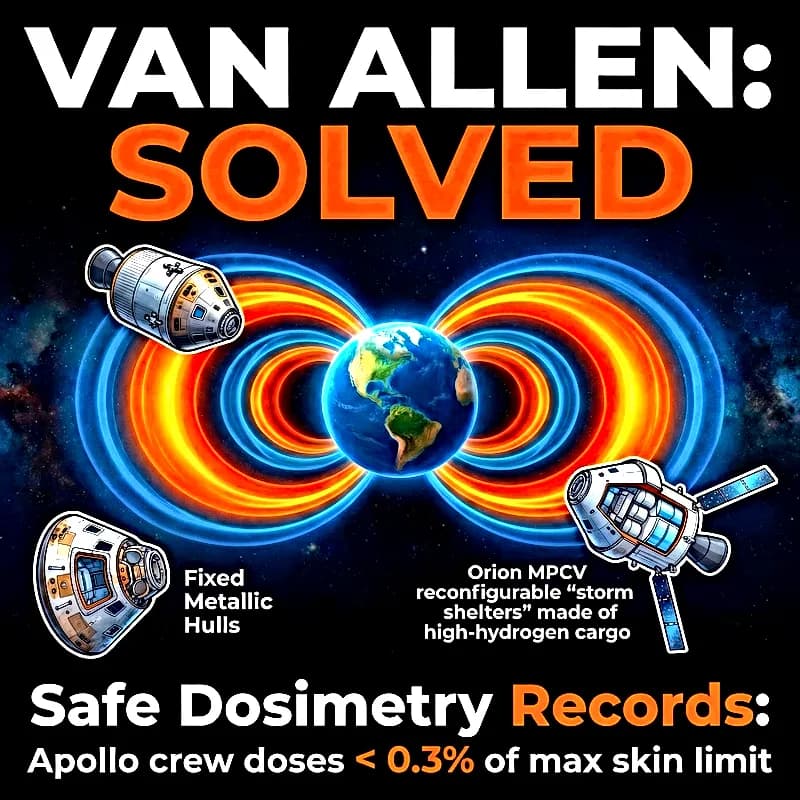
These readings represent the dose at the body surface. The blood-forming organs (BFO), located deeper within the body, received doses approximately 40% lower than the surface readings due to the self-shielding provided by the astronaut's own tissue. [4]Apollo Radiation Protection Report - NTRS https://ntrs.nasa.gov/api/citations/19760005583/downloads/19760005583.pdf For comparison, the Maximum Operational Dose (MOD) limit for Apollo was 400 rad to the skin and 50 rad to the BFO; no mission ever exceeded 0.3% of the skin limit. [7]Apollo Experience Report - Protection Against Radiation - NTRS https://ntrs.nasa.gov/api/citations/19730010172/downloads/19730010172.pdf
The Impact of Solar Particle Events (SPEs)
The primary radiological hazard during Apollo was not the Van Allen belts themselves, but the potential for a Solar Particle Event (SPE). In the well-shielded Command Module, even a large event would not have caused impairment. [14]Apollo Radiation Experiment - NASA Life Sciences Portal https://nlsp.nasa.gov/explore/exper?exp_index=369 However, the Lunar Module (LM), with its thin aluminum skin, offered much less protection. [4]Apollo Radiation Protection Report - NTRS https://ntrs.nasa.gov/api/citations/19760005583/downloads/19760005583.pdf Fortunately, no major solar events occurred during any crewed Apollo mission. [7]Apollo Experience Report - Protection Against Radiation - NTRS https://ntrs.nasa.gov/api/citations/19730010172/downloads/19730010172.pdf
Modern Orion MPCV Shielding: The Dynamic Storm Shelter
The Orion Multi-Purpose Crew Vehicle (MPCV) represents a generational shift in radiation mitigation—from static passive shielding to a dynamic reconfigurable approach. [16]Scientists and Engineers Evaluate Orion Radiation Protection Plan - NASA https://www.nasa.gov/missions/artemis/orion/scientists-and-engineers-evaluate-orion-radiation-protection-plan/
The Storm Shelter Strategy
Unlike the Apollo CM, which relied on the fixed mass of its hull, the Orion capsule utilizes the onboard mass of its payload to create a temporary storm shelter. In the event of an SPE warning, astronauts move to the central part of the crew module and stack stowage bags—containing food, water, and clothing—around themselves. [16]Scientists and Engineers Evaluate Orion Radiation Protection Plan - NASA https://www.nasa.gov/missions/artemis/orion/scientists-and-engineers-evaluate-orion-radiation-protection-plan/ These materials are high in hydrogen content, which is the most effective element for slowing down high-energy protons without producing secondary neutrons. [17]The Space Radiation Environment - NTRS https://ntrs.nasa.gov/api/citations/20250004252/downloads/Book%20Chapter.pdf
| Shielding Parameter | Apollo Command Module | Orion MPCV |
|---|---|---|
| Primary Shielding | Fixed Metallic Structure | Reconfigurable Mass (Stowage) |
| Material Optimization | High-Z (Steel/Stainless) | Low-Z (Aluminum-Lithium/Poly) |
| Total Shielding Mass | Static (≈6.15 g/cm²) | Variable (5 to 20 g/cm²) |
| Sensor Suite | TLD / PRD | HERA / Crew Active Dosimeter |
| Alert System | Ground-based (SPAN) | Autonomous Onboard (HERA) |
Validation from Artemis I
The uncrewed Artemis I mission in late 2022 provided the first modern data on the radiation environment during a lunar transit. Researchers discovered that the spacecraft's orientation plays a critical role in dose reduction. [19]Orion spacecraft radiation protection tested - DLR https://www.dlr.de/en/latest/news/2024/orion-spacecraft-radiation-protection-tested-initial-findings-from-artemis-i-moon-mission By performing a 90-degree turn relative to the magnetic field lines, the radiation dose inside the capsule was reduced by 50% during the transit of the inner proton belt. [20]Orion spacecraft radiation protection tested - Space Daily https://www.spacedaily.com/reports/Orion_spacecraft_radiation_protection_tested_findings_from_Artemis_I_mission_999.html
Data from the mannequins Helga (unprotected) and Zohar (wearing a protective vest) showed that internal dose rates varied by a factor of four depending on location within the capsule. [19]Orion spacecraft radiation protection tested - DLR https://www.dlr.de/en/latest/news/2024/orion-spacecraft-radiation-protection-tested-initial-findings-from-artemis-i-moon-mission The most shielded areas limited potential SPE doses to below 150 mSv, far below the threshold for acute radiation sickness. [20]Orion spacecraft radiation protection tested - Space Daily https://www.spacedaily.com/reports/Orion_spacecraft_radiation_protection_tested_findings_from_Artemis_I_mission_999.html
Biomedical Results and Health Implications of Belt Transit
Visual Light Flashes and HZE Particles
One of the most notable radiation-related phenomena was the reporting of visual light flashes by Apollo astronauts, first noted on Apollo 11. These flashes, often described as "blue stars" or "white streaks," occur when high-energy cosmic rays or heavy ions (HZE particles) pass through the retina or vitreous humor. [22]Colorado astronauts return from historic Polaris Dawn mission - CPR https://www.cpr.org/2024/10/14/colorado-astronauts-return-polaris-dawn-space-mission/ On Skylab 4, one astronaut counted 168 flashes over two sessions, confirming the continuous interaction of subatomic particles with human sensory organs even behind shielding. [21]To infinity and beyond! Human spaceflight and life science - PMC https://pmc.ncbi.nlm.nih.gov/articles/PMC6188462/
Cardiovascular and Neurological Context
Detailed analysis of Apollo 15 crew member Jim Irwin, who suffered a myocardial infarction 21 months after his flight, suggests that the stressors of deep space—including fluid shifts, potassium deficits, and potential endothelial injury from radiation—may have cumulative effects. [23]The Apollo 15 Space Syndrome - AHA Journals https://www.ahajournals.org/doi/10.1161/01.CIR.97.1.119
Furthermore, recent Congressional hearings on Anomalous Health Incidents (AHI), also known as Havana Syndrome, have brought renewed attention to how high-energy particles and microwave-frequency emissions interact with human neural pathways. [24]Former CIA Chief of Station Breaks Silence on Microwave Weapons - Shawn Ryan Show https://podcasts.happyscribe.com/the-shawn-ryan-show/283-aj-former-cia-chief-of-station-breaks-silence-on-microwave-weapons Testimony from the House Permanent Select Committee on Intelligence indicates that the understanding of "non-ionizing" and low-dose radiation effects on the human brain is still a matter of active investigation. [24]Former CIA Chief of Station Breaks Silence on Microwave Weapons - Shawn Ryan Show https://podcasts.happyscribe.com/the-shawn-ryan-show/283-aj-former-cia-chief-of-station-breaks-silence-on-microwave-weapons
Historical Record of Human Van Allen Belt Crossings
The following table comprises every documented occurrence of a human being transiting the Van Allen radiation belts—all astronauts from the Apollo lunar missions and the crew of the Polaris Dawn mission.
| Name | Mission | Date of Transit | Notes |
|---|---|---|---|
| Frank Borman | Apollo 8 | Dec 21, 1968 | First human transit |
| James Lovell Jr. | Apollo 8 | Dec 21, 1968 | First of two transits |
| William Anders | Apollo 8 | Dec 21, 1968 | First human transit |
| Thomas Stafford | Apollo 10 | May 18, 1969 | Lunar orbit transit |
| John Young | Apollo 10 | May 18, 1969 | First of two transits |
| Eugene Cernan | Apollo 10 | May 18, 1969 | First of two transits |
| Neil Armstrong | Apollo 11 | Jul 16, 1969 | First Moon landing mission |
| Edwin "Buzz" Aldrin | Apollo 11 | Jul 16, 1969 | First Moon landing mission |
| Michael Collins | Apollo 11 | Jul 16, 1969 | First Moon landing mission |
| Charles Conrad Jr. | Apollo 12 | Nov 14, 1969 | Solar event detected outside |
| Alan Bean | Apollo 12 | Nov 14, 1969 | Second Moon landing |
| Richard Gordon Jr. | Apollo 12 | Nov 14, 1969 | Lunar orbit transit |
| James Lovell Jr. | Apollo 13 | Apr 11, 1970 | Second belt transit |
| Fred Haise Jr. | Apollo 13 | Apr 11, 1970 | Free-return trajectory |
| John Swigert Jr. | Apollo 13 | Apr 11, 1970 | Free-return trajectory |
| Alan Shepard Jr. | Apollo 14 | Jan 31, 1971 | Record average dose (1.14 rad) |
| Edgar Mitchell | Apollo 14 | Jan 31, 1971 | Record average dose (1.14 rad) |
| Stuart Roosa | Apollo 14 | Jan 31, 1971 | Record average dose (1.14 rad) |
| David Scott | Apollo 15 | Jul 26, 1971 | J-series landing mission |
| James Irwin | Apollo 15 | Jul 26, 1971 | Cardiac arrhythmia noted |
| Alfred Worden | Apollo 15 | Jul 26, 1971 | Deep space EVA transit |
| John Young | Apollo 16 | Apr 16, 1972 | Second belt transit |
| Charles Duke Jr. | Apollo 16 | Apr 16, 1972 | Highest entry velocity mission |
| Ken Mattingly | Apollo 16 | Apr 16, 1972 | Lunar orbit transit |
| Eugene Cernan | Apollo 17 | Dec 7, 1972 | Second belt transit |
| Harrison Schmitt | Apollo 17 | Dec 7, 1972 | First geologist on Moon |
| Ronald Evans | Apollo 17 | Dec 7, 1972 | Final Apollo transit |
| Jared Isaacman | Polaris Dawn | Sep 10, 2024 | High-altitude commercial mission |
| Scott Poteet | Polaris Dawn | Sep 10, 2024 | High-altitude commercial mission |
| Sarah Gillis | Polaris Dawn | Sep 10, 2024 | Youngest spacewalker |
| Anna Menon | Polaris Dawn | Sep 10, 2024 | Medical officer on mission |
Technological Evolution in Radiation Monitoring
The methods used to ensure astronaut safety have progressed from the basic Personal Radiation Dosimeter (PRD) used during Apollo to the multi-sensor Hybrid Electronic Radiation Assessor (HERA) on Orion. [18]Artemis I Radiation Measurements Validate Orion Safety for Astronauts - NASA https://www.nasa.gov/missions/artemis/artemis-1/artemis-i-radiation-measurements-validate-orion-safety-for-astronauts/ HERA is an active system capable of real-time monitoring and providing autonomous warnings to the crew to take shelter, whereas Apollo relied on the Solar Particle Alert Network (SPAN), a ground-based network of solar observatories. [14]Apollo Radiation Experiment - NASA Life Sciences Portal https://nlsp.nasa.gov/explore/exper?exp_index=369
The integration of biometric monitoring during the Polaris Dawn mission—including the use of Garmin smartwatches and BioButtons—allows for the first time a correlation between real-time radiation flux and acute physiological responses such as heart rate variability and temperature changes. [28]How Health Data is Collected in Space Missions - TrialX https://trialx.com/how-health-data-is-collected-in-space-missions/ These datasets are now being archived in the EXPAND database, providing a standards-based repository for future research into long-duration space health. [29]EXPAND Database - Baylor College of Medicine https://www.bcm.edu/academic-centers/space-medicine/expand
Conclusions on Mission Feasibility
The engineering and radiological evidence gathered over seven decades of spaceflight confirms that the Van Allen radiation belts are a manageable risk rather than a fundamental barrier to human exploration. The success of the Apollo program was not a matter of ignoring radiation, but of understanding its physics—specifically its directionality, energy spectra, and flux intensity—and designing missions that minimized dwell time in the highest-intensity regions.
The modern Orion MPCV architecture further enhances this capability by utilizing reconfigurable mass and intelligent maneuvering to shield its crew from both trapped radiation and unpredictable solar flares. The historical record of 31 human transits, supported by thousands of pages of technical reports and medical data, demonstrates that the "insurmountable" claims are unsupported by the weight of available scientific evidence.
Sources
- What are the Van Allen Belts and why do they matter? - NASA Science, https://science.nasa.gov/biological-physical/stories/van-allen-belts/
- Recent Advances in Our Understanding of the Earth's Radiation Belts - NTRS, https://ntrs.nasa.gov/citations/20190030791
- Search: Van Allen radiation belts - NTRS, https://ntrs.nasa.gov/search?q=van%20allen%20radiation%20belts
- Apollo Radiation Protection Report - NTRS, https://ntrs.nasa.gov/api/citations/19760005583/downloads/19760005583.pdf
- Shielding: An Annotated Bibliography - DTIC, https://apps.dtic.mil/sti/tr/pdf/AD0274015.pdf
- Design for Ionizing Radiation Protection OCHMO-TB-020 - NASA, https://www.nasa.gov/wp-content/uploads/2023/12/ochmo-tb-020-radiation-protection.pdf
- Apollo Experience Report - Protection Against Radiation - NTRS, https://ntrs.nasa.gov/api/citations/19730010172/downloads/19730010172.pdf
- Apollo command and service module - Wikipedia, https://en.wikipedia.org/wiki/Apollo_command_and_service_module
- Radiation shielding - THREE Home, https://three.jsc.nasa.gov/articles/Shielding81109.pdf
- Modeling the acute health effects of astronauts from exposure to large solar particle events - ResearchGate, https://www.researchgate.net/publication/24191855_Modeling_the_acute_health_effects_of_astronauts_from_exposure_to_large_solar_particle_events
- Thickness of Apollo 11 CM heat shield - collectSPACE, http://www.collectspace.com/ubb/Forum29/HTML/002134.html
- Apollo Flights and the Hazards of Radiation - Herald Scholarly Open Access, https://www.heraldopenaccess.us/openaccess/apollo-flights-and-the-hazards-of-radiation
- Apollo Dosimetry Dataset - NASA Life Sciences Data Archive, https://lsda.jsc.nasa.gov/Dataset/dataset_detail_result/JMAPAP003_245
- Apollo Radiation Experiment - NASA Life Sciences Portal, https://nlsp.nasa.gov/explore/exper?exp_index=369
- Space Faring: The Radiation Challenge - NASA, https://www.nasa.gov/wp-content/uploads/2017/04/radiationchallenge.pdf
- Scientists and Engineers Evaluate Orion Radiation Protection Plan - NASA, https://www.nasa.gov/missions/artemis/orion/scientists-and-engineers-evaluate-orion-radiation-protection-plan/
- The Space Radiation Environment - NTRS, https://ntrs.nasa.gov/api/citations/20250004252/downloads/Book%20Chapter.pdf
- Artemis I Radiation Measurements Validate Orion Safety for Astronauts - NASA, https://www.nasa.gov/missions/artemis/artemis-1/artemis-i-radiation-measurements-validate-orion-safety-for-astronauts/
- Orion spacecraft radiation protection tested - DLR, https://www.dlr.de/en/latest/news/2024/orion-spacecraft-radiation-protection-tested-initial-findings-from-artemis-i-moon-mission
- Orion spacecraft radiation protection tested - Space Daily, https://www.spacedaily.com/reports/Orion_spacecraft_radiation_protection_tested_findings_from_Artemis_I_mission_999.html
- To infinity and beyond! Human spaceflight and life science - PMC, https://pmc.ncbi.nlm.nih.gov/articles/PMC6188462/
- Colorado astronauts return from historic Polaris Dawn mission - CPR, https://www.cpr.org/2024/10/14/colorado-astronauts-return-polaris-dawn-space-mission/
- The Apollo 15 Space Syndrome - AHA Journals, https://www.ahajournals.org/doi/10.1161/01.CIR.97.1.119
- Former CIA Chief of Station Breaks Silence on Microwave Weapons - Shawn Ryan Show, https://podcasts.happyscribe.com/the-shawn-ryan-show/283-aj-former-cia-chief-of-station-breaks-silence-on-microwave-weapons
- Apollo Missions - NASA, https://www.nasa.gov/specials/apollo50th/missions.html
- The Van Allen belts: are they dangerous? - ESA, https://blogs.esa.int/orion/2022/12/10/the-van-allen-belts-are-they-dangerous/
- First private spacewalk conducted by SpaceX - Warp News, https://www.warpnews.org/space/first-private-spacewalk-conducted-by-spacex-2/
- How Health Data is Collected in Space Missions - TrialX, https://trialx.com/how-health-data-is-collected-in-space-missions/
- EXPAND Database - Baylor College of Medicine, https://www.bcm.edu/academic-centers/space-medicine/expand