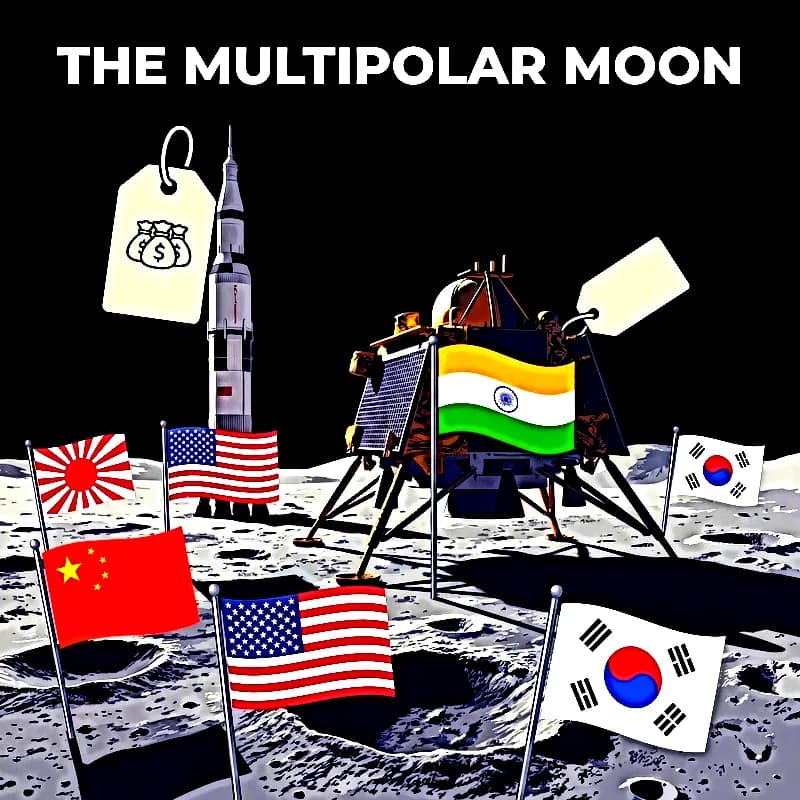
The Chandrayaan-3 Watershed and the Emergence of a Multipolar Lunar Order
The successful soft landing of the Indian Space Research Organisation's (ISRO) Chandrayaan-3 Vikram lander near the lunar South Pole on August 23, 2023, represents a geopolitical event whose significance extends far beyond the boundaries of planetary science. [1]Chandrayaan-3 - Wikipedia https://en.wikipedia.org/wiki/Chandrayaan-3, [2]Chandrayaan-3: India makes historic landing near Moon's south pole - BBC https://www.bbc.com/news/world-asia-india-66594520 India's achievement, occurring mere days after the failure of Russia's Luna-25 mission, irrevocably shattered the implicit assumption that the 21st-century return to the Moon would be a bipolar contest between the United States and China. [3]Luna 25 - Wikipedia https://en.wikipedia.org/wiki/Luna_25, [4]Russia's Luna-25 spacecraft crashes on the Moon - Nature https://www.nature.com/articles/d41586-023-02685-4 The mission made India the fourth country to achieve a controlled lunar soft landing and the first to land in the high-latitude southern polar region. [1]Chandrayaan-3 - Wikipedia https://en.wikipedia.org/wiki/Chandrayaan-3, [5]Chandrayaan-3 Landing Site - ISRO https://www.isro.gov.in/Chandrayaan3_landing_site.html This report frames Chandrayaan-3 not only as a technical accomplishment but as a strategic inflection point that has accelerated the emergence of a multipolar lunar order, with implications for the Artemis Accords, the International Lunar Research Station (ILRS), and the diplomatic alignment of the Global South.
Case Snapshot
Landing Date
August 23, 2023
Source Entries
30
Landing Site
69.37°S, 32.35°E
Mission Cost
$74.6 Million
Evidence Distribution
Section Headings
12
Markdown Tables
5
Unique Citations
30
Inline References
58
Core Timeline Anchors
| Year | Milestone |
|---|---|
| 2008 | Chandrayaan-1 confirms water molecules on Moon |
| 2019 | Chandrayaan-2 orbiter succeeds |
| lander crashes | - |
| 2023 Aug 11 | Luna-25 launches (Russia) |
| 2023 Aug 19 | Luna-25 crashes on Moon |
| 2023 Aug 23 | Chandrayaan-3 lands at South Pole |
| 2023 Jun | India signs the Artemis Accords |
Technical Architecture of Chandrayaan-3
The Chandrayaan-3 mission was designed with a singular focus on achieving a successful soft landing, correcting the failure modes that caused the Chandrayaan-2 Vikram lander to crash in September 2019. [6]Chandrayaan-3 Mission Details - ISRO https://www.isro.gov.in/Chandrayaan3_New.html, [7]What Chandrayaan-3 changed after Chandrayaan-2 failure - The Hindu https://www.thehindu.com/sci-tech/science/what-chandrayaan-3-changed-after-chandrayaan-2-failure/article67225837.ece The mission architecture consisted of three modules: a propulsion module (PM), a lander (Vikram), and a rover (Pragyan). [1]Chandrayaan-3 - Wikipedia https://en.wikipedia.org/wiki/Chandrayaan-3, [6]Chandrayaan-3 Mission Details - ISRO https://www.isro.gov.in/Chandrayaan3_New.html
Mission Design and Landing Sequence
The spacecraft was launched on July 14, 2023, aboard ISRO's LVM3 (formerly GSLV Mk III) launch vehicle from Satish Dhawan Space Centre. [1]Chandrayaan-3 - Wikipedia https://en.wikipedia.org/wiki/Chandrayaan-3, [8]LVM3 Launch Vehicle - ISRO https://www.isro.gov.in/LVM3_New.html Unlike the direct injections used by Apollo, Chandrayaan-3 entered a highly elliptical Earth orbit and used a series of phasing orbits to gradually raise its apogee before performing a Trans-Lunar Injection (TLI) burn. [6]Chandrayaan-3 Mission Details - ISRO https://www.isro.gov.in/Chandrayaan3_New.html This fuel-efficient approach extended the transit time to approximately 40 days. [6]Chandrayaan-3 Mission Details - ISRO https://www.isro.gov.in/Chandrayaan3_New.html
| Component | Specification | Function |
|---|---|---|
| LVM3 Launch Vehicle | 43.5 m, 640 tonnes | Injection to 170 km × 36,500 km orbit |
| Propulsion Module | 2,148 kg (wet) | Lunar orbit insertion; SHAPE payload |
| Vikram Lander | 1,752 kg (incl. Pragyan) | Powered descent, soft landing |
| Pragyan Rover | 26 kg | 500 m range; LIBS, APXS instruments |
The landing sequence was the most critical phase. ISRO implemented a "failure-based design" philosophy, incorporating redundancies that were specifically developed after the Chandrayaan-2 landing failure. [7]What Chandrayaan-3 changed after Chandrayaan-2 failure - The Hindu https://www.thehindu.com/sci-tech/science/what-chandrayaan-3-changed-after-chandrayaan-2-failure/article67225837.ece Key changes included:
- Expanded Landing Zone: The target landing ellipse was expanded from a narrow strip to a much wider 4 km × 2.4 km zone, providing greater tolerance for trajectory deviations. [7]What Chandrayaan-3 changed after Chandrayaan-2 failure - The Hindu https://www.thehindu.com/sci-tech/science/what-chandrayaan-3-changed-after-chandrayaan-2-failure/article67225837.ece
- Additional Sensors: Extra laser altimeters and velocimeters were added to provide redundant terrain data. [7]What Chandrayaan-3 changed after Chandrayaan-2 failure - The Hindu https://www.thehindu.com/sci-tech/science/what-chandrayaan-3-changed-after-chandrayaan-2-failure/article67225837.ece
- Hazard Avoidance: An onboard camera system was added that could identify and avoid boulders and craters during the final descent phase. [7]What Chandrayaan-3 changed after Chandrayaan-2 failure - The Hindu https://www.thehindu.com/sci-tech/science/what-chandrayaan-3-changed-after-chandrayaan-2-failure/article67225837.ece
- Strengthened Legs: The landing legs were redesigned to absorb a higher vertical velocity at touchdown. [7]What Chandrayaan-3 changed after Chandrayaan-2 failure - The Hindu https://www.thehindu.com/sci-tech/science/what-chandrayaan-3-changed-after-chandrayaan-2-failure/article67225837.ece
The South Pole Landing Site
The Vikram lander touched down at approximately 69.37°S, 32.35°E, a location near the Manzinus C and Simpelius N craters. [1]Chandrayaan-3 - Wikipedia https://en.wikipedia.org/wiki/Chandrayaan-3, [5]Chandrayaan-3 Landing Site - ISRO https://www.isro.gov.in/Chandrayaan3_landing_site.html This high-latitude region is of immense scientific and strategic importance because it is close to the Permanently Shadowed Regions (PSRs) where water ice is believed to exist in significant quantities. [5]Chandrayaan-3 Landing Site - ISRO https://www.isro.gov.in/Chandrayaan3_landing_site.html, [9]Water Ice at the Lunar South Pole - LPI https://www.lpi.usra.edu/lunar/lunar-south-pole/
The Cost Efficiency Paradigm: ISRO's Model
The most frequently discussed aspect of Chandrayaan-3 is its remarkably low cost: approximately ₹615 crore, or $74.6 million USD. [10]The Economics of Chandrayaan-3 - LiveMint https://www.livemint.com/science/news/chandrayaan-3-budget-cost-less-than-movie-interstellar-11692858695710.html, [11]How does ISRO manage such low costs? - Indian Express https://indianexpress.com/article/technology/tech-news-technology/how-does-isro-manage-such-low-costs-8909893/ This figure is lower than the production budget of many Hollywood films and a fraction of the cost of comparable missions from NASA, ESA, or CNSA.
| Mission | Agency | Cost (USD) | Outcome |
|---|---|---|---|
| Chandrayaan-3 | ISRO | $74.6 Million | Successful Soft Landing |
| Luna-25 | Roscosmos | ~$200 Million (Est.) | Crash (Aug 2023) |
| SLIM | JAXA | ~$120 Million (Est.) | Inverted Landing (Jan 2024) |
| Artemis I (Uncrewed) | NASA | ~$4.1 Billion | Successful Lunar Orbit |
| Chang'e 5 (Sample Return) | CNSA | ~$870 Million (Est.) | Successful Sample Return |
ISRO's cost efficiency is attributed to several structural factors:
- Low Labor Costs: Indian engineering salaries are a fraction of those in the US, Europe, or Japan. [10]The Economics of Chandrayaan-3 - LiveMint https://www.livemint.com/science/news/chandrayaan-3-budget-cost-less-than-movie-interstellar-11692858695710.html
- Domestic Manufacturing: A high percentage of components, including the CE-20 cryogenic engine, are manufactured domestically. [8]LVM3 Launch Vehicle - ISRO https://www.isro.gov.in/LVM3_New.html, [10]The Economics of Chandrayaan-3 - LiveMint https://www.livemint.com/science/news/chandrayaan-3-budget-cost-less-than-movie-interstellar-11692858695710.html
- Frugal Engineering Culture: ISRO has historically embraced a "jugaad" (frugal innovation) philosophy, optimizing for mission success with minimal resources. [11]How does ISRO manage such low costs? - Indian Express https://indianexpress.com/article/technology/tech-news-technology/how-does-isro-manage-such-low-costs-8909893/
- LVM3 Reuse: The LVM3 launch vehicle, originally developed for the GSAT communication satellite program, was adapted for the lunar mission, spreading development costs. [8]LVM3 Launch Vehicle - ISRO https://www.isro.gov.in/LVM3_New.html
However, the low-cost model has limitations. The Pragyan rover had a design life of only one lunar day (14 Earth days) and a range of just 500 meters. [1]Chandrayaan-3 - Wikipedia https://en.wikipedia.org/wiki/Chandrayaan-3 Compared to NASA's planned VIPER rover or China's Yutu-2, which operated on the lunar far side for over three years, the scientific yield of Pragyan was modest. [12]Yutu-2 Lunar Rover Operations - Nature Astronomy https://www.nature.com/articles/s41550-020-1092-y The strategic value of Chandrayaan-3 lies not in the depth of its science but in the political and diplomatic signal it sent to the world.
The Luna-25 Failure: A Juxtaposed Humiliation
The geopolitical impact of Chandrayaan-3 was amplified by the near-simultaneous failure of Russia's Luna-25 mission. [3]Luna 25 - Wikipedia https://en.wikipedia.org/wiki/Luna_25, [4]Russia's Luna-25 spacecraft crashes on the Moon - Nature https://www.nature.com/articles/d41586-023-02685-4 Luna-25, Russia's first lunar mission since Luna-24 in 1976, was designed to land near the Boguslawsky Crater at the South Pole. [3]Luna 25 - Wikipedia https://en.wikipedia.org/wiki/Luna_25 It launched on August 11, 2023, just three weeks after Chandrayaan-3, and was intended to reach the lunar surface first.
On August 19, 2023, during a pre-landing orbital correction maneuver, a malfunction in the attitude control system caused the spacecraft to fire its engines for 127 seconds instead of the planned 84 seconds. [3]Luna 25 - Wikipedia https://en.wikipedia.org/wiki/Luna_25, [4]Russia's Luna-25 spacecraft crashes on the Moon - Nature https://www.nature.com/articles/d41586-023-02685-4 This error sent Luna-25 into an uncontrolled trajectory, and it crashed into the surface of the Moon, ending Russia's 47-year absence from lunar exploration in ignominy. [3]Luna 25 - Wikipedia https://en.wikipedia.org/wiki/Luna_25
Strategic Implications of Luna-25's Failure
- Erosion of Russian Space Credibility: The failure undermined Russia's position as a credible partner in the ILRS, increasing the burden on China. [4]Russia's Luna-25 spacecraft crashes on the Moon - Nature https://www.nature.com/articles/d41586-023-02685-4, [13]Russia's Failing Space Program - CSIS https://www.csis.org/analysis/russias-failing-space-program
- Validation of India's Approach: By demonstrating that a "frugal" national program could succeed where a legacy superpower failed, India provided a template for other aspiring space nations. [14]India's Lunar Achievement and the Global South - Observer Research Foundation https://www.orfonline.org/expert-speak/indias-lunar-achievement-global-south
- Diplomatic Leverage: The timing gave India immense diplomatic leverage, as it established ISRO's reliability at the precise moment that Roscosmos's competence was questioned. [13]Russia's Failing Space Program - CSIS https://www.csis.org/analysis/russias-failing-space-program, [14]India's Lunar Achievement and the Global South - Observer Research Foundation https://www.orfonline.org/expert-speak/indias-lunar-achievement-global-south
Diplomatic Realignment: India, the Artemis Accords, and Strategic Hedging
India's decision to sign the Artemis Accords in June 2023—two months before the Chandrayaan-3 landing—was a watershed moment in space diplomacy. [15]India Signs the Artemis Accords - NASA https://www.nasa.gov/news-release/nasa-welcomes-india-as-newest-artemis-accords-signatory/, [16]India and the Artemis Accords - Carnegie Endowment https://carnegieendowment.org/posts/2023/07/india-artemis-accords India had historically maintained a non-aligned posture in space governance, cooperating with both the US and Russia through bilateral agreements. [17]India-Russia Space Cooperation - Manohar Parrikar IDSA https://www.idsa.in/idsacomments/india-russia-space-cooperation
India's Strategic Calculus
India's accession to the Artemis Accords was driven by a confluence of factors:
- Technology Access: The Accords provide a framework for potential cooperation with NASA on future lunar missions, including access to deep-space communication networks and navigation data. [16]India and the Artemis Accords - Carnegie Endowment https://carnegieendowment.org/posts/2023/07/india-artemis-accords, [18]NASA-ISRO Joint Missions - NASA https://www.nasa.gov/international-space-station/nasa-isro-collaboration/
- Market Positioning: By aligning with the US-led coalition, ISRO positioned itself as a cost-effective provider of lunar landing services for international payloads. [14]India's Lunar Achievement and the Global South - Observer Research Foundation https://www.orfonline.org/expert-speak/indias-lunar-achievement-global-south, [18]NASA-ISRO Joint Missions - NASA https://www.nasa.gov/international-space-station/nasa-isro-collaboration/
- Hedging Against China: While India maintains a working relationship with CNSA on Earth observation and disaster management, the Sino-Indian border dispute and broader geopolitical rivalry make alignment with the ILRS politically untenable. [17]India-Russia Space Cooperation - Manohar Parrikar IDSA https://www.idsa.in/idsacomments/india-russia-space-cooperation, [19]India-China Space Rivalry - Diplomat https://thediplomat.com/2023/09/indias-moon-landing-and-the-new-asian-space-race/
India's accession is significant because it is the largest democracy and the most populous nation to join the Accords, lending the coalition a legitimacy that a purely Western grouping would lack. [16]India and the Artemis Accords - Carnegie Endowment https://carnegieendowment.org/posts/2023/07/india-artemis-accords It also signals to other "swing states" in the Global South—such as Brazil, Indonesia, and Saudi Arabia—that alignment with the US on space governance is compatible with an independent foreign policy. [20]Space Diplomacy and the Global South - Space Policy https://www.sciencedirect.com/journal/space-policy
The Multipolar Cascade: JAXA, KARI, and Emerging Programs
Chandrayaan-3's success has catalyzed a wave of nationally driven lunar programs that collectively transform the bipolar US-China framework into a multipolar one. [14]India's Lunar Achievement and the Global South - Observer Research Foundation https://www.orfonline.org/expert-speak/indias-lunar-achievement-global-south, [21]The New Multipolar Space Race - Foreign Affairs https://www.foreignaffairs.com/articles/space/2023-09-01/new-moon-race
Japan: SLIM and the "Moon Sniper"
JAXA's Smart Lander for Investigating Moon (SLIM) achieved a soft landing on January 19, 2024, making Japan the fifth country to land on the Moon. [22]SLIM Mission - JAXA https://www.isas.jaxa.jp/en/missions/slim/ While the landing was technically a success, the spacecraft inverted due to an engine failure during descent, limiting its operational capability. [22]SLIM Mission - JAXA https://www.isas.jaxa.jp/en/missions/slim/ Despite this, the precision of the landing—within 55 meters of its target—validated JAXA's "pinpoint landing" technology, which is designed to enable future missions to land next to specific scientific targets. [22]SLIM Mission - JAXA https://www.isas.jaxa.jp/en/missions/slim/
South Korea: KPLO and Lunar Ambitions
South Korea's Korea Pathfinder Lunar Orbiter (KPLO), also known as Danuri, has been operational in lunar orbit since December 2022. [23]KPLO/Danuri - KARI https://www.kari.re.kr/eng/sub04_04.do While primarily an orbiter, KPLO carries the ShadowCam instrument, a NASA-provided camera specifically designed to peer into the Permanently Shadowed Regions of the South Pole. [23]KPLO/Danuri - KARI https://www.kari.re.kr/eng/sub04_04.do South Korea has announced plans for a lunar lander by 2032. [23]KPLO/Danuri - KARI https://www.kari.re.kr/eng/sub04_04.do
Other Emerging Programs
| Nation/Agency | Mission | Target Date | Objective |
|---|---|---|---|
| Israel (SpaceIL) | Beresheet 2 | 2025–2026 | Lunar orbiter and lander |
| UAE (MBRSC) | Rashid 2 | ~2026 | Micro-rover (ispace delivery) |
| Turkey (TUA) | AYAP-1 | 2028 (target) | First national lunar lander |
| Brazil (AEB) | Garatéa-L | Under study | Cubesat in lunar orbit |
The Governance Challenge: From Bipolar to Multipolar
The emergence of multiple independent lunar actors creates a governance vacuum. The 1967 Outer Space Treaty was designed for a bipolar world with two superpowers exercising restraint. [24]Outer Space Treaty - UNOOSA https://www.unoosa.org/oosa/en/ourwork/spacelaw/treaties/introouterspacetreaty.html, [25]Artemis Accords - US State Department https://www.state.gov/artemis-accords/ The current landscape—where 56 Artemis Accords signatories, the ILRS partnership, and independent actors like India all converge on the same South Pole region—requires a more sophisticated mechanism for deconfliction. [26]Safety Zones and Deconfliction - Secure World Foundation https://swfound.org/media/207548/swf-safety-zones-fact-sheet-2022.pdf
Competing Norms at the South Pole
The close proximity of planned landing sites raises the risk of "harmful interference" under Article IX of the OST. [24]Outer Space Treaty - UNOOSA https://www.unoosa.org/oosa/en/ourwork/spacelaw/treaties/introouterspacetreaty.html, [27]Harmful Interference in Space - EJIL Talk https://www.ejiltalk.org/harmful-interference-in-outer-space/ If Chandrayaan-4 (India), Artemis III (US), and Chang'e 7 (China) all target the South Pole within a three-year window, who establishes the first "safety zone"? Who has priority access to the water ice deposits? [27]Harmful Interference in Space - EJIL Talk https://www.ejiltalk.org/harmful-interference-in-outer-space/
The multipolar order makes these questions harder to answer because there is no longer a single bilateral channel for negotiation. The UNCOPUOS Working Group on Space Resources has produced draft principles, but these are non-binding and lack enforcement mechanisms. [28]UNCOPUOS Working Group on Space Resources - UNOOSA https://www.unoosa.org/oosa/en/ourwork/copuos/lsc/space-resources/index.html The practical reality is that the first nation to demonstrate sustained, repeated landing capability at the South Pole will set the de facto norms, regardless of the legal framework.
Conclusion: The Chandrayaan-3 Watershed
India's Chandrayaan-3 mission is more than a scientific success; it is a geopolitical catalyst that has permanently altered the structure of cislunar competition. By achieving a soft landing at the South Pole at a fraction of the cost of its competitors, ISRO demonstrated that access to the Moon is no longer the exclusive preserve of spacefaring superpowers. [1]Chandrayaan-3 - Wikipedia https://en.wikipedia.org/wiki/Chandrayaan-3, [14]India's Lunar Achievement and the Global South - Observer Research Foundation https://www.orfonline.org/expert-speak/indias-lunar-achievement-global-south
The near-simultaneous failure of Russia's Luna-25 underscored this transformation, revealing that legacy capability is no guarantee of current competence. [3]Luna 25 - Wikipedia https://en.wikipedia.org/wiki/Luna_25, [4]Russia's Luna-25 spacecraft crashes on the Moon - Nature https://www.nature.com/articles/d41586-023-02685-4 India's subsequent accession to the Artemis Accords positioned it as a key swing state in the diplomatic battle for lunar governance, while inspiring a cascade of national programs from Japan, South Korea, and others. [16]India and the Artemis Accords - Carnegie Endowment https://carnegieendowment.org/posts/2023/07/india-artemis-accords, [22]SLIM Mission - JAXA https://www.isas.jaxa.jp/en/missions/slim/, [23]KPLO/Danuri - KARI https://www.kari.re.kr/eng/sub04_04.do
The 21st-century Moon will not be claimed by a single flag. It will be navigated by a constellation of national programs, each bringing its own technological philosophy, economic model, and strategic ambition. Chandrayaan-3 is the mission that made this multipolarity an irreversible reality. [14]India's Lunar Achievement and the Global South - Observer Research Foundation https://www.orfonline.org/expert-speak/indias-lunar-achievement-global-south, [29]The Next Lunar Decade - The Planetary Society https://www.planetary.org/articles/the-next-lunar-decade, [30]Multipolarity in Space - Harvard Belfer Center https://www.belfercenter.org/publication/multipolarity-space
Sources
- Chandrayaan-3 - Wikipedia, https://en.wikipedia.org/wiki/Chandrayaan-3
- Chandrayaan-3: India makes historic landing near Moon's south pole - BBC, https://www.bbc.com/news/world-asia-india-66594520
- Luna 25 - Wikipedia, https://en.wikipedia.org/wiki/Luna_25
- Russia's Luna-25 spacecraft crashes on the Moon - Nature, https://www.nature.com/articles/d41586-023-02685-4
- Chandrayaan-3 Landing Site - ISRO, https://www.isro.gov.in/Chandrayaan3_landing_site.html
- Chandrayaan-3 Mission Details - ISRO, https://www.isro.gov.in/Chandrayaan3_New.html
- What Chandrayaan-3 changed after Chandrayaan-2 failure - The Hindu, https://www.thehindu.com/sci-tech/science/what-chandrayaan-3-changed-after-chandrayaan-2-failure/article67225837.ece
- LVM3 Launch Vehicle - ISRO, https://www.isro.gov.in/LVM3_New.html
- Water Ice at the Lunar South Pole - LPI, https://www.lpi.usra.edu/lunar/lunar-south-pole/
- The Economics of Chandrayaan-3 - LiveMint, https://www.livemint.com/science/news/chandrayaan-3-budget-cost-less-than-movie-interstellar-11692858695710.html
- How does ISRO manage such low costs? - Indian Express, https://indianexpress.com/article/technology/tech-news-technology/how-does-isro-manage-such-low-costs-8909893/
- Yutu-2 Lunar Rover Operations - Nature Astronomy, https://www.nature.com/articles/s41550-020-1092-y
- Russia's Failing Space Program - CSIS, https://www.csis.org/analysis/russias-failing-space-program
- India's Lunar Achievement and the Global South - Observer Research Foundation, https://www.orfonline.org/expert-speak/indias-lunar-achievement-global-south
- India Signs the Artemis Accords - NASA, https://www.nasa.gov/news-release/nasa-welcomes-india-as-newest-artemis-accords-signatory/
- India and the Artemis Accords - Carnegie Endowment, https://carnegieendowment.org/posts/2023/07/india-artemis-accords
- India-Russia Space Cooperation - Manohar Parrikar IDSA, https://www.idsa.in/idsacomments/india-russia-space-cooperation
- NASA-ISRO Joint Missions - NASA, https://www.nasa.gov/international-space-station/nasa-isro-collaboration/
- India-China Space Rivalry - Diplomat, https://thediplomat.com/2023/09/indias-moon-landing-and-the-new-asian-space-race/
- Space Diplomacy and the Global South - Space Policy, https://www.sciencedirect.com/journal/space-policy
- The New Multipolar Space Race - Foreign Affairs, https://www.foreignaffairs.com/articles/space/2023-09-01/new-moon-race
- SLIM Mission - JAXA, https://www.isas.jaxa.jp/en/missions/slim/
- KPLO/Danuri - KARI, https://www.kari.re.kr/eng/sub04_04.do
- Outer Space Treaty - UNOOSA, https://www.unoosa.org/oosa/en/ourwork/spacelaw/treaties/introouterspacetreaty.html
- Artemis Accords - US State Department, https://www.state.gov/artemis-accords/
- Safety Zones and Deconfliction - Secure World Foundation, https://swfound.org/media/207548/swf-safety-zones-fact-sheet-2022.pdf
- Harmful Interference in Space - EJIL Talk, https://www.ejiltalk.org/harmful-interference-in-outer-space/
- UNCOPUOS Working Group on Space Resources - UNOOSA, https://www.unoosa.org/oosa/en/ourwork/copuos/lsc/space-resources/index.html
- The Next Lunar Decade - The Planetary Society, https://www.planetary.org/articles/the-next-lunar-decade
- Multipolarity in Space - Harvard Belfer Center, https://www.belfercenter.org/publication/multipolarity-space