Jurisprudential and Infrastructural Determinants of Corporate Lunar Extraction: A Strategic Assessment of SpaceX and Blue Origin in the Context of the 1967 Outer Space Treaty
The transition of the Moon from a celestial object of scientific curiosity to a primary site for industrial and corporate resource extraction represents the most significant paradigm shift in space governance since the dawn of the Space Age. At the center of this transformation is a fundamental tension between the established principles of the 1967 Treaty on Principles Governing the Activities of States in the Exploration and Use of Outer Space—commonly referred to as the Outer Space Treaty (OST)—and the unprecedented logistical capabilities of private aerospace entities like SpaceX and Blue Origin. This report provides an exhaustive analysis of the legal frameworks governing lunar resource extraction, the specific infrastructure roles played by the two primary commercial contractors, and the geopolitical implications of their alignment with contemporary interpretations of international law.
Case Snapshot
Legal Framework
1967 Outer Space Treaty
Source Entries
33
Key Players
SpaceX, Blue Origin, NASA
Artemis Accords Signatories
56 Countries (2025)
Evidence Distribution
Section Headings
14
Markdown Tables
6
Unique Citations
33
Inline References
68
Core Timeline Anchors
| Year | Milestone |
|---|---|
| 1967 | Outer Space Treaty ratified |
| 1979 | Moon Agreement drafted (unratified by major powers) |
| 2015 | US Commercial Space Launch Competitiveness Act |
| 2020 | Artemis Accords launched |
| 2023 | Blue Origin selected for Artemis V (Appendix P) |
| 2025 | Blue Alchemist passes Critical Design Review |
The Legal Architecture of Lunar Resource Extraction
The legality of extracting and owning lunar resources is not defined by a single, universally accepted statute but rather by a complex interplay of decades-old treaties, emerging national laws, and non-binding "soft law" instruments. The Outer Space Treaty serves as the constitutional foundation of this regime, having been ratified by over 110 countries, including all major spacefaring nations. [1]Lunar Space Resource Utilization - Orange County Bar Association https://www.ocbar.org/All-News/News-View/ArticleId/6870/December-2025-Cover-Story-Lunar-Space-Resource-Utilization While the treaty was drafted in an era dominated by state actors and scientific exploration, its core provisions are now being reinterpreted to accommodate commercial mining interests. [2]Space Mining and (U.S.) Space Law - Peace Palace Library https://peacepalacelibrary.nl/blog/2015/space-mining-and-us-space-law
Article I and the "Province of All Mankind"
Article I of the Outer Space Treaty establishes that the exploration and use of outer space shall be the "province of all mankind" and shall be carried out for the benefit and in the interests of all countries. [3]The Moon Agreement / The legal status of lunar resources - UNOOSA https://www.unoosa.org/documents/pdf/copuos/lsc/2017/symp-01.pdf This principle has sparked a profound scholarly debate regarding the permissibility of private profit from lunar minerals. One school of thought argues that "province of all mankind" necessitates that any extraction must benefit all countries, effectively prohibiting unilateral commercial exploitation. [2]Space Mining and (U.S.) Space Law - Peace Palace Library https://peacepalacelibrary.nl/blog/2015/space-mining-and-us-space-law Conversely, proponents of commercial extraction distinguish between the "exploration and use" of space and the "appropriation" of its territory, arguing that the freedom of use must include the right to extract and consume resources. [1]Lunar Space Resource Utilization - Orange County Bar Association https://www.ocbar.org/All-News/News-View/ArticleId/6870/December-2025-Cover-Story-Lunar-Space-Resource-Utilization
Article II: The Non-Appropriation Principle
The most significant legal hurdle for corporate lunar extraction is Article II, which explicitly states that outer space, including the Moon, is not subject to national appropriation by claim of sovereignty, use, occupation, or any other means. [4]The Next Fifty Years of the Outer Space Treaty - State.gov https://2009-2017.state.gov/s/l/releases/remarks/264963.htm The majority legal view currently supporting the US and its commercial partners is that while a state cannot claim sovereignty over a lunar crater, it can authorize its citizens to own the resources they extract from that land. [1]Lunar Space Resource Utilization - Orange County Bar Association https://www.ocbar.org/All-News/News-View/ArticleId/6870/December-2025-Cover-Story-Lunar-Space-Resource-Utilization This is analogous to the international law of the sea, where no nation can own the high seas, yet any entity may legally own the fish they catch. [5]Outer Space Resource Acquisition – A Legal Perspective - Reddie & Grose https://www.reddie.co.uk/2024/10/09/outer-space-resource-acquisition-a-legal-perspective/
Article VI: State Responsibility and Private Actors
Article VI establishes a unique regime of international responsibility, stating that States Parties shall bear international responsibility for national activities in outer space, whether carried on by governmental agencies or by non-governmental entities. [3]The Moon Agreement / The legal status of lunar resources - UNOOSA https://www.unoosa.org/documents/pdf/copuos/lsc/2017/symp-01.pdf This means that the activities of SpaceX and Blue Origin on the Moon are legally considered activities of the United States. Consequently, the US has an affirmative legal obligation to provide "authorization and continuing supervision" of these corporations. [4]The Next Fifty Years of the Outer Space Treaty - State.gov https://2009-2017.state.gov/s/l/releases/remarks/264963.htm
Comparative Treaty Landscape: OST vs. Moon Agreement
| Feature | 1967 Outer Space Treaty (OST) | 1979 Moon Agreement |
|---|---|---|
| Status of Resources | Province of all mankind (Ambiguous) | Common heritage of mankind (Explicit) |
| Property Rights | Silent on private ownership | Requires an international regime for exploitation |
| Sovereignty | Strictly prohibited | Strictly prohibited |
| Signatories | 114+ (Includes all major space powers) | 18 (None of the major space powers) |
| Commercial Utility | Interpreted to allow resource ownership | Generally seen as an obstacle to commercialization |
Because no major spacefaring nation has ratified the Moon Agreement, its restrictive provisions are not considered binding on actors like the US, SpaceX, or Blue Origin. [6]Miners on the Moon: Taking the Framework from the Law of the Sea to Space - CJIL https://cjil.uchicago.edu/online-archive/miners-moon-taking-framework-law-sea-space Instead, the US has pivoted toward the Artemis Accords, a non-binding set of principles that reinforce a pro-commercial interpretation of the Outer Space Treaty. [7]Signatories of the U.S.-Led Artemis Accords Meet in Person for the First Time - Cambridge https://www.cambridge.org/core/journals/american-journal-of-international-law/article/signatories-of-the-usled-artemis-accords-meet-in-person-for-the-first-time/9637F1D9B
Infrastructure Role: SpaceX and the Logistics of High-Mass Extraction
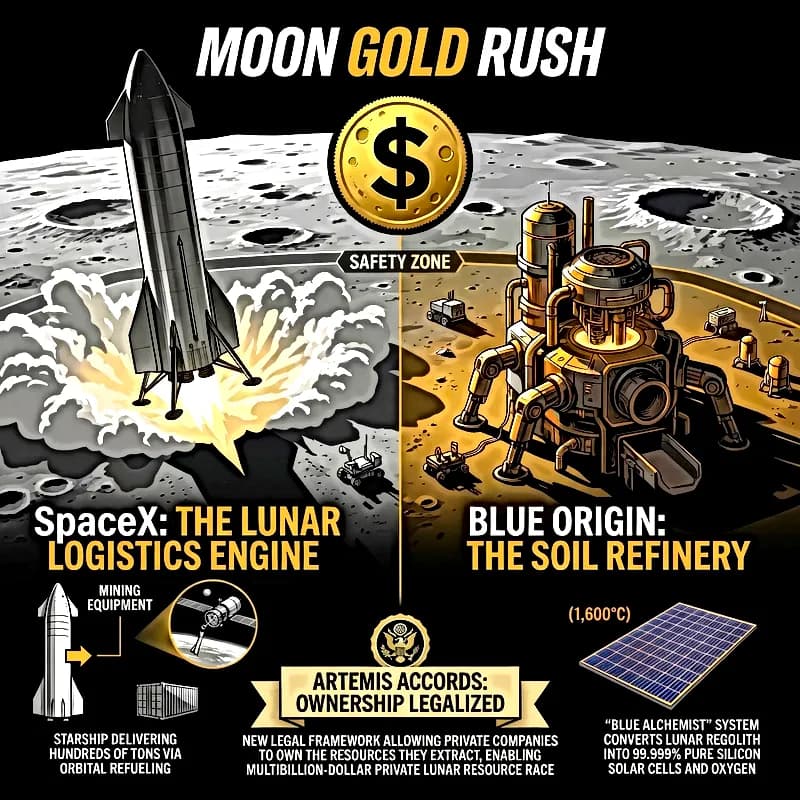
The primary infrastructural role of SpaceX in lunar extraction is the provision of a high-capacity, reusable transportation system capable of delivering the heavy industrial equipment required for mining and processing lunar regolith. The Starship Human Landing System (HLS) and its supporting orbital architecture represent a departure from the "small sample" missions of the past. [8]NASA Solidifies Lunar Strategy with Blue Origin VIPER Delivery Task Order - SatNews https://news.satnews.com/2025/12/17/nasa-solidifies-lunar-strategy-with-blue-origin-viper-delivery-task-order/
Starship HLS Architecture and Orbital Refueling
The Starship HLS is a specialized variant of the Starship spacecraft, optimized for lunar environments. Because the Moon lacks an atmosphere, the HLS variant forgoes the heat shield and aerodynamic flaps found on the Earth-reentry version, allowing for increased payload capacity. [9]Starship HLS - Wikipedia https://en.wikipedia.org/wiki/Starship_HLS
| Mission Component | Functional Role | Infrastructure Requirement |
|---|---|---|
| Starship HLS | Terminal lunar descent and ascent | 6 Raptor engines + landing thrusters |
| Propellant Depot | On-orbit storage of cryogenic fuel | Long-duration thermal management (Boil-off mitigation) |
| Starship Tanker | Delivering fuel to the depot | High launch cadence (10–16 launches per mission) |
| Super Heavy Booster | Launching all Starship variants from Earth | Full reusability (Launch and catch capability) |
Current NASA and GAO estimates suggest that a single crewed lunar mission using Starship will require approximately 16 launches to fill the on-orbit propellant depot. [9]Starship HLS - Wikipedia https://en.wikipedia.org/wiki/Starship_HLS
SpaceX Payload Capacity and Evolutionary Block Development
| Starship Iteration | Total Height | Payload to LEO (Reusable) | Booster Thrust |
|---|---|---|---|
| Block 1 | 121.3 m | 15 t | 7,500 tf |
| Block 2 | 123.3 m | 35 t | 7,500 tf (Upgraded engines) |
| Block 3 | 124.4 m | 100 t | 8,240 tf |
| Block 4 | 142 m | 200 t | 10,000 tf |
By the time the system reaches Block 3 and Block 4, it will be capable of delivering hundreds of tons to Low Earth Orbit (LEO), translating into roughly 15 metric tons of cargo to the lunar surface. [10]SpaceX Starship - Wikipedia https://en.wikipedia.org/wiki/SpaceX_Starship, [11]Work Underway on Large Cargo Landers for NASA's Artemis Moon Missions - NASA https://www.nasa.gov/directorates/esdmd/artemis-campaign-development-division/human-landing-system-program/work-underway-on-large-cargo-landers-for-nasas-artemis-moon-missions/, [12]Update on NASA's Human Landing System (HLS) Program - NTRS https://ntrs.nasa.gov/api/citations/20250008728/downloads/25%2008%2026%20IAC_Creech%20BP-1.pdf
Infrastructure Role: Blue Origin and the In-Situ Resource Economy
While SpaceX provides the heavy-lift logistics, Blue Origin has positioned itself as the leader in In-Situ Resource Utilization (ISRU) technology. Their Blue Alchemist project is an end-to-end commercial solution designed to transform lunar regolith into critical infrastructure components like solar cells and power transmission wires. [13]Blue Alchemist Hits Major Milestone - Blue Origin https://www.blueorigin.com/news/blue-alchemist-hits-major-milestone-toward-permanent-sustainable-lunar-infrastructure
Blue Alchemist: Molten Regolith Electrolysis (MRE)
The core of Blue Alchemist is the Molten Regolith Electrolysis (MRE) reactor. This system uses electricity to heat lunar regolith to 1,600 degrees Celsius, creating a molten melt that is then subjected to an electrical current to separate various elements. [14]From moon dust to moon colonies - Aerospace America https://aerospaceamerica.aiaa.org/departments/from-moon-dust-to-moon-colonies/
- Silicon Refinement: The MRE process produces silicon with a purity of 99.999%, high enough to manufacture efficient solar cells without toxic chemicals or water from Earth. [15]NASA gives Blue Origin $35 million to turn moon dust into solar cells - Freethink https://www.freethink.com/space/solar-cells-lunar-regolith
- Metallic Byproducts: The system also extracts iron, aluminum, and other metals that can be used for construction or electrical conductors. [16]ISRU-Based Power on the Moon - NASA TechPort https://techport.nasa.gov/projects/146991
- Oxygen Generation: A vital byproduct of MRE is oxygen, which can be harvested for life support or utilized as rocket propellant, significantly reducing the mass hauled from Earth. [13]Blue Alchemist Hits Major Milestone - Blue Origin https://www.blueorigin.com/news/blue-alchemist-hits-major-milestone-toward-permanent-sustainable-lunar-infrastructure
Blue Origin estimates that utilizing Blue Alchemist technology can make lunar landings up to 60% cheaper by removing the need to launch power systems and propellant from Earth. [17]Blue Alchemist Is One Step Closer to Creating Sustainable Infrastructure on the Moon - Universe Today https://www.universetoday.com/articles/blue-alchemist-is-one-step-closer-to-creating-sustainable-infrastructure-on-the-moon
Blue Moon Landers and Logistics Platforms
| Lander Variant | Mission Role | Payload Capacity | Key Technology |
|---|---|---|---|
| Blue Moon MK1 | Robotic cargo delivery (Pathfinder) | 3 metric tons | BE-7 engine, precision landing |
| Blue Moon MK2 | Crewed HLS for Artemis V | 4 crew members | Hydrolox propulsion, Gateway docking |
| Blue Ring | Orbital logistics and mobility | 3,000 kg (Host/Deploy) | Hybrid SEP-Chem propulsion |
The Blue Ring platform is particularly significant for corporate extraction. It is a highly maneuverable spacecraft designed to provide logistics, refueling, and data relay services in the cislunar region. [19]Blue Ring - Blue Origin https://www.blueorigin.com/blue-ring By hosting third-party payloads and providing "in-space cloud computing," Blue Ring facilitates a commercial ecosystem where multiple entities can operate on and around the Moon using a shared infrastructure backbone. [20]Blue Ring project - NASA Spaceflight Forum https://forum.nasaspaceflight.com/index.php?topic=55090.20
The Artemis Accords and the Interpretative Expansion of the OST
The Artemis Accords, launched in 2020 and now signed by 56 countries as of late 2025, represent a strategic attempt to modernize the application of the Outer Space Treaty for the commercial era. [21]Redefining the Rules for Commercial Space Mining - Opinio Juris https://opiniojuris.org/2025/12/18/redefining-the-rules-for-a-new-generation-of-national-laws-and-agreements-in-commercial-space-mining/ While technically non-binding "soft law," they function as a conduit for creating a new international norm that favors resource extraction. [22]The Artemis Accords: A Critical Legal Analysis - ANZSIL Perspective https://anzsilperspective.com/the-artemis-accords-a-critical-legal-analysis-of-space-mining-reforms-and-their-alignment-with-current-space-law/
Affirmation of Resource Ownership
Section 10 of the Artemis Accords explicitly states that the extraction of space resources does not inherently constitute national appropriation under Article II of the OST. [7]Signatories of the U.S.-Led Artemis Accords Meet in Person for the First Time - Cambridge https://www.cambridge.org/core/journals/american-journal-of-international-law/article/signatories-of-the-usled-artemis-accords-meet-in-person-for-the-first-time/9637F1D9B This provision is the most contentious, as it serves to validate the business models of SpaceX and Blue Origin by assuring them that their investment in lunar mining will lead to legally recognized property rights. Critics argue that this interpretation is a "full-frontal attack" on the settled principles of space law. [2]Space Mining and (U.S.) Space Law - Peace Palace Library https://peacepalacelibrary.nl/blog/2015/space-mining-and-us-space-law
The Implementation of "Safety Zones"
Section 11 introduces the concept of "safety zones" to operationalize the OST's Article IX requirement for "due regard" and the avoidance of "harmful interference." [23]The Artemis Accords and International Space Law - Diplomacy and Law https://www.diplomacyandlaw.com/post/the-artemis-accords-and-international-space-law
| Characteristic of Safety Zones | OST Legal Basis | Artemis Accords Requirement |
|---|---|---|
| Purpose | Avoid harmful interference (Art IX) | Protect equipment, personnel, and data |
| Duration | Not addressed | Temporary; must end when operations cease |
| Access | Free access to all areas (Art I) | Must not amount to de facto appropriation |
| Size/Scope | Not addressed | Reasonable and scientifically justified |
The establishment of safety zones is controversial because, if not strictly limited, they could be used to permanently occupy strategic areas of the Moon, such as the water-ice-rich craters at the South Pole. [24]Safety Zones: A Legally backed Concept or an Attempt to Colonize Space? - ANZSIL https://anzsilperspective.com/safety-zones-a-legally-backed-concept-or-an-attempt-to-colonize-space/ Opposing states like China and Russia have accused the US of using the Accords to consolidate an understanding of space law that exclusively favors US commercial interests. [7]Signatories of the U.S.-Led Artemis Accords Meet in Person for the First Time - Cambridge https://www.cambridge.org/core/journals/american-journal-of-international-law/article/signatories-of-the-usled-artemis-accords-meet-in-person-for-the-first-time/9637F1D9B
Corporate Competition and Redundancy in NASA HLS Contracts
To ensure a sustained presence on the Moon, NASA has awarded parallel contracts to both SpaceX and Blue Origin, fostering competition and providing redundancy. [25]NASA Selects Blue Origin as Second Artemis Lunar Lander Provider - NASA https://www.nasa.gov/news-release/nasa-selects-blue-origin-as-second-artemis-lunar-lander-provider/
SpaceX Artemis III and IV (Appendix H)
SpaceX was the first company selected for the Human Landing System program. Their contract, initially valued at $2.89 billion, includes an uncrewed demonstration landing and the first crewed landing of the 21st century on the Artemis III mission. [9]Starship HLS - Wikipedia https://en.wikipedia.org/wiki/Starship_HLS In November 2022, NASA exercised "Option B," a $1.15 billion modification directing SpaceX to evolve Starship for the "sustaining requirements" of Artemis IV. [26]NASA Awards SpaceX Second Contract Option for Artemis Moon Landing - NASA https://www.nasa.gov/humans-in-space/nasa-awards-spacex-second-contract-option-for-artemis-moon-landing/
Blue Origin Artemis V (Appendix P)
In May 2023, NASA selected Blue Origin as the second lander provider under the Sustaining Lunar Development (SLD) contract, awarded at $3.4 billion. [27]Blue Origin-Led Team to Build 2nd Artemis Lunar Lander - GovConWire https://www.govconwire.com/articles/blue-origin-led-team-to-build-2nd-artemis-lunar-lander-under-3-4b-nasa-contract The Blue Moon system is required to meet even more stringent "sustaining" requirements than the initial Starship design, such as supporting a crew of four for missions lasting up to a week. [25]NASA Selects Blue Origin as Second Artemis Lunar Lander Provider - NASA https://www.nasa.gov/news-release/nasa-selects-blue-origin-as-second-artemis-lunar-lander-provider/
UNCOPUOS and the Emerging Multilateral Governance
The legal status of space resources is currently being debated within the UN Committee on the Peaceful Uses of Outer Space (UNCOPUOS). In 2025, the Working Group on Legal Aspects of Space Resource Activities produced several drafts of "Recommended Principles." [28]UNCOPUOS and the Quiet Transformation of Space Resources Law - EJIL Talk https://www.ejiltalk.org/uncopuos-and-the-quiet-transformation-of-space-resources-law/
The December 2025 draft suggests a shift toward a "conditional legitimacy" model, under which the extraction of space resources would be considered compatible with the OST only if conducted in "full compliance" with multilateral principles regarding transparency, sustainability, and "equitable access." [28]UNCOPUOS and the Quiet Transformation of Space Resources Law - EJIL Talk https://www.ejiltalk.org/uncopuos-and-the-quiet-transformation-of-space-resources-law/ This contrasts with the US approach, which views the right to extract resources as an inherent freedom under Article I.
- Environmental Protection: The draft emphasizes Environmental Impact Assessments (EIAs) and adherence to space debris mitigation guidelines. [28]UNCOPUOS and the Quiet Transformation of Space Resources Law - EJIL Talk https://www.ejiltalk.org/uncopuos-and-the-quiet-transformation-of-space-resources-law/
- Scientific Prioritization: There is ongoing debate over whether scientific research should have legal priority over commercial mining. [28]UNCOPUOS and the Quiet Transformation of Space Resources Law - EJIL Talk https://www.ejiltalk.org/uncopuos-and-the-quiet-transformation-of-space-resources-law/
Geopolitical Competition: The Artemis Accords vs. the ILRS
The infrastructural push by SpaceX and Blue Origin is set against intensifying competition between the US-led Artemis coalition and the Sino-Russian International Lunar Research Station (ILRS). [29]Fly Me to the Moon - Artemis Accords and Russia-US Cooperation - Oxford https://uc.web.ox.ac.uk/article/fly-me-to-the-moon-what-are-the-artemis-accords-and-what-do-they-mean-for-russia-us-cooperat The ILRS mirrors many of the objectives of Artemis, including permanent installations and resource utilization. [30]Lunar Space Cooperation Initiatives - Secure World Foundation https://www.swfound.org/publications-and-reports/lunar-space-cooperation-initiatives However, the legal philosophy of the ILRS is more focused on state-led sovereignty and less on private property rights. [31]Guest Post: Ted Richard on China, International Law, and Outer Space - Duke Law https://sites.duke.edu/lawfire/2026/02/12/guest-post-ted-richard-on-china-international-law-and-outer-space/ This has led to concerns about the "fragmentation" of space law, where two parallel legal orders govern the same celestial body. [23]The Artemis Accords and International Space Law - Diplomacy and Law https://www.diplomacyandlaw.com/post/the-artemis-accords-and-international-space-law
The Future of Commercial Lunar Markets: 2026 and Beyond
The Role of VIPER and Resource Mapping
The Volatiles Investigating Polar Exploration Rover (VIPER), scheduled for late 2027 and delivered by the Blue Moon MK1 lander, will map the location and concentration of water ice at the lunar South Pole. [8]NASA Solidifies Lunar Strategy with Blue Origin VIPER Delivery Task Order - SatNews https://news.satnews.com/2025/12/17/nasa-solidifies-lunar-strategy-with-blue-origin-viper-delivery-task-order/ This "utility data" is the prerequisite for any commercial mining venture.
Private Payloads and Non-Governmental Customers
While NASA remains the primary customer, there is a "slow increase" in non-NASA business for lunar landers. [32]The commercial case for Mars - The Space Review https://www.thespacereview.com/article/5045/1 Startups like Interlune are planning to extract Helium-3 for terrestrial energy markets. [33]How AI and other trends in technology are supercharging the space industry - GeekWire https://www.geekwire.com/2025/ai-tech-trends-supercharge-space-industry/ However, the "hard reality" is that for the foreseeable future, the commercial market for lunar resources will be dominated by supporting national space agencies. [32]The commercial case for Mars - The Space Review https://www.thespacereview.com/article/5045/1
Conclusion: Synthesis of Legality and Infrastructure
Corporate lunar extraction is no longer a theoretical possibility but an infrastructural reality. SpaceX serves as the logistics engine of this new era, utilizing its Starship architecture to overcome the massive energy requirements of lunar transportation through orbital refueling and high-mass delivery. Simultaneously, Blue Origin provides the industrial capability to "live off the land" through the Blue Alchemist system, transforming lunar regolith into the building blocks of a permanent presence.
The legality of these activities will ultimately be determined by the "subsequent practice" of these entities. If the US and its partners can demonstrate that lunar mining and the establishment of safety zones can occur without violating the core prohibitions on territorial appropriation, they will have successfully navigated the "legal black hole" of extraterrestrial resources. As the first Starship and Blue Moon missions touch down in 2026 and 2027, the Moon will officially transition from the "province of all mankind" to the next great frontier of the global economy.
Sources
- Lunar Space Resource Utilization - Orange County Bar Association, https://www.ocbar.org/All-News/News-View/ArticleId/6870/December-2025-Cover-Story-Lunar-Space-Resource-Utilization
- Space Mining and (U.S.) Space Law - Peace Palace Library, https://peacepalacelibrary.nl/blog/2015/space-mining-and-us-space-law
- The Moon Agreement / The legal status of lunar resources - UNOOSA, https://www.unoosa.org/documents/pdf/copuos/lsc/2017/symp-01.pdf
- The Next Fifty Years of the Outer Space Treaty - State.gov, https://2009-2017.state.gov/s/l/releases/remarks/264963.htm
- Outer Space Resource Acquisition – A Legal Perspective - Reddie & Grose, https://www.reddie.co.uk/2024/10/09/outer-space-resource-acquisition-a-legal-perspective/
- Miners on the Moon: Taking the Framework from the Law of the Sea to Space - CJIL, https://cjil.uchicago.edu/online-archive/miners-moon-taking-framework-law-sea-space
- Signatories of the U.S.-Led Artemis Accords Meet in Person for the First Time - Cambridge, https://www.cambridge.org/core/journals/american-journal-of-international-law/article/signatories-of-the-usled-artemis-accords-meet-in-person-for-the-first-time/9637F1D9B1F81BCF5AA4AC659DA316AE
- NASA Solidifies Lunar Strategy with Blue Origin VIPER Delivery Task Order - SatNews, https://news.satnews.com/2025/12/17/nasa-solidifies-lunar-strategy-with-blue-origin-viper-delivery-task-order/
- Starship HLS - Wikipedia, https://en.wikipedia.org/wiki/Starship_HLS
- SpaceX Starship - Wikipedia, https://en.wikipedia.org/wiki/SpaceX_Starship
- Work Underway on Large Cargo Landers for NASA's Artemis Moon Missions - NASA, https://www.nasa.gov/directorates/esdmd/artemis-campaign-development-division/human-landing-system-program/work-underway-on-large-cargo-landers-for-nasas-artemis-moon-missions/
- Update on NASA's Human Landing System (HLS) Program - NTRS, https://ntrs.nasa.gov/api/citations/20250008728/downloads/25%2008%2026%20IAC_Creech%20BP-1.pdf
- Blue Alchemist Hits Major Milestone - Blue Origin, https://www.blueorigin.com/news/blue-alchemist-hits-major-milestone-toward-permanent-sustainable-lunar-infrastructure
- From moon dust to moon colonies - Aerospace America, https://aerospaceamerica.aiaa.org/departments/from-moon-dust-to-moon-colonies/
- NASA gives Blue Origin $35 million to turn moon dust into solar cells - Freethink, https://www.freethink.com/space/solar-cells-lunar-regolith
- ISRU-Based Power on the Moon - NASA TechPort, https://techport.nasa.gov/projects/146991
- Blue Alchemist Is One Step Closer to Creating Sustainable Infrastructure on the Moon - Universe Today, https://www.universetoday.com/articles/blue-alchemist-is-one-step-closer-to-creating-sustainable-infrastructure-on-the-moon
- New Glenn - Wikipedia, https://en.wikipedia.org/wiki/New_Glenn
- Blue Ring - Blue Origin, https://www.blueorigin.com/blue-ring
- Blue Ring project - NASA Spaceflight Forum, https://forum.nasaspaceflight.com/index.php?topic=55090.20
- Redefining the Rules for Commercial Space Mining - Opinio Juris, https://opiniojuris.org/2025/12/18/redefining-the-rules-for-a-new-generation-of-national-laws-and-agreements-in-commercial-space-mining/
- The Artemis Accords: A Critical Legal Analysis - ANZSIL Perspective, https://anzsilperspective.com/the-artemis-accords-a-critical-legal-analysis-of-space-mining-reforms-and-their-alignment-with-current-space-law/
- The Artemis Accords and International Space Law - Diplomacy and Law, https://www.diplomacyandlaw.com/post/the-artemis-accords-and-international-space-law
- Safety Zones: A Legally backed Concept or an Attempt to Colonize Space? - ANZSIL, https://anzsilperspective.com/safety-zones-a-legally-backed-concept-or-an-attempt-to-colonize-space/
- NASA Selects Blue Origin as Second Artemis Lunar Lander Provider - NASA, https://www.nasa.gov/news-release/nasa-selects-blue-origin-as-second-artemis-lunar-lander-provider/
- NASA Awards SpaceX Second Contract Option for Artemis Moon Landing - NASA, https://www.nasa.gov/humans-in-space/nasa-awards-spacex-second-contract-option-for-artemis-moon-landing/
- Blue Origin-Led Team to Build 2nd Artemis Lunar Lander - GovConWire, https://www.govconwire.com/articles/blue-origin-led-team-to-build-2nd-artemis-lunar-lander-under-3-4b-nasa-contract
- UNCOPUOS and the Quiet Transformation of Space Resources Law - EJIL Talk, https://www.ejiltalk.org/uncopuos-and-the-quiet-transformation-of-space-resources-law/
- Fly Me to the Moon - Artemis Accords and Russia-US Cooperation - Oxford, https://uc.web.ox.ac.uk/article/fly-me-to-the-moon-what-are-the-artemis-accords-and-what-do-they-mean-for-russia-us-cooperat
- Lunar Space Cooperation Initiatives - Secure World Foundation, https://www.swfound.org/publications-and-reports/lunar-space-cooperation-initiatives
- Guest Post: Ted Richard on China, International Law, and Outer Space - Duke Law, https://sites.duke.edu/lawfire/2026/02/12/guest-post-ted-richard-on-china-international-law-and-outer-space/
- The commercial case for Mars - The Space Review, https://www.thespacereview.com/article/5045/1
- How AI and other trends in technology are supercharging the space industry - GeekWire, https://www.geekwire.com/2025/ai-tech-trends-supercharge-space-industry/