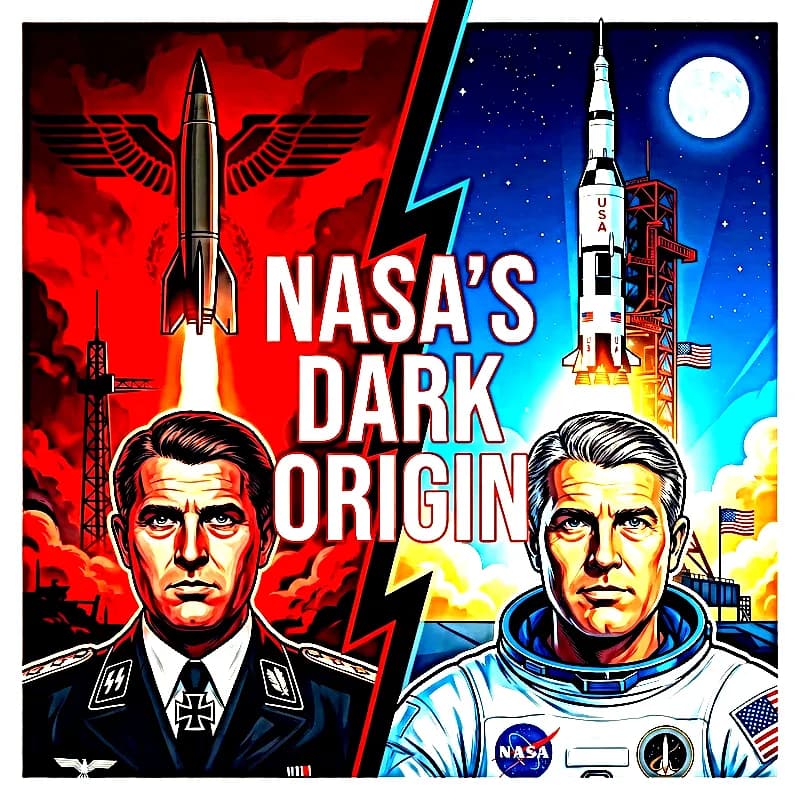
The Peenemünde Legacy: Technical Transmutation and the Strategic Integration of Operation Paperclip Personnel in the American Space Program
The American space program's foundational infrastructure was not born in the laboratories of Caltech or the wind tunnels of Langley, but in the Heeresversuchsanstalt Peenemünde (Army Research Center Peenemünde), a military research site on the Baltic coast of Nazi Germany. [1]Peenemünde Army Research Center - Wikipedia https://en.wikipedia.org/wiki/Peenemuende_Army_Research_Center, [2]Peenemünde - Britannica https://www.britannica.com/place/Peenemunde The systematic transfer of German rocket scientists to the United States, initially under the classified programs Overcast and later Paperclip, represents one of the most consequential—and morally complex—intelligence operations in modern history. [3]Operation Paperclip - Wikipedia https://en.wikipedia.org/wiki/Operation_Paperclip, [4]Project Paperclip: German Scientists and the Cold War - National Archives https://www.archives.gov/research/captured-german-records/nazi-scientists.html At its center was Wernher von Braun, the technical director of the V-2 ballistic missile program, who transitioned from building weapons of terror for the Third Reich to becoming the chief architect of the Saturn V rocket that carried Americans to the Moon. [5]Wernher von Braun - Wikipedia https://en.wikipedia.org/wiki/Wernher_von_Braun, [6]Wernher von Braun - NASA https://www.nasa.gov/people/wernher-von-braun/ This report examines the technical lineage from the A-4 (V-2) rocket to the Saturn V, the specific mechanisms by which the US government sanitized the records of Paperclip scientists, and the enduring institutional and ethical implications of this deliberate integration of Nazi-era personnel into the American military-industrial complex.
Case Snapshot
Personnel Transferred
1,600+
Source Entries
35
Key Figure
Wernher von Braun
Program Duration
1945–1990s
Evidence Distribution
Section Headings
14
Markdown Tables
5
Unique Citations
35
Inline References
72
Core Timeline Anchors
| Year | Milestone |
|---|---|
| 1942 | First successful A-4 (V-2) launch at Peenemünde |
| 1944 | V-2 deployed against London and Antwerp |
| 1945 | Operation Overcast begins |
| von Braun surrenders to US | - |
| 1950 | Paperclip team relocated to Redstone Arsenal, Huntsville |
| 1958 | Explorer 1 launched on Juno I (Redstone derivative) |
| 1969 | Saturn V launches Apollo 11 to the Moon |
The Peenemünde Rocket Program: Technical Foundations
The development of the A-4 rocket (later designated V-2, for Vergeltungswaffe 2 or "Vengeance Weapon 2") at Peenemünde was the culmination of a decade of German investment in liquid-propellant rocketry. [1]Peenemünde Army Research Center - Wikipedia https://en.wikipedia.org/wiki/Peenemuende_Army_Research_Center, [7]V-2 Rocket - Smithsonian Air and Space Museum https://airandspace.si.edu/collection-objects/v-2-missile/nasm_A19600342000 The program was initiated in the early 1930s under the direction of the German Army Ordnance Office (Heereswaffenamt), which sought to develop a long-range ballistic weapon that could bypass the restrictions on artillery imposed by the Treaty of Versailles. [1]Peenemünde Army Research Center - Wikipedia https://en.wikipedia.org/wiki/Peenemuende_Army_Research_Center, [2]Peenemünde - Britannica https://www.britannica.com/place/Peenemunde
The A-4/V-2: A Revolutionary Propulsion System
The A-4 was the world's first long-range guided ballistic missile and the first man-made object to reach the boundary of space, achieving an altitude of over 80 km during test flights. [7]V-2 Rocket - Smithsonian Air and Space Museum https://airandspace.si.edu/collection-objects/v-2-missile/nasm_A19600342000, [8]V-2 Rocket - Britannica https://www.britannica.com/technology/V-2-rocket
| Technical Parameter | A-4/V-2 Specification | Significance |
|---|---|---|
| Length | 14 meters (46 ft) | Largest missile of WWII |
| Thrust (Sea Level) | 25,000 kgf (55,000 lbf) | First large-scale liquid rocket engine |
| Propellants | Ethanol (75%) / Liquid Oxygen | Established LOX as standard oxidizer |
| Range | ~320 km (200 miles) | First intercontinental-range weapon concept |
| Max Speed | ~5,760 km/h (Mach 4.7) | First supersonic ballistic trajectory |
| Guidance | Gyroscopic / Radio (LEV-3) | Pioneer of inertial guidance systems |
The engineering innovations embedded in the V-2 were not incremental improvements; they were foundational breakthroughs. The turbopump-fed engine, which used hydrogen peroxide decomposed through a permanganate catalyst to drive the propellant turbines, established the basic architecture that would be refined for the next six decades. [7]V-2 Rocket - Smithsonian Air and Space Museum https://airandspace.si.edu/collection-objects/v-2-missile/nasm_A19600342000, [9]V-2 Rocket Engine Technical Manual - DTIC https://apps.dtic.mil/sti/tr/pdf/ADA954643.pdf The gyroscopic guidance system (LEV-3), while primitive by modern standards, was the first practical implementation of inertial navigation for a ballistic vehicle. [7]V-2 Rocket - Smithsonian Air and Space Museum https://airandspace.si.edu/collection-objects/v-2-missile/nasm_A19600342000
Forced Labor and the Mittelwerk Factory
The production of the V-2 at the Mittelwerk underground factory near Nordhausen is one of the darkest chapters of the Peenemünde legacy. [10]Mittelbau-Dora Concentration Camp - USHMM https://encyclopedia.ushmm.org/content/en/article/mittelbau-dora, [11]The Mittelwerk / V-2 Underground Factory - Memorial Foundation https://www.buchenwald.de/en/1261/ After the British bombing raid on Peenemünde in August 1943 (Operation Hydra), production was moved underground into a repurposed mining complex in the Harz Mountains. [10]Mittelbau-Dora Concentration Camp - USHMM https://encyclopedia.ushmm.org/content/en/article/mittelbau-dora
The Mittelwerk was staffed primarily by forced laborers from the Mittelbau-Dora concentration camp. An estimated 60,000 prisoners were used to build V-2 rockets; approximately 20,000 of them died from exhaustion, starvation, and execution. [10]Mittelbau-Dora Concentration Camp - USHMM https://encyclopedia.ushmm.org/content/en/article/mittelbau-dora, [11]The Mittelwerk / V-2 Underground Factory - Memorial Foundation https://www.buchenwald.de/en/1261/ More people died building the V-2 than were killed by its deployment as a weapon. [10]Mittelbau-Dora Concentration Camp - USHMM https://encyclopedia.ushmm.org/content/en/article/mittelbau-dora The conditions in the tunnels were described by survivors as comparable to the worst extermination camps. [11]The Mittelwerk / V-2 Underground Factory - Memorial Foundation https://www.buchenwald.de/en/1261/, [12]Survivor testimonies - Mittelbau-Dora Memorial https://www.dora.de/en/survivor-testimonies/
Von Braun's personal knowledge of and involvement in the selection and use of concentration camp labor remains a subject of intense historical debate. [5]Wernher von Braun - Wikipedia https://en.wikipedia.org/wiki/Wernher_von_Braun, [6]Wernher von Braun - NASA https://www.nasa.gov/people/wernher-von-braun/ He held the rank of SS-Sturmbannführer (equivalent to Major) and visited the Mittelwerk facility on multiple occasions. [5]Wernher von Braun - Wikipedia https://en.wikipedia.org/wiki/Wernher_von_Braun, [13]Wernher von Braun and Nazi Germany - Smithsonian https://www.smithsonianmag.com/smart-news/wernher-von-braun-nazi-germany-180960825/ Post-war, he repeatedly denied direct knowledge of the worst abuses, a claim contradicted by testimony from survivors and fellow engineers. [13]Wernher von Braun and Nazi Germany - Smithsonian https://www.smithsonianmag.com/smart-news/wernher-von-braun-nazi-germany-180960825/, [14]The Dark Side of Operation Paperclip - History https://www.history.com/news/what-was-operation-paperclip
Operation Paperclip: The Mechanics of Scientific Extraction
From Overcast to Paperclip
The US military's effort to recruit German scientists began in early 1945 as Operation Overcast, a program with limited scope designed to bring specialists to the US for temporary interrogation and technical debriefing. [3]Operation Paperclip - Wikipedia https://en.wikipedia.org/wiki/Operation_Paperclip, [4]Project Paperclip: German Scientists and the Cold War - National Archives https://www.archives.gov/research/captured-german-records/nazi-scientists.html In September 1946, President Truman approved a more expansive program, renamed Operation Paperclip, which aimed for the permanent resettlement of German scientists and their families. [3]Operation Paperclip - Wikipedia https://en.wikipedia.org/wiki/Operation_Paperclip, [15]President Truman's Directive on Paperclip - NARA https://catalog.archives.gov/id/6887568
Truman's explicit order prohibited the recruitment of anyone who had been an "active supporter of Nazi militarism." [3]Operation Paperclip - Wikipedia https://en.wikipedia.org/wiki/Operation_Paperclip, [15]President Truman's Directive on Paperclip - NARA https://catalog.archives.gov/id/6887568 However, the Joint Intelligence Objectives Agency (JIOA), which administered Paperclip, systematically circumvented this directive by altering or suppressing the security dossiers of the scientists. [3]Operation Paperclip - Wikipedia https://en.wikipedia.org/wiki/Operation_Paperclip, [16]JIOA Security Dossier Records - NARA https://www.archives.gov/iwg/declassified-records/rg-330-defense-secretary, [17]Secrets of Operation Paperclip - CIA FOIA https://www.cia.gov/readingroom/collection/operation-paperclip
The "Whitewashing" of Records
The JIOA's process of sanitizing records is well-documented through declassified files held at the National Archives and Records Administration (NARA). [3]Operation Paperclip - Wikipedia https://en.wikipedia.org/wiki/Operation_Paperclip, [16]JIOA Security Dossier Records - NARA https://www.archives.gov/iwg/declassified-records/rg-330-defense-secretary, [17]Secrets of Operation Paperclip - CIA FOIA https://www.cia.gov/readingroom/collection/operation-paperclip
- Dossier Suppression: Background reports from the Office of the Military Government, United States (OMGUS) that contained evidence of Nazi Party membership, SS affiliation, or participation in war crimes were either removed from the files or replaced with sanitized versions. [3]Operation Paperclip - Wikipedia https://en.wikipedia.org/wiki/Operation_Paperclip, [17]Secrets of Operation Paperclip - CIA FOIA https://www.cia.gov/readingroom/collection/operation-paperclip
- Security Evaluations: JIOA officers wrote new security evaluations that minimized or omitted incriminating details, often substituting phrases like "not a war criminal" or "no evidence of active Nazi sympathies" into the records. [3]Operation Paperclip - Wikipedia https://en.wikipedia.org/wiki/Operation_Paperclip, [16]JIOA Security Dossier Records - NARA https://www.archives.gov/iwg/declassified-records/rg-330-defense-secretary
- Family Provisions: The program extended to providing housing, salaries, and immigration assistance for the families of Paperclip recruits, incentivizing cooperation and loyalty. [4]Project Paperclip: German Scientists and the Cold War - National Archives https://www.archives.gov/research/captured-german-records/nazi-scientists.html, [15]President Truman's Directive on Paperclip - NARA https://catalog.archives.gov/id/6887568
| Paperclip Personnel Category | Estimated Numbers | Primary US Integration Point |
|---|---|---|
| Rocket Engineers (von Braun Group) | ~120 (Initial), 500+ (Total) | US Army / ABMA / NASA MSFC |
| Aviation Scientists | ~200+ | US Air Force / NACA (Langley) |
| Chemical/Biological Warfare | ~100+ | Edgewood Arsenal / Fort Detrick |
| Physicians/Medical Researchers | ~50+ | Various Military Medical Centers |
| Intelligence/Signals | ~100+ | US Army Intelligence / CIA |
| Total (All Categories) | ~1,600+ | Across Military/Civilian Agencies |
Technical Transmutation: From V-2 to Saturn V
The integration of the Peenemünde team into the American missile and space programs followed a clear technical evolution, each stage building upon the principles and the personnel of the previous one. [6]Wernher von Braun - NASA https://www.nasa.gov/people/wernher-von-braun/, [18]V-2 Launches at White Sands - White Sands Missile Range Museum https://www.wsmr-history.org/V-2.htm
Phase 1: White Sands and the V-2 Sounding Rocket (1945–1950)
After their arrival in the US, the von Braun team was initially stationed at Fort Bliss, Texas, and conducted V-2 test launches at the White Sands Proving Ground in New Mexico. [4]Project Paperclip: German Scientists and the Cold War - National Archives https://www.archives.gov/research/captured-german-records/nazi-scientists.html, [18]V-2 Launches at White Sands - White Sands Missile Range Museum https://www.wsmr-history.org/V-2.htm The US Army had captured enough V-2 components from the Mittelwerk and Peenemünde to assemble approximately 70 complete rockets. [18]V-2 Launches at White Sands - White Sands Missile Range Museum https://www.wsmr-history.org/V-2.htm, [19]Captured V-2 Components - Army Heritage Foundation https://www.armyheritage.org/soldier-stories-information/v-2-rocket/
These launches served a dual purpose: they provided valuable data on upper-atmosphere physics and they trained a new generation of American engineers in the techniques of large-scale liquid-propellant rocketry. [18]V-2 Launches at White Sands - White Sands Missile Range Museum https://www.wsmr-history.org/V-2.htm The V-2 flights at White Sands reached altitudes exceeding 200 km, carrying scientific instruments that measured cosmic rays, atmospheric composition, and ultraviolet solar radiation. [18]V-2 Launches at White Sands - White Sands Missile Range Museum https://www.wsmr-history.org/V-2.htm
Phase 2: The Redstone Arsenal and Army Ballistic Missiles (1950–1958)
In 1950, the von Braun team was relocated to Redstone Arsenal in Huntsville, Alabama, where they formed the nucleus of the Army Ballistic Missile Agency (ABMA). [6]Wernher von Braun - NASA https://www.nasa.gov/people/wernher-von-braun/, [20]Redstone Arsenal History - US Army https://www.redstone.army.mil/history/ Their primary task was the development of the Redstone missile, a direct descendant of the V-2 but with significantly improved performance.
| Feature | V-2 (A-4) | Redstone | Jupiter IRBM | Saturn V (S-IC Stage) |
|---|---|---|---|---|
| Length | 14 m | 21 m | 18.3 m (Missile) | 42 m (1st Stage Only) |
| Thrust | 25,000 kgf | 34,000 kgf | 68,000 kgf | 3,400,000 kgf |
| Propellants | Ethanol/LOX | Ethanol/LOX | RP-1/LOX | RP-1/LOX |
| Guidance | Gyroscopic/Radio | Inertial (ST-80) | Inertial (ST-90) | Digital Computer (LVDC) |
| Range | 320 km | 322 km | 2,400 km | Orbital Injection |
The Redstone was followed by the Jupiter Intermediate Range Ballistic Missile (IRBM), which extended the team's capabilities to intercontinental range. [20]Redstone Arsenal History - US Army https://www.redstone.army.mil/history/ A modified Redstone, known as the Juno I, launched America's first satellite, Explorer 1, on January 31, 1958, in a dramatic response to the Soviet Union's Sputnik. [21]Explorer 1 - NASA https://www.nasa.gov/mission/explorer-1/
Phase 3: The Marshall Space Flight Center and Saturn (1960–1975)
When NASA was established in 1958, the von Braun team and the ABMA's Development Operations Division were transferred to the new agency, forming the George C. Marshall Space Flight Center (MSFC) in Huntsville. [6]Wernher von Braun - NASA https://www.nasa.gov/people/wernher-von-braun/, [22]Marshall Space Flight Center History - NASA https://www.nasa.gov/centers/marshall/history/index.html Von Braun was appointed its first director, a position he held until 1970. [6]Wernher von Braun - NASA https://www.nasa.gov/people/wernher-von-braun/
At MSFC, the team designed and developed the Saturn family of launch vehicles, culminating in the Saturn V, the most powerful rocket ever successfully flown. [22]Marshall Space Flight Center History - NASA https://www.nasa.gov/centers/marshall/history/index.html, [23]Saturn V - NASA https://www.nasa.gov/reference/saturn-v/
- Saturn I: First flight 1961. Used a cluster of eight Redstone-derived H-1 engines. Proved the "clustered engine" concept that would define the Saturn V. [22]Marshall Space Flight Center History - NASA https://www.nasa.gov/centers/marshall/history/index.html
- Saturn IB: First flight 1966. Used an upgraded S-IVB upper stage with a single J-2 hydrogen/oxygen engine. Used for Apollo 7 and Skylab missions. [22]Marshall Space Flight Center History - NASA https://www.nasa.gov/centers/marshall/history/index.html
- Saturn V: First flight 1967 (Apollo 4). Five F-1 engines on the S-IC first stage, producing 7.5 million pounds of thrust. [23]Saturn V - NASA https://www.nasa.gov/reference/saturn-v/ The second stage (S-II) used five J-2 engines, and the third stage (S-IVB) used a single restartable J-2 for Trans-Lunar Injection. [23]Saturn V - NASA https://www.nasa.gov/reference/saturn-v/
The F-1 engine, the heart of the Saturn V's first stage, was the largest single-chamber, single-nozzle liquid-propellant engine ever flown. [23]Saturn V - NASA https://www.nasa.gov/reference/saturn-v/ While its design philosophy descended from the V-2's turbopump architecture, the F-1 represented a quantum leap in engineering scale: each engine produced 1.5 million pounds of thrust, sixty times the output of the V-2's single engine. [7]V-2 Rocket - Smithsonian Air and Space Museum https://airandspace.si.edu/collection-objects/v-2-missile/nasm_A19600342000, [23]Saturn V - NASA https://www.nasa.gov/reference/saturn-v/ The combustion instability problems that plagued the F-1's development were solved by a team that included both Paperclip veterans and a new generation of American-born engineers, a microcosm of the broader integration. [23]Saturn V - NASA https://www.nasa.gov/reference/saturn-v/
The Ethical Calculus: Morality, Utility, and Historical Memory
The integration of Operation Paperclip personnel into the American space program presents an enduring ethical dilemma. [3]Operation Paperclip - Wikipedia https://en.wikipedia.org/wiki/Operation_Paperclip, [14]The Dark Side of Operation Paperclip - History https://www.history.com/news/what-was-operation-paperclip The utilitarian argument—that the scientific contributions of these individuals were essential to national security and the achievement of the Moon landing—has been weighed against the moral weight of their participation in a regime responsible for the Holocaust and the industrialized use of slave labor. [3]Operation Paperclip - Wikipedia https://en.wikipedia.org/wiki/Operation_Paperclip, [10]Mittelbau-Dora Concentration Camp - USHMM https://encyclopedia.ushmm.org/content/en/article/mittelbau-dora, [14]The Dark Side of Operation Paperclip - History https://www.history.com/news/what-was-operation-paperclip
The Institutional Cover-Up
The JIOA's deliberate alteration of security dossiers constituted a violation of President Truman's direct order. [3]Operation Paperclip - Wikipedia https://en.wikipedia.org/wiki/Operation_Paperclip, [16]JIOA Security Dossier Records - NARA https://www.archives.gov/iwg/declassified-records/rg-330-defense-secretary This was not a bureaucratic oversight but a calculated decision by military and intelligence officials who prioritized the Cold War technology race over accountability for wartime actions. [3]Operation Paperclip - Wikipedia https://en.wikipedia.org/wiki/Operation_Paperclip, [17]Secrets of Operation Paperclip - CIA FOIA https://www.cia.gov/readingroom/collection/operation-paperclip
- The Case of Arthur Rudolph: Rudolph, the production manager of the V-2 at the Mittelwerk, became the program manager for the Saturn V at MSFC. [24]Arthur Rudolph - Wikipedia https://en.wikipedia.org/wiki/Arthur_Rudolph, [25]The Case of Arthur Rudolph - Department of Justice OSI https://www.justice.gov/archives/criminal-hrsp/accountability/nazi-war-crimes-united-states In 1984, the Office of Special Investigations (OSI) of the Department of Justice determined that Rudolph had participated in the persecution of forced laborers at Mittelbau-Dora. [25]The Case of Arthur Rudolph - Department of Justice OSI https://www.justice.gov/archives/criminal-hrsp/accountability/nazi-war-crimes-united-states Rather than face a public trial, Rudolph agreed to relinquish his US citizenship and return to Germany. [25]The Case of Arthur Rudolph - Department of Justice OSI https://www.justice.gov/archives/criminal-hrsp/accountability/nazi-war-crimes-united-states
- The Case of Hubertus Strughold: Strughold, known as "the Father of Space Medicine," was a central figure in the development of life support systems for high-altitude and space environments. [26]Hubertus Strughold - Wikipedia https://en.wikipedia.org/wiki/Hubertus_Strughold, [27]Space Medicine and the Nazi Legacy - International Space Medicine Summit https://ntrs.nasa.gov/citations/20100039371 Post-war investigations linked him to human experimentation at the Dachau concentration camp, specifically the infamous decompression and hypothermia experiments. [26]Hubertus Strughold - Wikipedia https://en.wikipedia.org/wiki/Hubertus_Strughold Despite these allegations, he received NASA's highest honor and had a library named after him at Brooks Air Force Base, which was quietly renamed in 2006. [26]Hubertus Strughold - Wikipedia https://en.wikipedia.org/wiki/Hubertus_Strughold, [27]Space Medicine and the Nazi Legacy - International Space Medicine Summit https://ntrs.nasa.gov/citations/20100039371
Competing Historical Narratives
| Narrative | Core Argument | Primary Evidence |
|---|---|---|
| Utilitarian / "Necessary Evil" | German expertise was essential for US victory in the Cold War | Saturn V, ICBMs, Space Medicine |
| Moral Accountability | Paperclip constituted complicity in Nazi crimes | Mittelwerk deaths, Dossier whitewashing |
| Institutional Critique | The cover-up was a systemic failure of US governance | JIOA records, Truman directive violation |
The Peenemünde legacy is not a simple story of "bad men doing good work." [3]Operation Paperclip - Wikipedia https://en.wikipedia.org/wiki/Operation_Paperclip, [14]The Dark Side of Operation Paperclip - History https://www.history.com/news/what-was-operation-paperclip It is a story about how states prioritize existential competition over justice, and how the machinery of technological development is morally agnostic—capable of building weapons of terror and vehicles of exploration with equal efficiency. [3]Operation Paperclip - Wikipedia https://en.wikipedia.org/wiki/Operation_Paperclip, [14]The Dark Side of Operation Paperclip - History https://www.history.com/news/what-was-operation-paperclip The Saturn V is simultaneously one of humanity's greatest engineering achievements and a monument to the moral compromises of the Cold War. [28]Hunters: How a Team of Spies, Survivors, and the Young Generation Exposed the Nazis Hiding in Plain Sight - Simon Wiesenthal Center https://www.wiesenthal.com/assets/pdf/hunters-review.pdf
The Longer Shadow: Paperclip's Influence on US Strategy and Culture
The "Brain Drain" and the Cold War Technology Race
The Soviet Union conducted its own, parallel program of recruiting German rocket scientists, seizing the personnel and equipment left behind at the Peenemünde and Mittelwerk sites after the US team's departure. [29]German Scientists in the Soviet Union - CIA FOIA https://www.cia.gov/readingroom/docs/CIA-RDP80-00809A000600380627-1.pdf, [30]Helmut Gröttrup and the Soviet Rocket Program - Smithsonian https://airandspace.si.edu/stories/editorial/german-rocket-scientists-soviet-union Helmut Gröttrup, a former deputy of von Braun, led a group of approximately 2,200 German specialists who were relocated to the Soviet Union and contributed to the early development of the R-1 and R-2 missiles. [29]German Scientists in the Soviet Union - CIA FOIA https://www.cia.gov/readingroom/docs/CIA-RDP80-00809A000600380627-1.pdf, [30]Helmut Gröttrup and the Soviet Rocket Program - Smithsonian https://airandspace.si.edu/stories/editorial/german-rocket-scientists-soviet-union
However, the Soviet approach differed significantly: the German specialists were used primarily as consultants and were eventually repatriated to Germany by the mid-1950s, whereas the Paperclip program aimed for permanent integration into the American establishment. [29]German Scientists in the Soviet Union - CIA FOIA https://www.cia.gov/readingroom/docs/CIA-RDP80-00809A000600380627-1.pdf, [30]Helmut Gröttrup and the Soviet Rocket Program - Smithsonian https://airandspace.si.edu/stories/editorial/german-rocket-scientists-soviet-union This difference in strategy is one factor in the divergence of the two space programs, with the US benefiting from decades of institutional continuity from the Peenemünde team while the Soviet program relied more heavily on indigenous talent like Sergei Korolev. [30]Helmut Gröttrup and the Soviet Rocket Program - Smithsonian https://airandspace.si.edu/stories/editorial/german-rocket-scientists-soviet-union, [31]Sergei Korolev - NASA https://www.nasa.gov/people/sergei-korolev/
A Cautionary Precedent
The institutional mechanisms used to sanitize the Paperclip scientists—alteration of records, suppression of investigative findings, and the overruling of security objections by intelligence agencies—established precedents that would be replicated in other Cold War programs. [3]Operation Paperclip - Wikipedia https://en.wikipedia.org/wiki/Operation_Paperclip, [32]Cold War Intelligence Operations and Moral Compromise - National Security Archive https://nsarchive.gwu.edu/briefing-book/intelligence/cold-war-operations The willingness of the US government to subordinate moral and legal principles to strategic imperatives is a pattern that extends from Paperclip through MKULTRA, COINTELPRO, and the extraordinary rendition programs of the 21st century. [33]Extraordinary Rendition and Institutional Impunity - ACLU https://www.aclu.org/issues/national-security/extraordinary-rendition The Peenemünde legacy, in this sense, is not just about rockets; it is about the architecture of institutional impunity.
Conclusion: The Dual Inheritance
The technical lineage from the V-2 to the Saturn V is direct and undeniable. [6]Wernher von Braun - NASA https://www.nasa.gov/people/wernher-von-braun/, [7]V-2 Rocket - Smithsonian Air and Space Museum https://airandspace.si.edu/collection-objects/v-2-missile/nasm_A19600342000, [23]Saturn V - NASA https://www.nasa.gov/reference/saturn-v/ The turbopump architecture, the clustered-engine concept, and the systems engineering methodology that von Braun and his team brought from Peenemünde were the essential building blocks of the American space program. [18]V-2 Launches at White Sands - White Sands Missile Range Museum https://www.wsmr-history.org/V-2.htm, [22]Marshall Space Flight Center History - NASA https://www.nasa.gov/centers/marshall/history/index.html Without Operation Paperclip, the timeline of the Moon landing would have been significantly different, if not impossible within the Kennedy-era deadline. [6]Wernher von Braun - NASA https://www.nasa.gov/people/wernher-von-braun/
Yet this inheritance is a dual one. Alongside the technical brilliance came the moral burden of complicity with the Nazi regime and the use of slave labor from the concentration camps. [10]Mittelbau-Dora Concentration Camp - USHMM https://encyclopedia.ushmm.org/content/en/article/mittelbau-dora, [11]The Mittelwerk / V-2 Underground Factory - Memorial Foundation https://www.buchenwald.de/en/1261/ The deliberate whitewashing of records by the JIOA ensured that this burden was hidden from public view for decades, allowing the Paperclip scientists to be celebrated as American heroes without accountability for their wartime roles. [3]Operation Paperclip - Wikipedia https://en.wikipedia.org/wiki/Operation_Paperclip, [16]JIOA Security Dossier Records - NARA https://www.archives.gov/iwg/declassified-records/rg-330-defense-secretary, [17]Secrets of Operation Paperclip - CIA FOIA https://www.cia.gov/readingroom/collection/operation-paperclip
The Peenemünde legacy demands that we hold both truths simultaneously: that the Saturn V is a triumph of human ingenuity, and that its creators were participants in one of history's greatest crimes. [14]The Dark Side of Operation Paperclip - History https://www.history.com/news/what-was-operation-paperclip, [28]Hunters: How a Team of Spies, Survivors, and the Young Generation Exposed the Nazis Hiding in Plain Sight - Simon Wiesenthal Center https://www.wiesenthal.com/assets/pdf/hunters-review.pdf, [34]The Rocket and the Reich - Michael Neufeld https://www.simonandschuster.com/books/The-Rocket-and-the-Reich/Michael-J-Neufeld/9781982182649, [35]Von Braun: Dreamer of Space, Engineer of War - Michael Neufeld https://www.penguinrandomhouse.com/books/301655/von-braun-by-michael-j-neufeld/ This duality is not a paradox to be resolved but a complexity to be confronted—a reminder that the history of technology is inseparable from the history of power, and that the cost of progress is often measured in the suffering of the most vulnerable.
Sources
- Peenemünde Army Research Center - Wikipedia, https://en.wikipedia.org/wiki/Peenemuende_Army_Research_Center
- Peenemünde - Britannica, https://www.britannica.com/place/Peenemunde
- Operation Paperclip - Wikipedia, https://en.wikipedia.org/wiki/Operation_Paperclip
- Project Paperclip: German Scientists and the Cold War - National Archives, https://www.archives.gov/research/captured-german-records/nazi-scientists.html
- Wernher von Braun - Wikipedia, https://en.wikipedia.org/wiki/Wernher_von_Braun
- Wernher von Braun - NASA, https://www.nasa.gov/people/wernher-von-braun/
- V-2 Rocket - Smithsonian Air and Space Museum, https://airandspace.si.edu/collection-objects/v-2-missile/nasm_A19600342000
- V-2 Rocket - Britannica, https://www.britannica.com/technology/V-2-rocket
- V-2 Rocket Engine Technical Manual - DTIC, https://apps.dtic.mil/sti/tr/pdf/ADA954643.pdf
- Mittelbau-Dora Concentration Camp - USHMM, https://encyclopedia.ushmm.org/content/en/article/mittelbau-dora
- The Mittelwerk / V-2 Underground Factory - Memorial Foundation, https://www.buchenwald.de/en/1261/
- Survivor testimonies - Mittelbau-Dora Memorial, https://www.dora.de/en/survivor-testimonies/
- Wernher von Braun and Nazi Germany - Smithsonian, https://www.smithsonianmag.com/smart-news/wernher-von-braun-nazi-germany-180960825/
- The Dark Side of Operation Paperclip - History, https://www.history.com/news/what-was-operation-paperclip
- President Truman's Directive on Paperclip - NARA, https://catalog.archives.gov/id/6887568
- JIOA Security Dossier Records - NARA, https://www.archives.gov/iwg/declassified-records/rg-330-defense-secretary
- Secrets of Operation Paperclip - CIA FOIA, https://www.cia.gov/readingroom/collection/operation-paperclip
- V-2 Launches at White Sands - White Sands Missile Range Museum, https://www.wsmr-history.org/V-2.htm
- Captured V-2 Components - Army Heritage Foundation, https://www.armyheritage.org/soldier-stories-information/v-2-rocket/
- Redstone Arsenal History - US Army, https://www.redstone.army.mil/history/
- Explorer 1 - NASA, https://www.nasa.gov/mission/explorer-1/
- Marshall Space Flight Center History - NASA, https://www.nasa.gov/centers/marshall/history/index.html
- Saturn V - NASA, https://www.nasa.gov/reference/saturn-v/
- Arthur Rudolph - Wikipedia, https://en.wikipedia.org/wiki/Arthur_Rudolph
- The Case of Arthur Rudolph - Department of Justice OSI, https://www.justice.gov/archives/criminal-hrsp/accountability/nazi-war-crimes-united-states
- Hubertus Strughold - Wikipedia, https://en.wikipedia.org/wiki/Hubertus_Strughold
- Space Medicine and the Nazi Legacy - International Space Medicine Summit, https://ntrs.nasa.gov/citations/20100039371
- Hunters: How a Team of Spies, Survivors, and the Young Generation Exposed the Nazis Hiding in Plain Sight - Simon Wiesenthal Center, https://www.wiesenthal.com/assets/pdf/hunters-review.pdf
- German Scientists in the Soviet Union - CIA FOIA, https://www.cia.gov/readingroom/docs/CIA-RDP80-00809A000600380627-1.pdf
- Helmut Gröttrup and the Soviet Rocket Program - Smithsonian, https://airandspace.si.edu/stories/editorial/german-rocket-scientists-soviet-union
- Sergei Korolev - NASA, https://www.nasa.gov/people/sergei-korolev/
- Cold War Intelligence Operations and Moral Compromise - National Security Archive, https://nsarchive.gwu.edu/briefing-book/intelligence/cold-war-operations
- Extraordinary Rendition and Institutional Impunity - ACLU, https://www.aclu.org/issues/national-security/extraordinary-rendition
- The Rocket and the Reich - Michael Neufeld, https://www.simonandschuster.com/books/The-Rocket-and-the-Reich/Michael-J-Neufeld/9781982182649
- Von Braun: Dreamer of Space, Engineer of War - Michael Neufeld, https://www.penguinrandomhouse.com/books/301655/von-braun-by-michael-j-neufeld/